Header 1

Our future, our universe, and other weighty topics


Saturday, February 15, 2020

They Claim to Understand Our Origins, But Don't Even Understand Cell Division

There's a basic principle sometimes evoked in the world of technology. The principle is sometimes expressed by the saying: don't try running until you've learned how to walk. What this expression means is: don't try some very difficult thing until you've first mastered some much simpler thing that should be mastered before you try the harder thing. An example of this in the technology world might be: don't try making a walking man-sized android robot until you've first made a little walking robot the size of a child's toy.

In the technology world, they are pretty good at following the principle of “don't try to run until you've learned how to walk.” But in the world of theoretical biology, scientists are very bad at following this simple rule of common sense. Again and again, our theoretical biologists do something that is like someone trying to run before he has learned how to walk. For our biology theorists attempt to answer the most difficult problems in biology (and even tell us that they have succeeded in such attempts) before they have answered some of the most simple problems in biology.

One of the most simple problems in biology is the problem of protein folding. Protein molecules have complex three-dimensional shapes. But the genes that make up DNA show no signs of specifying such shapes. A gene merely specifies a linear sequence of amino acids that make up a string-like chain of amino acids called a polypeptide chain. But such chains somehow fold into complex three-dimensional shapes, shapes that are necessary for the proper function of proteins. Why does that occur? Nobody knows.

It is sometimes claimed that the three-dimensional shape of a protein is somehow a consequence of its one-dimensional sequence of amino acids (the amino acids that make up the polypeptide chain). But there is no good evidence that this is true. If such a thing were true, it should be easy for scientists to predict the three-dimensional shape of a protein from its amino acid sequence specified in a gene. But for decades scientists have been failing at ab initio attempts to predict the shapes of complex proteins from the amino acid sequences specified in the gene that corresponds to the protein.

Long story short, we simply do not have the answer to the very simple and basic question of how proteins are able to successfully fold into the three-dimensional shapes needed for them to be functional. This is one the most low-level and basic and small-scale questions in biology, and we haven't even answered it yet.

There is another very low-level and basic and small-scale question in biology: why do cells reproduce? Why does a cell split into two to become two cells? Our biologists don't even understand this.

On a web page entitled "The Mystery of Cell Division," a scientist confesses that scientists don't understand how cells -- with a complexity of "airplanes" -- could self-reproduce. 

"Scientists have been trying to understand how cells are built since the 1800s. This does not surprise us and, as scientists ourselves, we have always been puzzled at how cells, such complex structures, are able to reproduce over and over again. Even more astonishing is that, despite the frequency of cell division, mistakes are relatively rare and almost always corrected. According to Professor David Morgan from University of California, the complexity that we observe in cells can be compared to that of airplanes."

If you do a Google search for “why do cells divide,” you will get various answers referring to high-level causes. A web site may state that cells divide to replace old, dead or damaged cells, or that cells divide so that an organism can grow, or that cells divide so that an organism can reproduce. But these are all “grand purpose” reasons, and none of them is a low-level reason. What we do not understand is: what cell-level reason is it that cells divide into two? Considering only the cell itself, and not some higher purpose, what would cause a cell to reproduce by splitting into two?

Scientists do not understand such a thing. They have identified particular stages in the most common type of cell reproduction (called mitosis): stages such as prophase, metaphase, anaphase and telophase. But without referring to higher-level “grand purpose” reasons, scientists do not understand why (on the individual cell level) a cell would pass through such phases and reproduce. A university press release confesses, "there are many remaining mysteries about how cells perform this remarkable feat." The answer is not at all "the cells follow the instructions in DNA." DNA does not contain any instructions for making cells or any specification or blueprint of a cell. 

An M. Pitkanen (who has a PhD in theoretical physics) has written the following about cell division:

"Replication is one of the deepest mysteries of biology. It is really something totally counterintuitive if cell is seen as a sack of water plus some chemicals. We have a lot [of] facts about what happens in the replication at DNA level but how this miracle happens is a mystery. At cell level the situation gets even more complex."

A university press release discusses scientific ignorance about the basis question of cell division. It states the following:

"When a rapidly-growing cell divides into two smaller cells, what triggers the split? Is it the size the growing cell eventually reaches? Or is the real trigger the time period over which the cell keeps growing ever larger?...'How cells control their size and maintain stable size distributions is one of the most fundamental, unsolved problems in biology,' said Suckjoon Jun, an assistant professor of physics and molecular biology at UC San Diego...'Even for the bacterium E. coli, arguably the most extensively studied organism to date, no one has been able to answer this question.' ”

The press release claims that some study has "shed light" on this mystery, but the study mentioned doesn't sound very impressive, merely being something that mathematically analyzed cell growth, and claimed to have found a "principle of cell-size control," without discussing a cause for such a thing. 

It would be easy to understand cell reproduction if cells were very simple. Imagine if a cells were just uncomplicated little blobs kind of like little bubbles. Then a cell might be able to reproduce easily enough by a simple collision. When one cell collided with another, it might cause a large cell to break up two smaller cells. But what goes on in cell reproduction is gigantically more complicated than that.

Cells are so complicated that they are sometimes compared to cities, and the organelles in cells (such as the mitochondria, ribosomes and Golgi apparatus) are sometimes compared to buildings in a city. You will vastly underestimate the complexity of a eukaryotic cell (the type of cells in the human body) if you look at one of those cell diagrams that shows only a few organelles in the cell. In some cells there are millions of ribosomes, and thousands of mitochondria. So when a cell reproduces, it's like some complicated machine made an exact copy of itself. Using Morgan's statement that cells are as complex as airplanes, this is as much a wonder as if some airplane were able to make an exact copy of itself.


We have no real understanding of why the marvel of cell reproduction happens. We understand high-level “grand purpose” reasons why such a thing needs to happen, but we have no understanding of low-level molecular factors that would cause a cell to undergo this fantastically complex act of reproduction.

Consider just one small aspect of cell division, an aspect discussed by a university press release : the "century-old mystery" of how cells "package long, tangled strands of chromosomes into tightly compact structures before cell division."  The press release has a kind of "mystery finally solved" sound to it, but this is just yet another example of the runaway tendency nowadays for university press releases to claim explanatory achievements that haven't actually been made (something we can see in literally thousands of other university press releases).  The scientific work being heralded merely discusses some speculations about some extremely complex structure that might be used during such a process, a structure consisting of a "helical arrangement of loops." We see a visualization of this very complicated intricate structure supposedly used to achieve only a small fraction of the huge job of cell division.  But nothing is mentioned about what could cause a structure so intricate and fine-tuned to arise so quickly during cell division that only takes about two hours.  Similarly, almost all press releases in the past twenty years claiming some progress in understanding cell division are mainly hype and exaggeration, the vast majority discussing work dealing with only a tiny fragment of the overall mystery of how cells reproduce. 

Even though such a basic low-level biological mystery as cell division cannot be well-explained by our biologists, they ask us to believe that they understand something a million times more complicated: the mystery of how human organisms first originated. A boast so preposterous is rather like a person who doesn't understand what a boat is telling you he understands how to command an aircraft carrier, or a person who doesn't understand what an atom is telling you he knows how the sun keeps shining, or a person who doesn't understand what a war is or a country is telling you he understands the history of the twentieth century.

Postscript: In a course outline, Andrew Murray (Harvard University Professor of Molecular Genetics) confesses this: "We don't understand how cells...harvest energy...self organize...call and respond (internally and externally), integrate, duplicate, evolve" (link). This is a confession that scientists do not understand how cells are able to reproduce. 

Tuesday, February 11, 2020

They Also Were "Ghost-Told" of a Death

In the four posts below I have described 100 cases of someone experiencing something like a suprising apparition of someone, only to soon learn that the corresponding person had died, usually at about the same time the apparition was seen. The four posts are below:

25 Who Were "Ghost-Told" of a Death

25 More Who Were "Ghost-Told" of a Death


In this post I will discuss additional cases of this type.  I will give links that you can use to go directly to the accounts that I refer to or quote, without having to scroll to the right page.  The links are from publications of the Society for Psychical Research, which was thorough in checking out the accounts told below, usually finding corroborating evidence or corroborating witnesses. 

First is an 1891 account by Mabel Olive Gore Booth that appeared in the Proceedings of the Society for Psychical Research (Volume 8, page 173). 

"We were about half way down, my brother a few steps in advance of me, when he suddenly said— 'Why, there's John Blaney, I didn't know he was in the house!' John Blaney was a boy who lived not far from us, and he had been employed in the house as hall-boy not long before. I said that I was sure it was not he, (for I knew he had left some months previously on account of ill-health), and looked down into the passage, but saw no one.... An hour or two afterwards I asked my maid how long John Blaney had been back in the house? She seemed much surprised, and said, 'Didn't you hear, miss, that he died this morning?'  On inquiry we found he had died about two hours before my brother saw him."

In the same volume, on page 214, we get another account of someone (a choirmaster) learning of a death from an apparition sighting. The 1890 account is by William W. Davis, a clergyman. 

"Mr. R[ussell], the bass-singer of the choir, fell in an apoplectic fit upon the street at 10 o'clock on a certain Friday ; he died at 11 o'clock at his house. My wife, learning of his death, sent my brother-in-law down to the house of the choirmaster [Mr. Reeves] to ask him about music for the funeral. The messenger reached the house of the choirmaster about 1.30 p.m. He was told that the choirmaster was upstairs, busy looking over some music. He accordingly sat down in the drawing-room, and, while waiting, began to tell the ladies (sister and niece of the choirmaster) about Mr. R.'s death. While they were talking they heard an exclamation in the hall-way. Someone said, 'My God !' They rushed out, and halfway down, sitting on the stairs, saw the choirmaster in his shirt-sleeves, showing signs of great fright and confusion. As soon as he saw them he exclaimed, ' I have just seen R. !'  The niece at once said, 'Why, R. is dead !' At this the choirmaster without a word turned back upstairs and went to his room."

Going back to the moment of the sighting by the choirmaster, the narrator tells us the following:

"At the door he saw Mr. R., who stood with one hand on his brow, and one hand extended, holding a sheet of music. The choirmaster advanced, extended his hand, and was going to speak, when the figure vanished. Then it was that he gave the exclamation mentioned above. You must remember that he knew nothing of R.'s death until he heard his niece speak of it as detailed above."

On page 216 of the same volume, Volume 8 of the Proceedings of the Society for Psychical Research, we have the first hand account of the choirmaster, who states the following:

 "The figure seemed to have a roll of music in one hand and the other over its face, but it was Russell's image. I am quite sure of that. As I advanced to the head of the stairway the figure seemed to turn, as if about to descend, and faded into the air." 

On page 222 of the same volume, we have the account below by someone acting in a production of the play Antigone: 

"I was passing from one dressing-room to another, a few steps further along the passage, just before going on to the stage, when I saw in the passage, leaning against the door-post of the dressing-room which I left, a Mr. H., whom I had met only twice, but whom I knew well by sight, and as an acquaintance, though I had heard nothing of him for two years. I held out my hand to him, saying, "Oh, Mr. H., I am so glad to see you.' In the excitement of the moment it did not occur to me as odd that he should have come thus to the door of the dressing-room,— although this would have been an unlikely thing for a mere acquaintance to do. There was a brilliant light, and I did not feel the slightest doubt as to his identity....He was looking at me with a sad expression...Next day, as a number of us were talking over the performance, my sister called out to me, ' You will be sorry to hear that Mr. H. is dead.' 'Surely not,' I exclaimed, 'for I saw him last night at the Antigone.' It turned out that he had been dead two days when I saw the figure." 

In Volume 12 of the Journal of the Society for Psychical Research (pages 326-327), we have the following account of a daughter "ghost told" of a mother's death, told by one Joshua Hodgson. 

"Between my wife and her mother a very close affection existed
and by a strange fate they both were confined to bed at the same time, the daughter daily expecting the birth of her child and the mother sick with what proved to be her last illness....When Grandma died, by the doctor's orders the news of her death was carefully kept from my wife, as it was feared that the consequences might be serious in her critical condition. She was therefore, at the time when the apparition passed her vision, absolutely ignorant of the fact that her mother had already passed away. On Saturday night she was left alone for a short time and during the time the nurse and doctor were out of the room, the apparition appeared to her, when she saw her mother standing at the foot of the bed. The figure beholding her distress spoke to her and simply said 'don't fret' and then immediately vanished. This would be upwards of eighteen hours after Grandma had passed away, my wife being then in total ignorance of her mother's death."

On pages 317 to 318 of the same volume, we read an account of a woman who woke up to see the head of Mrs. J. W., "all else swallowed in darkness." She later got a letter telling her that Mrs. J. W. had died at about the same time. 

On pages 322 to 323 of the same volume, Volume 12 of the Journal of the Society for Psychical Research, we read an account of three different people in three different places who saw an apparition of a grandmother who died at about the same time. Charles L. Tweedale stated the following:

"As I gazed I suddenly saw a face form on the panels of the cupboard or wardrobe. Indistinct at first, it gradually became clearer until it was perfectly distinct as in life, when I saw the face of my grandmother. What particularly struck me at the moment and burnt itself into my recollection was the fact that the face wore an old-fashioned frilled or goffered cap. I gazed at it for a few seconds, during which it was as plain as the living face, when it faded gradually into the moonlight and was gone....In the morning when at breakfast I began telling the experience of the night to my parents. I had got well into my story, when, to my surprise, my father suddenly sprang up from his seat at the table and leaving his food almost untouched hurriedly left the room. As he walked towards the door I gazed after him in amazement, saying to mother, 'Whatever is the matter with father?' She raised her hand to enjoin silence. When the door had closed I again repeated my question. She replied, 'Well, Charles, it is the strangest thing I ever heard of, but when I awoke this morning your father informed me that he was awakened in the night and saw his mother standing by his bedside, and that when he raised himself to speak to her she glided away.' This scene and conversation took place at about 8.30 a.m. on the morning of January llth. Before noon we received a telegram announcing the death of my father's mother during the night. We found that the matter did not end here, for my father was afterwards informed by his sister that she also had seen the apparition of her mother standing at the foot of her bed."

Here we have a case of an apparition seen by multiple observers. See my posts here and here for 34 other cases of apparitions seen by multiple observers.


On page 229 of Volume 13 of the Journal of the Society for Psychical Research, we read of a nun who was surprised to see her "Uncle Oldham" standing next to her. The nun reported the figure said that he had killed himself. The nun later learned that the corresponding person had died. She reported seeing the same figure additional times, for two months, but only momentarily. 

On page 234-235 of the same volume, we read the sad account told by a woman named A. A. Gollin who was suprised to see her fiancee at her place of work, at about 12:30 on Saturday.  She asked someone if that person saw the same figure, but that person said she did not. Then the figure could no longer be seen. The woman later found out her fiancee had died on the same day, at about 12:30.  

On page 230-231 of Volume 17 of the Journal of the Society for Psychical Research, we read of a Mary M. Paterson claiming that on April 4, 1913 the following happened:

"I had walked but a few paces when I was staggered by seeing,
as in a cinema show, reflected in the air in front of me a clear-cut picture of my brother in Australia, lying with the unmistakeably helpless look of a dead or unconscious man who had just fallen... I felt my brother was dying or dead, or that something tragic was happening to him..Suddenly, when halfway along the road, the picture shone out again before my eyes, this time against the dark sky. Again I saw the prone helpless figure, the colouring of clothes and hair, then as before it faded quickly away, and I did not see it again."

She soon learned that her brother had fallen unconscious on about April 4, 1913, and had not awoken, dying on April 7. 

On pages 80-81 of Volume 19 of the Journal of the Society for Psychical Research, we have an unusual account of someone who saw and talked to a pilot, only to later find that he had died elsewhere at the same time as this occurred. 

I will end this post with what is one of the most well-authenticated of all ghost stories. 

On page 39 of Volume 19 of the Journal of the Society for Psychical Research,  we read, "The most remarkable of the experiences which have been reported to us was an apparition of Captain Bowyer-Bower which was seen by his half-sister Mrs. Spearman in India, within a few hours of his death." On page 41-42 we have this account by Dorothy C. Spearman:

"My brother appeared to me on the 19th March, 1917....I saw my brother Eldred W Bowyer-Bower. Thinking he was
alive and had been sent out to India, I was simply delighted to see him, and turned round quickly to put baby in a safe
place on the bed, so that I could go on talking to my brother;
then turned again and put my hand out to him, when I found
he was not there. I thought he is only joking, so I called him
and looked everywhere I could think of looking. It was only
when I could not find him I became very frightened and the
awful fear that he might be dead."

On page 222 of Volume 27 of the Journal of the Society for Psychical Research, we are told the following about the same individual:

"An example of such test-proof evidence to my mind, if we agree (as Mr Saltmarsh appears implicitly not to agree) that latency is hardly likely to endure for six months, is the Bowyer-Bower case (Proceedings, xxxiii. 167). Captain Bower's apparition was seen not only at the time of his sudden violent death, but also six months later (by his mother and again by his fiancee). The details of development and behaviour are strikingly suggestive of the operation of an external intelligence."

Tracing the reference made in the quote above, I find that on page 172 of Volume 33 of the Proceedings of the Society for Psychical Research we have this quote by a relative of this Captain Bowyer-Bower, concerning her small daughter:

"One morning while I was still in bed, about 9.15, she came to my room and said, 'Uncle Alley Boy is downstairs,' and although I told her he was in France, she insisted that she had seen him. Later in the day I happened to be writing to my mother and mentioned this, not because I thought much about it, but to show that Betty still thought and spoke of her imcle of whom she was very fond. A few days afterwards we found that the date my brother was missing was the date on my letter."

We are told on page 172 of this volume that "Alley Boy" was a "pet name" for this Eldred W. Bowyer-Bower.  So apparently we have an apparition of this person appearing to two people at the time of his death or disappearance. A third person mentioned on page 173 had a "certain and awful feeling...that he was killed" before learning of his death. On page 174 we have an account of an apparition of this Eldred W. Bowyer-Bower appearing months after his death. His mother Mrs. Bowyer-Bower narrates it as follows:

"I watched, not at all nervously, and something like a crumpled filmy piece of chiffon unfolded and the beautiful wavy top of Eldred's head appeared, a few seconds and his forehead and broad, beautiful brow appeared, still it waited and his lovely blue eyes came, but no mischievous twinkle, but a great intensity. It all shook and quivered, then his nose came. More waiting and  quivering and then his tiny little moustache and mouth. At this point he turned his head very shghtly and looked right into my face, and moistened his lips slightly with his tongue. I kept quite quiet, but it quivered and shook so much and no chin came, and in my anxiety I put out my hands and said :  'Eldred, I see you,' and it all flickered quite out, light and all."

On page 175 of the same Proceedings, we have an account by the fiance of this Eldred, who tells us the following happened months after his death:

"Afterwards I woke up and looked around and saw Eldred on the bed beside me, he was wearing his blue suit. I sat up and started talking to him....I then tried to touch him, but my hand went through him, and like a fool I started to cry, and he disappeared."

So we can see why the writer quoted earlier called this case "test-proof evidence": the quotes above establish that this apparition of Eldred W. Bowyer-Bower was seen by four different persons in four different places: by his half-sister, his mother, his fiancee and a small child. 

Friday, February 7, 2020

Supersymmetry is the Standard Model's Wastrel Brother

Online at Symmetry magazine there is a new article that rather clearly explains one of the biggest cases of cosmic fine-tuning: the fine-tuning of the Higgs mass. Thankfully the magazine has corrected the original version of the article, which gave people wrong ideas by failing to use superscripts in some crucial places.

The issue of the fine-tuning of the Higgs mass (the mass of the Higgs boson) was skillfully explained by physicist Ben Allanach in a previous article at the Aeon site: 

"Behind the question of mass, an even bigger and uglier problem was lurking in the background of the Standard Model: why is the Higgs boson so light? In experiments it weighed in at 125 times the mass of a proton. But calculations using the theory implied that it should be much bigger – roughly ten million billion times bigger, in fact....Quantum fluctuations of ultra-heavy particle pairs should have a profound effect on the Higgs boson, whose mass is very sensitive to them....One logical option is that nature has chosen the initial value of the Higgs boson mass to precisely offset these quantum fluctuations, to an accuracy of one in 1016. However, that possibility seems remote at best, because the initial value and the quantum fluctuation have nothing to do with each other. It would be akin to dropping a sharp pencil onto a table and having it land exactly upright, balanced on its point. In physics terms, the configuration of the pencil is unnatural or fine-tuned. Just as the movement of air or tiny vibrations should make the pencil fall over, the mass of the Higgs shouldn’t be so perfectly calibrated that it has the ability to cancel out quantum fluctuations. However, instead of an uncanny correspondence, maybe the naturalness problem with the Higgs boson could be explained away by a new, more foundational theory: supersymmetry."

In the new article in Symmetry magazine, we have a similar explanation:

"To understand what’s fishy about the observable Higgs mass being so low, first you must know that it is actually the sum of two inputs: the bare Higgs mass (which we don’t know) plus contributions from all the other Standard Model particles, contributions collectively known as “quantum corrections.” The second number in the equation is an enormous negative, coming in around minus 1018 GeV. Compared to that, the result of the equation, 125 GeV, is extremely small, close to zero. That means the first number, the bare Higgs mass, must be almost the opposite, to so nearly cancel it out. To some physicists, this is an unacceptably strange coincidence."

How big a coincidence? The Symmetry article later quotes physicist Lawrence Lee Jr. as saying “the conundrum with the Higgs mass, which would require fine-tuning on the order of 1-in-1034,” which is a coincidence like the coincidence of you correctly guessing the full phone numbers of three consecutive strangers. 

Scientists should have just accepted this case of very precise fine-tuning in nature.  But instead, many of them made a long, quixotic, futile attempt to overthrow it (like someone trying to overthrow the observation that the sun is hot, with some elaborate theory trying to explain how the sun isn't really hot).  Why did they do that? Because they had a motivation, an ideological motivation rather than the motivation of simply discovering truth. Their ideological motivation was related to a belief that the universe should not be anything that looked like a product of design. This ideological motivation is clearly stated in the Symmetry article by physicist Lee, who states it as follows: “In general, what we want from our theories—and in some way, our universe—is that nothing seems too contrived.” If you want for the universe to not "seem too contrived," then you may twist yourself into knots trying to explain away cases of apparent fine-tuning in the universe. 


scientist speculation

This is exactly what physicists did, both with the theory of supersymmetry (an attempt to explain away the fine-tuning discussed above), and the ever-changing and never-substantiated theory of cosmic inflation (designed to explain away fine-tuning at the time of the Big Bang, such as the Big Bang having precisely the right expansion rate to allow for galaxies to form).  Supersymmetry (also called SUSY) involves the speculation that each of the 17 subatomic particles in the Standard Model has a matching undiscovered "superpartner" particle. This would involve 17 different coincidences in nature. The overall chance of having so many exact coincidences is much smaller than the chance of the Higgs mass or Higgs boson coincidentally being fine-tuned. So nothing is actually done to reduce fine-tuning. The theory simply reduces fine-tuning in one place (the Higgs boson or Higgs mass), at the price of adding it in 17 other places, all of these exact matches between the particles in the Standard Model and their imagined "superpartners." It's a similar deal with the cosmic inflation theory, which tries to get rid of extremely precise fine-tuning in one place (the expansion rate of the universe at the time of the Big Bang), at the price of adding even more fine-tuning scattered in various other places, various types of fine-tuning needed to make any cosmic inflation theory viable. 

Supersymmetry has been a complete observational failure.  If we can compare the Standard Model of physics to a high-achieving son who delights his parents with his success, we can compare supersymmetry to a wastrel brother who bungles his life away without accomplishing anything. 

The article in Symmetry says not a word about the utter failure of supersymmetry theories in all empirical tests thus far. The article should have had a passage like this:

Physicists spent countless hundreds of man-years on the theory of supersymmetry. Trying to make the universe look "not too contrived," they spun out ever-more-elaborate theories that evoked an abundance of contrivances to try to explain away the fine-tuning of the Higgs mass. But it all seems like a gigantic waste of time. Their theories have failed every test, and the Large Hadron Collider keeps shooting down their elaborate speculations.

But instead of getting a passage anything like that, we get no mention of the utter empirical failure of supersymmetry theories. Instead the Symmetry article ends with this supremely bombastic sky-high-hubris passage making it sound like the author has learned no lesson from the gigantic supersymmetry midadventure: 

"However bothered they are by apparent fine-tuning, in an ideal world, physicists will find the final Theory of Everything that can explain the underlying causes for every observed parameter in the universe. If physicists ever reach that point, Haley says, 'then you’d really know you solved physics.' ”

Monday, February 3, 2020

Are Public Schools Teaching a Stealth Religion?

According to the account by educational authorities, there is no teaching of religious doctrine in United States public schools. We are told that such a thing is strictly forbidden, because it would be a violation of the First Amendment of the US Constitution, which holds that “Congress shall make no law respecting an establishment of religion.” This has been interpreted to mean that taxpayer funds should not be used to support any particular religion, and since public schools receive taxpayer dollars, it is held that such schools cannot be supporting any type of religion.

But while it is widely believed that teaching of a religion is forbidden inside public schools, it may be that exactly such a forbidden thing is actually occurring in almost every public high school. This is because a substantial case can be made that a particular belief system spoon-fed to our children throughout high school is itself a religion or a religious position or a faith-based ideology.

The particular belief system I refer to is what we may call Darwinist materialism. Below is one way to describe the tenets of this creed:

  1. "Earthly biology can be explained entirely by naturalistic explanations such as natural selection and random mutations."
  2. "The human mind can be explained entirely by brain activity."
  3. "Charles Darwin provided some brilliant insight that eliminated the need to postulate any design or purpose in nature."
  4. "Life appeared on our planet purely because of lucky random combinations of chemicals."
  5. "Everything is pretty-well explained by science professors who assume there is just matter and energy; so there's no need to believe in anything like souls, spirits, or the paranormal."

Although constantly marketed and branded simply as “science,” Darwinist materialism seems to involve a very large element of faith. In particular, it has never been proven that any one complex visible organism or any of its organs or appendages or cell types has ever appeared mainly because of natural selection, or natural selection and random mutations. We can imagine no mathematically credible scenario under which natural selection could produce the fine-tuned protein molecules upon which life depends. An average protein molecule has a length of about 375 amino acids, and getting an arrangement of such amino acids by chance to produce the functionality of the protein molecule requires an arrangement with a chance likelihood of less than 1 in 10 to the two-hundredth power (even if you assume only half of the amino acid sequence has to match the actual sequence of amino acids in the protein). It would seem such molecules cannot appear through any gradually rewarded "each step yields a benefit" kind of process, because half-versions or quarter-versions of such molecules are useless. Yet Darwinist materialism wishes us to accept natural selection as an explanation for most or almost all biology. Since there seems to be a very large article of faith here, it would seem that we should at least be calling Darwinist materialism a kind of faith-based ideology.

But would it be correct to go even farther, and brand Darwinist materialism as a kind of religion? A supporter of such a belief system would immediately dismiss such an idea as an absurdity. He would vigorously argue: religion is some belief in God, and Darwinist materialism does not entail that.

But such a definition of “religion” is too narrow. Let's consider Eastern religions. These include Taoism, Confucianism, and Buddhism. There are certainly major forms of each of these religions that do not require any belief in a deity. One can be either an atheist or a theist, and still follow either Taoism, Confucianism, or Buddhism. In a religion such as Buddhism, there are some sects that pray to some entity that might be called a deity or the equivalent of a deity, but there are other sects that do not do that. Consider also a modern American religion such as Scientology. Again we have a religion which does not have any belief in a deity at the core of its teachings. As a Scientologist, you can be either an atheist or a theist.

It seems, therefore, that defining religion as some belief in a deity or some system of worship is too narrow a definition of the word “religion.” Scholars have offered many conflicting definitions of “religion,” some of which are too narrow to cover some of the known religions such as Taoism, Confucianism, and Buddhism. We need a definition that seems to cover almost all cases of religious belief.  One such definition was given by the anthropologist Clifford Geertz. He defined a religion as " a system of symbols which acts to establish powerful, pervasive, and long-lasting moods and motivations in men by formulating conceptions of a general order of existence and clothing these conceptions with such an aura of factuality that the moods and motivations seem uniquely realistic." 

Here is another rather similar definition: we can define a religion as  a set of beliefs about the fundamental nature of reality and life, or a recommended way of living, typically stemming from the teachings of an authority, along with norms, ethics, rituals, roles or social organizations that may arise from such beliefs. This definition covers Christianity, Islam, Taoism, Confucianism, Buddhism, and Scientology, religions which stem from authority figures such as Jesus, Muhammad, Moses, the writers of the Bible, Lao-Tzu, Gautama Buddha, Confucius, and L. Ron Hubbard. Interestingly, using the same definition of religion, it seems we should also classify Darwinist materialism as a religion. It is a fundamental way of looking at the nature of life, stemming from the teachings of an authority figure (Charles Darwin).

The idea that Darwinist materialism may be a religion should not seem unreasonable when we consider the activities of two young men, Rod and Bill. Rod decides to become a minister in a church. He is indoctrinated for years in a regimented minister-schooling environment in which complete allegiance to the belief system of his teachers is demanded. He then spends lots of time standing before assemblies of other people (parishioners), preaching the teachings of his belief system. Using lots of specialized jargon, Rod may also spend a lot of time in scholarly writing to advance the beliefs of his church, contributing to things such as religion journals and theological books. If a heretic arises in his church to dispute the accepted teachings, Rod may chasten such a person by criticizing his belief deviance.

Bill, however, decides to become a professor of evolutionary biology. He is indoctrinated for years in a regimented professor-schooling environment in which complete allegiance to the belief system of his teachers is demanded. He then spends lots of time standing before assemblies of other people (university students), preaching the teachings of his belief system. Using lots of specialized jargon, Bill may also spend a lot of time in scholarly writing to advance the beliefs of his scholastic tribe, contributing to things such as science journals and science books. If a heretic arises to dispute the accepted teachings, such as someone suggesting there may be purposeful design in living things, Bill may chasten such a person by criticizing his belief deviance. 

Given all these similarities, it seems both Bill and Rod are kind of spear-carriers for a particular belief tribe, products of a sociological structure that encourages regimentation of belief and strongly sanctions deviations from its orthodoxy of belief norms. In this light, the idea that Darwinist materialism may actually be a religion does not seem too far-fetched. Darwinist materialism has a sociological and authoritarian structure strongly resembling the sociological and authoritarian structure of a religion, with evolutionary biology professors and neuroscientists acting like some new priesthood, and members of the National Academy of Sciences or Nobel laureates having a higher authority (just as bishops or cardinals have a higher authority than priests).

It may be argued that we should not call Darwinist materialism as a religion, because its proponents are very level-headed people who don't get all emotional and carried away about their teachings, in the way that religious people do. But that's not always true. Let us consider the following quote from page 93 of the book The Origins of Creativity by biologist Edward O. Wilson:

"The preeminence of this universal process was nicely expressed in 1973 by the great geneticist Theodosius Dobzhansky and often quoted since: 'Nothing in biology makes sense except in the light of evolution.'  This claim should now be boldly expanded: Nothing in science and the humanities makes sense except in the light of evolution. As the philosopher Daniel Dennett has put it, evolution by natural selection is the acid that burns through every myth about ordained purposes and meanings."

The quote by Dobzhansky is very often quoted, but is not at all correct. For example, the thirtieth edition of Harper's Illustrated Biochemistry is an 800-page textbook describing cells, genes, enzymes, proteins, metabolism, hormones, and biochemisty in the greatest detail, with abundant illustrations. The book makes no mention of Darwin, no mention of natural selection, and only a single mention of evolution, on a page talking only about whether evolution had anything to do with limited lifespans. So it is clearly not true that nothing makes sense in biology except in the light of evolution. As for Wilson's claim that nothing in science or the humanities makes sense except in the light of Darwinian evolution, it is just nonsense. Darwin's theory of evolution has no appreciable place in cosmology, astrophysics, chemistry, physics, meteorology, computer science, poetry, mathematics, music, painting, sculpture, architecture, and most forms of literature.

Clearly Wilson feels the same way about his Darwinist materialism as a fervent fundamentalist feels about his Bible, and we can compare Wilson's statement to a fundamentalist's claim that nothing in science or nature makes sense except in the light of the Bible. When a prominent figure of Darwinist materialism speaks with this type of over-the-top seething fervor about Darwinism, it seems to support the suspicion that Darwinist materialism is a kind of surreptitious religion. And when, in the next sentence, that prominent figure enthuses about some supposed theological effect of his doctrine, we can again take note of the very strong religious motivations here. Given a choice between categorizing such runaway gushing as science or religion, the latter term seems more appropriate.

In the book The Inflamed Mind by Edward Bullmore, we have another example of the same type of zealotry.  Referring to biological explanation on page 158, the book says, "Ultimately the answer must always be Darwin."  This reminds us of a Christian saying that the answer to everything is Jesus. The Royal Society may have the slogan of Nullius in verba or "Take nobody's word for it," but the  authorities of scientific academia seem to be following quite the opposite, a motto of, "Always take Darwin's word for it."  This smells more like religion than science.  The authoritarian structure of a university is very suited for the propagation of a religion, and the first universities were created largely to propagate Christianity. Over the centuries, authoritarian universities seem to have gradually switched from propagating an ancient religion to propagating the more modern religion or belief system of Darwinist materialism. 

For many decades there have been many groups such as the ACLU ready to "scream bloody murder" if anyone tried to teach in public schools any religion that was called a religion by its adherents. But throughout the same period there was a little-known backdoor allowing infiltration of religion into our public schools: the possibility that a religion-in-all-but-name could infiltrate our public high school curriculum under the guise or branding of "science education."  If you think it is incredible that the state has imposed on our children a kind of stealth religion, under the cover of “science education,” simply consider that it is widely admitted that such a thing did happen elsewhere for decades. Between 1920 and 1990, the Soviet Union force-fed a Marxist-Leninist ideology to its students, something that was followed in such a regimented and authoritarian way that it was essentially a religion. But such indoctrination was never called religious indoctrination. When students were taught the catechism of Marxism-Leninism, they were told that they were simply being taught “economic science.”

The main objection you could make to the claim that Darwinist materialism is a stealth religion is to say that it can't be a religion, because it is science; and something cannot be both science and religion. But using a strict definition of science, Darwinist materialism isn't science. Although science can be loosely defined in terms of scientific activity, a strict definition of science is "facts established by observations and experiments."  None of the core tenets of Darwinist materialism is a fact established by observations or experiments. 

Although we know that evolution defined merely as "gene pool change over time" does occur, we absolutely do not know that Darwinian evolution is the correct explanation for the most impressive wonders of complexity and organization we observe in biology.  There are actually very strong reasons for suspecting that Darwinian evolution cannot possibly be the correct explanation for such wonders. One such reason is that the theory of evolution by natural selection is not even a theory of organization, but is something much less, a mere theory of accumulation. Another such reason is the speed at which biological innovation can occur (which in the case of the Cambrian Explosion was an explosive speed). Another such reason is the fact that  DNA does not actually store the body plans of organisms or a specification of how to make them, meaning that no conceivable random DNA mutations could explain one species evolving into some other species with a very different body plan.  As for claims that the brain is the cause of all mental activity, there are very strong scientific reasons for doubting that the brain is the cause of the leading mental activites such as intelligence or memory retrieval.  You can read about some of those reasons at this site.  As for claims that life arose naturally from mere chemicals, there is zero scientific evidence for it. Both the  enormous information complexity of the simplest living thing and the very meager results of scientific experiments trying to produce some of the most important building blocks of life (in conditions simulating the early earth) are scientific reasons for disbelieving in such a thing.  As for the denial of the paranormal that is part of Darwinist materialism,  such a thing is not at all "science," and is actually inconsistent with a huge amount of observational evidence for the paranormal, a good deal of it collected in controlled scientific experiments.  

It is true that the adherents of Darwinist materialism constantly try to brand their belief system as "science," and deny that such a system is a religion.  A religion which positions itself as "science" can be called a stealth religion or a surreptitious religion. 

The average person may regard the claims of Darwinist materialism to be science, because he has been taught them in a science class or read them in books written by scientists.  Similarly, if it were taught in physics class that the Shroud of Turin proved the resurrection of Jesus, and we were taught this again and again in science books, we would regard such a claim as being science, and would look strangely at anyone suggesting that this was a bit of religion that had been sneaked into our science textbooks. And if we were taught in our history textbooks that Noah had saved all the earth's animals, and if such a claim was frequently repeated by historians, we would regard such a claim as simply being an example of history, and would look strangely at anyone suggesting that such a claim was a bit of religion that had been sneaked into our history textbooks. Over the years very much has been sneaked into our science textbooks that is not science (defined as facts established by observations and experiments), but merely belief dogmas that have become popular among scientists who belong to a belief community with its own sociocultural speech customs and speech taboos. 

In 1993 comments to the American Association for the Advancement of Science, Darwinist philosopher of science Michael Ruse confessed the following:

"Certainly, historically, that if you look at, say, evolutionary theory, and of course this was brought out I think rather nicely by the talk just before me, it's certainly been the case that evolution has functioned, if not as a religion as such, certainly with elements akin to a secular religion.... And certainly, there's no doubt about it, that in the past, and I think also in the present, for many evolutionists, evolution has functioned as something with elements which are, let us say, akin to being a secular religion."

Many of the adherents of Darwinist materialism are trying to give this creed new features similar to features of Christianity: a world-transformation eschatology (in which the current world-order will be radically overturned by genetic engineering and intelligent robots), and a kind of afterlife eschatology based on ideas such as mind uploading (the uploading of minds into computer systems or robots).  The materialists saying "soon the robots will take over everything" may be compared to millenialist Christians saying "soon Jesus will take over everything." And the materialists saying "one day I will upload my mind into a robot or computer" are like millenialist evangelicals saying "one day Jesus will lift me and other true believers way up into the sky, when the Rapture happens."  Such transhumanist ideas (stemming from materialist assumptions) haven't yet made it into the high school curriculum, but it should be noted that Darwinist materialists are busy building what seems to be a belief system with all of the main features of modern religions.  In this essay, I list nine characteristics of modern religions, and I discuss how transhumanist versions of Darwinist materialism have all nine of these characteristics. 

Like a Catholic school controlling what its students are exposed to, the modern public high school makes sure to double-indoctrinate students in the creed of Darwinist materialism, and to exclude any teachings that might challenge such a doctrine. Our high school students receive not just one year of materialistic biology, but two years of such study, with the same subject matter being repeated in a different year. In the biology course it will be taught dogmatically that thoughts are created by brains, and that memories are stored in brains, even though scientists have no understanding of how a brain could generate a thought, no credible detailed theory of how a brain could encode human learned information in synapse states or neuron states, no credible theory of how brains could store memories for decades given rapid protein turnover, and no credible theory explaining the instantaneous retrieval of old memories (such as when you remember facts about a name you haven't heard mentioned in many years).  

The high school biology student will not learn about any of the many very substantial reasons for rejecting the dogma that the brain stores our memories and generates the mind, reasons that are mainly just neuroscience facts such as the low transmission reliability of synapses (which in the cortex transmit signals with a probability of less than 50%), and the short lifetimes of synapse proteins (only a few weeks). The student will be given the false impression that human biology has been largely figured out, even though everywhere there are still the most gigantic mysteries. The student will be go away with no understanding of how enormous are the unsolved mysteries of biology such as the origin of life, the origin of biological complexity, the source of human consciousness and cognition, protein folding and morphogenesis (how a newly fertilized egg manages to progress to become a full baby). In his textbook the student will see no chart showing almost all animal phyla appearing in one rather sudden burst of the Cambrian Explosion, lest his faith in the power of gradual random evolution be shaken. The student will probably go away with the false idea of DNA as a blueprint for the human form, when DNA is actually just a list of human chemical ingredients that does not even specify how to make any of the 200 types of cells in a human body. The student will not be well educated about the complexity of protein molecules, and will probably leave high school with no idea that in his body are some 20,000 complex inventions, the roughly 20,000 different types of protein molecules in his body, most of them about as complex as a 100-word computer program.  Education in such facts clashes with the causal ideas that our biology teachers are trying to foster. 
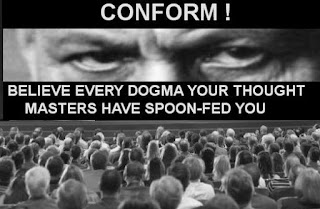
conformity
It's kind of like this in a public high school

Such students will also receive two years of physics studies. The physics courses will teach all kinds of mathematical calculation algorithms that 95 percent of students will very soon completely forget, but the courses will completely fail to teach the students something that they might remember the rest of their lives: an explanation of how the laws of nature and physical constants of our universe are very fine-tuned to allow for our existence. This is perhaps because teaching such a thing might conflict with the thrust of Darwinist materialism. Similarly, the high school student will also probably never be taught about the Big Bang, the baffling sudden origin of the universe, from what scientists say was a point of infinite density. Such a topic is conveniently omitted from the high school physics curriculum.

No course in psychology is normally required for high-school students. If the student takes such a course, there will be no discussion of any of the huge amount of evidence suggesting that the mind is something that cannot be explained purely by the brain. There will be no discussion of near-death experiences or accounts of apparitions or a discussion of very high-scoring subjects in ESP tests or people who managed to function well after half or 75 percent of their brains were surgically removed or replaced with fluid by hydrocephalus. The “we can't teach about anything spooky” rule will be followed.  In psychology courses and biology courses, there will be no discussion of biology facts that contradict the dogma that brains store memories, such as the extremely short lifetime of synapse proteins.  When the biology courses discuss morphogenesis, the growth of a human body from a tiny fertilized egg, the student may be given the false notion that such a growth occurs because of a reading of a body blueprint in DNA. There does not actually exist any such blueprint or recipe in DNA, which merely stores low-level chemical information, not high-level structural information, nor does there exist in a human womb anything sophisticated enough to read and execute a blueprint or recipe for making a human, which would be a set of instructions 1000 times more complex than a building blueprint (given all the incredibly complicated dynamics of cells).  The student may be given the impression that scientists understand how a fertilized egg progresses to become a full-sized human, even though such a progression is actually a thousand miles over the heads of scientists, being unexplained by any known biochemistry. 

The student enduring such a very dogmatic and one-sided course of study at his high school on a weekday such as Monday may rightfully wonder whether he is being religiously indoctrinated every bit as much as if he were attending a Sunday school class at a church.

Postscript: Julian Huxley has been called one of the founders of the so-called "modern synthesis" of evolutionary biology, and he coined that term. In an essay "Eugenics and Society," he made rather clear how Darwinism was to him pretty much a religion; for he stated this:

"Eugenics, Dean Inge writes in one of his essays, is capable of becoming the most sacred ideal of the human race, as a race; one of the supreme religious duties. In this I entirely agree with him. Once the full implications of evolutionary biology are grasped, eugenics will inevitably become part of the religion of the future, or of whatever complex of sentiments may in the future take the place of organized religion."

We saw the disastrous results of eugenics enthusiasm in the twisted work of the Nazis. A paper on Huxley states, "Julian Huxley was untroubled by this post-Orwellian 1984 nightmare – instead he continued to proselytize for the opposite: the idea of an evolutionary religion, based on objective science rather than revelation." So spellbound by his Darwinist religion, Huxley kept acting as a salesman for eugenics long after the horrors of the Nazis had been uncovered. 

Postscript: Another Huxley who acted as one of the chief advocates of Darwinism was Thomas Huxley. In his chief work arguing for Darwinism, he makes a statement that makes very clear how very much his considerations are motivated by a hatred towards the Catholic Church. He states this:  "In addition to the truth of the doctrine of evolution, indeed, one of its greatest merits in my eyes, is the fact that it occupies a position of complete and irreconcilable antagonism to that vigorous and consistent enemy of the highest intellectual, moral, and social life of mankind—the Catholic Church." The statement "makes mincemeat" out of Huxley's pretensions to be arguing on pure biology grounds, and makes it clear that his Darwinism has a very strong theological motivation, the motivation of antagonizing an existing religion.