Header 1

Our future, our universe, and other weighty topics


Showing posts with label particle physics. Show all posts

Saturday, January 20, 2024

Physicists Plea to Get Billions for Boondoggles

In December 2023 many a child wrote out a Christmas wish list, and gave it to their parents or mailed it to Santa Claus, in hopes of having their fondest material desires fulfilled. In the same month a panel of physicists published a wish list of particle physicists, asking for funding for projects that will cost many billions. The items on this wish list were mainly boondoggles unworthy of being funded by the US government. 

Let's look at some of the items on the wish list of the Particle Physics Project Prioritization Panel (P5). 

"Dirty Dune"

DUNE is an acronym standing for Deep Underground Neutrino Experiment.  The folly of this 3-billion-dollar project is discussed in my earlier post "Dirty DUNE: The 3 Billion Dollar Boondoggle Has Started." Neutrinos are "bit players" in the physics of the universe. Produced by the sun, they have no important role in the structure or habitability of the universe. Right now billions of these neutrino "ghost particles" produced by the sun are passing through your body. Nothing very important will come from studying such particles further. 

The DUNE project is an environmentally reckless project. The DUNE project will be very expensive in terms of its global warming cost. One of its detectors will be constructed more than a kilometer underground, and will require digging up as much as a billion cubic meters of dirt.  That kind of deep digging has a high cost in terms of carbon dioxide emissions, and tends to create pollution in a variety of ways. The government visual below (referring to arsenic contamination) reminds us of one of the countless reasons why massive hard-rock removal projects and massive soil removal projects can have very big environmental impacts.  At the end of the yellow line shown below is where DUNE will be massively involved. 


Claims have been made that the DUNE project may do something to help solve the long-standing baryon asymmetry problem, the problem of why the universe has vastly more matter than antimatter. Such claims have no good foundation, and are being made to try and make a piece of not very important scientific research sound like it might produce an important result.  
At an expert answers site, we read the following:

"The problem with neutrinos is that they are very light. There is no conceivable mechanism that would produce enough of them to make up a significant percentage of the total mass of the universe."

So research on the cosmic "bit players" that are neutrino particles will never solve the  problem of why the universe has vastly more matter than antimatter. DUNE is an environmentally reckless "white elephant" project that will produce results that will be of no interest to the general public, and will do nothing to benefit the general public. Spending billions on the project is unwise.   Senselessly, the Particle Physics Project Prioritization Panel recommends that the boondoggle of "Dirty DUNE" be expanded, and that even more billions be spent on this boondoggle project.  

CMB-S4

Around about 1978, cosmologists (the scientists who study the universe as a whole) were puzzled by a problem of fine-tuning. They had figured out that the expansion rate of the very early universe (at the time of the Big Bang) seems to have been incredibly fine-tuned, apparently to about one part in ten to the fiftieth power. This dilemma was known as the flatness problem.

Around 1980 Alan Guth (an MIT professor) proposed a way to solve the flatness problem. Guth proposed that for a tiny fraction of its first second (for less than a trillionth of a trillionth of a second), the universe expanded at an exponential rate. The universe is not expanding at any such rate, but Guth proposed that after a very brief instant of exponential expansion, the universe switched back to the normal, linear expansion that it now has. The theory was devised to get rid of some fine-tuning, but it turned out that the theory required fine-tuning of its own in multiple places. So we had a kind of "rob Peter to pay Paul" situation in which it was unclear that the need for fine-tuning had been reduced. A recent paper says this: "It actually requires much more fine-tuning for the Universe to have inflated than for it to have been placed in some low-entropy initial state (Carroll & Chen 2004)." The paper also refers to "the highly fine-tuned initial conditions required for inflation to work."

 For many decades cosmologists have been lost in a strange little world of fantasy whenever they dealt with this cosmic inflation theory. As different versions of the theory have kept failing, cosmologists have kept producing new versions of the theory; and by now there are hundreds of versions of it, making predictions all over the map.  All attempts to provide some empirical support for cosmic inflation theory have failed.  

The main prediction of cosmic inflation theories have been that there would be observed something called primordial gravitational waves, gravitational waves coming from the very early history of the universe. Although non-primordial gravitational waves have been detected (arising from times when the universe was already billions of years old), nothing has come from searches for primordial gravitational waves, which have gone on for years with ever-more-fancy and ever-more-expensive equipment.  A 2019 article states, "Models such as natural and quadratic inflation that were popular several years ago no longer seem tenable, says theorist Marc Kamionkowski of Johns Hopkins University."  A late 2021 article (based on this paper) is entitled "Primordial Gravitational Waves Continue to Elude Astronomers." But rather than discarding a theoretical approach that isn't working, our  cosmologists keep tying themselves into knots by spinning out more and more speculative ornate versions of the cosmic inflation theory (which already has many hundreds of different versions).  This has all been a giant waste of time and money, without any real success. 

The CMB-S4 project is a proposal that will be the latest piece in the huge fruitless money-wasting rathole that is cosmic inflation theory.  Having failed in numerous previous attempts to detect primordial gravitational waves, using ever-more-expensive equipment, our physicists now propose that we spend huge amounts on a new project to detect these primordial gravitational waves.  An analogy might be some billionaire who had this conversation:

Project Leader: I'm sorry, your 500 million dollar project to look for the Loch Ness monster has failed. 
Billionaire: Well, there's only one thing to do. Let's spend a billion dollars on an even fancier project to look for the Loch Ness monster. 

The Executive Summary of the Particle Physics Project Prioritization Panel falsely describes the CMB-S4 project as one that "looks back at the earliest moments of the universe." An important fact of nature that will never change is that it forever will be physically impossible for any technology to ever "look back at the earliest moments of the universe." In its  first 100,000 years the universe was so dense that every type of radiation coming from such a time must have hopelessly scattered, with all of its information as mangled as a top secret document passed through 1000 different paper shredders, and all of the resulting paper scraps being passed through 1000 paper scrap shredders.  It will therefore be forever impossible to ever "look back at the earliest moments of the universe." Such an impossibility is one reason why cosmic inflation theory seems like pseudo-science. Cosmic inflation theory makes claims about what went on in the first instants of the universe, but it will forever be physically impossible to verify such claims. 

What the CMB-S4 will actually look at is something called the cosmic background radiation, which dates from a time when the universe was about 300,000 years old.  That was when the density of the universe dropped to a low enough level to let radiation freely pass around without every ray or particle being scattered by all that density.  This cosmic background radiation has already been exhaustively analyzed by previous scientific instruments such as COBE. No evidence was found for the primordial gravitational waves predicted by cosmic inflation theory. 

We have extremely strong reasons for thinking that scientists will never be able to find primordial gravitational waves that provide any evidence for the theory of primordial cosmic inflation. One reason is the failure of all previous searches to find such a thing. Another reason is that there are two very strong "signal confounders" which will always preclude scientists from being able to reliably say some faint trace of gravitational waves comes from primordial cosmic inflation. Those "signal confounders" are dust and gravitational waves produced by black holes, both stellar black holes and primordial black holes. 

The failure to find the primordial gravitational waves predicted by cosmic inflation theory is like someone searching all of Loch Ness underwater, and failing to see the Loch Ness monster. The CMB-S4 project can be compared to someone saying, "Well, if we can't photograph the Loch Ness monster underwater, let's look for footprints on the lake bottom that the monster may have left long ago." The problem with that is you could never get convincing evidence from such a method. You might be able to claim some funny little thing seen on a lake bottom was a foot print of the Loch Ness monster, but it would never be convincing evidence. And so it is for the current search for primordial gravitational waves. If they are found, the signal would be so weak (and so capable of being explained by alternate explanations) that you would never have convincing evidence of primordial cosmic inflation. 

Therefore, the  CMB-S4 project is a boondoggle. It cannot ever produce a compelling scientific result establishing a likelihood that primordial cosmic inflation occurred. All it can ever produce with the best of luck is some hazy, ambiguous,  very debatable, hard-to-interpret result that will be no clear evidence of anything.  It's like feeding the fuzzy Zapruder film into some artificial intelligence program.  You won't learn anything new about the assassination of John Kennedy by doing that.  At best you'll get some weak talking point that you might enjoy using in some debate. 

A recent paper on the topic of the detection of primordial gravitational waves has the very misleading title "Using gravitational waves to see the first second of the universe." Because of reasons discussed above, it will forever be physically impossible to view the first 300,000 years of the universe's history, under the assumptions of Big Bang cosmology, because of photon scattering caused by the extreme density.  The paper (for example on page 28 and page 60) discusses countless possible theoretical causes of primordial gravitational waves, reminding us of the impossibility of ever detecting the source of such waves if they were ever found.  On page 94 we are told that there can be "many other sources" of such waves.  

Any project to look for such primordial gravitational waves that have not been found after so much money has already been spent looking for such waves is like some project scanning the mud at the bottom of Loch Ness, looking for the faintest traces of monster footprints left long ago. No important and reliable science will come from such activities, which almost certainly will be a waste of time.  The most that will ever come is some hopelessly murky results and some talking point for some eager theorist, or some busy work for scientists who can't figure out more productive things to do. 

Page 7 of the P5 wish list document contains these statements of dogma and error:

"Light from the early universe, known as the cosmic microwave background (CMB), carries the imprint of quantum fluctuations left behind by cosmic inflation. Precision measurements of the polarization of the CMB have already shaped our understanding of inflation and constrained certain neutrino properties."

No, the search for evidence for primordial cosmic inflation by studying polarization of the cosmic microwave background has not produced any evidence that primordial cosmic inflation ever occurred. The statement above is as misleading as someone referring to a failed attempt to photograph unicorns, and claiming that this attempt "shaped our understanding of unicorns" by setting limits on the population of unicorns. We do not know that "light from the early universe, known as the cosmic microwave background (CMB), carries the imprint of quantum fluctuations left behind by cosmic inflation," such an idea being a groundless speculation. 

Another Dark Matter Boondoggle

For decades scientists "bet the farm" on the Lambda Cold Dark Matter theory, a move which made little sense. There were never any direct observations of any such thing as cold dark matter, so scientists had to claim it was invisible.  And even though cosmologists and astrophysicists believed in it with a fervor, cold dark matter never had any place in the Standard Model of Physics. How ironic that scientists often blast people for having faith in important invisible realities, when they have put such unquestioning faith in things they say are important, invisible and never directly observed: dark matter and dark energy.  Maybe their thinking is: "you can believe in important invisibles but only OUR important invisibles." 

One of the biggest reasons for rejecting this theory of dark matter is that the location of our galaxy's satellite galaxies does not match the location predicted by dark matter theory. Our Milky Way galaxy is surrounded by more than a dozen much smaller "dwarf galaxies." The Dark Matter theory predicts that such satellite galaxies should be randomly distributed in a spherical volume surrounding our galaxy. But instead our galaxy's satellite galaxies are found in a disk-like distribution, near the plane of our disk-like galaxy. A Big Think article confesses, "There has been one observation that is extremely difficult for the dark matter camp to explain: the distribution of small galaxies surrounding bigger ones."  

The article makes this confession:

"The Milky Way is a spiral galaxy, which means it looks a little like a spinning disk, about 100,000 light-years across and 12,000 light-years thick — essentially a cosmic pizza pan. This is the shape of the visible stars and galaxies. However, dark matter theory says that dark matter is essentially a big, spherical cloud, maybe 700,000 light-years across, with the Milky Way located at the center. Because dark matter is important in galaxy formation, dark matter theory suggests that the satellite galaxies of the Milky Way should also be spherically distributed around it. On the other hand, if dark matter isn’t real, and the correct explanation for speedily rotating galaxies is that the laws of physics must be modified, scientists predict that the satellite galaxies should orbit the Milky Way in roughly the same plane as the Milky Way — essentially extensions of the Milky Way itself. When astronomers measure the location of the 11 known satellite galaxies of the Milky Way, they find that they are located in the plane of the Milky Way. Furthermore, the observed configuration is very improbable from a dark matter point of view.   

Instead of favoring the dark matter theory, the positions of our galaxy's satellite galaxies favors a different theory, the theory of MOND (Modified Newtonian Dynamics), an alternate theory of gravity. Some items in the press in recent years have been profoundly discouraging to believers in the dogma of dark matter. Specifically: 

ITEM 1: A news story entitled "No trace of dark matter halos" quotes a scientist saying that "the number of publications showing incompatibilities between observations and the dark matter paradigm just keeps increasing every year."

ITEM 2:  There not long ago appeared another science article with a headline of "Dark Matter Doesn't Exist."  That article (by an astrophysics professor) says there are multiple observations showing that dark matter cannot exist. The article says, "We need to scientifically understand why the dark-matter based model, being the most falsified physical theory in the history of humankind, continues to be religiously believed to be true by the vast majority of the modern, highly-educated scientists." This suggests all those dark matter stories we have read for so many years were just ivory tower tall tales.

ITEM 3: A recent paper discussing observations from the James Webb Space Telescope (JWST) notes that "early observations with JWST have led to the discovery of an unexpected large density...of massive galaxies... at extremely high redshifts z ≈ 10, " and finds in its Section 7 that the most-popular model of cosmology (called lambda cold dark matter or LCDM) is "excluded" (in other words, ruled out) at a moderately strong two-sigma level by the latest observations.

ITEM 4: A story in the science news a few days ago had the headline " 'We do not understand how it can exist': Astronomers baffled by 'almost invisible' dwarf galaxy that upends a dark matter theory." 

ITEM 5: A recent story in Quanta magazine gives us  a portrait that has a "cosmology in disarray" sound to it. We read this:

"Other inconsistencies abound. 'There are many more smaller problems elsewhere,' said Eleonora Di Valentino, a theoretical cosmologist at the University of Sheffield. 'This is why it’s puzzling. Because it’s not just these big problems.'....'The situation right now seems like a big mess,' Hill said. 'I don’t know what to make of it.' ”

But you would never know about such problems by reading the new wish list document of the Particle Physics Project Prioritization Panel (P5).  In Section 1.2.2 the document makes this statement in which we have a matter-of-fact claim assuming the truth of three of the most dubious dogmas of modern cosmology: the dogma of primordial cosmic inflation, the dogma of dark matter, and the dogma of dark energy: "The universe has evolved from early moments of rapid expansion (cosmic inflation), which left behind the seeds of its future structure, to intermediate periods dominated by radiation (potentially including unknown light particle species) and dark matter, to our current epoch of accelerated expansion, driven by an unknown component we call dark energy." No, there is no evidence that any such primordial cosmic inflation occurred; there is no direct evidence for dark matter, and many reasons for doubting it exists; and no one has ever directly observed dark energy.  The quote above is a kind of "just so" story to the third power.  The same section tells this lie: "Our observations of the universe tell us that dark matter exists, but we have yet to determine its nature." No, our observations of the universe have never told us that dark matter exists.  And when someone confesses that he doesn't understand the nature of something, we should always doubt him when he claims he knows that thing exists. That's as fishy as a prosecutor saying, "I know the defendant killed his wife -- I just don't know how or when he did it." 

The statement I just quoted shows how the small sect of cosmologists and particle physicists has become a dogma-driven belief community.  one in which the true believers no longer feel a need to explain why they believe the unproven things they believe, but merely use "this is what we believe" as their rationale.  
scientist misleading claims

According to the page here, billions have already been spent in fruitless searches for direct evidence of dark matter.  What do you do when you are part of a small priesthood with dark matter as one of its chief tenets, but no sign of a dark matter can be found? You keep asking for more and more money in hopes that your failed search might one day succeed. And that's what the Particle Physics Project Prioritization Panel has done, by pleading for even more to look for the never-found dark matter.  It's recommending the funding of something called the "Ultimate Generation 3 (G3) dark matter direct detection experiment." Very strangely, in section 4.1.4 of the document we hear a rationale for this G3 experiment mentioning the supersymmetry theory (SUSY), one of the most notorious failures of modern physics, a rathole which countless physicists wasted most of their careers on, without getting any success.  It's kind of like some quixotic visionary trying to justify his request for funds for his Loch Ness Monster research program by telling you how it relates to his failed search for the Lost City of Gold. 

Some Solid Principles of Research Funding

The proposals of the Particle Physics Project Prioritization Panel (P5) are in violation of sensible principles of research funding. Some sensible principles of research funding include these:

(1) Allocate funding in proportion to projects that have a high chance of benefitting the public or projects producing results of high interest to the public. 

(2) Allocate funding in proportion to how often something has already been observed, with little money going to trying to prove the existence of things that have never been observed. 

Principle #1 needs little explanation. It is rather evident that billions are not well spent looking for things that only the tiniest fraction of the population has any interest in, such as whether a fraction-of-a-second burst of primordial cosmic inflation occurred at the dawn of time.  It is rather evident that research funds would be better spent on things with a chance of helping the population, such as perhaps some physics technology for reversing or limiting global warming or some physics technology capable of blocking incoming nuclear missiles or some physics technology capable of diverting asteroids that might make man extinct.  

Principle #2 is less obvious, but easily explained.  The more something has already been observed, the more likely that further research on the subject will produce important results. For example, electricity has already been abundantly observed, so it is likely that further research on electricity will be justified, and will not be a waste of funds. Conversely, no one has ever observed primordial cosmic inflation or dark matter, and there exists a very strong chance (indeed a likelihood based on previous efforts) that further research looking for such things will be a waste of money. 

If scientists were to sensibly allocate research dollars, there would be very abundant funding for researching things such as ESP and clairvoyance and near-death experiences and out-of-body experiences and apparition sightings. These things have been very abundantly observed over the past two hundred years. Further research on them would have an excellent chance of shedding light on the most fundamental questions on who we are and how human minds arise, questions of the highest interest to everyone.  But research on such topics gets almost no funding. Instead, our scientists allocate billions of dollars to boondoggle "white elephant" projects looking for things that have never been observed, such as dark matter, dark energy and primordial cosmic inflation. It's as if trying to confirm the cherished  dogmas of their belief community was their #1 priority, rather than doing something of use or interest to the general public. 

I may note that the actual cost of many or most of the physics projects mentioned above will probably be vastly greater than the cost estimates given by the Particle Physics Project Prioritization Panel.  What happens is that scientists or defense contractors or NASA officials wanting funding for some project tend to give very "low ball" estimates of the cost of the projects, to help get initial funding. Then once the projects are quarter-funded or half-funded,  it often becomes clear that the cost of completing the project will be very much higher than originally estimated.  The people who make such estimates often are counting on "sunk cost" snaring, the idea that once a government spends many millions on some project it will never cancel the project because of 50% or 100% cost overruns.

Thursday, June 4, 2020

Dirty DUNE Is a Billion-Buck Boondoggle

The New York Times recently had a long story with this misleading headline: "Why the Big Bang Produced Something Rather Than Nothing."  The headline is baloney, because the story suggests no answer to this long-standing scientific problem. Nowadays bunk  clickbait headlines are frequently found in science news media, even in top-tier sources that we expect to be following better journalistic practices.

The story mentions some research on neutrinos, and tries to make it sound like maybe the research has some relevance to the long standing problem called the matter/antimatter asymmetry problem. Scientists believe that when two very high-energy photons collide, they produce equal amounts of matter and antimatter, and that when matter collides with antimatter, it is converted into high-energy photons. Such a belief is based on what scientists have observed in particle accelerators such as the Large Hadron Collider, where particles are accelerated to near the speed of light before they collide with each other. But such conclusions about matter, antimatter and photons lead to a great mystery as to why there is any matter at all in the universe.

Let us imagine the early minutes of the Big Bang about 13 billion years ago, when the density of the universe was incredibly great. At that time the universe should have consisted of energy, matter and antimatter. The energy should have been in the form of very high energy photons that were frequently colliding with each other. All such collisions should have produced equal amounts of matter and antimatter. For example, a collision of high energy particles with sufficient energy creates a matter proton and an antimatter particle called an antiproton. So the amount of antimatter shortly after the Big Bang should have been exactly the same as the amount of matter. As a CERN page on this topic says, "The Big Bang should have created equal amounts of matter and antimatter in the early universe." But whenever a matter particle touched an antimatter particle, both would have been converted into photons. The eventual result should have been a universe consisting either of nothing but photons, or some matter but an equal amount of antimatter. But only trace amounts of antimatter are observed in the universe. A universe with equal amounts of matter and antimatter would have been uninhabitable, because of the vast amount of lethal energy released when even a tiny bit of matter comes in contact with a tiny bit of antimatter.

Nothing in the New York Times story mentions anything like a possible answer to this matter/antimatter asymmetry problem. There is merely a mention of some T2K experiment that suggests only very weakly that maybe there's a tiny bit of asymmetry involving the all-but-massless "ghost particles" called neutrinos. This isn't anything like a resolution of the matter/antimatter asymmetry problem.   The anomaly detected by the T2K experiment is only a three-sigma observation, which could easily be the result of mere chance.  A three-sigma event occurs by chance about 1 in 625 times. The rule-of-thumb in physics is that you don't call something a discovery unless it is a five-sigma event, which occurs by chance only about 1 in 3.5 million times. A five-sigma result is roughly 5000 times harder-to-get than a three sigma result.

Neutrinos are "bit players" in the physical drama of the universe, and make up very much less of the universe's mass than protons. That means it is extremely unlikely that the matter/antimatter asymmetry problem will be solved by studying neutrinos. 

But now scientists are proposing that we spend more than 1 billion dollars on a project called the DUNE project, to study asymmetry or oscillation issues in neutrinos. DUNE stands for Deep Underground Neutrino Experiment. The cost of this project (which will be operational in 2027) will be between 1.2 billion dollars and 1.8 billion dollars, according to this document.  

They didn't get a convincing result from the massively expensive T2K experiment, so now our scientists want to spend more than a billion dollars on a whole other neutrino experiment.  The chance that anything terribly important will come from such an effort is very low. On its "Frequently Asked Questions" page, the web site of the DUNE project tries to answer the question, "Why is DUNE scientifically important?" It fails to answer that question in any remotely persuasive way.  It says, "DUNE aims to find out, for example, whether neutrinos are the key to solving the mystery of how the universe came to consist of matter rather than antimatter," but it gives no rationale for thinking that such a thing is true, and no explanation of how it might be discovered that such a thing is true.  There's a link to a video which also fails to explain any rationale for thinking that neutrinos could possibly be the explanation for the matter/antimatter asymmetry problem. 

Trying to play up the importance of neutrinos (which make up a vastly smaller fraction of the universe's mass than protons), the video makes the claim (at the 54 second mark) that neutrinos are "the most abundant matter particles in the universe."  Scientists actually believe that the amount of matter in protons is many times greater than the amount of matter in neutrinos, and that the most abundant matter substance in the universe is some other undiscovered type of matter called dark matter, which is believed to exist in vastly greater mass amounts than either protons or neutrinos. At an expert answers site, we read the following:

"The problem with neutrinos is that they are very light. There is no conceivable mechanism that would produce enough of them to make up a significant percentage of the total mass of the universe."

The DUNE project will probably end up being like the LIGO project, another billion-dollar boondoggle which has produced almost no astronomical results of any importance.  It has been claimed that by now the LIGO project has detected something like 50 examples of gravitational waves.   Some are not even sure that LIGO has actually detected gravitational waves.  Last year a physicist stated the following:

"The signals that LIGO and Virgo see are well explained by gravitational wave events. But we cannot be sure that these are actually signals coming from outer space and not some unknown terrestrial effect."

 Even if the LIGO detections are real gravitional waves from distant sources, they are of no great importance. None of these observations has done anything to change our understanding of the universe, or clarify any of the central problems of cosmology or astronomy.  The gravitational waves come only from rare freak events lasting only for the shortest times, events such as colliding black holes and colliding neutron stars. So LIGO has been a kind of sideshow of no great importance.  We might compare it to a billion-dollar project searching the world trying to track down all the cases of head-on collisions of tractor trailers, although such a project would probably be more useful than anything we learned from LIGO. 

LIGO cost American taxpayers more than a billion dollars. There was also a quite substantial environmental cost for constructing something like the two LIGO observatories, each an L-shaped unit stretching for 4000 meters.  All such massive construction projects contribute to global warming. Our scientists frequently lecture us about the importance of reducing global warming emissions. But when it comes to constructing gigantic boondoggle projects that contribute substantially to global warming, and produce only meager results,  our scientists raise no objections.

Like LIGO, the DUNE project will be very expensive in terms of its global warming cost. One of its detectors will be constructed more than a kilometer underground. That kind of deep digging has a high cost in terms of carbon dioxide emissions, and tends to create pollution in a variety of ways.  But you would never know that from a very misleading document that was filed, one claiming that this massive construction project will have "no significant impact," by which it means environmental impact.

Entitled "Finding of No Significant Impact and Floodplain Statement of Findings," the document tells us the following:

"Construction of the underground detector—necessary to eliminate cosmic radiation that could interfere with the detector—would require excavation and transportation of a large volume of rock. The rock would be transferred to either the Gilt Edge Superfund site, or to the Open Cut in Lead, a former surface mining pit that was part of the former Homestake Mine. Truck, conveyor and/or a rail system would be used. The Gilt Edge Superfund site is a highly disturbed former gold mine in Deadwood....Up to 950,000 cubic yards (yd3) of soils would be removed and re-used or stored on site. Up to 45,000 yd3 of rock would be excavated, but important geological resources would not be affected."

The document tells us that up to a million cubic yards of soil and rock would be excavated by the DUNE project, and much of it  transported and dumped at some pit or mine. This project has very obviously a very large environmental cost, including a very large global warming footprint. But contrary to all the facts it is stating, the document claims there will be "no significant impact" on the environment. It states that the DUNE construction project "
would not individually or cumulatively have a significant effect on the quality of the human environment."  You might as well claim that leveling fifty city blocks in Manhattan would have no significant effect on the environment. 

The government web page below reminds us of one of the countless reasons why massive hard-rock removal projects and massive soil removal projects can have very big environmental impacts.  At the end of the yellow line shown below is where DUNE will be massively involved. 


rock mining problem

The DUNE project is an environmentally reckless boondoggle "white elephant" project. Neutrinos are mere bit players in the physical makeup of the universe. There is no reason to think that the DUNE neutrino project will do anything to solve the great mystery of why the Big Bang did not yield a universe with equal amounts of matter protons and antimatter antiprotons, or nothing but photons arising from the combination of such antimatter and matter. And in the unlikely event that the scientists who work on the DUNE project ever happen to report some five-sigma event relating to neutrinos, we should be suspicious about  their reports.  Once a project has been born with the very misleading claim that digging a million cubic yards of soil and rock will have no significant environmental impact, then we should be suspicious about the accuracy of all further statements related to such a project. 

Let us imagine the best result that might happen from the DUNE project. There might be discovered some reason why the Big Bang should have produced more neutrinos (made of matter) than anti-neutrinos (made of antimatter). But it would be worth very little to know such a thing. What we are interested in knowing is not why the Big Bang might have produced some universe with only ghostly neutrinos as matter, but why the Big Bang left us with so many protons that are vastly more massive than neutrinos. The precise name for this problem is the baryon asymmetry problem.  It is the problem of why the observed number of baryons (protons and neutrons) in the universe is more than trillions of times greater than the number of antibaryons (antiprotons and antineutrons), contrary to what the Big Bang theory predicts. There is no hope that the baryon asymmetry problem can be solved by doing experiments with neutrinos, because neutrinos are not baryons.  There is no point at all in spending a billion dollars trying to establish why there might exist a universe with only neutrinos, because we don't live in such a universe.  There is a point in trying to figure out why we live in a universe with so many baryons.  But the DUNE project would do nothing to solve that problem. 

Friday, August 5, 2016

Pratfalls of the Physicists: Lessons of the SUSY and Diphoton Blunders

Ever since the atomic bomb was invented, some people have regarded physicists as almost godlike figures. But two examples I will discuss below show that large number of physicists are capable of falling flat on their faces.

What is called the 750 GeV diphoton excess is an observational blip reported in 2015 by scientists working with the Large Hadron Collider, the world's largest particle accelerator. When the diphoton excess was reported in 2015, scientists began to speculate that it might be a sign of physics beyond the Standard Model of physics.

But today scientists poured cold water on such thinking. As discussed here, they reported that the diphoton excess is just a random data blip that doesn't indicate anything important. David Charlton, leader of the ATLAS experiment at the Large Hadron Collider, reported the following:

There was a lot of excitement when we started to collect data. But in the [latest results] we see no sign of a bump, there's nothing. It is a pity because it would have been a really fantastic thing if there had been a new particle.

But (as mentioned here) our impatient theoretical physicists have already written 500 scientific papers pontificating on the deep significance of the diphoton excess. Today's announcement makes all such papers into laughable jokes. Such papers are now like some paper claiming to find some deep significance in an arrangement of objects on a road, with someone later announcing that the objects ended up in such a way because they fell out of a passing truck at random intervals.

You can call it the Diphoton Fiasco. But such a fiasco only has lasted for about 8 months. A much larger fiasco is what we may call the SUSY Fiasco. This embarrassing physicist's debacle has been dragging on for 30 years. 

It's "OOPS" time for our physicists 

SUSY is a shorter name for the theory known as supersymmetry. The theory is an extremely complicated speculation. The Standard Model of physics has less than 30 independent parameters. But according to one scientific web site, supersymmetry has more than 100 independent parameters. According to another page at the same web site, more than 10,000 scientific papers “reference” the theory of supersymmetry.

With all that work by physicists, you would think that there must be some evidence for supersymmetry. But efforts to find evidence for the theory have been a complete failure. The Large Hadron Collider has completely failed to support the theory.

Why have physicists spent so much time on such a theory? It seems they were troubled by something called the hierarchy problem or the naturalness problem. The problem is hard to explain, but some excerpts from the Wikipedia article on the hierarchy problem may give you a little scent of it.

It appears that Fermi's constant is surprisingly large and is expected to be closer to Newton's constant, unless there is a delicate cancellation between the bare value of Fermi's constant and the quantum corrections to it. More technically, the question is why the Higgs boson is so much lighter than the Planck mass (or the grand unification energy, or a heavy neutrino mass scale): one would expect that the large quantum contributions to the square of the Higgs boson mass would inevitably make the mass huge, comparable to the scale at which new physics appears, unless there is an incredible fine-tuning cancellation between the quadratic radiative corrections and the bare mass.

The “incredible fine-tuning cancellation” being talked about here is a kind of matching of two unrelated numbers so that they end up canceling each other out – rather like what you might have if you had to pay on Friday a $5000 payment to save your house from foreclosure, and you coincidentally won $5000 in the lottery on Friday morning.

But it's actually much more of a coincidence. Because according to this scientific web site, “one has to hypothesize that the several correction terms cancel out to a part in 10^34 (a hundred billionths of a billionth of a billionth of a billionth), if one is to make the Higgs mass smaller than a lead brick.” So maybe our analogy should be that you own 6 houses that are each behind $5000 on the mortgage, with Friday being the last day for you to save them; and you coincidentally on Friday morning buy 6 different lottery tickets that each win $5000. That's the kind of fine-tuning that seems to be involved in the case of the Higgs mass.

Supersymmetry (also known as SUSY) is an attempt to offer an explanation for this fine-tuning, or to explain it away. But supersymmetry has always been a ridiculously ornate contrivance. For example, it imagines that almost every known type of particle has a corresponding “superpartner.” It would be quite the fantastic coincidence if nature was set up in such a way. So supersymmetry is basically a kind of gigantic case of “robbing Peter to pay Paul.” It tries to get rid of one fine-tuned coincidence (the hierarchy problem) by introducing a whole bunch of other fine-tuned coincidences, involving all these cases in which a known type of particle happens to have a matching “superpartner” particle.

Why do I use the term “the SUSY Fiasco”? It's because supersymmetry has been a gigantic waste of time. For years scientists were hoping that the Large Hadron Collider would produce some evidence for supersymmetry. But no evidence has been produced. The chance of supersymmetry being confirmed in our lifetimes now seems almost zero.

Below are some lessons we might learn from these blundering fiascoes. The first lesson is: avoid the hero-worship pitfall, and remember that physicists are just fallible humans like the rest of us. The second lesson is: remember that many of our scientists have an unfortunate tendency to “jump the gun” – they often get overexcited about some theoretical idea before there is good evidence for it. This tendency is abundantly evident in the field of biology as well as the field of physics. The third lesson is: when nature presents you with a dramatic case of apparent fine-tuning, don't waste tons of time twisting yourself into knots trying to explain it away. Just live with it. 

Postscript: Engaging in some morose commentary triggered by Friday's announcement, physicist Sabine Hossenfelder writes this (perhaps using hyperbole) at her blog Backreaction:  

During my professional career, all I have seen is failure. A failure of particle physicists to uncover a more powerful mathematical framework to improve upon the theories we already have...What worries me much more is our failure to learn from failure. Rather than trying something new, we’ve been trying the same thing over and over again, expecting different results. When I look at the data what I see is that our reliance on gauge-symmetry and the attempt at unification, the use of naturalness as guidance, and the trust in beauty and simplicity aren’t working. The cosmological constant isn’t natural. The Higgs mass isn’t natural. 


She refers to the cosmological constant, because it has the same type of fine-tuning problem as the Higgs mass (as discussed here).
 

Friday, July 11, 2014

Pythagoras Would Exult: Another Crucial Cosmic Three

In my previous blog post Nature Seems to Love the Number Three, I pointed out that when we look at the most fundamental aspects of nature, we find that the number three seems to occur an unusually high number of times. Some examples are given in the visual below. We have cases where there are exactly three types of some fundamental part of nature: for example, three types of massive bosons, three types of neutrinos, and three types of subatomic forces. We have cases in which fundamental parts of nature are made of three smaller particles; for example, the fact that protons are made of three quarks. We also have a fundamental unit of charge (the electron charge) that is exactly three times greater than another fundamental unit of charge (the Down quark charge). Threes, threes, threes. Pythagoras (the ancient philosopher mathematician fascinated with the number 3) would be happy.

number 3 in nature

Now scientists may have found yet another example of a three in the fundamental layout of nature. The latest discovery is one that would really make Pythagoras jump for joy, as it involves his favorite piece of geometry: the triangle.

As PhysicsWorld.com reports: “Physicists have obtained important new evidence showing that the structure of the carbon-12 nucleus – without which there would be no life here on Earth – resembles that of an equilateral triangle.”

The carbon-12 nucleus is the nucleus of the most common isotope of carbon, the element on which earthly life is based. Every type of nucleus except the hydrogen nucleus consists of protons and neutrons. Scientists have usually thought of a carbon nucleus as being a bunch of protons and neutrons all stuck together, rather like the image below:


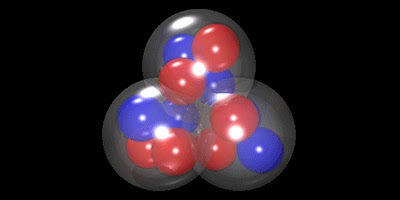
But apparently the carbon-12 nucleus consists instead of three little clumps arranged in an equilateral triangle, with each clump consisting of two neutrons and two protons. Below is a highly schematic diagram (the distance between the three clumps may be much greater).

carbon nucleus
Martin Freer/University of Birmingham


Nature apparently manages to preserve this perfect triangle, even though the carbon 12 nucleus is spinning madly.

The equilateral triangle has always been considered the simplest and most perfect shape in nature. Pythagoras and his followers would wax eloquent about the transcendental significance of equilateral triangles and the number three.

So does the discovery of a perfect equilateral triangle in the structure of the most fundamental nucleus of life have some deeper significance?

Wednesday, June 25, 2014

“Vacuum Catastrophe” Should Be Called the Vacuum Miracle

We tend to think of science as something that gives us the right answers. Almost always science does give us the right answer. But there is at least one case when science gives us the wrong answer – a really, really wrong answer. In fact, there is one case in which science gives us an answer wronger than any answer that you ever gave in school, even on those tests when you wrote wild guesses on your exam sheet because you had daydreamed through every class session.

The wrong answer given by science is the answer that it gives to the question: how much energy is in a vacuum?

A person not familiar with quantum mechanics tends to think of a vacuum as being just empty space. But according to quantum mechanics, empty space is not really empty. It is instead a seething froth of very short-lived particles called virtual particles. A virtual particle with mass is a particle that pops into existence and then pops out of existence a tiny fraction of a second later. Scientist think that the vacuum is filled with virtual particles corresponding to every type of actual subatomic particle that has been discovered. For example, they think that the vacuum includes incredibly short-lived virtual electrons, and incredibly short-lived virtual quarks (because both electrons and quarks are known types of subatomic particles).

You can get an idea of the modern concept of the vacuum by looking at the animation below. Each of the fleeting little specks represents one of the virtual particles that pop into existence, disappearing a fraction of a second later.


Imagine if there was a weird rule in your living room that every second 10,000 fireflies had to pop into existence, but that each of them would disappear a fraction of a second later. You might then then see in your living room these weird little streaks of motion and flashes that would be the signs of short-lived fireflies existing for an instant before disappearing. Scientists think that the vacuum of space is a little like that, except that the fireflies are subatomic virtual particles, so we can't see anything like the streaks and flashes.

Quantum field theory allows us to calculate how much energy there should be in the vacuum of space because of these virtual particles. The problem is that when scientists do the calculations, they get a number that is ridiculously wrong. According to this page of a UCLA astronomer, quantum field theory gives a prediction that every cubic centimeter of the vacuum should have an energy density of 1091 grams.  This number is 10 followed by 90 zeroes. That is an amount trillions of times greater than the mass of the entire observable universe, which is estimated to be only about 1056 grams.

This means that according to quantum field theory every cubic centimeter of empty space should have more mass-energy than all the mass-energy in the entire observable universe.

How far off is this calculation? It varies on how you do the calculations. According to one type of calculation, the predictions of quantum field theory is wrong by a factor of 1060, which is a factor of a trillion trillion trillion trillion trillion times. According to a different way of estimating it, the predictions of quantum field theory is wrong by a factor of 10120, which is a factor of a million billion quadrillion quintillion sextillion septillion octillion times.

This prediction has been repeatedly referred to as the worst prediction in the history of physics. It could just as well be called the most wrong prediction in the history of human thought. No zealous apocalyptic doomer ever made a prediction more wrong, not even the preacher who predicted the end of the world would occur in 1843.

The matter is discussed in this well-written post by physicist Matt Strassler, which includes some nice graphics. Scientists don't talk about this matter very much, as it is something of a skeleton in their closet. But when they do discuss the matter, they refer to it as the vacuum catastrophe or the cosmological constant problem. Scientists think that the vacuum does have a very slight energy density (believed to be the main driver of what is called the cosmological constant, which is causing the universe's expansion to accelerate). But that energy density is less than .00000000000000000000000000000000001 percent of the amount predicted by quantum field theory.

Now it might be easy for us to just dismiss quantum mechanics, because of this ridiculously wrong prediction – we could just say, “This just shows that quantum mechanics is all wrong.” But the problem is that quantum mechanics makes many other specific predictions that turn out to be exactly right. So scientists have to try struggle towards some guess as to how quantum mechanics could be right despite its very wrong prediction about the energy density of the vacuum.

One idea Strassler discusses is that the energy of the virtual particles related to bosons (one class of subatomic particles) is positive, and the energy of the virtual particles related to fermions (another class of subatomic particles) is negative. Could it be that these two somehow nearly cancel out each other, resulting in a vacuum with almost no energy density? But as Strassler points out, this doesn't work out, because there are “way too many fermions.”

Another problem is that for you to have an exact balance of positive and negative contributions to the vacuum energy density would require fine-tuning of about 1 part in 1060, which is 1 part in trillion trillion trillion trillion trillion times.

It could conceivably be that there are many additional undiscovered types of subatomic particles. It could also be that when one adds up the positive energy from all of the virtual particles corresponding to these particles, and subtracts from that the negative energy from all of the virtual particles corresponding to these particles, one ends up with a vacuum energy density of zero or almost zero. But that would require an incredibly improbable coincidence, one which randomly would have less than 1 chance in 1,000,000,000,000,000,000,000,000,000,000,000,000,000,000,000. It would be like the chance of you adding up all the money earned on planet Earth, comparing it to all the money borrowed, spent or charged on credit cards, and finding that the two sums matched exactly, to the penny – but it would be far more improbable.

As Professor Strassler puts it:

To say this another way: even though it is possible that there is a special cancellation between the boson fields of nature and the fermion fields of nature, it appears that such a cancellation could only occur by accident, and in only a very tiny tiny tiny fraction of quantum field theories, or of quantum theories of any type (including string theory).  Thus, only a tiny tiny tiny fraction of imaginable universes would even vaguely resemble our own (or at least, the part of our own that we can observe with our eyes and telescopes).  In this sense, the cosmological constant is a problem of “naturalness” as particle physicists and their colleagues use the term: because it has so little dark energy in it compared to what we’d expect, the universe we live in appears to be highly non-generic, non-typical one.

If such a coincidence has occurred, then scientists are using the wrong term to discuss this problem. They use the term “the vacuum catastrophe,” but the word catastrophe means something very bad. The fact that the vacuum is not even .000000000000000000000000000001 percent as large as predicted by quantum field theory, is however, something that is very good, because a very low vacuum energy density is necessary for our existence. If the vacuum energy density was even  .000000000000000000000000000001 as large as predicted by quantum field theory, empty space everywhere would be far denser than steel, and intelligent life never could have appeared in the universe. There would be many reasons why suns could never have formed, and if they did exist, the super-dense vacuum would block all sunlight from ever reaching planets.

What is the proper term for an incredibly improbable but fortunate occurrence? The term is miracle. One definition of miracle is simply a very fortunate but very unlikely event, as in “the miracle of the jet landing on the Hudson River,” or “the miracle that no one was killed by the bomb.” 


So rather than referring inappropriately to the “vacuum catastrophe,” as scientists do, we should be talking about the vacuum miracle by which a vacuum that is supposed to be super-dense turns out to be not dense at all.

Saturday, May 17, 2014

One Insanely Eerie Thing About the Neutron

I had quite a few readers for my previous blog post 4 Insanely Eerie Things About the Electron. Now let me discuss another of the basic subatomic particles: the neutron. Having no involvement with electricity, neutrons have a reputation as being rather boring particles. I will not be able to list four incredibly strange aspects of the neutron. And I may not be able to list anything as insanely eerie as this report from yesterday's NY Daily News. But there is one incredibly strange and improbable thing about the neutron which no scientist has been able to explain in a way that removes astonishment. This is simply the fact that neutrons are electrically neutral, having no net electrical charge at all. Let me explain why this is much, much less likely than you winning 100 million dollars in the Powerball lottery tomorrow.

If a neutron were not composed of any smaller charged particles, then there would be nothing particularly improbable about the fact that neutrons are electrically neutral. But according to the Standard Model of Physics, the neutron is composed of three smaller charged particles. The Standard Model says that a neutron is composed of one Up quark and two Down quarks.

According to the Standard Model of Physics, the Up quark has a positive electric charge equal to two thirds of the charge of a proton. The Down quark has a negative electric charge equal to one third the charge of the proton. The amount of positive charge in the neutron therefore exactly balances the amount of negative charge in the neutron, leaving the neutron with a net electric charge of 0.

I can illustrate this balance by the following visual. The scale shows the positive charge of the neutron on the left, and the negative charge of the neutron on the right. The two balance each other precisely (as represented by the balanced scale).

neutron


How precise is this balance? In the above visual I only use 9 decimal places to avoid making the numbers too small to read. But the actual balance is to at least twenty decimal places. The exact figure given in this scientific paper is that the neutron charges is less than 1.8 X 10⁻²¹ of an electron charge. For this to be true, the positive charge within a neutron must differ from the negative charge within the neutron by less than than 1 part in 100,000,000,000,000,000,000.

It would seem that the chance of this coincidentally happening is incredibly low. To give an analogy, imagine you make a great deal of money as a Wall Street investment banker, and your spouse is always losing money at the casino. At the end of the year, you calculate your net income, and find that even though you've made millions this year, when you subtract your spouse's gambling losses, you find that you net income is exactly 0 dollars and 0 cents, because your spouse's gambling losses coincidentally exactly canceled out your income, to the penny.

But isn't there some way to avoid believing that we have been blessed by a coincidence in this matter, a coincidence with a probability of less than 1 in 100,000,000,000,000,000,000? We might avoid the coincidence if we could say that an Up quark is made up of exactly two Down quarks – except that wouldn't really work, because the charge of the Down quark is negative and the charge of the Up quark is positive. Also, scientists do not actually think that an Up quark is made up of two Down quarks.

We might also avoid the coincidence if we had some good basis in believing in a required quantization of electric charge – a reason why electric charge must necessarily occur in a multiple of one third of the proton charge or one third of the electron charge. But no such reason is known. In fact, the scientific paper I just cited says at its beginning, “The Standard Model with three generations does not have electric charge quantization.”

One may ask whether this coincidence is the same coincidence as the fact that the proton charge exactly equals the electron charge (the only difference being that the proton charge is positive and the electron charge is negative). No, that is a separate coincidence, but one equally improbable, also requiring something with a chance smaller than 1 in 1,000,000,000,000,000,000.

The Standard Model gives us three stable charged particles: the Up quark with a charge of 2/3e, the Down quark with a charge of -1/3e, and the electron with a charge of -1e (where e is the proton charge of 1.60217657 coulomb). Protons are made of 2 Up quarks and one Down quark, and neutrons are made of 2 Down quarks and one Up quark. We have two separate coincidences here: (1) the fact that the charge of the Up quark is precisely twice the charge of the Down quark (not considering the sign), and (2) the fact that 2 Up quarks and a Down quark (the constituents of a proton) have a total charge that adds up to a number exactly equal to the charge of the electron (not considering the sign). Experiments have verified that the proton charge and the electron charge differ by less than 1 part in 1,000,000,000,000,000,000 (not considering the signs).

The second coincidence is perhaps more astonishing, given the fact that the rest mass of the proton is 1836 times larger than the rest mass of the electron, but I won't dwell on this fact given that this post is about the neutron.

Both of these coincidences are necessary for our existence, as are numerous other coincidences discussed here. Is there some simple way to visualize this strange situation, in which a habitable universe depends on an exquisite balance within nature? Perhaps the following visual will do. The spiral galaxy symbolizes our habitable universe. The upside-down pyramid symbolizes the degree of balance required for that habitability. 

cosmic fine-tuning
The exquisite balance