Header 1

Our future, our universe, and other weighty topics


Showing posts with label brain scanning. Show all posts

Friday, September 2, 2016

His Unbelievable Vision of a Post-Human Future

The Age of EM: Work, Love, and Life When Robots Rule the Earth by Robin Hanson (a professor of economics at George Mason University) is a new book that speculates in the greatest detail about what kind of world will arise if a weird possibility occurs. The weird possibility that Hanson imagines is that humans become "not the main inhabitants" of the earth, being overshadowed by what he calls “ems.” Hanson defines an “em” like this: “An em results from taking a particular human brain, scanning it to record its particular cell features and connections, and then building a computer model that processes signals according to those same features and connections.”

What Hanson is imagining is essentially android robots, but not robots who are controlled by artificial intelligence programming. Hanson is rather skeptical about artificial intelligence programming, and says on page 382 it will take two to four centuries before it is capable of achieving “human level” capabilities. But Hanson thinks there's a shortcut. He thinks we can get robots as smart as people by scanning human brains and then loading that information into robots. He thinks this will be feasible within about a hundred years. Hanson thinks that before our planet sees any robots smarter than man, there will be one or more centuries in which our planet is largely inhabited by robots about as smart as humans – robots whose electronic minds are duplicates of human brains.

Hanson gives us a cold vision that is morally repulsive. After discussing a destructive form of brain scanning that is rather like a turkey slicer (page 148), he suggests using eugenics to produce a superior stock of humans to have their brains copied into robots.
The rest of the world has pretty much rejected eugenics since the fall of the Nazis, but apparently not Hanson. On page 162 he says:

It is possible that sometime in the next half-century or so we we will be able to create babies of substantially higher genetic quality by embryo selection in the context of in vitro fertilization. If so, when they reach the right age these may be very attractive candidates for scanning into ems.

Does the professor thinks we should wait until the genetically engineered super-kids are grown, and then feed their brains into his brain scanner that is like a turkey slicer?

On page 146 the professor proposes that the millions of robot “ems” that are copies of human minds should be given only “wages near subsistence levels,” even though he assures us on page 150 that these “ems” are “mentally quite human.” He offers this cold justification for this cruel proposal.

Readers of this book may find near-subsistence wages to be a strange and perhaps scary prospect. So it is worth remembering that such wages in effect applied to almost all animals who ever lived, to almost all humans before a few hundred years ago, and for a billion humans still today.

And what about all the humans who would have all their jobs lost by this great army of “ems” that would appear? Hanson seems to have little interest in the fate of the old-fashioned creatures known as humans. I looked up “humans” in the index of his 384-page book, and I see the last reference to “humans” is on page 14. Hanson does not imagine that humans will become extinct, but he imagines on page 8 that humans will live in retirement cities, with the "em" robots living in separate cities (how is he is able to make so specific a claim I don't know). 

Hanson imagines that the human race will be economically eclipsed by robots that have copies of human minds, but we may ask: what would be the point of that? Hanson tells us that it would occur because such robots will be more efficient, and work much faster. But it is very far from clear that this would be true. Give me a year 2100 human armed with all the best year 2100 gadgets (and some pills helping him think faster), and such a person should do just as well as a robot with a brain copied from a human.

Hanson creates endless speculations based on this idea of robot minds being copies of human minds, but he does nothing to show the feasibility of the idea. So Hanson is like some person building a 10-story tower before laying a concrete foundation for such a tower. There are actually very good reasons for thinking that it is impossible to ever create a robot mind that is a copy of a human mind. One such reason is that while Hanson claims that the mind is just the brain, there are very good reasons for thinking they are not the same, and that you would not at all capture someone's mind by scanning his brain.

Let me specify some preliminary requirements that we should demand of any book centered upon speculations that robot minds can be created from scanning human minds. After these preliminary requirements are met, we can think to ourselves that we are not wasting our time by reading speculations about some possibility that will never be able to occur.

The first requirement we should demand is a detailed explanation of how it is that the human brain could possibly store memories stretching back 50 years. For the reasons I give in this post, scientists don't understand how the human brain can store memories for longer than three weeks. The most common explanation for memory is that humans store memories in synapses. But synapses are subject to molecular turnover which should prevent them from storing any memories for longer than a few weeks. So how is that humans can store memories for 50 years?

It may be too much to demand that a brain emulation theorist provide the answer to how humans store memories for 50 years, but we should demand that he can at least provide some possible answer – at least some speculative scenario which, if it were true, would explain how humans can store memories for 50 years. If no such scenario can be provided, we should not believe that you will ever be able to have robot minds that are copies of human minds.

The second requirement we should demand from our brain emulation theorist is an explanation of how such a mechanism for remembering 50-year-old memories could have naturally evolved (seeing that such a “humans will be replaced” thinker is presumably not someone who thinks some higher power had a role in human origins). This is a huge challenge, for while such a theorist may be tempted to imagine some very complicated scheme by which memories might be stored in the brain for 50 years, such a scheme will not be a plausible natural explanation unless it is something that might have naturally appeared through evolution. Here there is the huge difficulty that we cannot think of any reason why natural selection would give us memories lasting longer than a year or two. Primates could survive just as well if they only remembered memories going back a year or two.

The third requirement we should demand from our brain emulation theorist is some explanation that dismisses all of the evidence for human psychic abilities such as ESP and human survival after death. If such evidence is valid, then “your mind is your brain” assumptions are dead wrong. We have no way of explaining something like ESP as a function of the human brain, although it could be a sign of something like a human soul. If experiences such as near-death experiences are real, then we presumably have some kind of soul that survives death. But the brain emulation theorist cannot admit such possibilities.

Since such a theorist wishes to maintain that your mind is stored entirely in your brain (and not at all in any type of soul separate from the brain), such a theorist must somehow clear from the table all of the great deal of evidence that has been accumulated suggesting that there is a soul as well as paranormal psychic abilities. So our brain emulation theorist would have to somehow accomplish the long, difficult task of explaining why very many things that seem to be good evidence are not really evidence. I presume that would require at least a long chapter in a book.

As if all this is not hard enough, there is still a fourth requirement that our brain emulation theorist must accomplish before we should take seriously the claim that human minds could be copied to robot minds. The theorist must give a plausible explanation for how it could be that all the information in a human mind might be copied to a robot mind without destroying most or much of the information in the human mind.

There are good reasons for believing that even if your mind was entirely stored in your brain, it would be physically impossible to read the state of a mind in a way that would allow some robot mind to copy the contents of that mind. While things such as fMRI scanners can make large-scale maps of the brain, there is no type of external scanner that would allow us to know the exact molecular and electrical state of microscopic neurons. While we can imagine some tiny molecule-sized probe that could be injected into a brain and then read the state of one neuron, such a probe could never store more than a tiny bit of information. It would not work to simply inject millions of microscopic probes into someone's brain, for such probes would have no way of figuring out the exact positional coordinates of the neurons they were analyzing.

You might think that it is possible to do a destructive scan of the brain to determine its exact contents. We can imagine some machine that is something like a turkey slicer. First it would slice off one little slice of the brain, and then analyze that like a copy machine reading a document. Then the next little slice would be done, and so forth. But that would not work, for the very act of making these thin slices would disrupt any delicate information storage in the brain that was preserving memories.

To present a plausible scenario for robots emulating human minds, our brain emulation theorist would need to explain how this brain scanning would work, as well as do the three other items I mentioned. Hanson doesn't do anything like meeting the requirements I have mentioned.

Hanson does nothing to substantiate his claim that the mind is just the brain. Hanson's failure in considering the difficulties here are shown by page 148 of his book, where he says this about brain scans that would give human minds to robots: “The very first scans might perhaps be performed on cryonics customers, that is, people who had previously had their brains frozen and stored in liquid nitrogen, in the hope of being revived when technology improved, and who had agreed to allow em scanning later.” Determining the exact state of a brain that had just died would be a nightmare enough. Add brain freezing (with all of its resulting cell damage) to the mix, and the problem becomes 100 times worse. Hanson informs us that he is one of only 2000 living people who have arranged to be cryogenically frozen upon death.

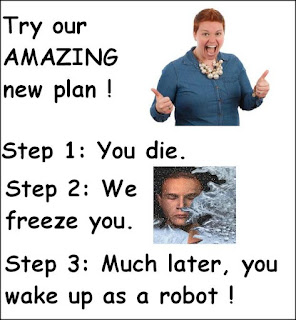
The cryogenics fantasy (represented by the slogan “freeze, wait, reanimate”) was implausible enough. Apparently Hanson believes in an even wackier notion – freeze your brain, stay in cold storage for a few decades, then wait until someone copies your brain state into a robot.  What convenience – after that fatal car crash, you wake up 40 years later with a nice steel robot body! 
plan
 

There are countless feasibility problems in the idea of copying human minds into robots, problems that Hanson has not paid attention to. The central assumption behind the idea is wrong. Your mind is not your brain, but something more than your brain. This is indicated both by well-substantiated psychic phenomena (such as ESP and near-death experiences), and also by the spectacular inability of neuroscience to explain basic facets of our mind such as consciousness, instant memory retrieval of obscure memories, and memories lasting 50 years despite very rapid molecular turnover in the brain (see here and here for why it is hard to imagine the last two will ever be explained neurologically). So Hanson's very elaborate speculations about what would happen if the world became full of “em” robots (with minds copied from human brains) are no more relevant than some speculations of what would happen if unicorns were to take charge of the planet.

Monday, July 6, 2015

Knowledge Lords or Lords of Exaggeration?

There is an intellectual sin that is very common among many modern scientists: the sin of speaking as if they had explanations that account for long-standing puzzles of nature, even if they don't really have such explanations, but at best merely have small fragments of such explanations. Imagine a person who doesn't have a blanket, but merely has some threads picked up from various places on the floor. Such a person might try to call those threads a blanket, or most of a blanket, but that would be quite an exaggeration. Similar to such a person, many a modern scientist speaks as if he is some great knowledge lord who has mastered some deep puzzle of nature, when he is merely someone familiar with a few things that might be fragments of the solution of such a puzzle (like individual pieces of a 50-meter-long jigsaw puzzle).

I read an example of this type of exaggeration today in a post by cosmologist Ethan Siegel. Siegel makes this claim: “The inflationary Big Bang Universe, with radiation, normal matter, dark matter and dark energy, explains the full suite of absolutely everything we’ve ever observed, and nothing else does.” Is this statement true? No, it's a ridiculous case of overselling a very patchy theoretical framework.

First, the inflationary Big Bang universe theory does not explain the origin of the universe itself, leaving it as a complete mystery. Second, there are many important physical things unexplained by the inflationary Big Bang theory -- things such as the hierarchical structure of the universe, the CMB cold spot, the persistence of spiral galaxies, and the  fine tuning of fundamental constants that makes possible a habitable universe. Third, we have no real understanding of either dark energy or dark matter. Neither is part of the Standard Model of Physics. The very terms “dark matter” and “dark energy” are pretty much just euphemisms for “some kind of mysterious something that we know nothing about.” So claiming that explains something (or is part of an explanation) is erroneous.

When physicists and cosmologists actually do calculations relevant to the issue of dark energy, they get a shocking result: that the vacuum of space should be filled with a dark energy or cosmological constant more than a billion trillion quadrillion times (more than 1,000,000,000,000,000,000,000,000,000,000,000,000 times) larger than we observe. This is the completely unsolved “cosmological constant” problem (sometimes called the vacuum catastrophe) that has long haunted physics and cosmology (it is discussed here). Claiming that dark energy is part of some explanation of “absolutely everything we've ever observed” is hilarious. Better to say that dark energy is part of the reason we can't even explain the simplest thing we can think of (the vacuum) – because according to physicist's calculations the vacuum should be so packed with dark energy that it should have more mass-energy than solid steel.

There are other fields of inquiry in which scientists claim to understand puzzles of nature they do not understand, by trying to exaggerate what they have learned. One such field is the field of biology. Here the most prominent cases of explanatory exaggeration involve evolution and natural selection. We commonly hear scientists speak as if evolution is some magic potion that explains “in one fell swoop” how it is that there came to be beings such as us on this planet.

But it isn't. While evolution and natural selection are very probably important pieces in the puzzle of the origin of intelligent life on our planet, they are probably no more than pieces in that jigsaw puzzle. For one thing, neither evolution nor natural selection can explain either the origin of life or the origin of the genetic code. That's because both evolution and natural selection require life itself, and you can't explain the origin of life by something that requires life.

Moreover, humans have many special mental and spiritual capabilities that are extremely difficult or impossible to explain by natural selection or evolution. Humans have inner selves and personalities. Humans are great at language, and at formulating very abstract ideas. Humans are capable of wonder, joy, love, guilt, compassion, imagination, and spirituality. Humans can create art and literature, ponder their own deaths, wonder about the meaning of life and the nature of the universe, create and follow moral codes, and consider philosophical matters. As argued here, it is hard to explain most of these things by evoking evolution or natural selection, because most of them have no survival value, from an evolutionary standpoint of making an organism more likely to survive until it reproduces.

Things evolution has a hard time explaining

How did humanity get these things? We don't know. The modern biologist offers an unconvincing, simplistic explanation – “it all just came from evolution.” But the actual explanation is probably far deeper and more complex. I can understand why the biologist would wish to offer this answer of “it all just came from evolution.” It is always better to be able to say, “I have the answer to this great mystery of nature,” than to say, “I have but a few tiny fragments that may one day be of use in solving this great puzzle.” It is always more pleasing to put yourself on a pedestal marked “Great Lord of Knowledge” than to humbly realize that the puzzles of nature vastly exceed your meager understanding. 

If you point out the explanatory limits of evolution to a biologist, you may be attacked as an evolution denier, even if you did not at all deny it, but merely pointed out its explanatory limits.  

Another example of inflated knowledge pretensions involve claims about the human brain. Scientists have done some brain imaging studies showing how parts of the brain light up differently under different conditions. If you read some enthusiastic reports of such studies, you might get the idea that scientists have a deep understanding of how our brains work. But they don't.

As the book Mind and Brain: A Critical Appraisal of Cognitive Neuroscience makes clear, brain imaging studies have cast relatively little light on the mysterious workings of the brain. Here are some points made on page 365-366 of the book:

Brain imaging meta-studies show that when the results of a number of experiments are pooled, the typical result is to show activations over most of the brain, rather than convergence on a single location... Considerable portions of modern cognitive neuroscience's empirical research support the idea that every cognitive process is a product of the action of a highly integrated system in which many parts of the brain interact rather than function independently as isolated regions...There has been little replication of most findings...No part of the brain has only a single, unique function...Clinical data, especially with traumatic injuries, do not display high degrees of correlation between particular brain lesions and cognitive states.

It would seem that those who claim to understand the brain through some kind of “this part does this thing” approach are exaggerating their understanding, and that the brain is still a deep, intractable mystery. Indeed, there is every reason to suspect that we are centuries away from being able to understand the brain's secrets.

How is it that these examples of knowledge hubris become so widely accepted? How is it that again and again our scientists get people to think that they are knocking on a door marked “Final Explanation” when they have often just walked a few paces down the long, long road that leads to that door? Part of the reason is that it's like a school where there are no teachers to give scientists grades, and they can make their own grades. Imagine if you were at a school without any teachers, one in which you give yourself a grade. You might learn just a few facts about modern history (such as the fact that soldiers landed on a beach on June 6, 1944, and the fact that some bombs were dropped on December 7, 1941). You might then conclude that because you had learned these things, you now had a deep understanding of modern history, and give yourself an “A” in the Modern History course. There would be no one around to say, “no, no, you have learned just the tiniest fraction of what you need to know to understand that topic.” Similarly, there is no one around to correct the scientist who fancies himself a knowledge lord after learning but a few paltry fragments of nature's vast and deep secrets.

Sunday, August 31, 2014

Brain Scan Stunts Are Not Mind Reading

Yesterday the top link on the Reddit futurology subreddit (www.reddit.com/r/futurology) was an article with a headline Mind Reader: Meet The Man Who Records and Stores Your Thoughts, Dreams and Memories. Over 700 readers have “liked” this article. But this article is junk technology reporting. Nobody has the slightest idea of how to record or store thoughts, dreams, or memories (outside of conventional media).

The article discusses a company founded by one Donald Marks. The company has some technology for doing brain scanning and storing the results. “"Some people call it 'thought identification' but it is essentially mind reading,” says Marks. “It is the process of recognizing activation patterns in the brain and identifying what thoughts are associated with them." Marks seems to be guilty of shameless overblown hype here, something he has a motive for because he has a financial interest in hyping his own company. The process his company is using is not at all mind reading. No one knows how to do any such thing.

There are various ways to scan the brain. One way is to use functional magnetic resonance imaging (fMRI), which measures change in blood oxygenation. Then there's CT scanning, and a process called PET. Then there's MEG, which measures magnetic fields produced by electrical activity in the brain. Then there's NIRS, another technique for measuring blood oxygenation in the brain.

None of these methods give one single bit of direct information about what someone is thinking or perceiving. However, scientists can try an elaborate technique for matching up brain scans taken at a particular time with data about what a person was observing at some particular time, or what a person says he was thinking at a particular time. It doesn't work very well at all, because two person's brains don't look the same way when they are thinking the same thing, or looking at the same thing. Even a single person's brain doesn't look exactly the same way when that person is looking at the same thing or thinking the same thought at two different times.

But there does seem to be a little bit of a tendency for one brain to look a little like another brain when they are observing the same thing or thinking the same thing. So scientists are able to do a little bit of what I may call a parlor trick. The parlor trick consists of analyzing sets of brain scans, and studying what a brain scan tends to look like when a particular thought is being thought, or a particular thing has being observed. Scientists can use that analysis to make a very weak limited-scope prediction about a person's thought or observations.

For example, when a person thinks about (or observes) something burning in a fire, his brain scan might tend to look a little different from the way it would look if he were thinking of (or observing) someone relaxing in an ocean. So given a set of brain readings, a scientist or a computer might be able to say something like, “It is 20% more likely that he is thinking about relaxing in an ocean than that he is thinking about someone burning in a fire.”

Should we call this type of thing “mind reading”? We should not. A proper term for it is brain scan correlation analysis. But such a term does not attract press attention or investors, so people doing such brain scan correlation analysis might resort to hype, and call it “mind reading” instead. Is there much use that we can foresee for brain scan correlation analysis? Not really. It's probably a dead end. It's basically a kind of parlor trick or stunt, good for attracting a few headlines, but not much else.

In my local library there are many Chinese books I can't read. I might create a new technique for trying to understand Chinese. I might take pictures of the covers of the Chinese books, and run these images through a computer program that correlates certain pictures on the book cover with Chinese words on the book covers. I could probably get a few results I could brag about using such a technique, which might attract some press attention, with headlines about a new computer program that can read Chinese. But such a technique would really be a parlor trick and a dead end. I would never be able to take it much farther, and never be able to really understand Chinese by using such a technique. Such a technique would be similar to using our current type of brain scans to try to read minds.

The items being read in brain scanning are like cloudy blobs, which severely limits the amount of usable information that can be derived from them. If you consider that the same person will have a different set of cloudy blobs when thinking the same thing at two different times (which would differ from the set of cloudy blobs that some other person would produce), it is hard to foresee much use that could be made of such analytics. One application you can think of is creating some kind of lie detector that would work from analyzing brain scans (because the cloudy blobs might look different when someone is lying). But such an approach would probably not be any more accurate than the existing technology of a polygraph. 

 The cloudy blobs of brain scans

The headline in the story I have cited (referring to “the man who records and stores your thoughts, dreams and memories”) is utterly misleading. What is being recorded is the brain scans of people while they are having thoughts, dreams, or recollections, not the thoughts, dreams, and recollections themselves. The story implies that such storage may be useful because a science of some later age may be able to analyze the cloudy blobs of brain scans more accurately, so that they can figure out memories, thoughts, and dreams from studying these cloudy blobs. There is no reason to be hopeful that any such thing will ever happen. It seems like something along the lines of saying, “Freeze yourself at death, and science will be able to figure out how to revive your body.” We might be able to figure out exactly how thoughts and memories are stored in the brain, but that would require science vastly more advanced than the crude indirect techniques of brain scanning correlation analysis.

When will we actually have technology for reading minds? My guess is sometime between 50 years from now and never. Contrary to the hyped claims of modern would-be technological mind readers, we are simply nowhere near to understanding the mystery of how the brain stores memories and how it produces thoughts. Our knowledge of the matter is so limited that we are not even sure whether the brain is the sole agent involved in storing memory and producing thoughts. We might one day unravel such a mystery after many decades of additional study. Or we might never figure it out.