Header 1

Our future, our universe, and other weighty topics


Showing posts with label astroengineering. Show all posts

Saturday, August 23, 2014

Hints of ET Civilizations Found in 50 Galaxies?

There are various possibilities for how mankind might first learn of the existence of extraterrestrial life. We might one day see a huge alien spaceship heading toward our planet. Or we might sniff out the chemical signatures of extraterrestrial life by studying nearby planets. Or we might get a radio message from extraterrestrials. Or, we might discover extraterrestrial intelligence by detecting indirect signs of large-scale astronomical engineering by alien civilizations.

I have always thought the last of these possibilities is quite plausible, and I have argued that perhaps the mysterious hard-to-explain planet Kepler 78b may be an example of extraterrestrial engineering at work. But now astronomers may have discovered evidence of astronomical engineering on a much vaster scale. The finding suggests the possibility of very large-scale astronomical engineering in about 50 different galaxies.

Before discussing the finding, I should discuss why the idea of large-scale engineering projects by extraterrestrials is a very plausible one, rather than some far-fetched idea dreamed up by a wild-eyed fantasist. The universe is about 13 billion years old, and intelligent life could have arisen on other planets at any time during the past several billion years. The universe consists of billions of galaxies which each contain millions or billions of stars. There are therefore a huge number of planets on which intelligent life could have evolved, and many eons during which such intelligent life could have appeared. A civilization much older than ours might be expected to engage in large astronomical engineering projects such as building large space colonies, constructing Dyson spheres, moving planets, or breaking up planets and creating space colonies from some of their parts. Such projects, very difficult for us, might be “child's play” for a civilization thousands or millions more advanced than ours.

Given all these factors, scientists have half-expected to scan the far reaches of space, and find evidence of the large-scale activities of extraterrestrials. It was hoped that such evidence would show up in the form of “heat signatures” that would take the form of infrared radiation. Infrared radiation is given off by all hot bodies. If an extraterrestrial civilization were to be engaging in large-scale engineering projects, this would give off a lot of excess heat which would create infrared radiation that could be read by scientific instruments. But prior to this year, scientists had found no such evidence. Quite a few scientists have said that it is surprising that such evidence has not been found. 

infrared radiation
Map of infrared radiation given off by a human

 So we should not be too surprised to hear about the exciting results from a recent astronomical survey. The survey was done by the Center for Exoplanets and Habitable Worlds at Penn State University, using data from a scientific satellite known as the Wide-Field Infrared Survey Explorer (WISE). According to team leader Jason Wright, a galaxy should emit only about 10 percent of its radiation as mid-infrared radiation. But the survey detected about 50 galaxies that are emitting more than half of their radiation as mid-infrared radiation.

This is exactly what we might expect to see if these galaxies had been “taken over” by one or more extraterrestrial civilizations that engaged in huge engineering projects that caused excess heat to be emitted. Someone speaking in the style of Erich von Daniken (author of Chariots of the Gods?) might call this excess infrared radiation the heat of the gods.

But scientists will need to do more work to rule out natural sources of radiation that might be producing all of this excess heat in these galaxies. Until that is done, we cannot say that proof has been found for extraterrestrial intelligence. But for the time being, we seem to have a tantalizing hint that extraterrestrial intelligence exists, and exists abundantly.

Saturday, August 2, 2014

Is Kepler-78b a Sign of Astronomical Engineering?

For decades astronomers have expected to one day find some sign of what is called astronomical engineering. Astronomical engineering is engineering on an astronomical scale, produced by a civilization. Astronomers have reasoned that since there are so many solar systems in our galaxy where life could evolve, we would expect that civilizations would have arisen on many planets, and that we would also expect to see evidence of large-scale activities by such civilizations. Such astronomical engineering projects might consist of a movement or manipulation of planets or asteroid belts, or the creation of huge artificial structures in space. One popular idea about astronomical engineering is that extraterrestrial civilizations might create a sphere around their sun to capture all its energy, a sphere known as a Dyson sphere.

Efforts to detect a Dyson sphere have come up short, but there may be a space discovery that offers possible evidence of astronomical engineering: the discovery of Kepler-78b, the “planet that shouldn't exist.”

Kepler-78b is a planet orbiting the star Kepler-78, a G-class star like the sun, located about 400 light-years away. The strangest thing about the planet is the location of its orbit. The planet orbits its star at a distance of about 900,000 miles, which is about the diameter of the sun and other G-class stars. This is an orbit which places the planet more than 30 times closer to its sun than the planet Mercury is to our sun. Scientists assume that the planet is some kind of lava world too hot for life to exist on it.

Scientists are baffled by how a planet of this size could exist in this orbit, and the Science Daily article on the discovery is entitled Lava World Baffles Astronomers: Planet Kepler-78b 'Shouldn't Exist.' The article says: “When this planetary system was forming, the young star was larger than it is now. As a result, the current orbit of Kepler-78b would have been inside the swollen star.” It then quotes astronomer Dimitar Sasselov as saying this about the planet: "It couldn't have formed in place because you can't form a planet inside a star. It couldn't have formed further out and migrated inward, because it would have migrated all the way into the star.” Sasselov therefore calls the planet “an abomination.”

But there is one way to explain this strange planet: by imagining that it is part of an astronomical engineering project started by a civilization living on some planet revolving around the sun-like star Kepler-78. Such a civilization may have moved the planet from a more distant orbit to its current orbit very close to the sun it orbits. The planet may have originally been a much larger planet (possibly a gas giant planet like Neptune or a frozen super-Earth several times larger than our planet). The planet may have been deliberately moved to the orbit close to its star, for the sake of stripping off its outer layers, and leaving behind an inner rocky metallic core. Such an astronomical engineering project may have been started for the sake of creating a gigantic mining target, a million-year source of metals and minerals to be exploited. Another possibility is that the astronomical engineering project may have been started with the goal of creating a new Earth-like habitable planet in the Kepler -78 solar system.

How to Move a Planet

Before considering such possibilities, we must ask: is it reasonable to imagine that an extraterrestrial civilization would be able to reposition planets in its solar system? Certainly when imagining such a civilization we should allow the possibility that they might have god-like powers of engineering. Such a civilization might be many thousands (or possibly even millions) of years more advanced than ours. Considering how much technical progress our civilization has made in the past hundred years, if we imagine an extraterrestrial civilization that mastered atomic power thousands of years ago, we should imagine that such a race would be able to do almost anything that is technically feasible.

When I wrote a blog post last year on this topic (entitled Is Mystery Planet Kepler-78b the Work of Intelligent Planet Movers?), I suggested the idea that a highly advanced civilization could move a planet in its solar system by causing asteroids to crash into the planet (and using asteroids as projectiles that might cause moons of a planet to crash into the planet). But it turns out there is a more sophisticated technique for moving planets. In 2001 three scientists wrote a scientific paper entitled Astronomical engineering: A strategy for modifying planetary orbits. The scientists describe how we could move our planet farther away from the sun by creating an accelerated mass stream that moves in a loop traveling between Earth and the planet Jupiter. The mass stream would consist of one or more asteroids or other massive objects. Jupiter would act as a gravitational slingshot to greatly accelerate the mass stream. The same technique could be used to move a planet closer to a sun. The accelerated mass stream would travel in a loop between the planet to be moved and the sun.

how to move a planet

As the highly accelerated asteroids pass by the planet, there is a transfer of angular momentum that causes the planet to be moved. Imagine if you are standing in a field and your friend runs towards you at high speed, looping around you before running away. If you grab your friend's coat edge as he is whizzing by, you will feel a little tug pulling you in one direction (and the faster your friend was moving, the greater the tug you would feel). Similarly, matter passing by a planet at high speed causes a little gravitational and angular momentum tug that can pull a planet in a particular direction. Given enough repetitions, sufficient speed, and sufficient mass in the matter passing by, this can be enough to gradually change the orbit of a planet.

So it seems that using techniques such as these scientists have described, an extraterrestrial civilization would definitely be able to move around planets in its own solar system. Changing a planet's orbit requires simple old Newtonian physics, not any far-out science fiction assumptions such as space warps or space-time wormholes. 
 
Why Move a Planet to an Orbit Very Close to a Sun?

But why would such a civilization want to move a planet very close to its sun? There are two possible motives:
  1. Kepler-78b might have been moved very close to its sun in order to heat up and “strip off” the outer layers of the planet, leaving behind a metallic rocky core that could be a mining target, a source of metals and minerals that might last for millions of years.
  2. Kepler-78b might have been moved very close to its sun in order to heat up and “strip off” the outer layers of the planet, leaving behind an Earth-sized metallic rocky core intended to be moved to another orbit in the habitable zone of the Kepler-78 solar system. This may be part of a massive astronomical engineering project to create a second habitable planet in this solar system.
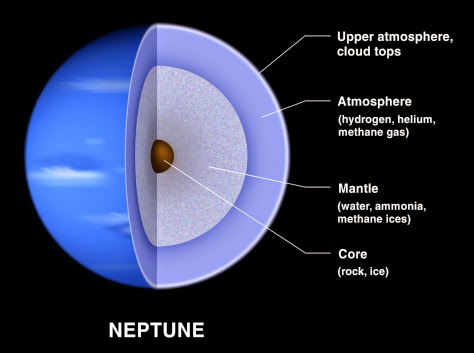
To explain both of these ideas, I must explain the idea of layer stripping. Planets such as Neptune, Jupiter, and Saturn are believed to be composed of different layers. For example, we see below a diagram showing the layers of Neptune. The outer layers are gases and frozen material. But the core is a rocky metallic core about the size of Earth. A similar diagram could be made of a frozen super-Earth planet with a mass five times greater than Earth, except that the proportions and element mixtures would be different.

layers of Neptune
Layers of Neptune (Credit: NASA)

Now what would happen if such a planet were to be moved very, very close to its sun, to the same distance that Kepler-78b is (a distance equal to about the diameter of the sun)? It would be like placing a big snowball with a rock at its center next to a big fire – the heat would strip off the outer layers, leaving only the rock remaining. All the gaseous and frozen layers of the planet would get so hot that they would steam off into space, like steam escaping from a boiling soup pan. What you would have left is a rocky metallic core about the size of the Earth – which exactly matches the description of Kepler-78b.

One possibility is that an extraterrestrial civilization will use Kepler-78b purely as a mining target, a source of metals and minerals. In such a case they might extract metals and minerals from the planet in its current orbit. Or they might later move the planet farther away, and then exploit its resources. It might be easier to mine the planet once it had been moved to a cooler location.

Another possibility is that extraterrestrials living in this solar system might later move Kepler 78b to an orbit in the habitable zone of their solar system, using the same simple technique they used to move the planet close to the sun. Their intention might be to create a new habitable planet in their solar system, a future home where they can live. They might have decided on such a massive astronomical engineering project after using up all the land and resources of their home planet, due to population growth.

Someone might object that Kepler-78b has been called a “lava world,” so such a planet would not be suitable as a future home for extraterrestrials living in the Kepler-78 solar system. But we're not actually sure that Kepler-78b is a lava world. There have been no measurements of the planet's temperature. The assumption that it is a lava world is based on the assumption that the planet has been in its current location for millions of years. But what if the planet had been moved to its location fairly recently, as part of an astronomical engineering project? In such a case it might not be a lava world. Imagine if the planet was in a particular stage of this “layer stripping” process when most of the gas and frozen layers had been stripped off, but there still remained a layer of ice a few miles thick. If such a planet were then moved to the habitable zone of the Kepler-78 solar system (the "Goldilocks zone" that is neither too hot nor too cold), it would be a rocky planet with oceans or seas, which could easily become habitable.

Gathering Support for These Ideas (Or Ruling Them Out)

Further scientific work may provide additional reasons for believing in these hypotheses, or such work may rule out these speculations. We do not know yet how many planets are in the Kepler-78 solar system. Kepler-78b is the only planet yet to be discovered there. But due to limitations in our planet detection techniques, it is perfectly possible that there is an undiscovered Earth-like planet in the habitable zone of this solar system. If such a planet were to be discovered (possibly by the forthcoming James Webb Space Telescope), it would make the ideas I have discussed seem more plausible (although it would not prove them true). If, on the other hand, astronomers were to conclude with high likelihood that there are no habitable planets in the Kepler-78 system, that would rule out the ideas discussed here.

There is also one way scientists might prove correct the ideas discussed here (or something close to them). We might point our radio telescopes to the Kepler-78 system, and listen for radio signals. If we were to detect such a radio signal, it would lend great credence to the ideas discussed here.

Friday, November 1, 2013

Is Mystery Planet Kepler-78B the Work of Intelligent Planet Movers?

Scientists just announced the discovery of the first extrasolar planet with a size and density very similar to our planet. The planet is Kepler-78b, orbiting the star Kepler 78, a G-class star like the sun, located about 400 light-years away.

The strangest thing about the planet is the location of its orbit. The planet orbits its star at a distance of about 900,000 miles, which is about the diameter of the sun and other G-class stars.  This is an orbit which places the planet more than 30 times closer to its sun than the planet Mercury is to our sun. The planet is so close to its star that it must be a kind of lava world too hot for life.


Depiction of Kepler-78b

Scientists are baffled by how a planet of this size could exist in this orbit, and the Science Daily article on the discovery is entitled Lava World Baffles Astronomers: Planet Kepler-78b 'Shouldn't Exist.'  The article says: “When this planetary system was forming, the young star was larger than it is now. As a result, the current orbit of Kepler-78b would have been inside the swollen star.”  It then quotes astronomer  Dimitar Sasselov as saying this about the planet:  "It couldn't have formed in place because you can't form a planet inside a star. It couldn't have formed further out and migrated inward, because it would have migrated all the way into the star.”

How, then, can we explain the orbit of the planet? Perhaps it is time for an audacious hypothesis.

The hypothesis I propose is this: Kepler-78b may be the result of intelligent extraterrestrial planet movers who deliberately moved the planet from a more distant orbit to its current orbit very close to the sun it orbits.  The planet may have originally been a much larger planet (possibly a gas giant planet). It may have been deliberately moved to the orbit close to its star, for the sake of stripping off its gaseous outer layers, and leaving behind an inner core of dense metals, metals needed by the civilization that moved the planet.  

Before explaining why this hypothesis may make sense, I need to first explain why the idea of an intelligent species moving around a planet in its solar system may be much less outrageous than it may seem at first.

Astronomers say that the universe is nearly 14 billion years old, but mankind is only a few million years old. Given that the age of the universe is several thousand times greater than the age of man, and that there are more than 1,000,000,000,000,000,000,000 stars that could support life-bearing planets, many astronomers suspect that intelligent life probably arose long, long ago on many planets. Some astronomers have looked for signs of gigantic engineering that might have been performed by civilizations millions of years more advanced than ours: projects such as the creation of a Dyson Sphere, a spherical structure that surrounds a star to capture as much of its energy as possible. 

In this context, the idea of a civilization with the power to move planets in its solar system does not seem too outrageous. Such godlike abilities are what we would expect to see in a technical civilizations many thousands or millions of years more advanced than ours.

Having looked at such a context, let us look at the hypothesis of a civilization moving a planet within its solar system, concentrating on two things: feasibility and motive. We will first look at whether a highly advanced civilization could possibly accomplish such a task, and then look at whether it would have a good motive for such a task.

The Feasibility of Moving A Planet


When looking at the idea of a civilization moving a planet in its solar system, you might first imagine the civilization attaching a giant rocket to a planet. Judging such a thing to be totally impractical, you might then dismiss the possibility of moving a planet. But there would be much easier ways for a civilization to go about moving a planet. One way would be for it to use other astronomical objects as projectiles to force a planet out of its orbit, into a different orbit.

Consider our solar system. We know that near Jupiter is an asteroid belt. We also know that Jupiter has dozens of moons, some of them a good fraction of the mass of the planet Mercury. In the distant future we might be able to accelerate asteroids, and use them as projectiles. Such projectiles could be launched towards Jupiter, to help nudge it out of its orbit. We could also launch projectiles towards the moons of Jupiter, causing them to crash into Jupiter, helping to nudge Jupiter out of its orbit.

The formula for kinetic energy is very simple:

Kinetic Energy = ½ * mass * (velocity * velocity)

This means that every time you double the velocity of a projectile, you are multiplying by four times its kinetic energy; and if you increase the velocity by ten times, you increase the kinetic energy by a hundred times. So if a super-advanced extraterrestrial civilization were to find some way of accelerating asteroids to a very high speed, the civilization might then have a very powerful way of rearranging the orbits of gas giant planets in its solar system. The mass of asteroids could be leveraged to move around moons orbiting a gas giant, causing them to crash into the gas giant; and the mass of those moons could then be leveraged to move around a gas giant itself.

The feasibility of re-positioning a gas giant would all depend on how fast the civilization was able to accelerate asteroids. Once the civilization developed a very fast way of accelerating asteroids, it would have the key to rearranging the orbit of a planet in its solar system. And there is every reason to think that a very advanced civilization would have the ability to accelerate asteroids to a high speed (ordinary nuclear rockets or matter/antimatter rockets would be sufficient, without any need for exotic physics).

It would seem, therefore, that a project of rearranging the orbital position of a gas giant planet within its solar system is something that should be feasible for a technical civilization many thousands of years more advanced than ours.

The Motive for Moving a Planet


But what about motive? Why would a super-advanced civilization want to move a gas giant close to its star? The motive might be simple: to acquire more metals that the civilization needed.

Consider the metal demands of a civilization thousands or million of years more advanced than ours. Such a culture might have an insatiable demand for metals. It might have already tapped out its planet for metals, and have already mined its asteroids for metals. Such a culture might need billions of tons more for any of a thousand possible projects, such as the building of more space colonies or the building of something like a Dyson Sphere.

Gas giant planets are believed to have dense metallic cores, as shown in the diagram below of the structure of Jupiter.


What would happen if an extraterrestrial civilization were to move a gas giant planet near its sun? Some of the “hot jupiter” planets located close to stars are called “puffy planets,” because their diameter is several times greater than Jupiter, even though they are only about the mass of Jupiter. Such planets have puffed-up, superextended atmospheres caused by all the solar heat they are receiving in their orbits close to a star.  If a gas giant was moved sufficiently close to a star,  the hot temperature would cause the planet to lose its gas atmosphere altogether. The gaseous outer parts of the planet would become so super-heated that the gases would diffuse away from the planet. What would be left would be a metallic core, which the civilization could then use as an endless supply of metal to meet its demands. The remaining planet in such an orbit would resemble Kepler-78b.
 
We therefore have a plausible motive for why an extraterrestrial civilization might wish to move a gas giant very close to its sun: to acquire a gigantic source of accessible metals, a source that would take millions of years to exhaust.

The hypothesis I have suggested here would be bolstered if we were to find an Earth-sized planet in the habitable zone of the solar system of Kepler 78b. If such a planet is never found, we will be able to exclude the hypothesis that there is an intelligent race in this solar system.  Until we know whether there are any habitable planets in this solar system, the hypothesis of a super-advanced race that has engaged in planet moving will remain a fascinating possibility to explain the strange orbit of Kepler-78b.

Postscript: Some scientists have concluded that moving planets is feasible, and the astrophysicist Neil deGrasse Tyson says he sees no reason why we can't start shifting planets around.  But the optimum technique would probably not be the rather crude technique I suggested of smashing asteroids or moons directly into a planet. There is a better technique described by this paper "How to Move a Planet," written by Paul Birch, and published in the Journal of the British Interplanetary Society. The technique involves what is called an accelerated mass stream, which would travel in an orbit between a planet's star and the planet itself, and make use of what is called a gravitational assist or gravitational slingshot to achieve greater acceleration.  The mass stream would pass near the planet, but not directly crash into it. Such a mass stream could slowly move the planet by means of a gradual transfer of angular momentum.