Header 1

Our future, our universe, and other weighty topics


Showing posts with label complexity. Show all posts

Tuesday, March 8, 2022

The New Yorker's Poor Portrait of Human Cells

For decades the magazine the New Yorker has been famous for its wonderful cartoons, such as the classic cartoons of Charles Addams. But the New Yorker has also long been famous for long essays. A recent essay in the magazine was a long article entitled "A Journey to the Center of Our Cells." It is a good thing that a major magazine should attempt to educate us about the fundamentals of cells, a deep and profound topic that can be a springboard to more intelligent ideas in biology.  Unfortunately, what the article gives us is a kind of shrink-speaking complexity-concealment affair like we so often read, an essay that repeatedly gives us wrong ideas and incorrect impressions.  

Two huge errors occur very early in the essay. The first is in the subtitle, which makes the untrue claim that scientists are learning to build their own cells. No progress has been made in making self-reproducing cells from scratch or from protein components. Then we read, "We accept that each of us was once a single cell, and that packed inside it was the means to build a whole body and maintain it throughout its life." It is very false indeed  to state that a fertilized ovum or human egg contains "the means to build a whole body and maintain it throughout its life." Such a fertilized ovum or egg contains only DNA with low-level chemical information, such as partial instructions for making protein molecules. DNA does not contain any instructions for building bodies or limbs or organ systems or skeletons or cells.  DNA does not even contain instructions for making the organelles that are the components of cells.  So how does a full-grown body with its many levels of hierarchical organization (and about 200 types of cells, most as organized as a factory) arise from a mere speck-sized cell containing no instructions for making such a wonder of functional complexity and vast hierarchical organization? That is a mystery a thousand miles over the heads of today's scientists. 

Just as automobiles are wonders of organization (marvels involving very many parts arranged in the right way to achieve a functional end), cells are wonders of vast organization (marvels involving very many parts arranged in the right way to achieve a functional end).  But you would never know that from reading the New Yorker article. We do not find the words "organized" or "organization" in the article, except for a most dubious reference to "self-organization."  The article refers to cells as "incredibly intricate," but that is not an adequate term to describe cells. "Intricate" means "very complicated or detailed."  Countless non-functional things are intricate. Cells are something much more than intricate: they are incredibly organized, internally dynamic and functionally complex. 
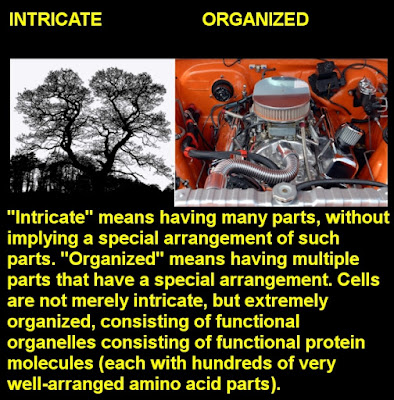
organization of cells

The article mainly speaks of "the cell," as if there was one type of cell. Nowhere are we told about all the different types of cells, except when the article mentions four types, by saying, "The human body contains brain cells and fingernail cells, blood cells and muscle cells, and dozens of species of single-celled bacteria."  Human beings actually have about 200 different types of cells, with characteristics as diverse as the diverse characteristics of the creatures in the Bronx Zoo. Just as each of the roughly 20,000 types of protein molecules in the human body is its own separate very complex invention, each of the roughly 200 types of cells in the human body is its own separate very complex invention. Why the failure to tell us about such a reality? 

The article then tells us, "Several groups of 'synthetic biologists' are now close to assembling living cells from nonliving parts."  This claim is a huge falsehood.  A living cell would be a cell capable of self-reproduction.  Scientists have no understanding of what causes cells to reproduce. So scientists are nowhere close to assembling living cells from nonliving parts.  On a web page entitled "The Mystery of Cell Division," a scientist confesses that scientists don't understand how cells -- with a complexity of "airplanes" -- could self-reproduce.  We read this:

"Scientists have been trying to understand how cells are built since the 1800s. This does not surprise us and, as scientists ourselves, we have always been puzzled at how cells, such complex structures, are able to reproduce over and over again. Even more astonishing is that, despite the frequency of cell division, mistakes are relatively rare and almost always corrected. According to Professor David Morgan from University of California, the complexity that we observe in cells can be compared to that of airplanes."

An M. Pitkanen (who has a PhD in theoretical physics) has written the following about cell division:

"Replication is one of the deepest mysteries of biology. It is really something totally counterintuitive if cell is seen as a sack of water plus some chemicals. We have a lot [of] facts about what happens in the replication at DNA level but how this miracle happens is a mystery. At cell level the situation gets even more complex."

A university press release discusses scientific ignorance about the basis question of cell division. It states the following:

"When a rapidly-growing cell divides into two smaller cells, what triggers the split? Is it the size the growing cell eventually reaches? Or is the real trigger the time period over which the cell keeps growing ever larger?...'How cells control their size and maintain stable size distributions is one of the most fundamental, unsolved problems in biology,' said Suckjoon Jun, an assistant professor of physics and molecular biology at UC San Diego...'Even for the bacterium E. coli, arguably the most extensively studied organism to date, no one has been able to answer this question.' ”

Later the New Yorker article makes the big mistake of equating a cell with its genes. It says, "Decipher the labelled genes and you’d approach a comprehensive understanding of cellular life."  To the contrary, neither DNA nor its genes specify how to make a cell or any of its component organelles; and neither DNA nor its genes specify the incredibly complex biochemistry of cells.  DNA and genes influence cellular behavior, but do not specify it.  Later the New Yorker article makes the unwarranted claim that protein molecules "self-assemble into biological machines." We do not know how incredibly complex organelles, cells, organs, organ systems and bodies arise from the low-level components that are protein molecules, and we should not be pretending to understand such a mystery (a thousand miles over our head) by using the empty term "self-assemble." 

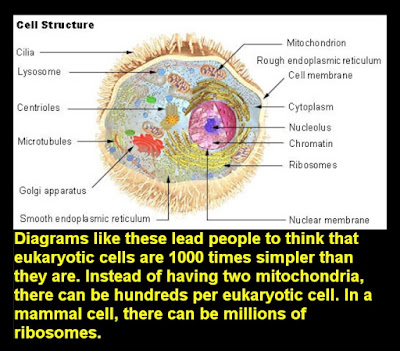
The New Yorker article fails to explain the basic structural reality that a human cell contains thousands of functional components called organelles.  In this sense, a human cell is like some car engine or aircraft carrier engine containing thousands of functional parts arranged in just the right way.  Such a reality will be suprising to those who remember the thousand-fold oversimplified and extremely misleading cell diagrams in biology textbooks, which falsely depict cells as having only a few dozen organelles. 

complexity of cells


Instead of describing this reality of vastly organized cell structure, the New Yorker article rather tries to depict a cell as if it was a mere bag or heap of proteins. It states this:

"If a cell were blown up to the size of a high-school gym, you wouldn’t be able to see across it. It would be filled with tens of thousands of proteins, most about the size of a basketball. Other biomolecules no bigger than your hand, and water molecules the size of your thumb, would fill the spaces between. (To scale, your whole body would be about the size of a ribosome.) The mixture would have the consistency of hair gel."

This is as misleading as describing the US Capitol Building as being kind of a big heap of carbon, oxygen and iron molecules. Hair gell is disorganized. Cells are enormously organized. 

There is a world of difference between the simplest type of cells (called prokaryotic cells) and the type of cells found in the human body (called eukaryotic cells). It has been said that the difference between prokaryotic cells and eukaryotic cells is like the difference between some one-room shack and a billionaire's mansion.  What visual do we see at the top of the "A Journey to the Center of Our  Cells" article in the New Yorker, an article with a title suggesting a discussion of human cells?  Not a visual of a eukaryotic cell, but a visual of a prokaryotic cell.  This is consistent with the whole thrust of the article, which seemingly is to conceal from us the complexity and organization of our cells, and to make us think our cells are vastly simpler than they are. 

Later the New Yorker article approvingly quotes some physicist saying, "This area of understanding how colloidal-scale physics is regulating and orchestrating cell function—this is the frontier."  The statement is very laughable and extremely misleading. Physics does not orchestrate cell function. Cells involve operations as complex as the construction of a skyscraper, and cannot be explained by simple rules of physics. Saying that cell function is orchestrated by physics is like saying the construction of a skyscraper is orchestrated by the law of gravity. 

In the last paragraph, the New Yorker article tries to create the impression that "synthetic life" has been created. It states this:

"Before I left town, Glass gave me a memento. It was a strange-looking cube, a sort of clear plastic paperweight with a pink square suspended inside. Glass explained that the square was a plate of agar on which colonies of the minimal cell had been grown. The colonies were encased in a few inches of resin. It’s on my desk now. Holding it up to the light, I can make out perhaps a dozen pinpricks. I wonder what these colonies—some of the first examples of synthetic life—will come to be seen as initiating."

The impression here is enormously misleading. The work in question by Glass involves stripping genes out of existing living cells, to try and find how many genes can be taken out without destroying a cell's ability to reproduce (rather like experimenting with how many parts can be removed from a mouse without killing the mouse). That isn't anything like creating synthetic life, which would be creating a living reproducing thing from some non-living inert substances. No one has produced any such thing as synthetic life, nor is anyone anywhere close to doing such a thing, which we should not expect to occur in this century. 

Given its very great internal complexity and very high state of functional organization, the reproduction of a cell is a marvel that can be compared to a working automobile splitting up to become two full-sized automobiles.  The author of the New Yorker article seems to have little understanding of how hard it would be to ever explain such a marvel or to cause it by tinkering with lifeless matter. The author fails to even mention cell reproduction, merely referring to cell division, something sounding much less impressive. Inanimate lifeless things like books can be easily divided into two, but they can't reproduce.  At one point the article laughably suggests that scientists may be able to get living cells from scratch after they have spent some more time tinkering with "different ingredients" or by fiddling with part arrangements.   This is like suggesting that if you tinker a little more with a car engine, you can get the car to split into two working cars.  

By referring to "different ingredients" in a cell, the article is using a common technique of complexity-concealing writers trying to make something sound vastly less organized than it is.  Although sometimes defined as a part or a component, the term "ingredient" is a word with a strong connotation implying something within an unordered mixture such as a pot of soup.  The wikipedia.org article on "ingredient" begins by saying, "An ingredient is a substance that forms part of a mixture (in a general sense)."  Cells are very complex functional arrangements of matter that are no more mixtures than the engine of a car is a mixture. 

Instead of giving us some incorrect impression that scientists such as John I. Glass are creating synthetic life, our New Yorker author should have properly analyzed and reported on papers co-authored by Glass such as the paper "Fundamental behaviors emerge from simulations of a living minimal cell." That paper describes "a genetically minimal bacterial cell, consisting of only ... 493 genes on a single 543-kbp circular chromosome with 452 genes coding for proteins (), some of which are subunits of multi-domain complexes." Each of those genes is a complex invention with hundreds of fine-tuned parts that almost all have to be just right. The total number of amino acids that have to be arranged just right in the proteins partially specified by these genes is roughly 150,000. Far from supporting any "life is simple, we can make it from scratch" narrative, such a paper supports the idea that even the simplest self-reproducing cell has a degree of organization and functional complexity greater than the organization and functional complexity of an 80-page technical manual. And even all that information does not give you a self-reproducing cell; it's only a prerequisite for such a cell. 

The extremely misleading give-you-the-wrong-ideas article that is "A Journey to the Center of Our Cells" reminds me of another extremely misleading give-you-the-wrong-ideas article recently published in the same magazine: its "The Science of Mind Reading" article that is debunked here.  The first article attempts to advance the groundless idea that scientists are making some progress in creating synthetic life from lifeless materials. The second article attempts to advance the groundless idea that scientists are making some progress in reading thoughts by scanning brains. 

Friday, July 2, 2021

The Complexity Concealments of Shrink-Speaking Professors

Let us imagine someone showed you some cards on a table in his backyard, some cards that had been arranged into something that looked like a house of cards. Suppose the person tried to persuade you that no one had purposefully arranged the cards into such a house-like structure, and that the structure had appeared because of purely random, accidental effects (such as say, friction or random wind gusts). The more complex such a house of cards was, the less likely you would be to believe such an explanation.

If the person showed you a “house of cards” consisting of only one card leaning against another card to make an upside-down “V” shape, you might easily be willing to believe the person's theory of accidental construction. But suppose the person showed you a “house of cards” consisting of twenty cards. You then would be vastly less likely to believe the person's theory of accidental construction. If the person showed you a “house of cards” consisting of 50 cards, like the one below, you would never accept any theory that such an intricate and hard-to-achieve arrangement had occurred by chance.


Speaking more generally, I can evoke a general rule: what I can call the first rule of accidental construction.

The first rule of accidental construction: the credibility of any claim that an impressively organized final result was accidentally achieved is inversely proportional to the number of parts that had to be well-arranged to achieve such a result, and the amount of organization needed to achieve such a result.

Because of this general rule, the rule that the more functionally organized something is the less likely it arose accidentally, there is a very important relation between the degree of organization and complexity in biological organisms and the credibility of Darwin's theory of natural biological origins. The relation is that the credibility of Darwin's theory of natural biological origins is inversely proportional to the degree of organization and functional complexity in biological organisms. The more organized and functionally complex that biological organisms are, the less likely that they might have appeared because of any accidental process.

Biological organisms have enormously high levels of organization. We know how to put together piece by piece aircraft carriers equipped with all their jets, but there is no team of scientists that could ever put together from scratch a living human body, by a molecule by molecule arrangement of parts.  The human body has a more impressive degree of organization and complexity than any machines humans have ever manufactured. So the advocates of Darwinism have a tough situation. If they realistically depict organisms such as humans as being as functionally complex and hierarchically organized as they are, all attempts to sell Darwinism will be undermined. So the advocates of Darwinism routinely attempt to portray organisms and their parts as being vastly less complex than they are.

Again and again (particularly when speaking to the general public), mainstream biologists will give us kind of kindergarten sketches of biological life, in which organisms or their parts are depicted as being enormously simpler than they are. They use a series of tricks by which people may be fooled into thinking that organisms and their parts are a hundred times simpler or a thousand times simpler or a million times simpler than they are.

To perform such a concealment, biologists very often engage in what I call shrink-speaking, which is misleadingly describing something as if it were vastly simpler than it is.  A person who describes the United States of America as "just a bunch of buildings" is engaging in shrink-speaking, as does a scientist who refers to you as "a bunch of chemical compounds." The same shrink-speaking would occur if someone described the volumes of a public library as "just some ink marks on paper."

Below are some of the tricks that are used as part of this gigantic complexity concealment. The tricks are most commonly used when professors are writing books for the general public or articles designed to be read mainly by the general public. Conversely, inside scientific papers rarely read by the public, professors often discuss the vast amount of organization and functional complexity of living things. 

Trick #1: The Frequent Mention of “Building Blocks of Life”

Scientists and science writers have long claimed that “building blocks of life” were produced by certain experiments, although the claims made along these lines are very erroneous and misleading. More baloney has been written about the Miller-Urey experiment (an experiment claimed to have produced “building blocks of life”) than almost any other scientific topic.

Without reviewing the huge number of misstatements that have been made about origin-of-life research, we can merely consider how utterly misleading is the very phase “building blocks of life.” The very term suggests that the simplest life would be something very simple. When we think of what is made from building blocks, we can think of something as simple as a wall or a simple house made of cinder blocks or bricks. But all cells are incomparably more complex than a simple house.

The building blocks of cells are organelles, which make up even the simplest prokaryotic cells. The building blocks of organelles are proteins, and the building blocks of proteins are mere amino acids. Whenever anyone describes an amino acid or a nucleobase as a “building block of life.” that person is misrepresenting the complexity of life. An amino acid is merely the building block of a building block (a protein) of a building block (an organelle) of a cell.

Trick #2: Misleading Cell Diagrams

A staple of biological instruction materials is a diagram showing the contents of a cell. Such diagrams are usually profoundly misleading, because they make it look like a cell is hundreds or thousands of times simpler than it actually is.

Specifically:

  • A cell diagram will typically depict a cell as having only a few mitochondria, but cells typically have many thousands of mitochondria, as many as a million.
  • A cell diagram will typically depict a cell as having only a few lysosomes, but cells typically have hundreds of lysosomes.
  • A cell diagram will typically depict a cell as having only a few ribosomes, but a cell may have up to 10 million ribosomes.
  • A cell diagram will typically depict one or a few stacks of a Golgi appartus, each with only a few cisternae, but a cell will typically have between 10 and 20 stacks, each having as many as 60 cisternae.
  • Cell diagrams create in the mind the idea of a cell as a static thing, when actual cells are centers of continuous activity, like some active factory or a building that is undergoing continous construction and remodeling. 
misleading cell diagram

Trick #3: Claiming that a Human Could Be Specified by a Mere “Blueprint” or “Recipe,” and Claiming DNA Has Such a Thing

The idea that DNA is a blueprint or recipe for making a human being is a claim that is both false and profoundly misleading, giving people a totally incorrect idea about the complexity of human being. It is false that DNA has any such thing as a recipe or blueprint for making a human. DNA contains only low-level chemical information such as information about the amino acids that make up proteins. DNA does not contain high-level structural information. DNA does not specify the overall body plan of a human, does not specify how to make any organ system or organ of a human, and does not even specify how to make any of the 200 types of cells in the human body. See this post for the statements of 18 science authorities telling you that DNA is not a blueprint or a recipe for making organisms.

Besides giving us an utterly false idea about the contents of DNA, claims such as “DNA is a blueprint for making humans” or “DNA is a recipe for making humans” create false ideas about the complexity of human beings. A blueprint is a large sheet of paper for doing a relatively simple construction job. A recipe is a single page for doing a relatively simple food preparation job. So whenever we hear people say something “DNA is a blueprint for making a human” or “DNA is a recipe for making a human,” we think that the construction of a human is a relatively simple affair. In reality, a human body is many thousands or millions of times too complex to be constructed from any blueprint or recipe.

If you were to give an analogy that would properly convey how complex would be the instructions needed for building a human, you might refer to something like a “a long bookshelf filled with many volumes of construction blueprints" or a “long bookshelf filled with recipe books.” But even such analogies would poorly describe the instructions for making a human, as they would be give you the idea of a human being as something merely static, rather than something that is internally dynamic to the highest degree.

Trick #4: Trying to Conceal the Complexities of Human Minds, by Claiming that Human Minds Are Like Animal Minds

Humans are enormously complex not only in their physical bodies, but in their minds. The human mind is its own separate ocean of mental complexity apart from the ocean of physical complexity that is the human body. Darwinists have always had the greatest difficulty in accounting for the subtleties and complexities of human thinking and human behavior. Very much of our mental activity seems like something inexplicable under any theory of natural selection. Much of what our minds do (such as mathematical ability, artistic creativity and philosophical reasoning) is of no survival value, and cannot be explained under any reasoning of survival-of-the-fittest or natural selection.

Darwinists have usually dealt with this problem by taking an approach of claiming that mentally humans are like animals. Such a claim is a gigantic example of complexity concealment, a case of trying to cover-up the complexities of the human mind, by sweeping them under the rug. Darwin committed this error most egregiously in a passage of The Descent of Man in which he made the extremely absurd claim that " there is no fundamental difference between man and the higher mammals in their mental faculties." 

Trick #5: Using the Shrink-Speaking Term "Consciousness" To Refer to Human Mentality

A very common trick of modern scientists is to refer to the human mind (an extremely multifaceted and complex reality) by the minimalist term "consciousness,"  which would be a suitable term for describing the mind of an insect. A dictionary defines consciousess as being awake and aware of your surroundings. But human mentality is something vastly more complex and multifaceted than that. So using the term "consciousness" for human mentality is an example of shrink-speaking, language that makes something look vastly simpler or smaller than it is. 

While the term "problem of consciousness" is often used, what we actually have is not some mere "problem of consciousness" but an extremely large “problem of explaining human mental capabilities and human mental experiences” that is vastly larger than merely explaining consciousness. The problem includes all the following difficulties and many others:
  1. the problem of explaining how humans are able to have abstract ideas;
  2. the problem of explaining how humans are able to store learned information, despite the lack of any detailed theory as to how learned knowledge could ever be translated into neural states or synapse states;
  3. the problem of explaining how humans are able to reliably remember things for more than 50 years, despite extremely rapid protein turnover in synapses, which should prevent brain-based storage of memories for any period of time longer than a few weeks;
  4. the problem of how humans are able to instantly retrieve little accessed information, despite the lack of anything like an addressing system or an indexing system in the brain;
  5. the problem of how humans are able to produce great works of creativity and imagination;
  6. the problem of how humans are able to be conscious at all;
  7. the problem of why humans have such a large variety of paranormal psychic experiences and capabilities such as ESP capabilities that have been well-established by laboratory tests, and near-death experiences that are very common, often occurring when brain activity has shut down;
  8. the problem of how humans have such diverse skills and experiences as mathematical reasoning, moral insight, philosophical reasoning, and refined emotional and spiritual experiences;
  9. the problem of self-hood and personal identity, why it is that we always continue to have the experience of being the same person, rather than just experiencing a bundle of miscellaneous sensations;
  10. the problem of intention and will, how is it that a mind can will particular physical outcomes.
It is therefore an example of a complexity cover-up and concealment for someone to refer to the human mind as merely "consciousness" or to speak as if there is some mere "problem of consciousness" when there is the vastly larger problem of explaining human minds that are so much more than mere consciousness.  Calling a human mind "consciousness" (a good term for describing the mind of a mouse) is like calling a city a bunch of bricks and lumber. 

aspects of human mentality
Our minds are so much more than just "consciousness"

Trick #6: Trying to Conceal the Complexities of Human Minds, by Denying the Evidence for Psi and Paranormal Abilities

As you can see by reading the 41 posts here, we have two hundred years of very good observational and experimental evidence for paranormal human abilities such as clairvoyance and ESP, very much of it published in the writings of distinguished scientists and physicians. But the existence of such abilities is senselessly denied by very many of our professors. Denying the reality of psi is essentially a cover-up, a case of sweeping under the rug complexities of the human mind that you would prefer not to deal with it, for the sake of depicting human minds as being much simpler than they are.  

Trick #7: Failing to Describe the Complexity of Typical Protein Molecules or Larger Protein Molecules

When biologists and writers on biology describe protein molecules, they typically tell us that protein molecules have "many" amino acids. But almost never are we given a statement that informs about how complex protein molecules are.  It is very easy to do such a thing. 

The first way to do such a thing is by simply mentioning that the average protein molecule has about 370 amino acids, and that very many protein molecules consist of more than 600 amino acids. Another way to do this by an analogy. If we compare an amino acid to a letter, we can say that the average protein has the information complexity of a well-written paragraph, and that the larger protein molecules have the information complexity of a well-written page of text.  

But we almost never are told such facts. Nine times out of ten a reader will simply be vaguely told that there are "many" amino acids in a a protein. The complexity of protein molecules are almost always hidden from readers, who may go away with the very incorrect idea that a protein molecule consists of only 10 or 20 amino acids. 

Trick #8: Failing to Discuss the Sensitivity of Protein Molecules

There are two ways to get an understanding of how organized and fine-tuned protein molecules are. The first is to learn how many parts they have (typically several hundred amino acid parts). The second is to learn how sensitive such molecules are to small changes, how easy it is to break the functionality of a protein by changing some of its amino acids. Some important papers have been written shedding light on how the functionality of protein molecules tends to be destroyed when only a small percentage of the molecule is changed. One such paper is the paper here, estimating that making a random change in a single amino acid of a protein (most of which have hundreds of amino acids) will have a 34% chance of leading to a protein's "functional inactivation."  Such papers tell us the very important truth that protein molecules are very sensitive to small changes, which means that they are exceptionally fine-tuned and functionally organized. But we almost never hear our professors discuss this extremely relevant truth. 

Trick #9: Failing to Tell Us Protein Molecules Are Very Often Functional Only As a Part of Protein Complexes Involving Multiple Proteins

Protein complexes occur when a protein is not functional unless it combines with one or more other proteins, which act like a team to create a particular effect or do a particular job.  When writing for the general public, our biology authorities conveniently mention as infrequently as they can the extremely relevant fact that a significant fraction of proteins are nonfunctional unless acting as team members inside a protein complex, a fact that makes Darwinian explanations of human biochemistry seem exponentially more improbable.  An example is a recent paper estimating the likelihood of photosynthesis on other planets,  which very misleadingly refers to photosynthesis as being something with "overall simplicity," conveniently failing to mention that photosynthesis requires at least four different protein complexes, making it something that can only be achieved by extremely organized functional arrangements of matter, incredibly unlikely to ever appear by chance of Darwinian processes. 

Trick #10: Not Telling Us How Many Protein Molecules Are in a Typical Cell

How many protein molecules are in a typical cell? I doubt whether one high-school graduate in 10 could correctly answer this question within a factor of 100. Biology's concealment aces are good about hiding this important information from us.  The answer (about 40 million) almost never appears in print.  We do sometimes hear mention of the fact that the human body contains more than 20,000 different types of protein molecules (each a separate complex invention), but not nearly as often as we should. 

Trick #11: Misleading "Cell Types" Diagrams Suggesting There Are Only a Few Cell Types

How many different cell types are there in the human body? Our biologists frequently publish "cell types" diagrams listing only a few types of cells. Such charts cause people to think there are maybe 5 or 10 types of cells in the human body.  The actual number of cell types in the human body is something like 200. When did we ever see a diagram suggesting this reality?

Trick #12: Describing Human Bodies As If They Were Static Things, Ignoring the Vast Internal Dynamism of Organisms and Cells

Inside the human body and each of its cells there are a thousand simultaneous choreographies of activity.  The physical structure of a cell is as complex as the physical structure of a factory, and the internal activity inside a cell is as complex as all of the many types of worker activities going on inside a large factory. Such a very important reality is almost never discussed by our professors when writing for the public. Such people love to describe cells as "building blocks," as if they were static things like bricks or cinder blocks.  

Trick #13: Failing to Describe the Hierarchical Organization of Human Bodies

The organization of organisms is extremely hierarchical.  Subatomic particles are organized into atoms, which are organized into relatively simple molecules such as amino acids, which are organized into complex molecules such as proteins, which are organized into more complex units such as protein complexes and cell structures called organelles, which are organized into cells, which are organized into tissues, which are organized into organs, which are organized into organ systems, which (along with skeletal systems) are organized into organisms.  You will virtually never read a sentence like the previous one in something written by a professor, and we may wonder that this is because a sentence like that one makes too clear the extremely hierarchical organization of organisms, something many of our biologists rather seem to want us not to know about. 

Trick #14: Making It Sound As If Particular Organs Accomplish What Actually Requires Organ Systems and Fine-Tuned Biochemistry

In discussions involving biological origins, our professors often speak as if an eye will give you vision or a heart will give you blood circulation, or a stomach will give you food digestion.  But nobody sees just by eyes; they see by means of extremely complicated vision systems that require eyes, optic nerves, parts of the brain involved in vision, and very complex protein molecules.  And hearts are useless unless they are working with extremely complex cardiovascular systems that include lung, veins, arteries and very complex biochemistry.  And nobody digests food simply through a stomach, but through an extremely complicated digestive system consisting of many physical parts and very complex biochemistry. Our professors do an extremely poor job of explaining that things get done in organisms only when there are extremely complex systems consisting of many diverse parts working like a team to accomplish a particular effect. 

Trick #15: Making Scarce Mention of the Countless Different Types of Incredibly Fine-Tuned Biochemistry Needed for Organismic Function

Everywhere biological functionality requires exquisitely fine-tuned biochemistry. But we rarely hear about that in the articles and books of professors written for the general public.  An example of such fine-tuned biochemistry is the biochemistry involved in vision, which a biochemistry textbook describes like this:
  1. Light-absorption converts 11-cis retinal to all-trans-retinal, activating rhodopsin.
  2. Activated rhodopsin catalyzes replacement of GDP by GTP on transducin (T), which then disassociates into Ta-GTP and Tby.
  3. Ta-GTP activates cGMP phosphodiesterase (PDE) by binding and removing its inhibitory subunit (I).
  4. Active PDE reduces [cGMP] to below the level needed to keep cation channels open.
  5. Cation channels close, preventing influx of Na+ and Ca2+; membrane is hyperpolarized. This signal passes to the brain.
  6. Continued efflux of Ca2+ through the Na+-Ca2+ exchanger reduces cytosolic [Ca2+].
  7. Reduction of [CA2+] activates guanylyl cyclase (CG) and inhibits PDE; [cGMP] rises toward “dark” level, reopening cation channels and returning Vm to prestimulus level.
  8. Rhodopsin kinase (RK) phosphorylates “bleached” rhodopsin; low [Ca2+] and recoverin (Recov) stimulate this reaction. Arrestin (Arr) binds phosphorylated carboxyl terminus, reactivating rhodopsin.
  9. Slowly, arrestin dissociates, rhodopsin is dephosphorylated, and all-trans-retinal is replaced with 11-cis-retinal. Rhodopsin is ready for another phototransduction cycle.
We hear no mention of such requirements in typical discussions of the origin of vision, nor do we hear a discussion of how vision requires certain protein molecules consisting of hundreds of parts arranged in just the right way.  Instead, our professors often speak as if vision could have kind of got started if something very simple existed.  Such insinuations are absurdly false. 

Such biochemical requirements are all over the place in biology. In general, any physical function of a body requires a vast amount of enormously complicated biochemistry which has to be just right. But you would hardly know such a thing from reading a typical article or book written by a professor.  The mountainous fine-tuned biochemistry complexity of every physical operation of living things is rarely mentioned, just as if our professors were trying to portray organisms as a thousand times simpler and less organized than they are.  

Darwinism seems to be of very little value in explaining such biochemistry. For example, the thirtieth edition of Harper's Illustrated Biochemistry is an 800-page textbook describing cells, genes, enzymes, proteins, metabolism, hormones, and biochemistry in the greatest detail, with abundant illustrations. The book makes no mention of Darwin, no mention of natural selection, and only a single mention of evolution, on a page talking only about whether evolution had anything to do with limited lifespans.

In papers and textbooks professors may accurately describe the complexities of humans, but so often in books and articles for the public such professors use sentences that can be compared to crude cartoon sketches.   Human minds have oceanic depths of complexity, and human bodies have oceanic depths of organization. But very often it is as if reductionist shrink-speaking professors describe such oceanic realities as if they were crummy little puddles. 

Monday, May 11, 2020

Five Levels of Complexity, the Last Two Still Unexplained

Living things have mountainous levels of complexity and functional organization. Many maintain that the level of complexity and organization in living things is too great to be explained though any theory of natural origins. But those who think otherwise may argue along these lines:

What we see in living things is just orderly complexity. But naturally explaining orderly complexity is no big deal. We know of many natural reasons why orderly complexity can arise. For example, there are physics and chemistry reasons why atoms in a rock become organized into a crystal. That's an example of orderly complexity, and it has a natural explanation.”

But there is the most gigantic difference between the complexity seen in something like a rock crystal, and the complexity in mammals and humans. To help clarify the difference, it will be helpful to create some categories of complexity.

Category #1: Unimpressive complexity

We can use the term “unimpressive complexity” for some complexity that arises because of a simple, easy-to-explain ordering rule. An example is the complexity we see in rock crystals. Such complexity can arise when one or two simple rules are applied to some matter.  Another example is the concentric complexity of the rings in a tree, something that arises from a very simple rule.


Category #2: Information-poor static enormously-organized complexity

We can use the term “enormously organized complexity” for complexity that requires multiple levels of organization. An example would be a very complex old building.

The term “information” is defined in various ways. In this discussion, by information I mean the use of symbolic tokens such as symbols or letters or units of representation. The essence of information is the use of some kind of token in which one thing stands for another.  

There may be a little information in an old building, but not very much (if we consider only the building and not any books or electronic devices inside the building). So complex old buildings  would seem to fall into the category of information-poor static enormously organized complexity.


Category #3: Information-rich static enormously-organized complexity

We can use the term “information-rich static enormously organized complexity” for certain types of things such as libraries of books. The library has a very high degree of organization, and also very much information. But the library is static. It doesn't move or grow by itself.


Another example might be a turned-off computer. Such a computer is static. It doesn't move or grow in size. But a computer is enormously organized, and rich in information.

Category #4: Information-rich dynamic enormously-organized complexity (IRDEOC)

We can use the term “information-rich dynamic enormously-organized complexity” (or the corresponding acronym IRDEOC) for things that are complex, enormously organized, information-rich and dynamic in the sense of moving, growing or changing internally.

We have in the biological world many examples of such things: large visible organisms such as lions and tigers and bears. The amount of organization in large living things is greater than in anything you can buy at an electronics store. Such an organization is hierarchical, existing on multiple levels. Atoms are organized into amino acids, which are organized into protein molecules, which are organized into organelles, which are organized into cells, which are organized into tissues, which are organized into organs, which are organized into organ systems, which are organized into bodies. 

Living things are rich in information. The DNA in every living thing surely qualifies as information. In DNA particular combinations of nucleotide base pairs serve as tokens or units of representation which stand for particular amino acids. Large visible organisms such as mammals are dynamic for three different reasons: (1) because they grow during their lifespan; (2) because they move around;  (3) because inside such organisms is an enormous amount of complex dynamic activity more impressive than the choreography of all the Broadway shows running in 2010.

In his interesting recent book Cosmological Koans, which has some nice flourishes of literary style, the physicist Anthony Aquirre tells us about just how complex biological life is. He states the following on page 338:

"On the physical level, biological creatures are so much more complex in a functional way than current artifacts of our technology that there's almost no comparison. The most elaborate and sophisticated human-designed machines, while quite impressive, are utter child's play compared with the workings of a cell: a cell contains on the order of 100 trillion atoms, and probably billions of quite complex molecules working with amazing precision. The most complex engineered machines -- modern jet aircraft, for example -- have several million parts. Thus, perhaps all the jetliners in the world (without people in them, of course) could compete in functional complexity with a lowly bacterium."

There are also some examples of IRDEOC (information-rich dynamic enormously-organized complexity) in the artificial world. One example is robots. Robots are information-rich because they use complex software rich in information. Robots are dynamic because they can move around. Most robots are enormously organized, consisting of very complex arrangements of parts.

Some IRDEOC

Category #5: Comprehending information-rich dynamic enormously-organized complexity (CIRDEOC)

By “comprehending” I mean being able to understand complex knowledge in the way that humans can. We know of one definite example of comprehending information-rich dynamic enormously-organized complexity (CIRDEOC): human beings. If it can be demonstrated that some other mammals are capable of comprehension, such mammals can also be classified as examples of CIRDEOC.  We can consider humans to be examples of both IRDEOC (information-rich dynamic enormously-organized complexity) and CIRDEOC (comprehending information-rich dynamic enormously-organized complexity), so the five categories I have given are not all mutually exclusive. 


Why Scientists Can't Naturally Explain IRDEOC or CIRDEOC

Technologists have natural explanations for man-made examples of IRDEOC (information-rich dynamic enormously-organized complexity).  The explanation is that human beings made such examples.  But scientists have no credible explanation for natural examples of IRDEOC. 

Neither Charles Darwin nor his successors have advanced a credible theory of how information-rich dynamic enormously-organized complexity can arise in the natural world.  Explaining such a thing would require a theory of organization, but Darwinism is no such thing.  Darwinism has tried to explain things by offering merely a theory of accumulation, the idea that favorable random mutations accumulate.  A theory of accumulation can never explain examples of enormously organized complexity.  We cannot explain the origin of incredibly complex things by the simplistic idea of accumulation.  Incredibly complex organizations never arise merely because of accumulation. We don't accumulate our way to computers; we don't accumulate our way to automobiles; and it is safe to say that nature does not accumulate its way to biological organisms that show far higher degrees of organization than computers or automobiles. 

Unconscious nature does not actually select things, and the not-literally-accurate term "natural selection" is not an explanation for IRDEOC complexity.  So-called "natural selection" is merely a filter excluding bad designs, not something creating good designs. As the leading botantist Hugo de Vries stated:

"Natural selection is a sieve. It creates nothing, as is so often assumed; it only sifts."  

You can't sieve your way or sift your way to things more organized and functionally complex than anything humans have ever created, and that is what mammals are. 

Our scientists have no credible explanation for the information richness of human beings, the fact that our DNA contains instructions for making the polypeptide sequences of more than  20,000 proteins. The chemical ingredients of proteins are specified by genes. A typical gene specifies a unique sequence of amino acids used by a protein.  The average human protein has an amino acid sequence length of about 375.  There are twenty amino acids used by proteins. If we calculate that a protein has to have exactly the amino acid sequence that it has, we would calculate that a total of twenty to the three-hundred-seventy-fifth power random trials would be needed before nature could discover the correct amino acid sequence for that protein. If we assume that only half of the amino acids in a protein have to be in exactly the same sequence for the protein to be functional, we would calculate that a total of twenty to the one-hundred-eighty-seventh power random trials would be needed.  Twenty to the one-hundred-eighty-seventh power equals ten to the two-hundred-forty-third power. So you would need at least 10243 random trials before nature could discover a functional protein by trial and error.  There would be no possibility that more than 1060 random trials could be attempted, even given billions of years of evolutionary activity on Earth.

You do not get around such a difficulty by assuming that small fractions of protein molecules are functional. It is well known that most of a protein molecule must exist for the protein molecule to fold properly, and protein molecules that do not fold properly are not functional.  The calculation above (that nature would need at least 10243 random trials before it could discover a functional protein by trial and error) is already assuming that merely half of the amino acid of a protein must be exactly right, so you don't change those numbers by appealing to the possibility that some half-completed protein might be functional. 

It is not at all true that each protein achieves its functionality purely by virtue of its amino acid sequence. A large fraction of all protein molecules have external dependencies, such as a dependency on other protein molecules called chaperone proteins.   Were we to calculate the probability of the chance formation of a protein molecule and its required chaperone molecules, we would have some number incredibly smaller than the microscopic probability just calculated. 

The mathematical considerations above are rather complicated, but you can express the explanatory problem very simply by saying this: very complex functional information is something that humans have never observed arising from anything other than intelligent sources, and we have no understanding of how vast amounts of very complex functional information could arise from unconscious accidental processes. 

Looking at the "dynamic" word in the phrase "information-rich dynamic enormously-organized complexity," we find that our scientists have done almost nothing to explain a key part of the dynamic nature of organisms: the fact that organisms grow from a tiny state to a large state. How does a speck-sized fertilized egg grow to become a full-sized human? Darwinism has no realistic answer for this fundamental mystery of nature. It is untrue that this occurs because an organism reads assembly instructions for making a human. There are no such assembly instructions in DNA, which merely specifies low-level chemical information such as protein ingredients to be used in making a human. 

Then there is the constant dynamic activity inside the human body, which is so complex and targeted and seemingly goal-oriented that it can be compared to the purposeful movements of the US Pacific fleet during World War II, or the activity of 50,000 construction workers involved in building new buildings in a city and tearing down old buildings.  Virtually none of this activity is specified by a genome, which merely specifies chemicals, and completely lacks any power of expression to describe high-level processes.  The constant enormous activity within our bodies is almost entirely unexplained by scientists, who still cannot even give a credible low-level explanation of what low-level factors would cause a cell to reproduce. Such explanatory shortcomings were not recognized by Charles Darwin, who had no knowledge of the information richness of organisms, and had almost no knowledge of the enormous dynamic activity within organisms. 

As for CIRDEOC complexity, our scientists have done nothing to credibly explain the "comprehending" part of Comprehending Information-Rich Dynamic Enormously Organized Complexity. No one has presented any credible explanation of how a brain could ever produce understanding, an idea or a thought.  Contrary to the claim that the brain is the source of our thinking and understanding, we know of many cases when humans could think very well and understand very well when half of their brain had been removed in an operation to prevent seizures, or when 70% or more of their brains had been lost to disease.  Sometimes the measured intelligence of such persons was above average, as discussed here and here and here and here. Such cases suggest that scientists have no actual understanding of how humans are able to comprehend anything, and that the "brains produce your understanding" idea is untrue.