Header 1

Our future, our universe, and other weighty topics


Showing posts with label electromagnetism. Show all posts

Tuesday, July 11, 2017

Cosmic Coincidence Cover-Up

"A mere 1 percent offset between the charge of the electron and that of the proton would lead to a catastrophic repulsion....My entire body would dissolve in a massive explosion...The very Earth itself, the planet as a whole, would crack open and fly apart in an annihilating explosion...This is what would happen were the electron's charge to exceed the proton's by 1 percent. The opposite case, in which the proton's charge exceeded the electron's, would lead to the identical situation...How precise must the balance be?...Relatively small things like atoms, people and the like would fly apart if the charges differed by as little as one part in 100 billion. Larger structures like the Earth and the Sun require for their existence a yet more perfect balance of one part in a billion billion." -- Astronomy professor emeritus George Greenstein, "The Symbiotic Universe: Life and Mind in the Cosmos," pages 64-65

In a recent post entitled “The Universe Itself May Be Unnatural,” cosmologist Ethan Siegel discusses some issues that he calls “coincidence problems.” He says, “If aspects of the Universe that should be very different turn out to be similar, we call this a "coincidence problem." He discusses some cosmic coincidences, but neglects to discuss the most dramatic ones, including the “vacuum catastrophe” issue discussed here, and the issue I will discuss in this post: the coincidence of the proton charge being the exact opposite of the electron charge.

As many a scientist has admitted in recent decades, the fundamental constants of the universe are very fine-tuned to allow the existence of living creatures such as us, in the sense that there are quite a few “coincidences” required for our existence, lucky breaks that we needed and just happened to get. Any fully informative listing of the universe's fundamental constants should show at least one such coincidence, standing out very plain for the eye to see. Such a listing would look like this:

Fundamental Constants

Speed of light 299,792,458 meters per second
Planck's constant 6.62607004 × 10⁻³⁴ m2 kg / s
Gravitational constant 6.67408 × 10⁻¹¹ m3 kg-1 s-2
Proton mass 1.6726231 × 10⁻²⁷ kg
Electron mass 9.1093897 × 10⁻³¹ kg
Proton charge 1.60217733 × 10⁻¹⁹ coulomb
Electron charge -1.60217733 × 10⁻¹⁹ coulomb

As we can see in this accurate listing, there is a great big coincidence. Even though each proton has a mass 1836 times greater than each electron, the charge of the proton is the exact opposite of the charge of the electron. An absolute magnitude is a number that you get when you discard the sign in front of the number. Experiments have actually indicated that the absolute magnitude of the proton charge and the absolute magnitude of the electron charge differ by less than 1 part in 1,000,000,000,000,000.

But if you do a Google search looking for listings of the fundamental constants of nature, you are not likely to notice this coincidence involving the proton charge and the electron charge. Why is that? It's because almost all of the tables of fundamental constants you will see will have concealed the coincidence.

Imagine some bank employee named John Wilson who each day is supposed to send out an email to his superiors entitled “Today's most important transactions.” On a particular day such an email might honestly include the following:

Money we lost overnight in bank robbery: $1,345,239
Today's biggest deposit (to account of John Wilson): $1,345,239

Of course, this coincidence is very embarrassing to Mr. Wilson, as it suggests that the bank robbery was what they call an “inside job.” So Wilson would no doubt arrange his table of “today's important transactions” so that it somehow covered up the coincidence. Similarly, almost always modern scientists creating a table of fundamental constants of the universe will arrange the table in such a way so that no one can notice any coincidence involving the charge of the electron and the proton. For they don't want anyone to think that the universe is something like “an inside job.”

A convention is followed as to how this concealment is done. The convention is to avoid listing both the proton charge and the electron charge, and to list a single value that is called “the elementary charge.” So the table of fundamental constants will look like this:

Fundamental Constants

Speed of light 299,792,458 meters per second
Planck's constant 6.62607004 × 10⁻³⁴ m2 kg / s
Gravitational constant 6.67408 × 10⁻¹¹ m3 kg-1 s-2
Proton mass 1.6726231 × 10⁻²⁷ kg
Electron mass 9.1093897 × 10⁻³¹ kg
Elementary charge 1.60217733 × 10⁻¹⁹ coulomb

This “elementary charge” is supposed to represent both the charge of the proton and the charge of the electron. Is it honest and accurate to be using such a term for both the positive charge of the proton and the negative charge of the electron? No, it isn't. Since the electron charge is negative and the proton charge is positive, it is misleading and inaccurate to use a single positive value to represent both of these things. It is as  misleading as representing both a $1000 withdrawal and a $1000 deposit under a single line giving a positive number. For example, you would be misleading your mortgage lender if you withdrew $20,000 one day and then re-deposited it the same day, and then emailed your mortgage lender with a line such as this:

Today's bank activity: +20,000

The convention followed in tables of fundamental constants of listing both the proton charge and the electron charge under a single “elementary charge” line listing a positive value is therefore a deceptive concealment. It is a concealment because it hides from us a fundamentally important fact that we should be informed about, that there is a huge coincidence in nature involving the proton charge being the exact opposite of the electron charge. The concealment is deceptive (in the sense of being literally inaccurate) in the sense that after looking at tables of fundamental constants that follow this convention, you will be left with the very inaccurate idea that the electron charge is positive.

Moreover, in physics the term “elementary” is used to mean something that cannot be reduced any further, as in the phrase “elementary particles” which refers to particles which cannot be subdivided any further. But we know that the proton charge is not even elementary in this sense. A proton is believed to consist of two Up quarks which each has a charge of 2/3 of the proton charge, and one Down quark which has a negative charge of 1/3 of the proton charge. So as the proton charge is not at all elementary, it is misleading to be listing it in a line labeled “elementary charge.”

There is quite a bit of talk in the news these days about obstruction of justice. What we have going on in the typical table of fundamental constants is what we can call an obstruction of learning. The person who bothered to view such a table should have been informed of the basic fact that the proton has a charge that is the exact opposite of the charge of the electron. Such a person is obstructed from learning this important fact by the typical table of fundamental constants, just as if the scientist creating the table was interested in covering up such a fact, and sweeping it under the rug.

sweeping under rug


The “elementary charge” concealment trick is used in many different physics references, but very rarely a physicist will let down his guard and “spill the beans.” That's what happens in the informative and entertaining new book We Have No Idea by physics professor Daniel Whiteson and Jorge Cham (which has many fun little cartoons which make it easier to read than a typical book on science). On page 54 the authors state this:

If the quarks had any more (or less charge), then the charge of protons wouldn't precisely balance the negative charge of the electron, and you couldn't form stable neutral atoms. Without these perfect -1/3 and + 2/3 charges, we wouldn't be here. There would be no chemistry, no biology and no life.

But is there any explanation for this? Apparently not, because the authors next state this:

This is actually fascinating (or creepy, depending on your level of paranoia) because, according to our current theory, particles can have any charges whatsoever; the theory works just as well with any charge value, and the fact they balance perfectly is, as far as we know, a huge and lucky coincidence.

It's not just one coincidence but two coincidences. The first coincidence is that the absolute magnitude of the charge of the Up quark is exactly twice the absolute magnitude of the Down quark. The second coincidence is that when you add up the charges in a proton (consisting of two Up quarks and one Down quark), you get a charge that is the exact opposite of the charge of the electron. As far as we can tell, these are separate coincidences, each with a likelihood no better than 1 in 1,000,000,000,000,000. The chance of both occurring in nature is like the odds of you correctly guessing the telephone numbers of two strangers, and then correctly the guessing the telephone numbers of the next two strangers you met. 

The use of the word "creepy" in the quote above is interesting, as if the authors were afraid of learning about some contrivance in nature needed for their own existence. Would not "wondrous" be a more suitable adjective? 

Postscript: The universe's fundamental constants are correctly listed at this page, one of the few listings that correctly has separate lines for the proton charge and the electron charge, using a positive sign for the proton charge and a negative sign for the electron charge. 

Thursday, August 25, 2016

An Analysis of the Recent Claim the Solar System Is in a “Unique Area of the Universe Just Right for Life”

Imagine if some huge extraterrestrial spaceship were to appear in a fixed position above some US city. Suppose the extraterrestrials wanted to get started communicating with us. How could they start the conversation, if their language was so different from ours that English was utterly unintelligible to them? One way would be for them to place 1836 identical small objects in a field. Every physicist would understand the meaning of this. 1836 is the ratio between the proton mass and the electron mass, a constant throughout the universe.

Or if the extraterrestrials wanted to do something similar that wouldn't require so many objects, they could place 137 identical small objects on a field. Every physicist would recognize what this meant. 137 is the number associated with a universal constant of nature known as the fine-structure constant. Its value is normally represented as 1/137 (or more exactly, 0.007297351). The behavior of stars crucially depends on the value of the fine-structure constant.

A few days ago the Daily Galaxy web site had an article involving the rather prosaic topic of the fine-structure constant. Following the Daily Galaxy's standard rule of “spice things up to the max,” the article had this sensational title: Our Solar System “Is In a Unique Place in the Universe – Just Right for Life.”

Such a title must have excited those who like to believe the egotistical idea that man is the centerpiece of the universe. But the facts cited by the Daily Galaxy story do not warrant the article's sensational title implying something special about the position of our solar system.

The article in question refers to some research published in 2012 by John Webb and his colleagues at the University of New South Wales. The relevant scientific paper can be found here. Studying the fine-structure constant (a fundamental constant generally believed not to vary in time or space), the scientists claimed to find evidence that the fine-structure constant “increases with increasing cosmological distance from Earth.”

But the variation reported was only about 1 part in 100,000. There is probably insufficient basis for thinking that a variation of only 1 part in 100,000 in the fine-structure constant would rule out the habitability of a particular region.

There are some reasons for thinking that stars like the sun could not exist if the fine-structure constant were much larger or smaller. The fine-structure constant controls the strength of electromagnetism. On page 73 of his book The Accidental Universe, Paul Davies states the following:

If gravity were very slightly weaker, or electromagnetism very slightly stronger, (or the electron slightly less massive relative to the proton), all stars would be red dwarfs. A correspondingly tiny change the other way, and they would all be blue giants.

But we see yellow stars like the sun all over the galaxy, and in many other nearby galaxies. So a space-dependent variation of 1 part in 100,000 cannot justify any claim that our solar system is in a “unique place in the universe – just right for life,” not unless you mean “place” to mean some large fraction of the universe.  The problem with such a claim is not the "just right for life" part, but the "unique" part implying some special zone of habitability in just one part of the universe.

 Bubble around a bright star (Credit: NASA)

There has been other research on the fine-structure constant that does not agree with that of Webb and his colleagues. A more recent paper (published in June 2016) found no evidence for variation in the fine-structure constant, not even 3 parts in a million.

So the Daily Galaxy's article title seems to be unwarranted. Another interesting result on the fine-structure constant was reported in 2016 in a scientific paper by scientist McCullen Sandora. Sandora dealt with the “inverse fine structure constant,” which is the fine-structure constant divided by 1 (this has been measured to be 137.036). The iron lying around our planet (needed for technical civilizations) is believed to have arisen in the core of a distant star (stars shoot out iron when they explode in supernova explosions). Sandora found that for stars to produce iron, the inverse fine-structure constant must have a value of 145, give or take 50. 

Sandora also found a more sensitive requirement, finding that for a planet to have plate tectonics like the Earth, the inverse fine-structure constant must be 145, give or take 9. Sandora gives some complicated reasons why such plate tectonics are a requirement for the appearance of creatures such as us. 

The latter finding puts the measured value of the inverse fine-structure constant (137.036) just barely inside the range consistent with a planet like Earth (a range between 136 and 154). This finding is consistent with the claim in this scientific paper, which says that an inverse fine structure constant “close to 137 appears to be essential for the astrophysics, chemistry and biochemistry of our universe.”

The fine-structure constant is actually derived from three other fundamental constants of nature. The formula for the fine structure constant is that it is equal to e2/hc, where e is the charge of the proton, h is Planck's constant, and c is the speed of light.

According to Sandora, planets just like ours (with plate tectonics) could not exist if the fine-structure constant varied by more than 6%. If the fine structure constant must fall in a very narrow range, then think of how fine-tuned the proton charge must be, if the fine structure constant depends on the square of the proton charge.

This is only one way in which the proton charge must be exquisitely fine-tuned. There is the additional fact (involving a far-greater sensitivity) that planets will not hold together unless the proton charge and the electron charge match each other to many decimal places (the only difference being that the electron charge is negative). For if there were not so precise a match (far more unlikely than you randomly guessing correctly someone's Social Security number), the electromagnetic force (more than a trillion trillion trillion times stronger than the gravitational force) would cause repulsion exceeding the gravity holding the planet together (as mentioned here). Experiments have shown that the proton charge and the electron charge do actually differ by less than 1 part in 1,000,000,000,000,000,000. This fact is unexplained by our physicists, and is extremely surprising given that each proton has a mass 1836 times greater than each electron.

We therefore have hints some very precise fine-tuning went on here, although we have no adequate reason for thinking that it is some special blessing applying only to our local region of the universe. 

Thursday, August 13, 2015

Electromagnetism is Algorithmic and Exquisitely Balanced (Part 2 of 2)

Two of the main forces that help keep the universe orderly are gravitation and electromagnetism. In Part 1 of this 2-part post, I explained why electromagnetism is algorithmic, in the sense of involving “if/then” logic. Now let me justify the claim that electromagnetism is exquisitely balanced.

There are two major reasons for making such a claim. Let me explain the first such reason, which has to do with the relative strength of electromagnetism. Electromagnetism is one of the four fundamental forces of the universe. If you do a Google image search using the phrase “relative strength of four fundamental forces,” you will find quite a few tables that compare the strength of these fundamental forces. The tables typically give numbers like this:

Fundamental Force Relative Strength
Strong nuclear force 1
Electromagnetism 1 divided by 137
Weak nuclear force 10-6
Strong nuclear force 10-39

We see here that electromagnetism has a very specific strength level that is about a trillion trillion trillion times stronger than the force of gravitation. Referring to the short-lived stars known as blue giants (which don't last long enough to support planets where life evolves), and to the type of stars known as red dwarfs (generally regarded as being stars not as suitable for Earth-like planets as yellow stars like our sun), the physicist Paul Davies says on page 73 of The Accidental Universe: “If gravity were very slightly weaker, or electromagnetism very slightly stronger (or the electron slightly less massive relative to the proton), all stars would be red dwarfs. A correspondingly tiny change the other way, and they would all be blue giants.” So apparently the existence of sun-like stars depends on electromagnetism having a level of strength very close to its actual strength. 

We also know from consideration of the atom that the electromagnetic force is finely tuned. There is an electromagnetic force of repulsion between the protons that make up much of the nucleus of an atom, and the nucleus holds together only because there is a strong nuclear force holding protons together (along with neutrons). That strong nuclear force is only about 100 times stronger than the electromagnetic force.  A fairly small increase in the electromagnetic force would cause atoms with more than 6 protons in their nucleus to become unstable because of the electromagnetic repulsion between protons.  In such a case the calcium in your bones (not to mention the iron in your blood) would be radioactive.  A fairly small decrease in the electromagnetic force would mean that electromagnetism would be insufficient to allow for the complicated molecules on which life depends.

So apparently our universe lucked out with the strength level of electromagnetism that we have. This is one way in which electromagnetism is exquisitely balanced. But there's another way, which pertains to the strength of the charges on the proton and the electron. At the subatomic nature there is great uniformity, in the sense that each electron is exactly like every other electron, and each proton is exactly like every other proton. Each proton has a mass 1836 times greater than the mass of each electron. If one knew only of this fact, and knew nothing about how strong the charges are on these particles, you might guess that the charge of a proton is about 1000 or 2000 times greater than the charge of each electron. But that is not the case. Instead, the charges are exactly the same (although by convention – a not really warranted convention – the charge of an electron is called a negative charge). 

According to scientists, the charge of the proton is 1.60217657 ×10¹⁹ coulomb, and the charge of the electron is 1.60217657 ×10¹⁹ coulomb. This scientific paper is by a scientist who used a molecular beam deflection method to conclude that the proton charge and the electron charge have a magnitude differing by less than 5 parts in 10,000,000,000,000,000,000. 

The chemistry on which life depends could not exist if the magnitude of the charge on the electron did not match the magnitude of the charge on the proton. It would require only a small difference between the two to make planets unstable (not surprising because electromagnetism is a force about a trillion trillion trillion times greater than the gravity that holds our planet together). 

In his book The Symbiotic Universe, astronomer George Greenstein (a professor emeritus at Amherst College) says this about the equality of the proton and electron charges:  "Relatively small things like stones, people, and the like would fly apart if the two charges differed by as little as one part in 100 billion. Large structures like the Earth and the Sun require for their existence a yet more perfect balance of one part in a billion billion."  

So we have the second reason why electromagnetism is exquisitely balanced. But it would be easy for you not to notice this second reason, because scientists use a little semantic convention that almost seems to have been designed to hide or cover up this exquisite balance.  The semantic convention is one that involves failing to list the proton charge and the electron charges as separate constants, but referring to them as a single constant called the "elementary charge."

We can see how this is kind of a cover-up by considering an analogy. Imagine that your parents were born on exactly the same day and the same hour. If you listed those two times and dates of birth in a table like the one below, it would really catch your attention, and might make you think that perhaps some meaningful synchronicity was involved. You might think to yourself, "This isn't just a coincidence."


Father's birth place San Diego, USA
Mother's birth place Toledo, USA
Father's birth date/time January 22, 1990 10:37 PM EST
Mother's birth date/time January 22, 1990 10:37 PM EST
Parental assets $22,035.00

But imagine you wanted to hide this coincidence. You might instead list this data in the following table, which someone might read without noticing any coincidence.


Father's birth place San Diego, USA
Mother's birth place Toledo, USA
Parental birth date/time January 22, 1990 10:37 PM EST
Parental assets $22,035.00

 Here we have a little trick in which the two separate birth dates and times of the parents are listed under a single row marked "Parental birth date/time."  This kind of hides the coincidence of the exact match (or at least makes it much harder to notice). 

Scientists use a very similar little trick in listing the fundamental constants of nature. A typical table listing the fundamental constants will start out looking something like this (with the charge of the proton and the charge of the electron represented by a single row labeled "elementary charge"):

Gravitational constant 6.67384(80)×10−11 m3·kg−1·s−2
Planck's constant 6.626 069 57(29) × 10−34 J·s
Proton mass 1.672 621 777(74) × 10−27 kg
Electron mass 9.109 382 91(40) × 10−31 kg
Elementary charge 1.602 176 565(35) × 10−19 C

But this is the same kind of trick as the "parental birth date/time" trick mentioned above.  There is no physical basis for assuming that the charge of the proton and the charge of the electron are the same actual thing -- they are instead two separate things that happen to exactly match.  The honest, correct way to list the above constants is as follow.

Gravitational constant 6.67384(80)×10−11 m3·kg−1·s−2
Planck's constant 6.626 069 57(29) × 10−34 J·s
Proton mass 1.672 621 777(74) × 10−27 kg
Electron mass 9.109 382 91(40) × 10−31 kg
Proton charge 1.602 176 565(35) × 10−19 C
Electron charge -1.602 176 565(35) × 10−19 C

 When we see the constants listed as above, we suddenly notice  the coincidence of the proton charge and the electron charge matching exactly.  The actual match is not just to 10 decimal places (as indicated in the table below), but to at least 18 decimal places. 

Electromagnetism (upon which all life depends) is algorithmic, involving "if/then" logic (as I explained in Part 1 of this post).  Electromagnetism is also exquisitely balanced, for the two reasons given in this post.  The exquisite balance of electromagnetism is comparable to what we would have if an obelisk the size of the Washington Monument was balanced on its top. 


Electromagnetism is only one aspect of physics, which is only part of science. But it would seem that electromagnetism by itself has an intrinsic ingenuity and extreme fine-tuning that is sufficient to suggest weighty philosophical implications.

Monday, August 10, 2015

Electromagnetism is Algorithmic and Exquisitely Balanced (Part 1 of 2)

Two of the main forces that help keep the universe orderly are gravitation and electromagnetism. Electromagnetism actually seems to have “if/then” logic embedded within it, although scientists have used a semantic cheat that tends to hide this reality.

Before scientists advanced an equation describing electromagnetism, there was first Newton's famous law of gravitation. The equation for this law is one that can be used to calculate the gravitational attraction between any two objects in the universe. The equation looks like this.


In this equation F represents the force of gravitation between the two objects, m1 represents the mass of the first object, m2 represents the mass of the second object, and d is the distance between the two objects. G is a fundamental constant of nature called the gravitational constant.

After this equation was introduced, scientists began learning a lot about electrical charges. Before too long, someone had the idea: let's try to describe electromagnetism with an equation similar to the equation for gravitation. But there was a problem with that. Gravitation always results in attraction. But electromagnetism is a force that can either result in attraction that moves thing closer together, or repulsion that tends to push things apart.

It works like this: if you have two particles nearby that are both protons (or both electrons), there is an electromagnetic force of repulsion between them. But if one of the particles is an electron and the other particle is a proton, there is an electromagnetic force of attraction between them. If one of the two particles is a neutron, then there is neither a force of electromagnetic repulsion between the two, nor a force of electromagnetic attraction between the two.

But how to shoehorn such a setup so that it follows an equation similar to the law of gravitation? Scientists came up with an answer. The answer was to create a semantic convention by which electrons are considered negative charges, and protons are considered positive charges. Using such a convention, it was possible to declare Coulomb's law, which is stated as follows.


In this equation F represents the force of electromagnetic attraction or repulsion between the two objects, qa represents the charge of the first object, qb represents the charge of the second object, and r is the distance between the two objects. K is a fundamental constant of nature. Under this formula, a negative number (for F) is considered a force of attraction, and a positive number (for F) is considered as a force of repulsion.

For scientists, this semantic convention works very well. It allows them to do exact calculations involving electrical charges. There is just one problem with this semantic convention: it is a cheat, a cheat that is not justified by the actual situation we find in nature. We can call this cheat “Coulomb's cheat.”

Judging nature purely by its actual characteristics (without considering semantic conventions or what is convenient for scientists doing calculations), it is not accurate to say that electrons are negative charges and protons are positive charges. Nature itself has no characteristics that justify the claim that a proton has a positive charge and an electron has a negative charge.

It is easy to imagine universes in which it might be justified and accurate to call the electron charge negative and the proton charge positive. One such universe would be one in which electrons always caused a repulsion between themselves and other particles, and in which protons always caused an attraction between themselves and other particles. But we don't live in such a universe. It might also be accurate to call the electron charge negative if electrons tended to produce repulsion more often than they tend to produce attraction. But as far as scientists can tell, electrons do not tend to produce more repulsion than attraction, and produce just as much attraction as repulsion. The same thing is true for protons.

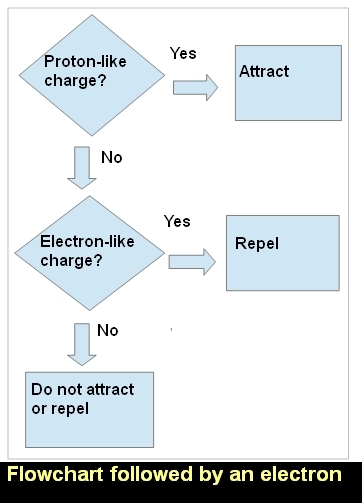
So the long-honored semantic convention of considering electrons as negative charges and protons as positive charges is not actually warranted by what we find in nature. But how can we accurately describe what is going on, without using this time-honored cheat? For starters, we can stop using the terms “negative” and “positive” in talking about charges, and simply use the term “proton-like charges” to refer to charges like that of the proton, and the term “electron-like charges” to refer to charges like that of the electron.

To describe what is going on in nature (without using Coulomb's cheat), we can use two flowcharts. Below is a flowchart that describes the rule followed by a proton in regard to how to react to some nearby particle.

Below is a flowchart that describes the rule followed by an electron in regard to how to react to some nearby particle.

flowchart

These flowcharts give us an accurate description of electromagnetism, without the unwarranted cheat of considering electrons as negative charges and protons as positive charges. But when you look at these flowcharts, you might have quite a realization. The realization is: nature is actually computing to determine whether there should be an attraction, a repulsion or neither between two particles. What is going on is not simply a law that can be expressed as an equation. What is going on is that nature is using an algorithm, a bit of programming, some “if/then” logic. Each one of those diamonds in the diagram represents a piece of “if/then” logic. Each line leading out of the diamond represents either an “if” or a “then” in some "if/then" logic.

This particular piece of “if/then” logic is actually fundamental to our existence, because if nature stopped performing this piece of code at any instant, the chemistry in our bodies would instantly be turned off, and we would all die within a few seconds.

The realization that electromagnetism is fundamentally algorithmic is not at all a trivial one. If nature has programming inside its very core – if it has "if/then" logic at the heart of one of its most fundamental forces – it is reasonable to assume that programming is controlling other key operations of nature, such as the development of large-scale order, the origin of life, and the origin of intelligence. Pondering this at length, it becomes all too reasonable to assume that since the time of the Big Bang, the universe has been progressing along a path that it was programmed to achieve from the very beginning.

So far I have justified the first part of this post's title, by explaining why electromagnetism is algorithmic. But what about my claim that electromagnetism is exquisitely balanced? I will justify that claim in the second part of this two-part post, and will explain two ways in which electromagnetism is as finely balanced as the Washington Monument would be if it were positioned upside down, and balanced on its top tip.