Header 1

Our future, our universe, and other weighty topics


Showing posts with label extrasolar planets. Show all posts

Tuesday, August 8, 2023

Astronomers Can Give Scrambled Reasoning About UFOs

At the link here you can read a full transcript of the recent US Congress hearing on UFOs or UAPs, which occurred on July 26, 2023. Some government committee or group is currently using the term UAP, previously defining that term as Unidentified Aerial Phenomena and then later more broadly defining it as Unidentified Anomalous Phenomena. The testimony last Wednesday had some very interesting quotes, and it is testimony that seems to deserve very serious follow-up investigation. But while the testimony included some riveting second-hand testimony (in which witnesses described amazing things they said other people told them they saw), the testimony was light on compelling first-hand testimony, and featured no photographic evidence. 

An astronomer named Adam Frank not long ago wrote an article for the New York Times with a title saying "U.F.O.s Don't Impress Me." Now Frank has written a response to the recent UFO testimony, one entitled "Here’s what a scientist makes of Congress’ UFO hearing." In the article Frank makes no mention of any of the more sensational quotes that came out of the hearing, which I quote in my previous post here.  We may wonder whether Frank carefully reviewed the full testimony given. What we should remember is that the vast majority of scientists writing articles about the paranormal (outside of scientific journals) have never bothered to seriously study what they are writing about. So, for example, if you read a scientist article in Scientific American mentioning ESP or out-of-body experiences or apparition sightings, there will be a 90% chance the article was written by someone who has never bothered to seriously study such topics. 

Frank's article starts out badly by giving us this quote which draws a conclusion that makes no sense:

"At their first press conference, held this summer, the team announced that only 6% of the many UAP cases they studied could not be explained. In other words, 94% of their UAP cases had earthly causes. This conclusion is consistent with other studies of this kind that have been done. So, it’s safe to say that the Earth is not suddenly awash in strange and unexplainable phenomena sailing through the skies. "

This reasoning is illogical. UAP means "Unidentified Aerial Phenomena" or "Unidentified Anomalous Phenomena." From a supposed estimate that only 6% of UAP reports are unexplained, we are not entitled to draw any conclusion at all about whether there are "strange and unexplainable phenomena sailing through the skies." On page 19 of the recent RAND Corporation report here, we read of "101,151  reported  UAP  sightings" in the United States between 1998 and 2022. So we may presume that the worldwide count of UFOs or UAP during that time was probably more than 500,000. Given so many UAP or UFO reports around the world, if 6% are unexplained that would still leave something like 30,000 sightings that could not be explained. 

Frank then gives us the very goofy suggestion that scientists should not pay attention to personal testimony.  He states this:

"While we could spend lots of time trying to figure out exactly what the pilots saw, I feel like that’s a dead end. Science cannot do much with personal testimonies. One problem, as every cop and psychologist will tell you, is that human memory is not a photographic record. Instead, it’s a reconstruction that can differ from the original event in many ways, no matter how earnest the reporters are. But what’s even more important, and as I describe more fully in the book, is that to really do science you need hard data collected through rational search strategies from instruments you fully understand."

This is a very silly thing for a scientist to say. Documenting, analyzing and classifying personal testimonies is one of the most important jobs of some types of scientists.  The fact that human memories are not photographs does not excuse a scientist from the responsibility of documenting, analyzing and classifying personal testimonies. Frank's appeal here to cops (policeman) and psychologists is laughable, because documenting, analyzing and classifying personal testimonies is one of the most important job responsibilities of policeman and psychologists. The idea that you can only do science using "instruments you fully understand" is nonsense. A very large fraction of scientific data is gathered by scientists recording things seen with their eyes and heard with their ears, knowledge not obtained by using instruments such as telescopes and microscopes. There are very many things scientists can do with personal testimonies:  publish them, summarize them, analyze them, classify them, corroborate them, quantify them, correlate them, index them, tag them, try to explain them, and ponder their consequences. 

Only an astronomer would make the claim that you can only do real science using instruments. Astronomers spend their lives staring through telescopes or coldly analyzing data coming from space telescopes, involving objects in distant space.  It's a great job for people who don't love dealing with other people. Anyone is entitled to such a career path if they want to pursue it, but we should heap scorn on such people if they ever try to evoke some "science is only done with instruments"  principle, which is every bit as false as the claim that medicine is only done with instruments such as scalpels and X-ray machines. 

bad science principle

The idea that some observation becomes more reliable when it occurs using metal instruments is not a sound one. The very introduction of such instruments often creates all kinds of additional possibilities for error, for maybe a scientist didn't use exactly the proper settings when using his fancy hi-tech instrument. For example, computerized telescopes have fancy interfaces for moving the telescope to an exact spot in the sky; and if you don't use such an interface just right, your telescope will end up pointing at the wrong little spot in the sky. And it is just as easy for scientists to commit very bad errors when using instruments as when using their unaided eyes. For example, nowadays we see a huge proliferation of poorly designed junk science fMRI bran scan studies producing mainly false alarms. All that junk science comes from scientists who used metal instruments. 

In his next paragraph Frank speaks in an equally illogical manner, making this claim:

"If my colleagues and I ever want to claim that we have detected signatures of life on alien planets light-years away, we will have to know everything about our instruments: how they respond to light when the telescope is at 40°F and how that response changes when the temperature goes up to 60°. The exact same type of knowledge is required to determine whether a UAP accelerated in ways that no human technology could reproduce. Personal testimony, onboard targeting cameras, and even military radars cannot do that."

No, any of these things would be sufficient to tell whether a UFO accelerated in ways that no human technology could reproduce, given sufficient speed of the UFO. Frank seems to be making here some strange assumption that makes no sense. Is he evoking a principle that you can't know how fast something is moving unless you use some technology and fully understand that technology? That principle makes no sense. Anyone standing on the edge of a highway can estimate fairly reliably how fast a car is moving. And the police officers who use radar guns to reliably determine the speed of speeding cars often  don't understand the details of their technology.  

Frank then states this:

"There is no reason, based on any existing science, to take these truly stunning claims seriously. I’m not changing this position until somebody ponies up some actual artifacts (which I will note are always promised to be coming but never show up). In other words, show me the spaceship."

This sounds like Frank is evoking a principle of "ignore the evidence for something until you have conclusive evidence for that thing."  Thankfully, scientists have never followed so senseless a rule, which would have prevented them from discovering most of the things they have discovered. The process of scientific discovery typically starts out with a scientist getting only weak signs or signals of something, what salesmen call "leads." If scientists follow up with years of additional diligent inquiry, they may end up getting proof of the thing or effect investigated.  "Don't pay attention until you have conclusive proof" is a rule that would cripple science. I may note that if you wanted an example of a group of scientists who do not follow such a rule, and spend entire careers investigating unproven things based on weak evidence, you could not find a better example than Frank's own group of scientists: astronomers. The modern astronomer spends a good  fraction of his time trying to prove the existence of dark matter and dark energy, mysterious things that have never been directly observed.  

We should also note the strangeness of Frank's claim "There is no reason, based on any existing science, to take these truly stunning claims seriously." Astronomers such as Frank frequently try to persuade us that extraterrestrial life exists, based on the large number of extrasolar planets that astronomers have discovered.  In fact, later in the article Frank says, "I know that the astronomical telescopes, technologies, and techniques coming online now mean we will soon be able to sniff out life in the atmospheres of alien worlds."  If we accept the claims that people such as Frank make, that would provide a very large reason, based on existing science, why one should take seriously claims of extraterrestrial visitors, and diligently investigate such claims. 

I may note that the claim by Frank just quoted is an untrue one. He certainly does not "know that the astronomical telescopes, technologies, and techniques coming online now mean we will soon be able to sniff out life in the atmospheres of alien worlds."  Even the simplest life is a state of organization so vast that we should never expect life to arise by chance chemical combinations even given billions of planets in each of billions of galaxies. The simplest self-reproducing cell requires something like 90,000 very well-arranged amino acids (consisting of a total of roughly a million very well-arranged atoms), and the chance of getting that from chance events is very much like the chance of typing monkeys producing a grammatical, well-written 300-page instruction book. It is possible that there is very much life in the universe, but only if some purposeful agency is at work to help produce such life.  If the origin-of-life dice are not "loaded" to overcome the prohibitive odds against natural abiogenesis,  it is improbable that life exists elsewhere in our galaxy, and improbable that life will be discovered on another planet anytime in this century. We have in the quote above a very good example of something that is constantly occurring: scientists claiming that they know things they do not at all know. 

Frank claims to "know that the astronomical telescopes, technologies, and techniques coming online now mean we will soon be able to sniff out life in the atmospheres of alien worlds." He's talking about things like the James Webb  Space Telescope. That telescope has already been operating for 20 months, and has not succeeded in sniffing out life or discovering life. There's no particular reason to be optimistic that it will be able to do in the near future what it failed to do in the first 20 months of its existence. 

Another astronomer who has given us scrambled reasoning about UFOs is astronomer Seth Shostak, who has spent decades heaping scorn on people who claim to see unidentified things in the sky.  It would be a rather pessimistic but at least an internally consistent position for someone to maintain (based on the extremely high organization and functional complexity of even the simplest living cell) that extraterrestrial life is extremely rare or nonexistent, and that we therefore should not expect to be getting visitors from other planets. That's not what's going on with Shostak. He is supremely optimistic about the number of extraterrestrial civilizations in our galaxy (maintaining "our galaxy should be teeming with civilizations"), but seems likes someone always heaping scorn on the idea that any such civilization might have recently visited our planet. 

Shostak's essays on this UFO topic always seems like hasty armchair reasoning rather than the work of a careful scholar of anomalous things in the sky. He gives the impression of someone who cannot be bothered to get his hands dirty by closely investigating individual observational cases.  In an article entitled "Aliens There But Not Here," Shostak gives some extremely bad armchair reasoning. First, he tries to insinuate that traveling between solar systems is too difficult. He tells us that having an interstellar rocket would require "100 million times as much energy as a NASA rocket." But that's no reason for skepticism, as an extraterrestrial civilization much older than ours could surely make rockets using that much energy.  Then he makes this ridiculous objection: "High velocity travel though space means bulldozing through the dust and gas that bathe our galaxy at a blistering pace, turning it into tiny bullets that will pierce the hull of any rocket and quickly dispatch the biology within." Galactic dust has only very sparse densities, and is concentrated in dust clouds, which could easily be avoided by an interstellar spacecraft. And even if traveling through dust so sparse, a technology vastly older than ours could easily deflect such dust, or simply build ships with hulls strong enough to not be damaged by it. Shostak very strangely seems to think that a hull of a starship built by extraterrestrials with godlike powers would not be strong enough to protect against "tiny bullets." He then tries to insinuate that imagining interstellar visitors requires postulating new physics, saying, "Presumably, extraterrestrial visitors have mastered something akin to warp drive or breaking into hyperspace."  No, it is well-known that there are relatively simple spacecraft construction techniques that would be capable of traveling between stars, such as building a multi-generation starship or building a starship populated by robots or creatures with very long lifespans or creatures extending their lifetimes by using hibernation techniques. Such possibilities do not require any "new physics" things such as warp drives or hyperspace travel. 

The next part of Shostak's article is equally fallacious. He attempts to insinuate that there's something implausible about us getting interstellar visitors now, because we didn't get them in the nineteenth century. That makes about as much sense as arguing, "He couldn't have traveled to Chicago in 2017, because he didn't go there in 2016."

Of course, there's a  perfectly good answer to such an objection, one that mentions how Earth has been leaking radio signals for many decades, that would have alerted nearby civilizations to our existence. Such signals have escaped Earth for about 75 years, meaning (allowing for a near-lightspeed travel) that stars within about about 37 light years might be more likely to be the home planets of interstellar visitors.  Shostak's answer to this objection is scrambled logic:

"The simple fact is that there are fewer than two thousand stars within thirty-seven light-years. It beggars belief to say that the cosmos is so densely packed with aliens that some are camped out so near to us. If you assume that there are between one and 100 million alien societies in our home galaxy now (an optimistic estimate), then the closest would be a few hundred lightyears’ distant. They won’t know about us."

Shostak's logic here is very bad. Making completely arbitrary estimates of the number of civilizations in our galaxy (estimates which have an uncertainty factor ranging from about 10,000 on the upside to about 100,000,000 on the downside), Shostak is arguing here that the galaxy must have just about as many extraterrestrial civilizations as he thinks, and not ten times more or 100 times more.  Given the very large uncertainties, such logic makes no sense even before we consider the issue of interstellar colonization. Once we consider that issue, we can see Shostak's logic as being worthless. Once one civilization arose in one solar system, there would be a good chance that it might spread around to many other solar systems, something that can be called interstellar colonization.  So if you estimated that intelligent life naturally arose on 100 million planets in our galaxy, and if you pay attention to the possibility of interstellar colonization, then you should think that there are now many billions of inhabited planets in our galaxy, because of the tendency of intelligent life to spread from one solar system to another. Once you get that estimate, then you get  extraterrestrial civilizations within 37 light-years of Earth. 

I mention these points merely to rebut Shostak's reasoning on this matter, not because there is any need why a believer in spaceships from other planets visiting today's Earth needs to defend the idea that an extraterrestrial civilization would exist within 37 light-years of Earth or 100 light-years of Earth. A civilization vastly more advanced than ours would be able to build multi-generation starships capable of traveling many hundreds or thousands of light-years, in voyages lasting very many generations. The very hard part is getting life on a planet, and then getting civilized intelligent life. Creating ships that can cross many light years (once you already have an interplanetary civilization) is child's play, relatively speaking.

It seems that when mainstream scientists other than parapsychologists write about the paranormal, they usually give us their laziest efforts, failing to be diligent in either scholarship or logic. It's as if their rule was: when writing about the paranormal, just "phone it in." An example of the lazy responses scientists have given to the US Congress UFO hearing is a tweet by physicist Brian Cox, in which he stated, "I watched a few clips and saw some people who seemed to believe stuff saying extraordinary things without presenting extraordinary evidence."  How very lazy, to scold people based on impressions got after you just "watched a few clips" rather than watching the entire hearing (easily available on youtube.com) or reading a full transcript of the testimony.  

Postscript: Seth Shostak has written another anti-UFO article. I guess he has time for this because nothing much is going on in his fruitless field of searching for radio signals from extraterrestrials. In the article Shostak gives us another example of defective astronomer reasoning on UFOs. He states this:

"There are thousands of satellites orbiting Earth. The majority sport cameras aimed downward. Actual alien craft in our airspace bigger than an office desk would likely be visible to satellites that — among other things — supply imagery to Google Earth. "

No, it is not true that the majority of satellites are satellites devoted to photographing the Earth. And there is no particular reason to think that a small UFO entering the atmosphere would have been picked up by some camera devoted to photographing Earth's surface. Google Earth photographs each little spot on our planet only very rarely. And some UFO picked up by a Google Earth photo would probably just be ignored.  

Then Shostak asks this: "And why is it that the aliens at least seem to invariably set their navigation hardware to visit America and not some other country that might not feel the need to keep these visitors under wraps?" He links to a map of UFO sightings that shows plenty of them in England, refuting his own insinuation. The UFO sightings map here shows very many UFO sightings in France and Spain, and the map here shows very many in Europe.  In his new article Shostak provides further evidence supporting my claim in this post that "when mainstream scientists other than parapsychologists write about the paranormal, they usually give us their laziest efforts, failing to be diligent in either scholarship or logic."

Saturday, August 2, 2014

Is Kepler-78b a Sign of Astronomical Engineering?

For decades astronomers have expected to one day find some sign of what is called astronomical engineering. Astronomical engineering is engineering on an astronomical scale, produced by a civilization. Astronomers have reasoned that since there are so many solar systems in our galaxy where life could evolve, we would expect that civilizations would have arisen on many planets, and that we would also expect to see evidence of large-scale activities by such civilizations. Such astronomical engineering projects might consist of a movement or manipulation of planets or asteroid belts, or the creation of huge artificial structures in space. One popular idea about astronomical engineering is that extraterrestrial civilizations might create a sphere around their sun to capture all its energy, a sphere known as a Dyson sphere.

Efforts to detect a Dyson sphere have come up short, but there may be a space discovery that offers possible evidence of astronomical engineering: the discovery of Kepler-78b, the “planet that shouldn't exist.”

Kepler-78b is a planet orbiting the star Kepler-78, a G-class star like the sun, located about 400 light-years away. The strangest thing about the planet is the location of its orbit. The planet orbits its star at a distance of about 900,000 miles, which is about the diameter of the sun and other G-class stars. This is an orbit which places the planet more than 30 times closer to its sun than the planet Mercury is to our sun. Scientists assume that the planet is some kind of lava world too hot for life to exist on it.

Scientists are baffled by how a planet of this size could exist in this orbit, and the Science Daily article on the discovery is entitled Lava World Baffles Astronomers: Planet Kepler-78b 'Shouldn't Exist.' The article says: “When this planetary system was forming, the young star was larger than it is now. As a result, the current orbit of Kepler-78b would have been inside the swollen star.” It then quotes astronomer Dimitar Sasselov as saying this about the planet: "It couldn't have formed in place because you can't form a planet inside a star. It couldn't have formed further out and migrated inward, because it would have migrated all the way into the star.” Sasselov therefore calls the planet “an abomination.”

But there is one way to explain this strange planet: by imagining that it is part of an astronomical engineering project started by a civilization living on some planet revolving around the sun-like star Kepler-78. Such a civilization may have moved the planet from a more distant orbit to its current orbit very close to the sun it orbits. The planet may have originally been a much larger planet (possibly a gas giant planet like Neptune or a frozen super-Earth several times larger than our planet). The planet may have been deliberately moved to the orbit close to its star, for the sake of stripping off its outer layers, and leaving behind an inner rocky metallic core. Such an astronomical engineering project may have been started for the sake of creating a gigantic mining target, a million-year source of metals and minerals to be exploited. Another possibility is that the astronomical engineering project may have been started with the goal of creating a new Earth-like habitable planet in the Kepler -78 solar system.

How to Move a Planet

Before considering such possibilities, we must ask: is it reasonable to imagine that an extraterrestrial civilization would be able to reposition planets in its solar system? Certainly when imagining such a civilization we should allow the possibility that they might have god-like powers of engineering. Such a civilization might be many thousands (or possibly even millions) of years more advanced than ours. Considering how much technical progress our civilization has made in the past hundred years, if we imagine an extraterrestrial civilization that mastered atomic power thousands of years ago, we should imagine that such a race would be able to do almost anything that is technically feasible.

When I wrote a blog post last year on this topic (entitled Is Mystery Planet Kepler-78b the Work of Intelligent Planet Movers?), I suggested the idea that a highly advanced civilization could move a planet in its solar system by causing asteroids to crash into the planet (and using asteroids as projectiles that might cause moons of a planet to crash into the planet). But it turns out there is a more sophisticated technique for moving planets. In 2001 three scientists wrote a scientific paper entitled Astronomical engineering: A strategy for modifying planetary orbits. The scientists describe how we could move our planet farther away from the sun by creating an accelerated mass stream that moves in a loop traveling between Earth and the planet Jupiter. The mass stream would consist of one or more asteroids or other massive objects. Jupiter would act as a gravitational slingshot to greatly accelerate the mass stream. The same technique could be used to move a planet closer to a sun. The accelerated mass stream would travel in a loop between the planet to be moved and the sun.

how to move a planet

As the highly accelerated asteroids pass by the planet, there is a transfer of angular momentum that causes the planet to be moved. Imagine if you are standing in a field and your friend runs towards you at high speed, looping around you before running away. If you grab your friend's coat edge as he is whizzing by, you will feel a little tug pulling you in one direction (and the faster your friend was moving, the greater the tug you would feel). Similarly, matter passing by a planet at high speed causes a little gravitational and angular momentum tug that can pull a planet in a particular direction. Given enough repetitions, sufficient speed, and sufficient mass in the matter passing by, this can be enough to gradually change the orbit of a planet.

So it seems that using techniques such as these scientists have described, an extraterrestrial civilization would definitely be able to move around planets in its own solar system. Changing a planet's orbit requires simple old Newtonian physics, not any far-out science fiction assumptions such as space warps or space-time wormholes. 
 
Why Move a Planet to an Orbit Very Close to a Sun?

But why would such a civilization want to move a planet very close to its sun? There are two possible motives:
  1. Kepler-78b might have been moved very close to its sun in order to heat up and “strip off” the outer layers of the planet, leaving behind a metallic rocky core that could be a mining target, a source of metals and minerals that might last for millions of years.
  2. Kepler-78b might have been moved very close to its sun in order to heat up and “strip off” the outer layers of the planet, leaving behind an Earth-sized metallic rocky core intended to be moved to another orbit in the habitable zone of the Kepler-78 solar system. This may be part of a massive astronomical engineering project to create a second habitable planet in this solar system.
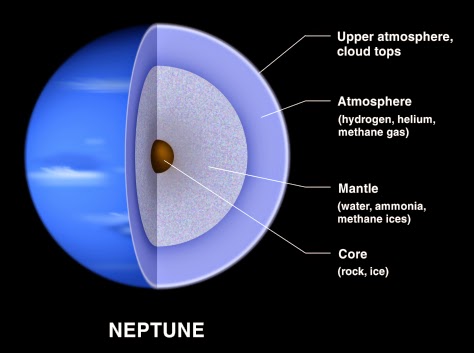
To explain both of these ideas, I must explain the idea of layer stripping. Planets such as Neptune, Jupiter, and Saturn are believed to be composed of different layers. For example, we see below a diagram showing the layers of Neptune. The outer layers are gases and frozen material. But the core is a rocky metallic core about the size of Earth. A similar diagram could be made of a frozen super-Earth planet with a mass five times greater than Earth, except that the proportions and element mixtures would be different.

layers of Neptune
Layers of Neptune (Credit: NASA)

Now what would happen if such a planet were to be moved very, very close to its sun, to the same distance that Kepler-78b is (a distance equal to about the diameter of the sun)? It would be like placing a big snowball with a rock at its center next to a big fire – the heat would strip off the outer layers, leaving only the rock remaining. All the gaseous and frozen layers of the planet would get so hot that they would steam off into space, like steam escaping from a boiling soup pan. What you would have left is a rocky metallic core about the size of the Earth – which exactly matches the description of Kepler-78b.

One possibility is that an extraterrestrial civilization will use Kepler-78b purely as a mining target, a source of metals and minerals. In such a case they might extract metals and minerals from the planet in its current orbit. Or they might later move the planet farther away, and then exploit its resources. It might be easier to mine the planet once it had been moved to a cooler location.

Another possibility is that extraterrestrials living in this solar system might later move Kepler 78b to an orbit in the habitable zone of their solar system, using the same simple technique they used to move the planet close to the sun. Their intention might be to create a new habitable planet in their solar system, a future home where they can live. They might have decided on such a massive astronomical engineering project after using up all the land and resources of their home planet, due to population growth.

Someone might object that Kepler-78b has been called a “lava world,” so such a planet would not be suitable as a future home for extraterrestrials living in the Kepler-78 solar system. But we're not actually sure that Kepler-78b is a lava world. There have been no measurements of the planet's temperature. The assumption that it is a lava world is based on the assumption that the planet has been in its current location for millions of years. But what if the planet had been moved to its location fairly recently, as part of an astronomical engineering project? In such a case it might not be a lava world. Imagine if the planet was in a particular stage of this “layer stripping” process when most of the gas and frozen layers had been stripped off, but there still remained a layer of ice a few miles thick. If such a planet were then moved to the habitable zone of the Kepler-78 solar system (the "Goldilocks zone" that is neither too hot nor too cold), it would be a rocky planet with oceans or seas, which could easily become habitable.

Gathering Support for These Ideas (Or Ruling Them Out)

Further scientific work may provide additional reasons for believing in these hypotheses, or such work may rule out these speculations. We do not know yet how many planets are in the Kepler-78 solar system. Kepler-78b is the only planet yet to be discovered there. But due to limitations in our planet detection techniques, it is perfectly possible that there is an undiscovered Earth-like planet in the habitable zone of this solar system. If such a planet were to be discovered (possibly by the forthcoming James Webb Space Telescope), it would make the ideas I have discussed seem more plausible (although it would not prove them true). If, on the other hand, astronomers were to conclude with high likelihood that there are no habitable planets in the Kepler-78 system, that would rule out the ideas discussed here.

There is also one way scientists might prove correct the ideas discussed here (or something close to them). We might point our radio telescopes to the Kepler-78 system, and listen for radio signals. If we were to detect such a radio signal, it would lend great credence to the ideas discussed here.

Friday, June 13, 2014

The 5 Most Inexplicable Planets

Scientists have learned more and more about planets by studying them with instruments such as the Kepler Space Telescope. But in five different cases they have found results that leave them baffled – planets that either shouldn't be there or shouldn't be the way they are. Below is a list of the five most head-scratching planetary mysteries.

Gliese 436 b

Gliese 436 b is a Neptune-sized planet orbiting a red dwarf star. The planet orbits so close to its star that the planet's temperature is estimated to be 439 degrees Centigrade. But scientists estimate that most of the planet is solid water – some kind of weird solid water that doesn't melt even at very high temperatures.

Scientists also say the planet has more carbon monoxide than it should have. The biggest mystery about the planet, however, is that it apparently has about 7000 times less methane than it should, according to models of planetary formation.

The Pisces Puzzler

GU Piscium b (also known as GU Psc b) is a planet that orbits its star at a distance of 2000 times the distance between the Earth and the Sun. By comparison, in our solar system the dwarf planet Pluto orbits at a distance of about 32 times the distance between the Earth and the Sun.

Scientists are baffled by how such a planet could have formed. The prevailing model of planetary formation holds that planets and a star form from a single disk of gas and dust. It's hard to imagine such a disk originally extending 2000 times the distance between the Earth and the Sun. The planet GU Piscium b takes about 163,000 years to orbit its star.

Kepler 10c

Kepler 10c is a recently discovered planet that has 2.3 times the Earth's radius, and about 17 times the Earth's mass. According to planetary formation models, a planet with that mass and radius should be a gaseous planet similar to Neptune. But scientists say that Kepler 10c is actually a rocky planet – a super-Earth bigger than the maximum size of a rocky planet, according to previous scientific estimates. Scientists had a previous notion of the “most massive super-Earth possible,” but Kepler 10c is a super-Earth much bigger than that.

Kepler 10C
  My guess about what it looks like on Kepler 10C

Scientists conclude that the solar system which Kepler 10c formed from is about 11 billion years old, only a few billion years younger than the universe. According to prevailing theories, there needed to be quite a few generations of stars before there could be enough heavy elements for rocky planets to form. So how could a rocky planet have formed so early? Scientist Dimitar Sasselov says, “Finding Kepler-10c tells us that rocky planets could form much earlier than we thought.” Could the universe have been on an accelerated development schedule, like some bright kid who skips a grade or two in school?

TrES-4

TrES-4 is a planet about 1.7 times the size of Jupiter. “TrES-4 is way bigger than it's supposed to be," says scientist Georgi Mandushev. "For its mass, it should be much smaller. It basically should be about the size of Jupiter and instead it's almost twice as big."

Kepler 78b

Kepler-78b is a planet orbiting the star Kepler 78, a G-class star like the sun, located about 400 light-years away. The strangest thing about the planet is the location of its orbit. The planet orbits its star at a distance of about 900,000 miles, which is about the diameter of the sun and other G-class stars. This is an orbit which places the planet more than 30 times closer to its sun than the planet Mercury is to our sun. The planet is so close to its star that it must be a kind of lava world too hot for life.

Scientists are baffled by how a planet of this size could exist in this orbit, and the Science Daily article on the discovery is entitled Lava World Baffles Astronomers: Planet Kepler-78b 'Shouldn't Exist.'  The article says: “When this planetary system was forming, the young star was larger than it is now. As a result, the current orbit of Kepler-78b would have been inside the swollen star.” It then quotes astronomer  Dimitar Sasselov as saying this about the planet: "It couldn't have formed in place because you can't form a planet inside a star. It couldn't have formed further out and migrated inward, because it would have migrated all the way into the star.”

Earth?

That's all for my list of the five most inexplicable planets, but perhaps I should add a sixth: our own planet Earth. For this is the planet where there has occurred two all-but-inexplicable things we have never witnessed on any other planet: the origin of life and the origin of advanced consciousness.

As discussed here, the origin of life seems nearly inexplicable because a very high degree of sophistication must be reached before any Darwinian biological evolution can begin. You apparently need a genetic code and self-replicating molecules before any biological evolution can occur, but how could those have appeared? Scientists are trying to create models of “chemical evolution” to bridge this gap, but it's not at all clear that the concept of evolution can be carried over in an adequate and meaningful way from the world of biology to the world of chemistry.

The origin of advanced consciousness seems nearly inexplicable because humans have so many subtle mental abilities that are hard to explain by evoking natural selection: things such as spirituality, aesthetic appreciation, language abilities, moral impulses, math abilities, philosophical abilities and so forth. Quite a few of these are abilities or traits that have no obvious benefit in allowing a human to survive until reproduction, and they therefore seem to be things that are very hard to account for under any explanation of natural selection in the “survival of the fittest” sense, as I discuss here. This does not suggest that evolution doesn't occur, but may suggest that it can't explain everything about the human mind.

We might say, therefore, that none of the astonishing things discovered on other planets is as astonishing as what we know has happened on our own planet.

My own view is that the known laws of nature and features of nature are probably inadequate to explain the appearance of life (and particularly intelligent life) on our planet, and that we may need to postulate the existence of additional undiscovered features of nature that could help account for such phenomena. See other posts on this blog (for example, this one) for my thoughts on this topic.

Friday, November 1, 2013

Is Mystery Planet Kepler-78B the Work of Intelligent Planet Movers?

Scientists just announced the discovery of the first extrasolar planet with a size and density very similar to our planet. The planet is Kepler-78b, orbiting the star Kepler 78, a G-class star like the sun, located about 400 light-years away.

The strangest thing about the planet is the location of its orbit. The planet orbits its star at a distance of about 900,000 miles, which is about the diameter of the sun and other G-class stars.  This is an orbit which places the planet more than 30 times closer to its sun than the planet Mercury is to our sun. The planet is so close to its star that it must be a kind of lava world too hot for life.


Depiction of Kepler-78b

Scientists are baffled by how a planet of this size could exist in this orbit, and the Science Daily article on the discovery is entitled Lava World Baffles Astronomers: Planet Kepler-78b 'Shouldn't Exist.'  The article says: “When this planetary system was forming, the young star was larger than it is now. As a result, the current orbit of Kepler-78b would have been inside the swollen star.”  It then quotes astronomer  Dimitar Sasselov as saying this about the planet:  "It couldn't have formed in place because you can't form a planet inside a star. It couldn't have formed further out and migrated inward, because it would have migrated all the way into the star.”

How, then, can we explain the orbit of the planet? Perhaps it is time for an audacious hypothesis.

The hypothesis I propose is this: Kepler-78b may be the result of intelligent extraterrestrial planet movers who deliberately moved the planet from a more distant orbit to its current orbit very close to the sun it orbits.  The planet may have originally been a much larger planet (possibly a gas giant planet). It may have been deliberately moved to the orbit close to its star, for the sake of stripping off its gaseous outer layers, and leaving behind an inner core of dense metals, metals needed by the civilization that moved the planet.  

Before explaining why this hypothesis may make sense, I need to first explain why the idea of an intelligent species moving around a planet in its solar system may be much less outrageous than it may seem at first.

Astronomers say that the universe is nearly 14 billion years old, but mankind is only a few million years old. Given that the age of the universe is several thousand times greater than the age of man, and that there are more than 1,000,000,000,000,000,000,000 stars that could support life-bearing planets, many astronomers suspect that intelligent life probably arose long, long ago on many planets. Some astronomers have looked for signs of gigantic engineering that might have been performed by civilizations millions of years more advanced than ours: projects such as the creation of a Dyson Sphere, a spherical structure that surrounds a star to capture as much of its energy as possible. 

In this context, the idea of a civilization with the power to move planets in its solar system does not seem too outrageous. Such godlike abilities are what we would expect to see in a technical civilizations many thousands or millions of years more advanced than ours.

Having looked at such a context, let us look at the hypothesis of a civilization moving a planet within its solar system, concentrating on two things: feasibility and motive. We will first look at whether a highly advanced civilization could possibly accomplish such a task, and then look at whether it would have a good motive for such a task.

The Feasibility of Moving A Planet


When looking at the idea of a civilization moving a planet in its solar system, you might first imagine the civilization attaching a giant rocket to a planet. Judging such a thing to be totally impractical, you might then dismiss the possibility of moving a planet. But there would be much easier ways for a civilization to go about moving a planet. One way would be for it to use other astronomical objects as projectiles to force a planet out of its orbit, into a different orbit.

Consider our solar system. We know that near Jupiter is an asteroid belt. We also know that Jupiter has dozens of moons, some of them a good fraction of the mass of the planet Mercury. In the distant future we might be able to accelerate asteroids, and use them as projectiles. Such projectiles could be launched towards Jupiter, to help nudge it out of its orbit. We could also launch projectiles towards the moons of Jupiter, causing them to crash into Jupiter, helping to nudge Jupiter out of its orbit.

The formula for kinetic energy is very simple:

Kinetic Energy = ½ * mass * (velocity * velocity)

This means that every time you double the velocity of a projectile, you are multiplying by four times its kinetic energy; and if you increase the velocity by ten times, you increase the kinetic energy by a hundred times. So if a super-advanced extraterrestrial civilization were to find some way of accelerating asteroids to a very high speed, the civilization might then have a very powerful way of rearranging the orbits of gas giant planets in its solar system. The mass of asteroids could be leveraged to move around moons orbiting a gas giant, causing them to crash into the gas giant; and the mass of those moons could then be leveraged to move around a gas giant itself.

The feasibility of re-positioning a gas giant would all depend on how fast the civilization was able to accelerate asteroids. Once the civilization developed a very fast way of accelerating asteroids, it would have the key to rearranging the orbit of a planet in its solar system. And there is every reason to think that a very advanced civilization would have the ability to accelerate asteroids to a high speed (ordinary nuclear rockets or matter/antimatter rockets would be sufficient, without any need for exotic physics).

It would seem, therefore, that a project of rearranging the orbital position of a gas giant planet within its solar system is something that should be feasible for a technical civilization many thousands of years more advanced than ours.

The Motive for Moving a Planet


But what about motive? Why would a super-advanced civilization want to move a gas giant close to its star? The motive might be simple: to acquire more metals that the civilization needed.

Consider the metal demands of a civilization thousands or million of years more advanced than ours. Such a culture might have an insatiable demand for metals. It might have already tapped out its planet for metals, and have already mined its asteroids for metals. Such a culture might need billions of tons more for any of a thousand possible projects, such as the building of more space colonies or the building of something like a Dyson Sphere.

Gas giant planets are believed to have dense metallic cores, as shown in the diagram below of the structure of Jupiter.


What would happen if an extraterrestrial civilization were to move a gas giant planet near its sun? Some of the “hot jupiter” planets located close to stars are called “puffy planets,” because their diameter is several times greater than Jupiter, even though they are only about the mass of Jupiter. Such planets have puffed-up, superextended atmospheres caused by all the solar heat they are receiving in their orbits close to a star.  If a gas giant was moved sufficiently close to a star,  the hot temperature would cause the planet to lose its gas atmosphere altogether. The gaseous outer parts of the planet would become so super-heated that the gases would diffuse away from the planet. What would be left would be a metallic core, which the civilization could then use as an endless supply of metal to meet its demands. The remaining planet in such an orbit would resemble Kepler-78b.
 
We therefore have a plausible motive for why an extraterrestrial civilization might wish to move a gas giant very close to its sun: to acquire a gigantic source of accessible metals, a source that would take millions of years to exhaust.

The hypothesis I have suggested here would be bolstered if we were to find an Earth-sized planet in the habitable zone of the solar system of Kepler 78b. If such a planet is never found, we will be able to exclude the hypothesis that there is an intelligent race in this solar system.  Until we know whether there are any habitable planets in this solar system, the hypothesis of a super-advanced race that has engaged in planet moving will remain a fascinating possibility to explain the strange orbit of Kepler-78b.

Postscript: Some scientists have concluded that moving planets is feasible, and the astrophysicist Neil deGrasse Tyson says he sees no reason why we can't start shifting planets around.  But the optimum technique would probably not be the rather crude technique I suggested of smashing asteroids or moons directly into a planet. There is a better technique described by this paper "How to Move a Planet," written by Paul Birch, and published in the Journal of the British Interplanetary Society. The technique involves what is called an accelerated mass stream, which would travel in an orbit between a planet's star and the planet itself, and make use of what is called a gravitational assist or gravitational slingshot to achieve greater acceleration.  The mass stream would pass near the planet, but not directly crash into it. Such a mass stream could slowly move the planet by means of a gradual transfer of angular momentum.

Friday, July 5, 2013

If You Had Been Born Elsewhere in the Universe

If You Had Been Born Elsewhere in the Universe

The universe is full of strange habitats very different from our familiar planet. Let us look at different habitats in the universe, and how life would be different for you if you had been born in one of these places.

If You Had Been Born on an Ice World

A planet revolving around a star can only support life if the planet has an orbit that is neither too close nor too far from the sun. Planets with such an orbit are said to exist in the habitable zone. Many planets must exist on the outer edges of the habitable zones of the stars they orbit. Many of these planets must be ice worlds – worlds that could have been like Earth if they had only been a little closer to their sun.

If you had been born on an ice world, your planet might have many large oceans, but the tops of every sea, ocean, and lake would be frozen solid. On your planet, people could not grow crops the way they do on Earth. Your planet would be too cold for that. How would you get food? You would presumably do that by ice fishing. Life for you and your family would revolve around fishing, and hunting other animals that ate fish. You would probably live rather like an Eskimo, perhaps living in a house like an igloo. So would every one else on your planet.

If You Had Been Born on an Ocean World

There is no reason why a planet within the habitable zone has to have a mixture of continents and oceans such as Earth has. Some planets must consist almost entirely of oceans, with only a few isolated islands.


water world


If you had been born on an ocean world, you might live on some tiny little island, and never leave that island for your whole life. If you ever wanted to travel somewhere else, you might have to go on a long sea voyage for hundreds of miles, before coming to some other tiny little island. You would probably never ride in a train or drive on a large highway. The civilized population of your planet might only be a few thousand people, or perhaps a few million people. Life on your planet would be much simpler than life on Earth.

If You Had Been Born on a Super Earth

Scientists are now using the term Super Earth to refer to a rocky planet a few times larger than our planet. Life can presumably exist on such planets when they are inside the habitable zone, but the gravity of a Super Earth would be much higher than on our planet.

If you had been born on a Super Earth, you would probably be much more careful about walking around than you now are. You would know that one good fall from a height as small as five meters would kill you. On your planet there would be no very tall buildings such as our planet has. You would probably have short legs much thicker than a human's legs, and your neck would probably be shorter and thicker. You might never go on a plane trip, because air travel might be extremely difficult and expensive on your planet. As the atmosphere on your planet would probably be quite thick, you would probably have just a tiny slit for a nose, which would be all that you needed.

If You Had Been Born on a Mini-Earth

A mini-Earth can be defined as a planet significantly smaller than Earth in the habitable zone of a star. Because it is easier to detect larger planets than smaller ones, the Kepler Space Telescope hasn't yet detected any habitable mini-Earth planets. But it is expected that such planets will be detected by the Kepler Space Telescope's successor.

If you had been born on a mini-Earth, you might have thin long legs. You would be able to jump much farther than a human being, perhaps as long as 30 meters. Your lungs and nose would probably be much bigger to help you breathe the rather thin atmosphere on your planet. It's quite possible that you could fly just by putting on some wing-like attachments to your arms. On your planet you would see trees grow to astonishing heights. Your civilization might be able to build buildings hundreds of stories tall.

If You Had Been Born on a Tidally Locked Planet

When a planet is tidally locked in relation to the sun, one side of the planet always points toward the sun which the planet revolves around. The other side of the planet always points away from that sun. Life could exist on such a planet, but it would be confined to a ringlike band between the hot side of the planet and the cold side of the planet. Scientists think that there are many tidally locked planets within habitable zones of stars, particularly red dwarf stars.

tidally locked planet


If you had been born on a tidally locked planet, the winds on your planet would probably be much greater than the winds on our planet. If you ever wanted to keep one of your possessions, you would never leave it in your back yard overnight, because by the time you woke up the object would probably have blown away, perhaps traveling for miles. There would be a good chance that everyone on your planet would live underground. There might be a huge network of tunnels that would allow people to travel for many miles underground. If you traveled more than a little way to the East or West, you would go to one of the parts of your planet that was too hot or too cold. So when people would travel on your planet, they might go on long trips to the North and South, but they would only go on short trips in a direction of East or West.


If You Had Been Born on an Arid World

Life requires water, but that does not mean that life can only exist on a planet with liquid water visible from space. In theory life and possibly even intelligent life could evolve on a very arid world, as long as there was underground water or oases scattered around here and there.

If you had been born on an arid world, your language might have no word meaning boat or ship or ocean or river. You might have extra bodily organs allowing you to store a gallon or more of water, so you could live weeks without drinking any. You would regard a small garden stretching ten meters long as the most extravagant type of paradise, suitable only for a king. Your people might fight battles or wars over water. When one of your fellow citizens died, your people might use some extraction process to squeeze out every drop of water from the body, and would then bury only dust and bones.


If You Had Been Born on a Moon Revolving Around a Gas Giant

We should not at all assume that intelligent life exists only on planets. We know that Jupiter has a moon named Ganymede that is larger than the planet Mercury, and Saturn has a moon named Titan that is also larger than Mercury. It is likely that many stars have gas giant planets within their habitable zone, and a certain fraction of these should have moons that are large enough to support civilized life. 


habitable moon of gas giant

If you had been born on a moon revolving around a gas giant in the habitable zone, the moon would probably be tidally locked with the gas giant. So there would be a 50% chance that you would see a glorious sight in your sky: an object that looked perhaps 10 or 15 times larger than the moon looks in our sky. This object would probably always appear in the same part of the sky, but it would have phases like the phases of our moon. The reflected sunlight from this planet would be so great that you might not see any stars in your sky, or only a few. If, on the other hand, you had been born on the other side of your moon, you would never see any planet in your sky, and you would see plenty of stars in your sky. You might hear tales of how people on the other side of your moon world could see a giant planet filling a good fraction of their sky. You might not believe such tales, thinking them too fantastic. Or perhaps you would spend lots of money to travel to the other side of your moon world, so you could see this glorious sight, as a once-in-a-lifetime treat.

Tuesday, June 25, 2013

Can Nearby Aliens See a Triple Sunset?

Can Nearby Aliens View a Triple Sunset?

On Saturday I put up on this blog a post entitled “Where is the Most Beautiful View in the Universe?” I imagined nine types of views that can be considered candidates for the most beautiful view in the universe. One of the nine types was: The View From a Planet Orbiting a Binary Star. I depicted a planet where one could view a double sunset. But the universe has a way of surpassing our wildest imaginings. Today it was announced by scientists that in a nearby star system there are 3 “super Earth” planets in the habitable zone where someone might be able to view not just a double sunset, but a triple sunset.

The star is Gliese 667C, which is only 22 light years away, pretty much in the back yard of our sun (the nearest star is a little less than 5 light years away). Astronomers have discovered three “super Earth” planets in the habitable zone of this star. The habitable zone is the region of a solar system that is neither too hot for liquid water to exist, nor too cold for liquid water to exist. Each of the planets is a few times larger than the Earth, and life and water might exist on any one of them.

This star Gliese 667C is actually part of a triple star system, the other two stars being Gliese 667B and Gliese 667A. The three stars rotate around each other, but the three super-Earth planets of Gliese 667C revolve around just that star, rather than the whole triple system of stars.

Since the three super-Earth planets of Gliese 667C are in the habitable zone, and are not too large to preclude the existence of life, there seems a quite real chance that life may have evolved on one of the planets. An observer on such a planet would apparently have the incredible spectacle of being able to see a triple sunset – a sunset involving not one sun, but three suns.

Today's news story came up with an artist's depiction of the view from a planet of Gliese 667C, showing three suns in the triple star system. However, I doubt whether the artist got things rights. The artwork shows three whitish yellow suns. But Gliese 667C is a red dwarf star, and Gliese 667A and Gliese 667B are K class stars, which means they should have an orange color.

Below is my own depiction of the view from one of the super-Earth planets revolving around Gliese 667C, and I think this depiction has the correct color scheme. I imagine life existing on the planet, which is consistent with what we know about the three super-Earth planets being in the habitable zone. I also imagine that from one of the super-Earth planets you would be able to see one of the other super-Earth planets, and see just a tiny bit of its features. This is rather plausible given what we know, that these three planets larger than Earth are fairly close to each other.

So we have a new candidate for a type of view that would be one of the most beautiful in the universe.


exotic sunset

Thursday, June 6, 2013

12 Reasons Why Fermi's Paradox Does Not Show We Are Alone

12 Reasons Why Fermi's Paradox Does Not Show We Are Alone The prima facie case for intelligent life on other planets seems very strong, as we live in a galaxy of more than 100 billion stars,  and in a universe consisting of billions of galaxies; and we now know (thanks to the Kepler Space Telescope) that planets of all sizes are very abundant. But there is one thing  used by those who don't want to believe in extraterrestrial intelligence: Fermi's Paradox. Fermi's Paradox is the paradox that despite the huge number of stars and planets in the universe, we have no observations of intelligent life outside of our planet. This paradox is sometimes evoked by simply asking: where is everybody?  Fermi's Paradox has often been used by people who wish to believe that extraterrestrial life is rare or nonexistent. Such people make arguments such as this: if extraterrestrial intelligence existed, it would have arisen long, long ago, and would already have come to our planet, leaving many traces of its existence.  A similar argument goes along these lines: if an extraterrestrial civilizations existed, we would have seen some evidence of it in outer space, or would have received radio signals from it.


City on an alien planet. Art by M. Mahin.


I will now give some reasons why Fermi's Paradox is not a valid argument against the abundant existence of intelligent life in our galaxy and other galaxies.

 (1)    Interstellar travel is in all likelihood very, very slow.  While science fiction stories talk about spaceships whizzing around quickly through the galaxy, they are indulging in wishful thinking. Einstein's Special Theory of Relativity tells us that the speed of light is an absolute speed limit to the universe.  The average distance between stars in our galaxy is roughly the same as the distance to the nearest star, about five light years. This means a starship could not travel from one star to another in less than about five years. In fact, there are practical engineering reasons for suspecting that it would typically take decades to travel from one star to the nearest star. One of these reasons has to do with the difficulty of accumulating enough fuel to last for an entire interstellar voyage, and another reason pertains to the need to start decelerating long, long before reaching a star you are traveling to, to avoid overshooting it.  There is currently no evidence that anything like space warps can be used for quick interstellar travel (although one cannot rule out such a possibility).  The slowness of interstellar travel means that even if civilizations arose long ago in many different places in our galaxy, it is not at all evident that spaceships from such civilizations (or colonies arising from them) would have reached our planet by now.
 (2)    If extraterrestrials had previously reached Earth, there is a large chance they would have been unable to colonize it because it was biologically or physically unsuitable for them. The “if they existed, they would be here already” argument is undermined by the fact that there is a large chance that colonizers from another planet might come to a planet like Earth and decide not to colonize it (or fail at colonizing it) because it wasn't what they were hoping to find.  The arriving extraterrestrials might have been spindly thin-legged organisms adapted to live on  a planet with a gravity much lower than ours. Or they might have been organisms used to living on a planet with a gravity much greater than ours. Or they might have been organisms adapted to live on a planet much hotter or much colder than ours. Or they might have required a planet with a different composition of atmospheric gases than our planet has. Or there could have been some biochemical reason or biological reason why they couldn't live here. Perhaps their chemistry wasn't compatible with our soil, or perhaps common microbes on our planet were lethal to them. There are any number of reasons why a colonization mission from another planet to Earth might have failed without establishing a long-lasting colony, and there are also any number of reasons why colonizers from another planet might choose to head for another planet after reaching here and investigating Earth's conditions.
 (3)    The current non-existence of an extraterrestrial colony on Earth does not rule out that there might have been such a colony in the past, possibly existing for a very long time. We have no experience at all with any civilization lasting longer than a few thousand years. Nothing that we know about the development of advanced technology should convince us that if an extraterrestrial colony had been established it would be able to survive for millions of years. We also know that Earth is a geologically dynamic planet, and that things that existed on the planet long ago became buried or destroyed by geological processes. For all we know an extraterrestrial colony could have been created in the past, and existed for a long time. It could then have passed away and been covered up by geological processes, like those that buried so many layers under the Grand Canyon. So we cannot at all say that we have never been colonized in the past.
 (4)    Extraterrestrial civilizations would be more likely to concentrate on using radio and television signals to find out about other planets, rather than the infinitely more difficult route of interstellar travel.  Imagine you are in charge of an advanced extraterrestrial civilization. You can probably get all kinds of information about other planets (probably including images and video) if you build yourself a really good set of radio antennae vastly better than anything we now have. Or you can build starships to try and get the same information. The first technique is 10,000 times cheaper and may give you results this year. The second technique is infinitely more expensive, and probably won't give you knowledge until many decades in the future (given the slowness of interstellar travel). Which are you more likely to concentrate on? Presumably it would be radio communication. This may help to explain why we don't get many interstellar visitors, and may not have gotten any.
 (5)    Super-intelligent extraterrestrials might not have any of the “lust for control” that might fuel a drive for interstellar colonization.  We have no idea what type of mental attitudes extraterrestrials would have. Human beings have repeatedly shown a kind of “lust for control” that may drive imperialistic expansion. We may want to get as many countries as possible under our control, and we may get a thrill out of planting our flag on places such as the moon. But to  super-intelligent extraterrestrials vastly smarter than us, such impulses may seem utterly childish.  For every extraterrestrial civilization that sends out colony ships in all directions, there may be 100 that do not, because they see little benefit in creating distant outposts, given the slowness of interstellar communication. We may be projecting on our superiors a “lust for control” drive of our own they are unlikely to have (just as a 2-year old boy might try to imagine what his father does at work, and imagines him playing with stuffed animals all day, just like the 2-year old boy).
 (6)    As interstellar colonies could not really be controlled from another star (and can only be communicated with after a delay of many years),  other planets would have little incentive to create colonies outside of their solar system.  According to the laws of physics as we currently understand them, traveling faster than the speed of light is impossible. So the idea of a galactic emperor issuing commands that are quickly obeyed over many light years is not realistic.  Once a colonization mission left for some other star, it would be the master of its destiny, and it would be beyond the practical control of the planet that launched it. So what incentive would that planet have for creating such colonies? Would it be worthwhile for the sake of getting transmissions from a colony established on a distant world? But it would be much cheaper just to build radio antennae and listen to radio signals from all over the galaxy.
 (7)    Colonization missions by extraterrestrial civilizations could commonly be wiped out when they encounter defensive technology.  Those who use Fermi's Paradox to argue that man is unique commonly speak as if some extraterrestrial civilization could send colony ships out and colonize countless other planets without difficulty, like a mailman dumping letters in a hundred mail boxes. But it could be that many extraterrestrial civilizations employ defensive technology in their solar systems, designed to destroy any incoming visiting spacecraft capable of colonization. If that happens, then any attempt by one planet to colonize many other planets would be a risky undertaking, facing a much larger chance of eventual failure before it gets very far. 
 (8)     We might currently be receiving visitors from other planets.  I refer here to the possibility that one or more UFO sightings here on Earth may actually be caused by extraterrestrial spacecraft. Now, of course, one can argue that there is no conclusive proof for that; and I would agree. But the mere fact that there are frequent UFO sightings (many of them strange and hard to explain) weakens any argument (based on Fermi's Paradox) that we are alone in the galaxy. It means the first premise of such an argument (the premise that “they are not here”) is not even beyond dispute.
 (9)      We may already have received one radio signal from an extraterrestrial civilization.  I refer here to the famous “Wow signal” of 1977.  See http://news.discovery.com/space/alien-life-exoplanets/the-wow-signal-130524.htm for a good recent explanation. The signal was exactly the type of signal astronomers expected to get from an extraterrestrial transmission. The fact that we are not sure the signal was artificial does not change the fact that it weakens the first premise of any argument (based on Fermi's Paradox) saying “since we have no sign of them, they don't exist.”
 (10)    Extraterrestrials may communicate through some advanced technology more advanced than radio waves.  Other than the possible success listed above (the “Wow signal”), our attempts to pick up radio signals from extraterrestrials have not succeeded.  But that may be because extraterrestrials commonly communicate through some technique more advanced than radio transmissions. There are all kinds of possibilities including laser communication and “subspace” communication. So our failure to pick up signals from them may simply mean we're not trying the right technique.
 (11)    Since intergalactic travel is presumably impossible, we have no reason for not assuming that most spiral galaxies have at least one civilization.  Our galaxy of more than 100 billion stars is a spiral galaxy, and there are billions of spiral galaxies. But the distance between spiral galaxies is about 100,000 times greater than the incredibly vast distance between stars. The distance between galaxies is so great that we should assume intergalactic travel is basically impossible. Traveling between two spiral galaxies would require a journey on the order of a million years, making it unlikely that any civilization (no matter how advanced) could achieve it. Therefore any type of “if they existed, they would be here already” reasoning totally falls apart when we consider civilizations in other galaxies. No,  no matter how old they might be, if they existed in another galaxy they would not at all be here, no matter how eager they might be to get here.  There is no reason to think that any civilization, no matter how old, could achieve a million year journey between galaxies.
 (12)    The extraterrestrials may not be here because they have so many other places to go (real or virtual), and so many other things to do.  Let us imagine a colony of ants in a forest using reasoning similar to arguments based on Fermi's Paradox.  They might argue like this: “If there existed any beings in the world greater than we ants, they would be here already. They would be here at our anthill, trying to control or investigate us. But we see no such creatures. Therefore we ants are the most advanced creatures in the world.” The argument is a fallacy because we humans exist, but we don't go into the forest and peer into the anthill of these ants, because we have a vast number of other more important places to go to, and have a vast number of other more important activities to busy ourselves with. The same thing may be true of extraterrestrials: they may have limitless virtual computer-generated worlds to play in, and a billion places in our galaxy to travel to (not to mention billions of unimaginable and unfathomable activities far more worthy of their time than colonizing our planet). Their non-presence here now proves nothing. 


 These reasons are enough to rebut the most general form of an argument for man's uniqueness based on Fermi's Paradox. There is a very specific (and more elaborate) version of such an argument, built around the possibility of self-reproducing robotic von Neumann probes spreading exponentially throughout the galaxy. I will rebut that argument in a later post to this blog.  My rebuttal will be based on reasons such as these: (1) self-replicating von Neumann probes are an example of runaway, cancerous technology that we would not expect extraterrestrials more intelligent than us to build; (2) if such technology had entered the solar system in the past, it is as likely as not that it would not have left any signs we could now detect; (3) rather than letting such planet-altering probes run amok uninhibited throughout the galaxy, civilizations on other planet would be expected to release counter-technology designed to find and destroy such self-reproducing probes.