Header 1

Our future, our universe, and other weighty topics


Showing posts with label tininess of human knowledge. Show all posts

Sunday, February 23, 2025

Problems a Hundred Miles Over Our Heads

While scientists often boast about how much they know, the truth is that human knowledge is merely fragmentary. The English expression "over your head" means something that is beyond your understanding. There are very many fundamental problems that are a hundred miles over the heads of today's scientists. The diagram below illustrates the situation.

problems scientists have not solved

Let me explain the diagram by explaining why each of the listed problems is many miles over the heads of today's scientists. 

The problem of explaining minds, memory and psychical phenomena. The first cloud in the diagram mentions the mountain-sized problem of explaining human minds and human memory. The problem is gigantic and very much over the heads of today's scientists, both because of the huge variety of human mental experiences and human mental capabilities, and because of the many brain physical shortfalls that exclude the brain as a credible explanation for most such capabilities and experiences. 

boasting scientist
A scientist trying to play "fake it until you make it" 

Morphogenesis problems (super-hard because of DNA limitations).  If someone defines a fertilized human egg as a human being, a definition that is very debatable, you might be able to say, "I understand the physical origin of a human being," and merely refer to a sperm uniting with an egg cell as such an origin.  But a more challenging question is whether anyone understands the physical origin of an adult human being. The physical structure of an adult human being is a state of organization many millions of times more complex than a mere fertilized speck-sized egg cell.  (A human egg cell is about a tenth of a millimeter in length, but a human body occupies a volume of about 75 million cubic millimeters.) So you don't explain the physical origin of an adult human being by merely referring to the fertilization of an egg cell during or after sexual intercourse. 

We cannot explain the origin of an adult human body by merely using words such as "development" or "growth." Trying to explain the origin of an adult human body by merely mentioning a starting cell and mentioning "growth" or "development" is as vacuous as trying to explain the mysterious appearance of a building by saying that it appeared through "origination" or "construction."  If we were to find some mysterious huge building on Mars, a state of great organization, we would hardly be explaining it by merely saying that it arose from "origination" or by saying that it appeared through "construction." When a person tries to explain the origin of a human body by merely mentioning "growth" or "development" or "morphogenesis," he is giving as empty an explanation as someone who tells you he knows how World War II started, because he knows that it was caused by "historical events."

There is a more specific account often told to try to explain the origin of an adult human body. The account goes something like this:

"Every cell contains a DNA molecule that is a blueprint for constructing a human, all the information that is needed. So what happens is that inside the body of a mother, this DNA plan for a human body is read, and the body of a baby is gradually constructed. It's kind of like a construction crew working from a blueprint to make a building."

The problem with this account is that while it has been told very many times, the story is just plain false, as many scientists have confessed. There is no such blueprint for a human being in human DNA. We know exactly what is in human DNA. It is merely low-level chemical information such as the sequence of amino acids that make up polypeptide chains that are the starting points of protein molecules. DNA does not specify anatomy. DNA is not a blueprint for making a human. DNA is not a recipe for making a human. DNA is not a program or algorithm for making a human. 

Not only does DNA not specify how to make a human, DNA does not even specify how to make any organ or appendage or cell of a human. There are more than 200 types of cells in human beings, each an incredibly organized thing (cells are so complex they are sometimes compared to factories or cities).  DNA does not specify how to make any of these hundreds of types of cells. Cells are built from many types of smaller structural units called organelles. DNA does not even specify how to make such low-level organelles. 

The chart below diagrams the hierarchical organization of the human body, and what part of that organization is explained by DNA:

pyramid of organization in a human body

Partially because so few of these layers are explained by DNA or its genes, the problem of explaining morphogenesis (the formation of a full human body) is a problem very far over the heads of scientists. 

Problem of explaining vast levels of biological organization. Below are some categories of innovations. These categories are not mutually exclusive.


Name

Description

Example(s)

Type A Innovation

Innovation requires all of its parts to have any functional benefit

Mousetrap, probably some biological units

Type B Innovation

Innovation requires almost all of its parts before any functional benefit

Jet aircraft, many protein molecules. Suspension bridge. Television, digital computer.

Type C Innovation

Innovation requires most of its parts before any benefit

Cells, most protein molecules, an automobile (which doesn't need its roof, doors or seats or car hood or bumper to be functional), electric fan (which gives some benefit even if the cage and stand are missing), cardiovascular system

Type D Innovation

Innovation requires a series of sub-components, each of which is useless until mostly completed.

Office tower. Each floor provides a benefit. But the construction of each floor requires many new parts, and no floor is useful until mainly completed. Also porcupine barbs (each barb is useful).

Type E innovation

Innovation may have some use in a relatively simple fractional form, but then requires many more parts organized in the right way to achieve a higher level of usefulness

Vision systems (?)

Type F innovation

Innovation requires an arrangement of several complex parts before becoming useful, with at least 25% of its part existing and well-arranged until functionality is achieved


Type G innovation

As each small simple part of the innovation is added, usefulness is slightly increased

Roof insulation, but almost nothing in the world of biology.

Darwinism may be able to explain some Type G innovations. But most of the impressive innovations in biology seem to be Type B innovations or Type C innovations. Innovations of that type are not credibly explained by any of the ideas of Darwinism, including the idea of so-called natural selection. Some of the reasons why Darwinism and gradualism are not credible explanations for most of the more complex innovations in natural history and biology are explained in my post "Anatomically Uninformative DNA, Nonfunctional Intermediates and Useless Early Stages Are Why Gradualism Does Not Work" which you can read here. 

Part of the reason why biological systems are beyond the explanation of scientists is the very great interdependence of the components of such systems, illustrated by the diagrams below:

complex biological system


interdependence of biological components

Origin of life problem. Everything we have learned about the very great organization and complexity of even the simplest living things suggests that the natural origin of life should be impossible, and should be as unlikely as a thrown deck of cards accidentally forming into a house of cards consisting of 52 cards. The concept of abiogenesis (that life can naturally arise from non-life) is a concept with zero observational and experimental support. Scientists have had no luck in trying to create a living thing in experiments simulating the early Earth, and have failed to create even a single protein molecule in such experiments. Below are some relevant quotes by scientists:

  • "The transformation of an ensemble of appropriately chosen biological monomers (e.g. amino acids, nucleotides) into a primitive living cell capable of further evolution appears to require overcoming an information hurdle of superastronomical proportions (Appendix A), an event that could not have happened within the time frame of the Earth except, we believe, as a miracle (Hoyle and Wickramasinghe, 1981, 1982, 2000). All laboratory experiments attempting to simulate such an event have so far led to dismal failure (Deamer, 2011; Walker and Wickramasinghe, 2015)." -- "Cause of Cambrian Explosion - Terrestrial or Cosmic?," a paper by 21 scientists,  2018. 
  • "Biochemistry's orthodox account of how life emerged from a primordial soup of such chemicals lacks experimental support and is invalid because, among other reasons, there is an overwhelming statistical improbability that random reactions in an aqueous solution could have produced self-replicating RNA molecules."  John Hands MD, "Cosmo Sapiens: Human Evolution From the Origin of the Universe," page 411. 
  • "The ongoing insistence on defending scientific orthodoxies on these matters, even against a formidable tide of contrary evidence, has turned out to be no less repressive than the discarded superstitions in earlier times. For instance, although all attempts to demonstrate spontaneous generation in the laboratory have led to failure for over half a century, strident assertions of its necessary operation against the most incredible odds continue to dominate the literature." -- 3 scientists (link).
  • "The interconnected nature of DNA, RNA, and proteins means that it could not have sprung up ab initio from the primordial ooze, because if only one component is missing then the whole system falls apart – a three-legged table with one missing cannot stand." -- "The Improbable Origins of Life on Earth" by astronomer Paul Sutter. 
  • "Even the simplest of these substances [proteins} represent extremely complex compounds, containing many thousands of atoms of carbon, hydrogen, oxygen, and nitrogen arranged in absolutely definite patterns, which are specific for each separate substance. To the student of protein structure the spontaneous formation of such an atomic arrangement in the protein molecule would seem as improbable as would the accidental origin of the text of Virgil's 'Aeneid'  from scattered letter type." -- Chemist A. I. Oparin, "The Origin of Life," pages 132-133.

Matter-antimatter asymmetry problem. Let us imagine the early minutes of the Big Bang about 13 billion years ago, when the density of the universe was incredibly great. At that time the universe should have consisted of energy, matter and antimatter. The energy should have been in the form of very high energy photons that were frequently colliding with each other. All such collisions should have produced equal amounts of matter and antimatter. For example, a collision of high energy particles with sufficient energy creates a matter proton and an antimatter particle called an antiproton. So the amount of antimatter shortly after the Big Bang should have been exactly the same as the amount of matter. As a CERN page on this topic says, "The Big Bang should have created equal amounts of matter and antimatter in the early universe." But whenever a matter particle touched an antimatter particle, both would have been converted into photons. The eventual result should have been a universe consisting either of nothing but photons, or some matter but an equal amount of antimatter. But only trace amounts of antimatter are observed in the universe. A universe with equal amounts of matter and antimatter would have been uninhabitable, because of the vast amount of lethal energy released when even a tiny bit of matter comes in contact with a tiny bit of antimatter.

Below are some relevant quotations by scientists or scientist organizations:

  • "One cannot ignore the deep, unanswered question concerning the origin of the baryonic component because baryons and antibaryons should have annihilated almost completely, leaving only a negligible abundance today. Yet we observe a far greater concentration than the standard model of particle physics  and the first and second laws of thermodynamics should have permitted. So where did baryons come from?"  Astronomer Fulvio Melia, "A Candid Assessment of Standard Cosmology," 2022.
  • "We believe the big bang produced the same amounts of matter and antimatter. These should have annihilated each other, leaving a universe made of electromagnetic radiation and not much else.” -- Professor Stefan Ulmer, a scientist at CERN (link). 
  • "The Big Bang should have created equal amounts of matter and antimatter in the early universe. But today, everything we see from the smallest life forms on Earth to the largest stellar objects is made almost entirely of matter. Comparatively, there is not much antimatter to be found." -- "The matter-antimatter asymmetry problem," a page on the CERN web site describing the European Organization for Nuclear Research projects (link).
The matter/antimatter asymmetry problem is one scientists have made no progress in solving. It seems to be a problem a hundred miles over their heads. 

matter/antimatter asymmetry problem

Problem of explaining the origin of universe. Scientists have no testable theory as to what caused the origin of the universe in the Big Bang. Every attempt that has been made to suggest a natural explanation for the Big Bang has been the thinnest speculation. The problem of what caused the Big Bang is a hundred miles over the heads of scientists. 

Cosmic fine-tuning problem.  Life is possible in our universe because of many seemingly fine-tuned features and fundamental constants. All attempts to naturally explain such fine-tuning have failed.  In particular:
  • Faced with an undesired case of very strong fine-tuning involving the Higgs boson or Higgs field, scientists wrote more than 1000 papers speculating about a theory called supersymmetry which tries to explain away this fine-tuning; but the theory has failed all experimental tests at the Large Hadron Collider.  

  • Faced with an undesired result that the universe's expansion rate at the time of the Big Bang was apparently fine-tuned to more than 1 part in 1,000,000,000,000,000,000,000, scientists wrote more than a thousand speculative “cosmic inflation” cosmology papers trying to explain away this thing they didn't want to believe in, by imagining a never-observed earliest instant in which the universe expanded at an exponential rate. But the "cosmic inflation" theories are unverifiable. Because of the density of the earliest years of the universe, we can never observe the first thousand years of the universe's history. The main prediction of these "cosmic inflation" theories has been that there would be observed something called primordial b-modes. Gigantic sums have been spent looking for these primordial b-modes, but all attempts have failed. 

  • Scientists tried to explain away cosmic fine-tuning by speculating about a multiverse, an imagined infinity or near-infinity of universes. All such speculations do nothing to explain cosmic fine-tuning, for reasons I explain in my posts here and here. 

Below are some relevant quotations by scientists:

  • "We conclude that a change of more than 0.5 % in the strength of the strong interaction or more than 4 % change in the strength of the Coulomb force would destroy either nearly all C [carbon] or all O [oxygen] in every star. This implies that irrespective of stellar evolution the contribution of each star to the abundance of C or O in the ISM would be negligible. Therefore, for the above cases the creation of carbon-based life in our universe would be strongly disfavoured." -- Oberhummer, Csot, and Schlattl, "Stellar Production Rates of Carbon and Its Abundance in the Universe."
  • "The cosmological constant must be tuned to 120 decimal places and there are also many mysterious ‘coincidences’ involving the physical constants that appear to be necessary for life, or any form of information processing, to exist....Fred Hoyle first pointed out, the beryllium would decay before interacting with another alpha particle were it not for the existence of a remarkably finely-tuned resonance in this interaction. Heinz Oberhummer has studied this resonance in detail and showed how the amount of oxygen and carbon produced in red giant stars varies with the strength and range of the nucleon interactions. His work indicates that these must be tuned to at least 0.5% if one is to produce both these elements to the extent required for life."  -- Physicists B.J. Carr and M.J. Rees, "Fine-Tuning in Living Systems." 
  • "The Standard Model [of physics] is regarded as a highly 'unnatural' theory. Aside from having a large number of different particles and forces, many of which seem surplus to requirement, it is also very precariously balanced. If you change any of the 20+ numbers that have to be put into the theory even a little, you rapidly find yourself living in a universe without atoms. This spooky fine-tuning worries many physicists, leaving the universe looking as though it has been set up in just the right way for life to exist." -- Harry Cliff, particle physicist, in a Scientific American article.
  • "If the parameters defining the physics of our universe departed from their present values, the observed rich structure and complexity would not be supported....Thirty-one such dimensionless parameters were identified that specify our universe. Fine-tuning refers to the observation that if any of these numbers took a slightly different value, the qualitative features of our universe would change dramatically. Our large, long-lived universe with a hierarchy of complexity from the sub-atomic to the galactic is the result of particular values of these parameters." -- Jeffrey M. Shainline, physicist (link). 
  • "The overall result is that, because multiverse hypotheses do not predict the fine-tuning for this universe any better than a single universe hypothesis, the multiverse hypotheses fail as explanations for cosmic fine-tuning. Conversely, the fine-tuning data does not support the multiverse hypotheses." -- physicist V. Palonen, "Bayesian considerations on the multiverse explanation of cosmic fine-tuning."
  • "A mere 1 percent offset between the charge of the electron and that of the proton would lead to a catastrophic repulsion....My entire body would dissolve in a massive explosion...The very Earth itself, the planet as a whole, would crack open and fly apart in an annihilating explosion...This is what would happen were the electron's charge to exceed the proton's by 1 percent. The opposite case, in which the proton's charge exceeded the electron's, would lead to the identical situation...How precise must the balance be?...Relatively small things like atoms, people and the like would fly apart if the charges differed by as little as one part in 100 billion. Larger structures like the Earth and the Sun require for their existence a yet more perfect balance of one part in a billion billion." -- Astronomy professor emeritus George Greenstein, "The Symbiotic Universe: Life and Mind in the Cosmos," pages 63-64. 
  • "What is particularly striking is how sensitive the possibility of life in our universe is to a small change in these constants. For example, if the constant that controls the way the electromagnetic field behaves in a vacuum is changed by four percent, then fusion in stars could not produce carbon....Change the cosmological constant in the 123rd decimal place and suddenly it's impossible to have a habitable galaxy." --  Marcus Du Sautoy, Charles Simonyi Professor for the Public Understanding of Science at Oxford University, "The Great Unknown," page 221. 
  • "The evolution of the cosmos is determined by initial conditions (such as the initial rate of expansion and the initial mass of matter), as well as by fifteen or so numbers called physical constants (such as the speed of the light and the mass of the electron). We have by now measured these physical constants with extremely high precision, but we have failed to come up with any theory explaining why they have their particular values. One of the most surprising discoveries of modern cosmology is the realization that the initial conditions and physical constants of the universe had to be adjusted with exquisite precision if they are to allow the emergence of conscious observers. This realization is referred to as the 'anthropic principle'...Change the initial conditions and physical constants ever so slightly, and the universe would be empty and sterile; we would not be around to discuss it. The precision of this fine-tuning is nothing short of stunning. The initial rate of expansion of the universe, to take just one example, had to have been tweaked to a precision comparable to that of an archer trying to land an arrow in a 1-square-centimeter target located on the fringes of the universe, 15 billion light years away!" -- Trinh Xuan Thuan, Professor of Astronomy, University of Virginia, “Chaos and Harmony”  p. 235.


Problem of explaining cell reproduction:  Cells like humans have are enormously complex things.  We have been misled by diagrams that depict cells as having only a few organelles. Most types of human cells have thousands of organelles, of many different types. Human cells are so complex that they have been compared to factories or cities.  How are cells so complex able to reproduce? Scientists cannot explain it. Although the problem of cell reproduction is a million times simpler than the problem of human morphogenesis, even the problem of explaining how cells reproduce is a hundred miles over the heads of scientists.  Typically consisting of many hundreds or thousands of types of proteins, which each has its own special arrangement of hundreds or thousands of amino acids, a human cell can be compared in complexity to an automobile. But suppose you saw an automobile split to become two separate automobiles. That would be a miracle of origination that would confound and baffle you. Human cell reproduction is an event just as baffling as an automobile splitting into two working automobiles. 

Why is there something rather than nothing.   The utter non-existence of the universe is perfectly conceivable, and involves no contradiction. If there had never existed any universe, such a counter-factual state of utter nonexistence would be the simplest possible state of existence, and would have involved zero explanatory problems.  So why is there something rather than nothing? The problem is one a hundred miles over the heads of scientists. 

Problem of explaining the paranormal.  Humans have systematically observed and studied the paranormal for roughly 200 years. The explanatory problems of explaining the paranormal are endless. They include the problem of explaining all of these things:
  • The accounts of very many thousands of reliable witnesses who had near-death experiences, often reporting the most vivid and life-changing experiences at a time when their heart had stopped and their brain waves had shut down, something that should have prevented any experience according to "brains make minds" dogmas. 
  • The accounts of very many people reporting out-of-body experiences in which they observed their own bodies from a position meters away (discussed here, here, and here). 
  • The many cases in which medical personnel who did not have such experiences verified the medical resuscitation details recalled by people who had near-death experiences, who recalled medical details that occurred when such people should have been completely unconscious because their hearts had stopped.
  • Abundant cases of dying people who reported seeing dead relatives.
  • Very many cases of people who saw an apparition of someone they did not know had died, with the witness soon learning the person did die at about the time the apparition was seen (discussed in the 18 posts here). 
  • Very many cases when multiple witnesses reported seeing the same apparition (discussed in my series of posts here). 
  • The very careful research of people like Ian Stevenson who documented countless cases of children who claimed to recalk past lives, and found that their accounts often checked out well, with the details of the “past lives” being corroborated, with the children often having birthmarks corresponding to the deaths they recalled, and with the children often recognizing people or places they should not have been able to recognize unless they had the reported past life.
  • A great abundance of reports in the nineteenth century of spiritual manifestations such as mysterious raps that spelled out messages, tables moving when no one touched them, tables half-levitating when no one touched them, and tables fully levitating when no  one touched them (discussed in the series of posts here).  
  • Spectacular cases in the history of mediums, with paranormal phenomena often being carefully documented by observing scientists, as in the cases of Daniel Dunglas Home, Eusapia Palladino, Leonora Piper, and Indridi Indridason.
  • Two hundred years of evidence for clairvoyance in which people could observe things far away or observe things when they were blindfolded or observe things in closed containers such as locked boxes. 
  • Abundant photographic evidence for mysterious orbs, including 800 photos of mysterious striped orbs, orbs appearing with dramatically repeating patterns, and orbs appearing with dramatically repeating patterns while falling water was being photographed. 
  • Abundant reports of mysterious orbs being seen with the naked eye, described in the 120+ posts here.
  • A great abundance of anecdotal evidence for telepathy, with large fractions of the human population reporting telepathic experiences. 
  • More than a century of solid laboratory evidence for telepathy, including cases discussed here, here, and here.  
  • A great abundance of evidence for a phenomenon of materialization, involving the mysterious appearance of tangible human forms. 
  • Extremely numerous cases in which living people report hard-to-explain events and synchronicity suggesting interaction with survivors of death.
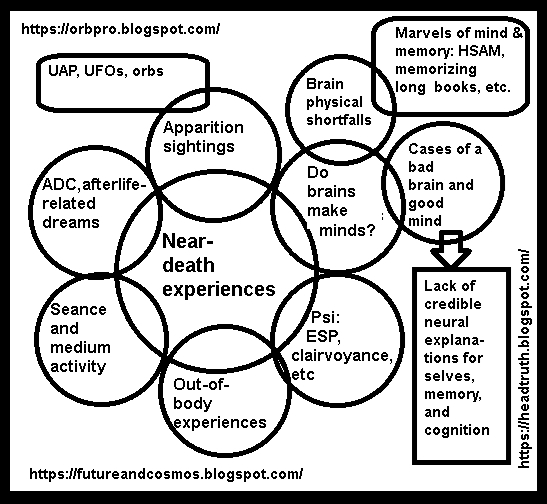
Mainstream scientists typically take a "head in the sand" approach when faced with the problem of explaining such things. Their typical attitude is a clear hint about how the problem of explaining the paranormal is a hundred miles over their heads. 

paranormal phenomena

Protein and protein complex origination problem.  There are three aspects of this problem.

Problem of explaining the origin of proteins.  In 2019 computer scientist David Gelernter published a widely discussed book review entitled "Giving Up Darwin." He commented on the improbability of the natural origin of a new type of functional protein:

"Now at last we are ready to take Darwin out for a test drive. Starting with 150 links of gibberish, what are the chances that we can mutate our way to a useful new shape of protein? We can ask basically the same question in a more manageable way: what are the chances that a random 150-link sequence will create such a protein? Nonsense sequences are essentially random. Mutations are random. Make random changes to a random sequence and you get another random sequence. So, close your eyes, make 150 random choices from your 20 bead boxes and string up your beads in the order in which you chose them. What are the odds that you will come up with a useful new protein?...The total count of possible 150-link chains, where each link is chosen separately from 20 amino acids, is 20150. In other words, many. 20150 roughly equals 10195, and there are only 1080  atoms in the universe. What proportion of these many polypeptides are useful proteins?"

Gelernter tells us that the ratio of long useful amino acid sequences (compared to useless amino acid sequences that will not be the basis of functional proteins) is incredibly small. He cites a paper by Douglas Axe estimating that the ratio is something like 1 in ten to the seventy-fourth power, or about 1 in 1074 . 

Gelernter states this:

"Try to mutate your way from 150 links of gibberish to a working, useful protein and you are guaranteed to fail. Try it with ten mutations, a thousand, a million—you fail. The odds bury you. It can’t be done."

The phrasing of the middle sentence is a great understatement. What it should be is something like "Try it with a million mutations, a billion, a trillion, a quadrillion, a quintillion—you fail." If you have some result that you can only get about 1 in 1074 attempts, then you can try 1,000,000,000,000,000,000,000,000,000,000,000,000,000,000,000,000,000,000,000,000,000,000,000,000 times, and you still very probably do not succeed.  According to the paper here, "we arrive at a figure of 4×10²¹ different protein sequences tested since the origin of life." The problem is that isn't enough tries to get even one success, if you're talking about proteins of average length.  If you have some result that you can only get about 1 in 1074 attempts, then 4×10²¹ tries will not give you a 1 in 1,000,000,000,000,000,000,000,000,000,000,000,000,000,000,000 chance of a single success.

Gelernter misstated the average number of amino acids in a protein. He states, "A protein molecule is based on a chain of amino acids; 150 elements is a 'modest-sized' chain; the average is 250." No, according to the 2012 scientific paper here, "Eukaryotic proteins have an average size of 472 aa [amino acids], whereas bacterial (320 aa) and archaeal (283 aa) proteins are significantly smaller (33-40% on average)." Mammals like us have eukaryotic proteins, so the average human protein has about 472 amino acids, almost twice as many as the number Gelernter cited. 

Let's do some simple math to show the difference here between the right numbers. A reasonable assumption is that every functional protein needs to have at least half of its amino acid sequence just as it is, or the molecule will not perform its function. (There are reasons for thinking that the fraction is actually much larger than 50%, given the high fragility of protein molecules, and their extreme sensitivity to small changes.)  So given that there are twenty amino acids used by living things, the probability of getting a random amino acid sequence serving the purpose of a particular protein can be very roughly estimated as 1 in 20n, where n is half the length of a protein's amino acid sequence. If we have a protein with a sequence of 250 amino acids, this equals a probability of about 1 in 20125, which is the same as about 1 in 10162. But if we have a protein with a sequence of 472 amino acids, this equals a probability of roughly 1 in 20236, which is the same as about 1 in 10307.  

Humans have 20,000+ types of protein molecules, and the animal kingdom has many millions of types of protein molecules. But the relevant math calculations (like those above) tell us that no type of functional protein ever should have naturally originated in the history of Earth. Darwinism does not remove this problem, or even significantly reduce it. Here are two relevant quotes by scientists:

  • "A wide variety of protein structures exist in nature, however the evolutionary origins of this panoply of proteins remain unknown."  -- Four Harvard scientists, "The role of evolutionary selection in the dynamics of protein structure evolution." 
  • "Tawfik admits the issue of a first protein is 'a complete mystery' because it reveals a paradox: enzymatic function depends upon the well-defined, three-dimensional structure of a protein scaffold, yet the 3D structure is too complex, too intricate, and too coordinated to arise without simpler precursors and intermediates....Tawfik soberly recognizes the problem. The appearance of early protein families, he has remarked, is 'something like close to a miracle.'....'In fact, to our knowledge,' Tawfik and Tóth-Petróczy write, 'no macromutations ... that gave birth to novel proteins have yet been identified.' " -- Tyler Hampton, quoting Dan  S. Tawfik, professor in a Department of Biological Chemistry (link). 
The diagram below illustrates how a protein molecule can be made nonfunctional by a very small mutation involving a change in only one or a few of the protein's amino acids. The lack of a credible natural explanation for the origin of protein molecules becomes all the more apparent when we ponder the need for most types of protein molecules to have very special sequences of hundreds or thousands of amino acids that have to be almost exactly right for the molecule to function. 

protein fragility


Problem of explaining protein complex formation. A large fraction of all types of proteins are useless unless they act as team members within teams of proteins that are called protein complexes. But scientists do not understand how protein complexes are able to form into such useful teams of proteins. The problem is not explained by DNA and its genes, which do not specify the structure or makeup of any protein complex. You may realize how huge the explanatory problem is when you study how scientists are calling many of these protein complexes "molecular machines" because they so strongly resemble something purposefully constructed. We see below one example, one including propeller-like parts. 

protein complex

Below are some relevant quotes:

  • "The majority of cellular proteins function as subunits in larger protein complexes. However, very little is known about how protein complexes form in vivo." Duncan and Mata, "Widespread Cotranslational Formation of Protein Complexes," 2011.
  • "While the occurrence of multiprotein assemblies is ubiquitous, the understanding of pathways that dictate the formation of quaternary structure remains enigmatic." -- Two scientists (link). 
  • "A general theoretical framework to understand protein complex formation and usage is still lacking." -- Two scientists, 2019 (link). 
  • "Protein assemblies are at the basis of numerous biological machines by performing actions that none of the individual proteins would be able to do. There are thousands, perhaps millions of different types and states of proteins in a living organism, and the number of possible interactions between them is enormous...The strong synergy within the protein complex makes it irreducible to an incremental process. They are rather to be acknowledged as fine-tuned initial conditions of the constituting protein sequences. These structures are biological examples of nano-engineering that surpass anything human engineers have created. Such systems pose a serious challenge to a Darwinian account of evolution, since irreducibly complex systems have no direct series of selectable intermediates, and in addition, as we saw in Section 4.1, each module (protein) is of low probability by itself." -- Steinar Thorvaldsen and Ola Hössjerm, "Using statistical methods to model the fine-tuning of molecular machines and systems,"  Journal of Theoretical Biology.

molecular machines in human body

Problem of explaining protein folding. Proteins are almost always useless unless they have a specific three-dimensional shape.  Different types of proteins have different three-dimensional shapes. But how do such shapes arise? Scientists do not understand this. This unsolved problem is called the protein folding problem.  One attempt at solving the problem has been to advance what is called Anfinsen's Dogma, the claim that the amino acid sequence of a protein forces it to be some particular three-dimensional shape. But there has never been any good evidence to support Anfinsen's Dogma, and there are strong reasons for believing that it cannot be correct.  The case against Anfinsen's Dogma is made in two of my posts that you can read here.  It is sometimes claimed that the AlphaFold2 software did something to help solve the protein folding problem, but such claims are not correct. That software instead merely did something to help solve a different problem, one called the protein folding prediction problem.  The protein folding problem is still unsolved, and there are no good prospects of it being solved. 

biological layers

Homochirality problem.  Chemicals such as amino acids and sugars can be either left-handed or right handed. A left handed amino acid looks like a mirror image of the right-handed amino acid, and a right-handed sugar looks like the mirror image of the left-handed sugar. Homochirality is the fact that in living things essentially all amino acids are left-handed, and all sugars in DNA are right-handed. But when such things are synthesized in a laboratory, or produced in experiments simulating the early Earth, you see equal amounts of left-handed and right-handed amino acids and equal amounts of left-handed and right-handed sugars.

Based on the fact that it is just as easy for left-handed amino acids to form in the laboratory as right-handed amino acids, and just as easy for left-handed sugars to form in the laboratory as right-handed sugars, we would expect for there to be a symmetry in the handedness of amino acids, with an equal amount of left-handed and right-handed amino acids. We would also would expect a symmetry in the handedness of sugars, with equal amounts of left-handed sugars and right-handed sugars. But what we see is an asymmetry, with living things having only left-handed amino acids and right-handed sugars in DNA. This characteristic of earthly life is called homochirality. 

I can give an analogy for why homochirality is such a mystery. Let us imagine a very large box filled with 5000 cards, each displaying one of the letters in the alphabet. On one side of each card is a letter. For example:


On the back side of each card is the mirror image of the letter on the front side of the card. For example:


Now, let us suppose that someone dumped this large box of cards from the top of a tall building. Imagine that the cards fell to the ground, forming a set of useful instructions that was 5000 letters long, and that none of those letters were the mirror  images of the letters in the alphabet. 

We would have two gigantic difficulties in explaining this outcome.  The first problem would be in explaining how we accidentally got a useful and intelligible set of instructions 5000 characters long.  The second problem would be in explaining how the 5000 cards all ended up showing the card side with the regular English letter, with none of them showing the mirror image of the letter on the opposite side of the card. 

The origin of life is as hard-to-explain as the falling cards event just described.  It would be easier to explain if scientists had an explanation for homochirality, but they do not. 

homochirality problem

For twenty other posts on this blog on the topic of the tininess of human knowledge, use the link here, and continue to press Older Posts at the bottom right. 

Thursday, January 9, 2025

Two 2024 Nobel Prize Press Releases Misinformed Us Badly

In a previous post entitled "Misleading Statements in a Recent Nobel Prize Announcement" I analyzed quite a few misleading statements in the press release (and a supplementary document of that release) issued by a  Nobel Prize committee announcing the year 2024 Nobel Prize in Chemistry. The press release I discussed was not the only misleading press release issued in 2024 by a Nobel Prize committee. There were also bad errors in the press release announcing the Nobel Prize in Physiology or Medicine. 

In its second sentence that press release contained this piece of fiction: "The information stored within our chromosomes can be likened to an instruction manual for all cells in our body."  The information referred to is DNA, also called the genome. DNA consists mainly of genes. But neither DNA nor its genes contain any such thing as an instruction manual for cells. DNA has no specification of how to build a cell or any of its organelles, or how to maintain or correctly position any cells.  DNA does not even specify how to construct the protein complexes that make up organelles. 

The level of organization in the body is as follows: a body consists mainly of organ systems and a skeletal system; organ systems are built mainly from organs; organs are built from tissues; tissues are built from cells; cells are built from many types of organelles; organelles are built mainly from proteins complexes; protein complexes are built from proteins; and proteins are built from amino acids. The chromosome and its DNA does not have any specification of how to construct any of these levels higher than protein molecules. So it is a huge falsehood to claim that "the information stored within our chromosomes can be likened to an instruction manual for all cells in our body."  DNA does not tell how to make a cell or any of the main components of a cell; and DNA does not tell cells how to act or where they should go in the body. 

The Nobel Prize press release contained the following paragraph. I will put the false statements in boldface underline:

"The information stored within our chromosomes can be likened to an instruction manual for all cells in our body. Every cell contains the same chromosomes, so every cell contains exactly the same set of genes and exactly the same set of instructions. Yet, different cell types, such as muscle and nerve cells, have very distinct characteristics. How do these differences arise? The answer lies in gene regulation, which allows each cell to select only the relevant instructions. This ensures that only the correct set of genes is active in each cell type."

No, gene regulation does not constitute even a half-explanation of why we end up with different cell types.  Gene regulation refers to a cell's use or non-use of certain types of proteins. But that does not even half-explain why the human body has 200 different types of cells, with so many different functions, structures and characteristics. Similarly, if there were some person traveling to different construction sites, and merely saying things such as "use copper pipes" and "don't use cinder blocks" and "use steel beams" and "don't use wood 2 by 4's," that would never explain how one construction site might produce a stone church and another construction site might produce a mansion and another construction site might produce a shopping mall. Nowhere in chromosomes or DNA are there any instructions for building a cell or any of its organelle components, and neither chromosomes nor DNA nor its genes has any instructions on how to maintain, position or reproduce a cell. 

The press release in question announced the awarding of a Nobel Prize for the discovery of a microRNA  by Victor Ambros and Gary Ruvkun. A microRNA is a very tiny chemical unit that is only 18 to 25 nucleotides. About 1000 microRNA molecules have been discovered.  Molecules so small with so little information are utterly incapable of explaining the vast mystery of why there arises so many different types of enormously complex cells specialized for different biological purposes. 

The Nobel Prize press release I am discussing gives us the extremely misleading visual below:

biology complexity misrepresentation

The diagram above misleads us badly in three different ways. First, it omits two different layers of organization, and gives us the profoundly misleading idea that cells are directly made from proteins. The truth is that cells are made from extremely complex components called organelles, which are built from extremely complex protein complexes, which are built from protein molecules.  Second, the diagram misleads us badly by giving us a visual suggesting  that cells are very simple. We see a cell that has only a few organelles.  The truth is that human cells typically contain very many thousands of organelles. Third, the diagram makes proteins look like very simple things with only a few parts. Human proteins have an average of about 450 amino acids each, which must be very specially arranged for them to perform their functions. 

Schematic diagrams of cells are constantly misleading us by depicting cells with only a few organelles. Specifically:

  • A cell diagram will typically depict a cell as having only one or a few mitochondria, but human cells typically have many thousands of mitochondria, as many as a million.
  • A cell diagram will typically depict a cell as having only only one or a few lysosomes, but human cells typically have hundreds of lysosomes.
  • A cell diagram will typically depict a cell as having only a few ribosomes, but a human cell may have up to 10 million ribosomes.
  • A cell diagram will typically depict one or a few stacks of a Golgi apparatus, each with only a few cisternae. But a cell will typically have between 10 and 20 stacks, each having as many as 60 cisternae.
  • A cell diagram will rarely even depict a microtubule, although according to the paper here "cells can contain from just a few to many hundreds of microtubules (Aikawa, 1971; Osborn & Weber, 1976)." 
  • The membranes of cells are extremely complicated structures, consisting of four layers, with each layer being populated by many types of proteins each consisting of hundreds of well-arranged parts.  Some of this complexity could easily be shown by a "closeup circle" in a cell diagram, showing a closeup of part of the membrane.  But we rarely see any such depiction of the complexity of the cell membrane,  and cell diagrams almost always have cell membranes depicted as featureless things looking as simple as the surface of a balloon. 
  • The cytosol of a cell is typically depicted as if it were a simple fluid like water. But the cytosol is actually loaded with many types of complex protein molecules needed for cell function. 

There is no excuse for the continuation of misleading cell diagrams in the literature of biology. For the past twenty years it has been easy to use computer graphics to make very sophisticated high-resolution diagrams capable of properly representing the complexity of cells. But almost no one is creating such diagrams, and we continue to see most cell diagrams looking like something hand-painted in the 1950's.  

The type of cell diagrams we usually see in biology literature are misrepresentations as absurd as trying to depict gigantic skyscrapers like the Empire State Building or the 828-meter-tall Burj Khalifa tower  by using ridiculously simplistic diagrams like this:


We get more very misleading talk later in the Nobel Prize press release with this statement:

"Gene regulation by microRNA, first revealed by Ambros and Ruvkun, has been at work for hundreds of millions of years. This mechanism has enabled the evolution of increasingly complex organisms."

The word "enable" means "give (someone or something) the authority or means to do something." The biological and chemical requirements for complex organisms are endless and ubiquitous, and most involve things vastly more complex than microRNA molecules, which are very small molecules. So to claim that mere microRNAs  "enabled the evolution of increasingly complex organisms" is to misspeak badly.  A correct statement would be that microRNAs are some of the least complex of the enormously high number of things needed for the appearance of organisms as complex as humans. 

The diagram below correctly describes the levels of organization in the human body, and tells us what is not specified by DNA. 

what DNA does not specify

We have in this Nobel Prize press release and its diagram a repetition of one of the most misleading claims of biologists between 1975 and 2024: the groundless claim that genes contain programs for development. DNA is not a program, and the genes that make up DNA are not any program that forms organisms. DNA does not have any of the control structures (such as if/then statements) found in computer programs. DNA does not specify the growth of an organism, and does not know or state anything about organisms or their cells. 

Professor Massimo Pigliucci (mainstream author of numerous scientific papers on evolution) has stated  that "old-fashioned metaphors like genetic blueprint and genetic programme are not only woefully inadequate but positively misleading." In the book Mind in Life by Evan Thompson (published by the Belknap Press of Harvard University Press) we read the following on page 180: "The plain truth is that DNA is not a program for building organisms, as several authors have shown in detail (Keller 2000, Lewontin 1993, Moss 2003)."  Developmental biologist C/H. Waddington stated, "The DNA is not a program or sequentially accessed control over the behavior of the cell." On the web site of the well-known biologist Denis Noble, we read that "the whole idea that genes contain the recipe or the program of life is absurd, according to Noble," and that we should understand DNA "not so much as a recipe or a program, but rather as a database that is used by the tissues and organs in order to make the proteins which they need." A paper by cell biologist Stuart A. Newman states,  "It would be unfortunate if we find ourselves having emerged from a period of misconceived genetic program metaphors only to land in a brave new world captivated by equally misguided ones about self-organization."

Part of the press release helps reveal the utter inadequacy of anything discovered by the awarded scientists to explain the mountain-sized mystery of cell differentiation. We read this: "Ambros and Ruvkun performed further experiments showing that the lin-4 microRNA turns off lin-14 by binding to the complementary sequences in its mRNA, blocking the production of lin-14 protein."  These guys merely found 
an off-switch for a particular protein. That cannot be more than just the tiniest piece in a gigantic puzzle with thousands of missing pieces, since cells use 20,000+ proteins, and since off-switches can't explain 200 very diverse types of enormous organization as we see in cells. And since tiny little microRNAs don't even have as much information as found on a single sentence of this post, it's pretty laughable to be elevating them to be things explaining the variety of human cells, things far more complex than any blog post I've ever written. 

The false claim made by the Nobel Prize press release (that gene regulation or gene expression explains why we have 200 different types of cells with vastly different sizes, structures, locations and functions) has been stated by many sources. False information about genes and DNA is super-abundant in the literature of biology, where groundless fictions about DNA have been steadily told for 75 years. The main reason such misinformation has been passed around in my post here. The same post quotes dozens of scientists and doctors who told us the truth about such matters, telling us that DNA is no blueprint, recipe or program for building a body or any of its cells. 

A phrase such as "gene expression" or "gene regulation" is vacuous as an explanation for why cells have different structures and different locations and why they use different proteins. Gene expression refers to what proteins a cell uses and how often they are used. Rather than being an explanation for why different cells are different, the phrase "gene expression" is one aspect of how they are different.  Appealing to "gene expression" as an explanation for why two cells are different is as vacuous as answering a question of "how come a computer is arranged differently from a refrigerator" by saying "because they have different parts in different places." Similarly the term "gene regulation" refers to a large variety of different complicated factors that differ when different cells end up with different concentrations of proteins.  But as an explanation for why two cells are different, the phrase "gene regulation" is as vacuous as trying to answer the question of "how come a computer is arranged differently from a refrigerator" by using a phrase such as "part placement differences." Having within it no concept or specification of a cell, DNA has no "gene regulator" controlling how many proteins of different types go into particular cells. Instead of referring to one discrete thing, the term "gene regulation" refers to dozens of scattered little things that differ when different types of cells arise.  Appealing to "gene regulation" as an explanation is as vacuous as trying to explain why a cathedral looks different from a factory by appealing to "assembly differences"  or "construction methodology." When used as an attempted explanation, the obscure phrase "gene regulation" is an example of hand-waving. Different gene regulation in different cells is one aspect of different cells being different, not an explanation of why they are different. 

As shown by this post and a previous post of mine, the year 2024 has proven that we should have no great confidence in the claims made by press releases announcing Nobel Prize awards. Nobel Prize press releases should be treated with the same suspicion and critical scrutiny we should have for university press releases announcing science research. Such press releases are very often guilty of very bad groundless boasting and misleading claims. 

Earlier in this century a biologist spoke truthfully about how little biologists understand cells, stating this:

"Cell biology is a mystery for many reasons one
of which is the lack of basic knowledge. This may
be the fault of scientists or simply a failure in basic
information at the level of common contemporary
knowledge. The well known sentence of Socrates:
'I know that I know nothing' is as true in cell
biology as in other scientific fields. This sentence
was modified by Lloyd in 1986 who claimed: 'The
closer we look, the less we see'. I would like to
modify this sentence yet again as a cell biologist and
microscopist: 'The closer we look, the less we know
about.' ... Everyone involved in cell
biology, is surprised how limited is our knowledge
about the various cell compartments....It should now be mentioned that our knowledge even of basic cell organelles, including their various functions, is very limited....We know something about cell organelles, including various nuclear compartments, but most of their functions are waiting for further and better clarification....Depending on conditions, selected genes may be repressed or derepressed and activated giving to rise to the particular cell lineage with characteristic cell structures and functions. On the other hand, such transformations, including the homing of the transformed cells are also very mysterious although both these processes are empirically used in clinical medicine."

A year 2022 statement by Intel claims that some analysis technique is "beginning to unravel the mystery of cell differentiation." In general when scientists say that they are merely "beginning to unravel" some great mystery, it is a confession that the mystery is still very much not understood by them. Humans don't understand how different cell types arise in the human body, contrary to the boast of the Nobel Prize committee that this is explained by "gene regulation." In 2019 two scientists confessed, "We have little understanding of the processes that allow cells to become different"  (link).

cell differentiation

In the Nobel Prize press release I have criticized, there is a link to some speech given describing the 2024 award for the Nobel Prize in Medicine and Physiology.  The speech gives us a very clumsy analogy in which the construction of a cell is compared to the performance of some symphony, and individual genes are compared to instrument players. The analogy is inappropriate because musicians work with a musical score exactly specifying how a symphony should sound, but DNA and its genes are nothing like a specification of any cell or any organ or any adult body. We read this:

"MicroRNAs are conductors with a special ability. Instead of passionately making gestures to either amplify or dampen music intensity, microRNAs tell musicians only when to quiet down or take a break. ‘You there, play softer! You, take a break!’ "

It's obvious from this analogy that individual MicroRNAs are mere "bit players" or minor cogs in the gigantically complicated process by which enormously organized cells are originated and vastly organized organism bodies are constructed. The awarded discovery merely involves finding one piece in a gigantic jigsaw puzzle which has almost all of its pieces still undiscovered, as illustrated in the visual below. 

current state of developmental biology
 
In many of these cases that are hailed as progress in understanding things, there may be no real progress at all, but just some explanatory "robbing Peter to pay Paul." For example, let us suppose that there is some gene which has its rate of expression slowed down at some particular point in some type of cell. Let us suppose that someone postulates that this occurred because some microRNA sent a message at some point telling the gene  to slow down.  That's just a mere speck of explanatory progress. We've simply gone from "how did the gene know to slow down at this particular time in this particular cell?" to the equally great mystery of "how did the microRNA know that it should signal the gene to slow down at this particular time in this particular cell?"  The problem is that DNA has no actual specification of cells or the organelles that make up cells. So from a mechanistic or reductionist standpoint, none of these chemicals should know anything about what it should be doing at a particular time to help achieve some grand result such as the construction of a particular type of vastly organized cell, or its placement in the correct position in a human body.