Header 1

Our future, our universe, and other weighty topics


Showing posts with label origin of eukaryotic cells. Show all posts

Monday, December 16, 2024

Handling Biological Complexity, the Mainstream Gives Us Flagrant Falsehoods and Fairy Tales

Quanta Magazine is a widely-read online magazine with slick graphics. On topics of science the magazine again and again is guilty of the most glaring failures. Quanta Magazine often assigns its online articles about great biology mysteries (involving riddles a thousand miles over the heads of PhDs) to writers who lack even a bachelor's degree in biology. Often it will assign such articles to be written by people identified as "writing interns."  The articles at Quanta Magazine often contain misleading prose, groundless boasts or the most glaring falsehoods. I discuss some examples of such poor journalism in my posts here and here and here.

Let us look at a fairly recent example of very misleading journalism at Quanta Magazine. It is an article with the enormously misleading title "Meet the Eukaryote, the First Cell to Get Organized." We are deceived very badly by this title.  Eukaryote cells are the type of cells found in human bodies. Eukaryote cells are vastly more organized than a much simpler type of cell called prokaryotic cells. But prokaryotic cells are also enormously organized.  Prokaryotic cells simpler than eukaryotic cells are fantastically organized cells, requiring more than 100,000 base pairs very specially arranged in a vastly improbable way to achieve functional performance.

The paper "Fundamental behaviors emerge from simulations of a living minimal cell"  describes "a genetically minimal bacterial cell, consisting of only ... 493 genes on a single 543-kbp circular chromosome with 452 genes coding for proteins ( ), some of which are subunits of multi-domain complexes." Each of those genes is a complex invention with hundreds of fine-tuned parts that almost all have to be just right. The total number of amino acids that have to be arranged just right in the proteins partially specified by these genes is roughly 150,000. Far from supporting any "life is simple, we can make it from scratch" narrative, such a paper supports the idea that even the simplest self-reproducing cell has a degree of organization and functional complexity greater than the organization and functional complexity of an 80-page technical manual. And even all that information does not give you a self-reproducing cell; it's only a prerequisite for such a cell. 

The claim that eukaryote cells were "the first cell to get organized" is a glaring falsehood.  The predecessors of eukaryote cells (prokaryote cells) were themselves enormously organized.  The claim that the earliest cells were simple is a lie told by materialists to help bolster their claims of accidental biological origins.  If you are trying to sell the unbelievable idea that life accidentally originated, then the lie that the earliest cells were simple is one of the lies that you need to tell.  And materialists keep telling that lie. We may excuse the writing intern who is the author of this article for the article's glaringly false headline, because writing interns should not be held to very high standards.  But we should not excuse the editors of Quanta Magazine, who have let an article with a glaringly false headline be published in their publication. 

origin-of-life lie
A guy lying (in the 2nd sentence) about the earliest cells

In the rest of the article, we get an attempt to sell us the fairy tale story of endosymbiosis, the idea that we got enormously complex eukaryotic cells by some "lucky swallowing." We read this:  "How this all happened isn’t entirely clear, but today, most experts agree that 2 billion or 3 billion years ago, an archaean cell engulfed a bacterial cell, which somehow escaped digestion and adapted to life inside its host." How did eukaryotic cells originate? Our professors have now "got the memo" that they are supposed to be telling a particular answer, one that is extremely unbelievable. They now maintain that the first eukaryotic cell originated because of an incredibly improbable “combination” accident. The idea is that a bunch of prokaryotic cells somehow ganged up to become a eukaryotic cell – kind of like what would happen if five people collided into each other to somehow originate a new species of three-headed creatures which each had ten legs and ten arms.

Inside a eukaryotic cell are many specialized units called organelles. The organelles include things like ribosomes, lysosomes, mitochondria, and endoplasmic reticulum. Our professors attempt to convince us that these mitochondria are ancestors of prokaryotic cells that somehow got incorporated into eukaryotic cells.

There are several reasons for thinking that such a thing is far too improbable to have ever happened. Among these are the following:
  1. No one has ever observed any type of event like the supposed event in which prokaryotic cells combined to become a eukaryotic cell. Microbiologists have done innumerable experiments with prokaryotic cells, and have never observed any combination of prokaryotic cells become anything like a eukaryotic cell.
  2. A prokaryotic cell injected with the DNA of a eukaryotic cell will not start producing eukaryotic cells as its offspring.
  3. Nowhere in human DNA does it specify the overall shape of a human body, the structure of a human organ system, the structure of a particular human organ, the structure of a tissue, the structure of a cell, or even the structure of any organelle of a cell. Although genotypes influence phenotypes, genotypes do not specify phenotypes. Genotypes merely list chemicals used by an organism.  DNA does not specify the physical structure of an organism. We can therefore imagine no conceivable event by which some lucky combination of prokaryotic DNA could result in a cell that produced eukaryotic offspring, because the structure of a eukaryotic cell is not even specified in DNA.

  In the book Aliens, biologist Matthew Cobb gives a description of current thinking on this topic, emphasizing the improbability of it:

"What happened on Earth – known as eukaryogenesis – was not the product of random mutation and the subsequent sifting of acquired characters that have differential fitness (the essence of natural selection). Instead there appears to have been a single event of mind-boggling improbability, for it involved two life forms interacting in a most novel way....Prior to that moment, all life had consisted of small microbes with no cell nucleus and no mitochondria. Everything changed when one unicellular life form, known as an archaebacterium, ended up inside another, called a eubacterium."

On another page Cobb says this:

"We could in principle calculate the probability of the appearance of eukaryotes, but we would soon run out of zeros...That weird hybrid was our ancestor, and its existence – and therefore ours – was incredibly improbable. As far as we are aware, no such event happened before or since."

Obviously we have here a fairy tale, an "old wives' tale."  Scientists have no credible tale to tell of how eukaryotic cells originated, just as they have no credible tale to tell of how prokaryotic cells originated. Whenever they refer to eukaryotic cells arising by fantastically improbable combination accidents, biologists are merely engaging in the most farfetched hand-waving. Because neither prokaryotic cells nor eukaryotic cells specify in their DNA how to make either a eukaryotic cell nor any of its organelle components, there is no conceivable lucky combination accident of prokaryotic cells that would result in eukaryotic cells with the ability to reproduce to make other eukaryotic cells. 

Only at the end of the Quanta Magazine story (with a deceptive title and the most unbelievable fairy tale as its content) do we get some candid truth telling.  At the end the evolutionary biologist Toni Gabaldon says, "The most fascinating thing about eukaryotes is that we still don’t understand how they came about.”  Correct -- so why is it that biologists are claiming to understand the origin of species such as ours? If you don't understand how the cells in human bodies originated, then you don't understand how the human species originated. 

What happens is that biologists are always making these groundless boasts about understanding great mysteries they do not understand. But every now and then they make confessions that contradict such boasts, and reveal how little they know. You can read many hundreds of such confessions in my very long post "Candid Confessions of the Scientists."  

The same Quanta Magazine had a recent story with the groundless headline "The Cosmos Teems With Complex Organic Molecules," with the false subtitle of "Wherever astronomers look, they see life’s raw materials."  The article gives the asteroid Ryugu as an example of such claimed abundance. The truth is that amino acids (the smallest components of living things) have only been detected in space in the tiniest trace amounts.  The only biologically relevant amino acid reportedly found in Ryugu were three of the simplest amino acids (glycine, alanine and valine), which were reportedly found at a level of only 1 part per billion; and whenever levels that small are reported, the reported detection is questionable. Senselessly the Quanta article describes molecules containing only 20 atoms as "very complex." That isn't a complex molecule from the perspective of biology.  An average-sized protein molecule has about 8,000 atoms in it.  No protein molecule has ever been found in space outside of manned spacecraft or space stations. 

Those wishing to push unbelievable ideas of accidental biological origins engage in different types of misspeaking.  Most commonly they engage in a kind of misspeaking in which great marvels of vast organization are described as if they are things not complex. So, for example,  they may falsely describe a human body (something with sky-high levels of organization) as a mere "bundle of atoms." But when it comes time to sell the groundless notion that life can accidentally originate, then their language is entirely different. Suddenly they are trying to persuade us that molecules of merely 20 atoms are "very complex."  

The Quanta Magazine article "Meet the Eukaryote, the First Cell to Get Organized" was enormously misleading, but its brazen falsehoods and absurdity is not quite as great as the brazen falsehoods and absurdity in a recent article on the site The Conversation, another materialist propaganda site often littered with the type of false and nonsensical statements so often found in Quanta Magazine. 

The writer of the article is a professor of astronomy. Trying to sell Darwinism, the astronomy professor teaches the glaring falsehood that Darwinists keep  telling again and again, the claim that DNA is a specification for building an organism.  He states this: "In biology, information refers to the instructions stored in the sequence of nucleotides on a DNA molecule, which collectively make up an organism’s genome and dictate what the organism looks like and how it functions." No, DNA does not dictate what an organism looks like and how it functions.  DNA contains no anatomy information. DNA does not specify the structure or function of any organ system;  DNA does not specify the structure or function of any organ; DNA does not specify the structure or function of any cell; DNA does not specify the structure or function of any of the organelles that are the building components of cells. See my post here for a long list of quotations by scientists and doctors saying that DNA is no such thing as a specification for building an organism. 

The levels of hierarchical organization in the human body are shown in the diagram below, which correctly tells us that none of the seven highest levels of organization are specified by DNA or its genes. 

organization levels in human body

I explain in other posts (such as here) why if there were to exist a blueprint in DNA for making a human body or any of its organs or cells -- something never found -- that would not at all explain how human bodies or their organs or their cells get built, for reasons such as the fact that such building instructions would be so vastly complex that nothing inside a human womb would be capable of understanding them and acting on them to produce the state of vast hierarchical organization that is a human body. 

After inexcusably telling us the flagrant falsehood that DNA dictates "
what the organism looks like and how it functions," the astronomy professor then makes the supremely ludicrous statement  that "it’s wrong to conclude that animals are more complex than microbes." This is very obviously the worst kind of nonsense. Animals such as mammals are very obviously gigantically more complex than microbes. 

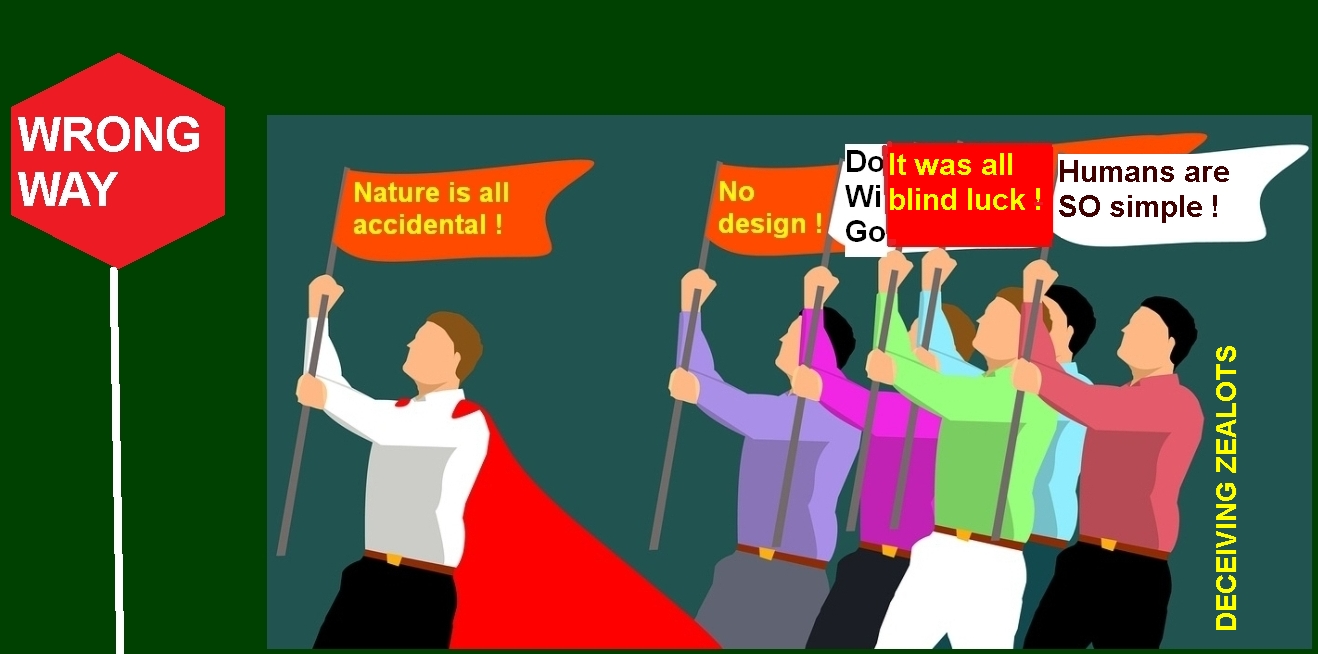
Wise worldviews tend to make the people who argue for them sound smart. But when people try to sell foolish or fallacious worldviews they can end up making very stupid-sounding statements, even if they have high IQs. And when the proponents of an ideology again and again make many different types of deceptive statements in their zeal to sell that ideology, you have a very clear sign of people marching in the wrong direction. 

Darwinist error


Humans have minds, mental capabilities and mental experiences of gigantic depth and complexity, and bodies more organized and functionally impressive than anything humans manufacture. In a previous post I stated what I called the first rule of accidental construction:

The first rule of accidental constructionthe credibility of any claim that an impressively organized final result was accidentally achieved is inversely proportional to the number of parts that had to be well-arranged to achieve such a result, and the amount of organization needed to achieve such a result.

I can state a similar rule relating to minds:

The first rule of neural explanation: the credibility of any claim that human minds are produced by brains (or are the same thing as brain states) is inversely proportional to the diversity and depth of human mental experiences, the number of mental powers that humans have, and the speed, skill and depth of such powers. 

It is because of such rules that Darwinists tend so strongly to misrepresent the vast physical complexity of humans and other living things and misrepresent the vast mental complexity of human minds, telling us the most absurd nonsense and falsehoods such as the claim quoted above that an animal is not more complex than a microbe, or other falsehoods as glaring and other word tricks as bad, such as the deception of trying to describe a human as mere "consciousness." What is going on is that such people are telling the falsehoods they need to tell and performing the deceptive tricks they need to perform in order to sell us on a theory of accidental construction that has a credibility inversely proportional to the degree of organization and complexity in living organisms and human beings, and to sell us a "brains make minds" theory that has a credibility inversely proportional to the skill, speed, depth and diversity of human mental powers and human mental experiences. The more we can be tricked and deceived into thinking that living organisms and humans are a million times simpler than they are, the more likely such ideology pitchmen will be to succeed. 

Wednesday, March 6, 2019

The Tall Tale of Eukaryogenesis

The book Power, Sex, Suicide: Mitochondria and the Meaning of Life by biologist Nick Lane is one that advances a few unbelievable ideas. The most unbelievable idea it pitches is one concerning the origin of eukaryotic cells.

The cells in our bodies are very complex cells called eukaryotic cells. Such cells are vastly more sophisticated than the much simpler cells we see in bacteria. Such cells are called prokaryotic cells. The analogy that has sometimes been given is that a prokaryotic cell is like a studio apartment, and a eukaryotic cell is like a millionaire's mansion (although a better analogy might be to compare the eukaryotic cell to a skyscraper).  The difference between prokaryotic cells and eukaryotic cells is very poorly depicted by cell diagrams, which typically depict eukaryotic cells as being many times simpler than they are. 


How did eukaryotic cells originate? Our professors have now standardized on an answer, one that is extremely unbelievable. They now maintain that the first eukaryotic cell originated because of an incredibly improbable “combination” accident. The idea is that a bunch of prokaryotic cells somehow ganged up to become a eukaryotic cell – kind of like what would happen if five people collided into each other to somehow originate a new species of three-headed creatures which each had ten legs and ten arms.

Inside a eukaryotic cell are many specialized units called organelles. The organelles include things like ribosomes, lysosomes, mitochondria, and endoplasmic rheticulum. Our professors attempt to convince us that these mitochondria are ancestors of prokaryotic cells that somehow got incorporated into eukaryotic cells.

There are several reasons for thinking that such a thing is far too improbable to have ever happened. Among these are the following:

  1. No one has ever observed any type of event like the supposed event in which prokaryotic cells combined to become a eukaryotic cell. Microbiologists have done innumerable experiments with prokaryotic cells, and have never observed any combination of prokaryotic cells become anything like a eukaryotic cell.
  2. A prokaryotic cell injected with the DNA of a eukaryotic cell will not start producing eukaryotic cells as its offspring.
  3. Nick Lane evidently thinks that that the origin of eukaryotic cells through the process imagined by scientists is so improbable that it has occurred only once in the history of the universe. He states at the end of his book that he thinks “bacterial sludge is likely to be the climax of evolution across this lonely universe.” Similar statements have been made by other biologists, based on the vast improbability of prokaryotic cells combining to become a eukaryotic cell.  For example, biologist Michael Cobb has stated, "We could,  in  principle calculate the probability of the appearance of eukaryotes, but we would soon run out of zeros." 
  4. Nowhere in human DNA does it specify the overall shape of a human body, the structure of a human organ system, the structure of a particular human organ, the structure of a tissue, or even the structure of a cell. Although genotypes influence phenotypes, genotypes do not specify phenotypes. Genotypes merely list chemicals used by an organism.  DNA does not specify the physical structure of an organism. We can therefore imagine no conceivable event by which some lucky combination of prokaryotic DNA could result in a cell that produced eukaryotic offspring, because the structure of a eukaryotic cell is not even specified in DNA.
Let me explain why item 3 in this list is a very big reason for thinking that the “prokaryotic cells ganged up to become a eukaryotic cell” idea (sometimes called eukaryogenesis) is utterly unbelievable. Scientists estimate there are many trillions of other planets in the universe, and we have found many planets not very far from our planet. If a scientist has a plausible explanation for something, he or she will tend to maintain that such a thing will commonly occur elsewhere in the universe. For example, the collision of tectonic plates is a plausible explanation for earthquakes; and if you ask a scientist whether earthquakes occur on many planets, he will say that they do. But if you have an explanation for something that is extremely far-fetched and not at all plausible, you might tend to make a statement suggesting that such a thing happened only on our planet. When any scientist suggests that something has occurred only on our planet, it is a gigantic red flag suggesting that his explanation for that thing is not at all believable.

Show me a scientist who tells us that something happened because of a “once in the history of the universe” event, and I'll show you a scientist who does not have a remotely believable explanation for such a thing.

We may note that the modern account of eukaryogenesis (the origin of eukaryotic cells) is not at all a Darwinian account. The account relies on a sudden leap forward in nature rather than a gradual transition, breaking Darwin's rule that "nature does not make leaps." Just before evoking the principle of "nature does not make leaps," Darwin stated this on page 471 of the first edition of On the Origin of Species: "As natural selection acts solely by accumulating slight, successive, favourable variations, it can produce no great or sudden modification; it can act only by very short and slow steps." 

It is remarkable that while it is often claimed that Darwinism explains all the wonders of life, the modern biologist does not believe that Darwinian natural selection can explain either the origin of life itself (which must occur before natural selection begins) or the origin of eukaryotic cells.  To explain both of these origins,  our biologists must basically appeal to a special miracle of a type that has never been observed. In the lab chemicals have never turned into life, and prokaryotic cells have never turned into eukaryotic cells.  Hence neither abiogenesis (the claimed origin of life from non-living chemicals) nor eukaryogeneis (the claimed origin of eukaryotic cells from prokaryotic cells) fall into the category of observational science, and both exist in the same "cloud cuckoo land" realm of speculations as string theory and speculations about other universes.  For a theory of biological origins to fail to explain the origin of either the first life or the origin of the first eukaryotic cells is as embarrassing a shortfall as a theory of modern global conflicts that fails to explain either World War I or World War II. 

Let us look at some nonsensical statements Nick Lane makes on the last page of his book, in which he raves on and on about mitochondria with the same overzealous single-mindedness of a besotted teenybopper telling you that her new boy band crush is the secret to everything.

Lane: “Mitochondria teach us how molecules sprang to life on our planet, and why bacteria dominated for so long.”

Reality: This statement is not correct. Mitochondria are complex structures in a living cell, and did not exist before life existed. Mitochondria do nothing to explain the origin of life. 

Lane: “They [mitochondria] show us why bacterial sludge is likely to be the climax of evolution across this lonely universe.”

Reality: Taken literally, this statement is, of course, absurd, since humans (or something more advanced on another planet) must be regarded as the high point of the biological universe. Here Lane teaches that probably no other planet has eukaryotic cells (his "bacterial sludge" being mere prokaryotic cells). But teaching such a thing makes his theory of the origin of eukaryotic cells seem utterly unbelievable. If he had a plausible explanation for the origin of eukaryotic cells, he would not be suggesting that such an event was a unique miracle occurring only on our planet.

Lane: “They [mitochondria] teach us how the first genuinely complex cells came into being, and why, since then, life on Earth has ascended a ramp of complexity to the glories we see around us, the great chain of being.”

Reality: Here Lane portrays eukaryotic cells as “the first genuinely complex cells,” which is false. Prokaryotic cells simpler than eukaryotic cells are fantastically complex cells, requiring more than 100,000 base pairs arranged in a vastly improbable way to achieve functional performance. Mitochondria do not in any way teach us how eukaryotic cells came into existence, because the theory that eukaryotic cells originated from an incredibly unlikely combination of prokaryotic cells or mitochondria (probably an “only once in a universe” event according to Lane) is not at all a credible theory. And tiny fragments of cells such as mitochondria do not to any extent teach us how complex multi-cellular life could have originated, or why life would have or could have ascended a ramp of complexity leading to creatures such as us that are a trillion times more complicated than mitochondria. 

Lane: “They [mitochondria] show us why energy-burning, warm-blooded creatures arose, thrusting off the shackles of the environment; why we have sex, two sexes, children, why we must fall in love."

Reality: Mitochondria do nothing to explain the origin of warm-blooded creatures such as us, and to suggest otherwise is as silly as saying that bricks teach us why New York City arose. Mitochondria also do not explain the origin of sex, which is a gigantic difficulty for all naturalistic explanations of earthly life. You can understand only a small bit of the difficulty of explaining the origin of multi-cellular sex when you consider questions such as “which came first, the testicles or the vaginal canal,” two things that are useless (from a reproduction standpoint) without each other. There are a thousand such "which came first, the chicken or the egg" problems for anyone trying to explain biological innovations, making a mockery of claims that scientists understand such matters. 

The evidence given for the theory that eukaryotic cells arose from prokaryotic cells is laughably weak. The evidence given on one university page is that both mitochondria and prokaryotic cells have membranes, and that both have internal DNA. These are hardly strong reasons for thinking that mitochondria in eukaryotic cells are ancestors of prokaryotic cells. Using similar logic, I could argue that a dog must be an ancestor of me, because we have both four limbs and a head. The page neglects to tell us that the number of base pairs in the DNA of a prokaryotic cell is a hundred times greater than the number of base pairs in a mitochondrion, meaning that there is no strong similarity between the two.  A mitochondrion doesn't even look like a prokaryotic cell. 

You can read here a long Nautilus article about the modern-day folklore about the origin of eukaryotic cells.  Use some critical judgment, and you will find no solid evidence is presented. Calling the imagined origin event "ludicrously unlikely" despite arguing for it, the author says, "Prokaryotes have only managed it once in more than 3 billion years, despite coming into contact with each other all the time." But are not those 2.999999999999 billion years in which no such thing happened to prokaryotic cells evidence against the possibility of such a thing?

Postscript: Quanta magazine has a recent article entitled "Researchers Rethink the Ancestry of Complex Cells." The article unintentionally paints a picture of biological theorists in disarray on the topic of the origin of eukaryotic cells, with the thinkers hesitantly vacillating all over the place.  Clearly the origin of eukaryotic cells is not a topic our experts understand, despite the pretentious claims they have made to the contrary. 

Friday, December 25, 2015

The Difficulties in Explaining the Big Leaps in Life's History

I read Bill Nye's book Undeniable: Evolution and the Science of Creation to give a well-known author a chance to change my opinion that there is no compelling evidence for the claim that the blind process of natural selection can explain the astounding wonders of biological complexity (for the kind of reasons I discuss here). Looking at the book's index, I found that only 8 pages in the 298-page book discuss natural selection. I didn't find this surprising, because while there is lots of evidence that evolution (or a succession of life forms mimicking evolution) has occurred, the evidence that natural selection is the main explanation for this progression is actually very weak. Natural selection is a real biological effect, which can explain a few things, such as a change in a population of organisms in which a trait held by the minority becomes a trait held by the majority. But natural selection is not very good at explaining the origin of new forms of biological complexity, contrary to what is often claimed.

Looking at the index's first reference to natural selection, I found immediately a very misleading statement by Nye. He states, “Evolution is also not random; it's the opposite of random” (a misstatement he repeats later). No, orthodox Darwinian evolution is, in fact, quite random. When I do a Google search for “definition of random,” the first definition that comes up is: made, done, happening, or chosen without method or conscious decision.” The synonyms that are listed include “unplanned” andundirected.” Evolution as described by Darwinian orthodoxy is therefore quite random, as very many evolution enthusiasts have themselves told us over the years.

Nye suggests that evolution isn't random because it “selects” fitter organisms. Using the same type of reasoning, we could argue that hurricanes aren't really random, because they “select” lighter buildings to destroy rather than heavy buildings made of steel and brick. We could also argue that forest fires aren't really random because they “select” wooden buildings to destroy rather than heavy steel buildings. Such reasoning about hurricanes and forest fires would, of course, be quite erroneous and sophistical. It is just as erroneous and sophistical for Nye to claim that evolution (as described by Darwinian orthodoxy) is not random just because it “selects” fitter organisms. The real issue in whether something is random is whether it is blind and mindless, without a plan. The type of evolution Nye believes in is utterly blind and mindless, without any plan; so it is extremely misleading for him to describe it as the “opposite of random.”

The first four pages in which Nye discusses natural selection do not give anything like a coherent argument that natural selection can explain biological complexity. In fact, Nye seems to repeatedly veer into attempts to explain natural selection by discussing marketplace and corporate behavior. This is misguided, because corporate and market behavior (such as the “survival of the fittest” of well-designed products) are examples of what is known as artificial selection , which involves conscious decision making and is entirely different from unconscious natural selection. You can in no way validate the power of natural selection by giving examples of artificial selection.

The main problem with believing that natural selection is the main explanation for biological complexity is that the biological world has a thousand marvels of immense coordination, in which components are arranged in extremely coordinated and complex groups of components; but neither natural selection nor random mutations offer any mechanism for coordination. Random mutations can explain why different small components might occasionally arise, but orthodox Darwinism offers no mechanism by which these components would arrange themselves into highly coordinated and complex groups of components. For the orthodox Darwinists there are countless problems of this type: how did nature “climb the staircase” to reach some top level of complex coordination, in such a way so that each step added to the reproductive value or survival value of an organism, so that each step was useful? Under Darwinian assumptions, each step must be useful, or we can't explain it.

One such “climbing the staircase” problem involves the evolution of wings. To the naive mind, it does not appear that a small part of a wing would have any use. Nye tackles this problem, but fails to explain it away. For one thing, his approach involves a kind of cheat. His chapter on the topic is entitled “What Good Is Half a Wing?” Trying to explain just that is cheating, because it is starting halfway up the stairway, when you should be starting at the bottom of the stairway. The question that should be asked is not “what good is half a wing” but “what good is an eighth of a wing” or “what good is a wing stump.” To explain this problem under orthodox Darwinian assumptions, one would need to offer a scenario by which a species might progress through this series: (1) no wing; (2) an eighth of a wing; (3) two eighths of wing; (4) three eighths of a wing; (5) four eighths of a wing; and so forth. One would need to explain how each of these progressions involved an increase in either reproductive value or survival value.

Nye is unable to explain such a thing. He offers two ideas to try to help explain the evolution of wings. The first is that organisms began to develop wings to keep them warm. This doesn't work, because that can't explain the first two steps in the stairway; it can't explain why a species would start to evolve a wing stump or just an eighth of a wing. A wing stump or an eighth of a wing is worthless for keeping you warm. If you doubt this, I suggest the following experiment. Break a chopstick in half, and paste a few feathers on it. Then tape that feathered half chopstick on your shoulders, and go out on a cold night. You will not feel any warmer.

The second idea Nye offers to try to explain the evolution of wings is to suggest that partial wings were useful for gliding. This does not work, for two reasons. A lesser reason is that gliding is only useful for certain types of animals (such as tree-dwellers); but it is believed that birds evolved from reptiles that did not live in trees. The larger reason is that to get even a capability for gliding, a wing must be quite well developed, much more than just a wing stump. So a gliding hypothesis cannot explain why an organism would evolve the first eighth of a wing or a wing stump.

For the orthodox Darwinian, there are countless problems like this wing stump problem – problems of explaining how blind evolution could have reached some improbable target involving a great complex coordination of components. If you shrink the scale, things get much, much worse. The problem of explaining the mechanisms of cellular machinery are vastly more difficult. For example, the basic cellular operation of protein synthesis involves at least six different very complicated components which must all be tightly coordinated: a genetic code, DNA, messenger RNA, ribosomal RNA, transfer RNA, and proteins. The degree of coordination at this microscopic level makes the coordination of muscles and bones in a wing look very trivial in comparison.

How can all this coordination be explained when Darwinian orthodoxy offers no mechanism for coordination? Nye offers no hint, and I do not find “coordination” in the ten-page index at the back of his book. I see in his index only two pages that discuss biological complexity (pages 60-61), and those pages offer nothing to explain it (other than the not very helpful claim that the “speed of sexual selection” may contribute to biological complexity). I also see no mention of “coordination” in the index of Ridley's 600-page textbook on evolution. But I guess that's not surprising, since explaining biological coordination is not something that Darwinian orthodoxy does in any substantive way.

A better book on evolution is Nick Lane's book Life Ascending: The Ten Great Inventions of Evolution. Lane talks about ten leaps that life had to make to get to where it is now, but he sure doesn't persuade a probing reader that natural selection was all that was involved. One of the great leaps he talks about is the leap of prokaryotic cells to eukaryotic cells. Prokaryotic cells are primitive cells, and eukaryotic cells are the vastly more complicated, feature-rich cells which we are made up of. The move from one type to another has been described as like moving from a one-room studio apartment to a millionaire's mansion. We could also explain it as like upgrading from a 1980's version of MS-DOS to the current version of Windows (Windows 10). 


Here is how Lane attempts to describe this change, using not natural selection as the explanation but the weird theory of endosymbiosis.

The world is split in two. There are the eternal prokaryotes and the kaleidoscopic eukaryotes. The transition from one to the other seems not to have been a gradual evolution, no slow climb to complexity...Only a rare and fortuitous event, a collaboration between two prokaryotes, one somehow getting inside the other, broke the deadlock. An accident. The new chimeric cell faced a host of problems...A happenstance solution may have given rise not just to the cell nucleus but also to a tendency to collect DNA and to combine it it in the endless constellations of the magical world around us. Another accident. The world of marvels around us, it seems, springs from two deep accidents. On such tender threads hangs fate. We are lucky to be here at all.

This is the weird theory that seems to be that a very complicated cell arose after one simple cell ate another simple cell and they somehow magically became a nice coordinated cell that was vastly more complicated. It's extremely hard to believe that this would happen by chance. “A quantum leap in complexity by digesting something” is not a plausible theory, particularly since eukaryotic cells are a hundred times larger in diameter than typical prokaryotic cells such as bacteria. That such a theory must be resorted to is further evidence that natural selection is not up to the job of explaining the origin of biological complexity.

Lane's book highlights the fact that the growth of biological complexity is a story of “great leaps.” These leaps include:
  1. The appearance of the first self-replicating molecules.
  2. The appearance of the first primitive cells, and the genetic code they required (a system of symbolic representations).
  3. The appearance of photosynthesis -- quite the marvel, judging from the complexity described by Lane, who describes it as five “complex interrelated systems” that “work in sequence...it's an enormously complicated way to crack this particular nut.”
  4. The appearance of eukaryotic cells vastly more complex than prokaryotic cells – a quantum leap which Lane suggests cannot be explained by a gradual progression.
  5. The transition of life from the sea to the land (hard to explain under current thinking, rather like explaining an evolution from earth-based organisms to organisms that live in a vacuum of outer space).
  6. The appearance of birds, which has the wing stump problem.
  7. The appearance of the human mind (with lots of features that natural selection doesn't explain, because they don't have survival value, as explained here).
Overall, the ability of natural selection and mutations to explain these things is poor. If scientists think otherwise, it's partly because they have long had a habit of underestimating requirements, as Lane does rather laughably when he makes this reductionist claim about the famous “hard problem of consciousness” emphasized by philosopher David Chalmers: “Surely Chalmers' hard problem is actually a problem in biochemistry.” As if some chemical equation could explain how Mind arises from matter.

But the very clannish and dogmatic community of evolutionary biologists will probably continue for quite a while to push the Official Party Line that natural selection explains the origin of biological complexity, in a way rather similar to the way that Marxist dogmas (an Official Party Line) would be handed down authoritatively from Moscow in the years of the Soviet Union. 

Postscript:  See this link for a list of about 50 researchers who are described as "a list of researchers and authors who have one way or another expressed their concerns on natural selection’s scope and believes that other mechanisms would better explain evolution processes." It's a very distinguished group (mostly scientists and professors), and each of them has written a book describing their views.