Header 1

Our future, our universe, and other weighty topics


Showing posts with label dark energy. Show all posts

Tuesday, January 27, 2026

Oops: Six-Year Project Flops, But Scientist Calls It "Transformative"

 So-called "science news" sites these days are undergoing a slow, sickening degeneration, with their quality being deteriorated by profiteers. The headlines are dominated by the most shameless clickbait trying to get you to click on enticing headlines that take you to pages filled with ads that make money for the science news profiteers. Some examples of the deterioration include these:

  • When you click on a headline at the RealClearScience site, you will typically not go directly to an article page, but to some annoying popup ad that you will have to dismiss before going to the article page. 
  • Clicking on the Phys.org science news site now will often be a futile click, as you will often be informed that you have hit some five-article limit. 
  • Clicking on articles at the NewScientist site will typically be futile, unless you have subscribed. 
  • When I clicked on a science news story at Vox.com, I got some "you can't read because you're not a subscriber" notification. 
You might call this the crapification of science news. Wading through such annoyances, including a popup annoyance trying to read an article at Space.com, I found news about the release of results from a six-year Dark Energy Survey. It's an article at Space.com with this headline:

Scientists just got the clearest picture of the dark universe yet: 'Now the dream has come true'

Wow, sounds like dark energy or dark matter has finally been observed, right? Wrong. All that happened is that the results of a six-year Dark Energy Survey have been released, and no dark energy was ever observed. 

We have the "sheds new light" rhetorical trick so commonly used by scientists when their research has failed to discover anything or failed to discover anything important. The trick works like this: no matter how insignificant your results are, you simply claim that your research "sheds new light" on some longstanding problem. The "shed new light" quote is the one below:

"These results from DES shine new light on our understanding of the universe and its expansion," Regina Rameika, Associate Director for the Office of High Energy Physics in the Department of Energy’s Office of Science, said in a statement. "They demonstrate how long-term investment in research and combining multiple types of analysis can provide insight into some of the universe’s biggest mysteries."

But reading further in the article, we fail to learn of any new light that was shed. We fail to read of any actual detection of dark energy. We read that the observations are compatible with the main theory of dark energy and dark matter (called LCDM), but also compatible with a different theory ( wCDM)  in which dark energy is described as evolving over time. We read, "The DES results conformed well to the LCDM, but also fit nicely with the wCDM."

Then we read what sounds like a confession that both of these theories are failing observation tests:

"But there is one parameter that these new results found to be off in comparison to both of these cosmic models: how matter in the modern universe is predicted to cluster based upon measurements of the early universe. These findings not only confirmed that modern galaxies don't cluster as either the LCDM or the wCDM predicts, but the difference between observations and theory became even more pronounced."

But such a confession sounds too troubling to be the article's ending. That confession has a "cosmologists don't understand what's going on, and are fumbling around and failing" ring to it. So the article ends on a happy note, with some scientist saying that this basically-found-nothing six-year Dark Energy Survey was "transformative." It's a claim as bogus as the "now the dream has come true" quote in the article's headline. The Dark Energy Survey would have been a "dream come true" if the scientists had actually observed some dark energy. 

science spin

The clustering explanation problem mentioned above involves the hierarchical organization of cosmic structure. Stars are organized into galaxies, which are organized into galaxy clusters, which are organized into gigantic clusters of galaxy clusters called superclusters. So many levels of organization are pretty much impossible to explain under current theories depicting only blind, purposeless things like dark matter and dark energy. And the dark energy used (unsuccessfully) to try to explain such organization is not even the dark energy predicted by quantum field theory, which predicts dark energy a gazillion or googol times stronger (as I discuss here). 

cosmic hierarchy

Postscript: Just after correcting a typo in this post, I read a new article at Quanta Magazine making this confession:

"The Standard Model doesn’t include particles that could comprise dark matter, for instance. It doesn’t explain why matter dominates over antimatter in the universe, or why the Big Bang happened in the first place. Then there’s the inexplicably enormous disparity between the Higgs boson’s mass (which sets the physical scale of atoms) and the far higher mass-energy scale associated with quantum gravity, known as the Planck scale. The chasm between physical scales — atoms are vastly larger than the Planck scale — seems unstable and unnatural."

At the same time we have got these groundless triumphal boasts about dark energy, our science news sites are reporting about a paper claiming to have produced a map of dark matter. The claim is groundless, and no dark matter was seen. All that was observed is gravitational lensing, the bending of light.    It's a case of scientists saying "we saw" dark matter, when they should be saying "we inferred" or "we guessed" dark matter. For more on the topic, read my recent post  "A Paraverse Interaction Map Might Be More Empirically Warranted Than a Dark Matter Map," which has some interesting links. 

The dark matter theorists are displaying willingness to imagine any dark matter shapes that they feel may help solve the explanatory shortfalls of dark matter. So we have the recent paper here, "The mass distribution in and around the Local Group," in which the theorists "succeed" by throwing away the "spherical halo of dark matter" idea, and by resorting to a speculation of a super-gigantic sheet of dark matter. Referring to the lambda [dark energy] cold dark matter theory using the term ΛCDM, they say, "The observations are reconcilable within ΛCDM, but only if mass is strongly concentrated in a plane out to 10 Mpc, with the surface density rising away from the Local Group and with deep voids above and below." So they're imagining a giant invisible sheet or plane of spooky dark matter, one many times bigger than any galaxy. There's no "successful predictions" going on here when you are willing to imagine invisible spooky matter shapes of any type or size to try to explain observations you cannot credibly explain. 

In a page entitled "The Pathologies of Cosmology," scientist M. J. Disney has stated the following:

"Cosmology must be the slowest moving branch of science. The number of practitioners per relevant observation is ridiculous. Consequently the same old things have to be said by the same old people (and by new ones) over and over and over again. For instance 'Cold Dark Matter' now sounds to me like a religious liturgy which its adherents chant like a mantra in the mindless hope that it will spring into existence. Much of cosmology is unhealthily self-referencing and it seems to an outsider like myself that cosmological fashions and reputations are made more by acclamation than by genuine scientific debate."

Saturday, July 8, 2023

Euclid Won't Actually Scan Dark Matter or Dark Energy

Have you heard the recent news report claiming that scientists launched a big telescope to study dark matter and dark energy? With a single voice, the science news sites passed on the claim of  the European Space Agency, that their big new Euclid telescope will serve to study dark matter and dark energy. The only problem is the story is false.  The European Space Agency did launch their Euclid telescope, but it is not a telescope that will study or scan either dark matter or dark energy. 

The Euclid telescope is not some type of new telescope that will search the sky in a way that has never been done before, some way that might detect previously unseen dark matter or dark energy.  The Euclid telescope is just a regular-style telescope that will study regular visible matter and energy, not invisible dark matter or dark energy.  

But you would never know that from reading the science news reports, which had headlines such as this:

Euclid is an ordinary space telescope that will be able to only observe regular visible matter and regular visible energy. Scientists tell us that the dark matter and dark energy they claim to exist are both invisible, and incapable of being detected by regular telescopes. The Euclid site says something trying to get us to believe that scientists will be able to "infer"  something about dark matter or dark energy from the observations Euclid makes. But such claims are very dubious. It's rather like someone who believes that Chinese satellites make heat waves claiming that he will be able to infer something about Chinese satellites by studying heat waves. 

A dark matter detection device is a type of instrument totally different from Euclid. A 2020 press story describes a device that will attempt to detect dark matter:

"This spring, ten tons of liquid xenon will be pumped into a tank nestled nearly a mile underground at the heart of a former gold mine in South Dakota. With this giant vat of chemicals, scientists hope to detect the historically undetectable, a mysterious substance that makes up more than 85 percent of all mass in our universe: dark matter. 'One of the annoying features of dark matter is we have really no idea [what it is],” says Murdock Gilchriese, project director of this experiment, known as LUX-ZEPLIN (LZ). 'We know it exists, but as a particle and what its mass is, there’s a huge range.' "

Gilchriese was not speaking correctly. We do not at all know that dark matter exists. Alas, scientists keep making incorrect statements claiming that they know certain things exist that they have never observed. They do not know that such things exist. Be very suspicious when you hear a scientist saying, "We know it exists." The theory of dark matter is only one of two competing theories trying to explain observation anomalies in deep space. The dark matter theory is opposed by a modified gravity theory called MOND, and quite a few scientists argue that the belief in dark matter is groundless. When someone confesses that he has no idea what something that he believes in is, that's big a red flag that should cause you to doubt that such a thing exists.   

It's a similar story for dark energy. No one has observed either dark matter or dark energy. We do not know that either dark matter or dark energy exist. The LZ project mentioned above has now run for years, finding no evidence yet of dark matter. Theoretically, the situation in regard to dark matter is much different than for dark energy. There are theoretical reasons why dark energy should exist, but in quantities so great that empty space should be so filled with dark energy that all space should be denser than steel. We know we don't live in any such universe. This unsolved problem is called the vacuum catastrophe problem, and it's impossible to imagine any way that Euclid could solve it. 

When scientists tell you that they have reasons for thinking that dark energy exists, they fail to tell that the reasons actually lead to thinking that dark energy should be 1,000,000,000,000,000,000,000,000,000,000,000,000,000,000,000 times more dense that it is, so dense that none of us should ever have existed, because all of outer space would be denser than steel.  They don't tell you that part. 

The web site describing the Euclid project gives us an uncritical presentation of the belief tenets of the LCDM ideology (the theory of cold dark matter and dark energy). Nowhere are we told of the very important fact that there is a very well-established framework called the Standard Model of Physics, and that neither dark energy nor dark matter have any place in that Standard Model. Nowhere are we told that claims about dark matter are vigorously disputed by quite  a few scientists saying that things are more economically explained by a theory of modified Newtonian gravity (MOND). The site conflates  "finding more about the universe's expansion" with "finding more about dark energy" and "finding more about galaxies" with "finding more about dark matter."  That's how it goes when someone has an ideology intractably entangling two things that should be distinguished. For example, if you believe that the warm weather is caused by invisible fire spirits, then you may believe that every time you check the temperature outside, you are measuring today's work performance of the invisible fire spirits. 

The ESA scientists trying to get funding for their Euclid telescope were probably rather like some movie executives trying to sell their latest superhero movie:

Executive John: Okay, let's milk our favorite cash cow once again. But how do we sell yet another superhero movie? People are getting sick of superhero movies. 

Executive Jane: I got it! We can market it as a multiverse movie. The multiverse idea hasn't been around so long, so it isn't as stale. 

Something similar may have happened with the Euclid telescope. The scientists may have figured that there would not be much support for a regular sky mapping telescope, because that's been done several times. So they marketed the project as a telescope specialized for studying dark matter and dark energy. It isn't any such thing. Euclid is just a regular old sky-mapper. 

A press release last year on the previously mentioned LZ project was a prime example of the clickbait lies of university press headlines. The press release had the phony clickbait headline "Dark matter mysteries unraveled by researchers in underground South Dakota mine." In the same press release a professor confessed, "We did not see any dark matter." Now it's a year later, and still no dark matter detection from the big "dark matter detector." 

The Euclid telescope consists of a regular telescope for observing visible matter, and a telescope for detecting hot ordinary matter by observing near-infrared radiation emitted by such matter. It is believed that neither dark matter nor dark energy emit near-infrared radiation.  A Scientific American article puts it this way:

"Dark matter does not reveal its presence by emitting any type of electromagnetic radiation. It emits no infrared radiation, nor does it give off radio waves, ultraviolet radiation, X-rays or gamma rays. It is truly 'dark.' "

Euclid telescope

Wednesday, March 25, 2020

Why It's Not Scientific to Call Speculative Things “Scientific”

The physicist Sabine Hossenfelder writes a very readable physics and cosmology blog. Hossenfelder has a recent blog post entitled “Are Dark Energy and Dark Matter Scientific?” It is clear in her post that she wants to give an answer of “Yes,” and the RealClearScience.com site has a link to her post with the title “Are Dark Energy and Dark Matter Scientific? Yes.” In the post Hossenfelder claims, “Dark energy and dark matter are entirely normal, and perfectly scientific hypotheses.” She also states the following:

“This is why dark matter and dark energy are good scientific explanations. They are simple and yet explain a lot of data.”

But I will argue the following:

  • Hossenfelder was not speaking in a scientific manner when she stated “dark energy and dark matter are entirely normal.”
  • Hossenfelder was not speaking in a scientific manner when she stated dark energy and dark matter are “perfectly scientific hypotheses.”
  • Hossenfelder was not speaking in a scientific manner when she stated dark energy and dark matter “are simple.” 

First, let us delve into the question of what it is to be scientific. The definition I get when I do a Google search for "scientific" is “based on or characterized by the methods and principles of science.” Upon hearing such a definition, the idea that dark matter or dark energy could be scientific sounds very strange and far-fetched. How could some undiscovered postulated particles be “based on or characterized by the methods and principles of science”?

The term “scientific” is not really something we should be using about physical entities, whether observed or unobserved. It makes no particular sense to say something such as “the moon is scientific” or "the ocean is scientific" or “dark energy is scientific.” The term “scientific” is one that should be used mainly when referring to speech, writing, and behavior.

What are some of the things that make writing, speech or behavior “scientific”? The two biggest hallmarks I can think of are the following:

  1. Scientific behavior is conduct that involves very careful and precise observations and very careful and precise recording of such observations.
  2. Scientific speech uses language that is precise, accurate and unambiguous.

It is easy to give examples of speech that is scientific and speech that is unscientific. If I say, “The instant I saw him I knew he'd taken more than he could handle, because he had this kind of 'hit by a tidal wave' look that showed he was in for a world of trouble,” that is not at all scientific language. It's not scientific mainly because it's so ambiguous and imprecise. What is meant by “taken more than he could handle”? What exactly is meant by a “hit by a tidal wave” look? What is meant by “in for a world of trouble?” No one knows. On the other hand, it would be a scientific language if you said something like, “On initial examination I observed the patient had an elevated pulse of 103 beats per minute, a temperature of 102 degrees F, and complaints of weakness and a headache.”

Now, what about calling some theoretical physical entity “scientific”? It's not scientific to be calling theoretical physical things “scientific.” Why is that? Because “scientific” is usually not a precise term when used in any reference that is not a reference to behavior, speech or conduct.

In fact, when you use the term “scientific” when referring to some theory of something unobserved, you are using what is called “loaded language.” Loaded language is language that isn't very precise, but is heavy with hazy connotations, often emotional or judgmental connotations.

Here are some “loaded language” terms that are vague, and heavy with emotional or judgmental connotations, which may be either favorable connotations or unfavorable connotations:

  • un-American
  • imperialistic
  • propaganda (rather than “messaging”)
  • holy
  • virtuous
  • subversive
  • exemplary
  • simple (rather than “skimpy”)
  • skimpy (rather than “simple”)
  • hijack (rather than “use”)
  • flourishing (rather than “growing”)
  • cancerous (rather than “growing”)
  • scientific (rather than “speculative” or “hypothetical”)
  • first-rate
  • top-notch
  • economical (rather than “cheap”)

Notice that I have included “scientific” on my list of “loaded language” terms, meaning terms that are vague and heavy with emotional or judgmental connotations. If you are talking about someone's method of operation, it is fairly clear what is meant by calling such a method “scientific”: you mean that the method is precise and rich in careful truthful observations. But what does it mean to call some unverified speculation “scientific”? It really means nothing precise at all. But someone may call some speculation "scientific" as a way of evoking a vague feeling of approval. Calling some speculation “scientific” is really no more precise or meaningful than calling it “top-notch” or “first-rate.” Since it's not precise to be calling some speculation “scientific,” and since being scientific is largely about being precise, it's not scientific to be saying things such as “dark matter and dark energy are scientific.”

What would be a scientific thing to say about dark matter or dark energy? It would be a precise statement such as “dark energy is a mysterious invisible unobserved energy speculatively postulated by cosmologists to help deal with various observational mysteries they are faced with.”

But what about calling dark energy and dark matter “simple” as Hossenfelder did? That is vague spin-speak that has no precise meaning when used in a discussion of a scientific theory. When people use the term “simple” in regard to speculations about nature, what they mainly mean is “parsimonious,” which means “postulating not very much.” Neither “parsimonious” nor “simple” is a precise term.

And there are very good reasons why neither dark matter nor dark energy should be regarded as simple or parsimonious theories. Dark energy postulates that there is some unobserved energy that has more mass-energy than all other observed matter and energy in the universe. This is the idea that for every observed particle there are very many unobserved particles. There's nothing parsimonious about that. Anyone postulating a theory of dark energy will become entangled in the extremely complex "cosmological constant" problem, the problem of why the vacuum does not have an incredibly high energy density because of quantum contributions. This is one of the most complex problems of science. You can't have a dark energy theory without becoming entangled in great complexities. 

Dark matter involves a similar assumption, that for every observed material particle there are many unobserved invisible particles. Moreover, dark matter requires you to believe in very specific assumptions about the arrangement of such dark matter. In order to solve the observational problems which the idea of dark matter was contrived to solve, you must believe not just that dark matter exists, but that dark matter is arranged in very specific ways. We may compare this to some theory that does not just postulate that angels exist, but also says that angels live in some very specific geographical arrangements such as angel kingdoms existing in particular locations. It is very dubious spin-speak indeed to be calling such a theory of dark matter “simple.”


scientific theory

As for Hossenfelder's claims that “dark energy and dark matter are entirely normal” and that they are “perfectly scientific,” one might coin the term “double spin-speak” to refer to such phrases, which are not at all scientific claims, being completely lacking in the unambiguous precision that characterizes truly scientific claims. Dark matter is supposedly invisible, so how can invisible matter be "entirely normal"? All in all, Hossenfelder's claims about dark matter and dark energy being “perfectly scientific” and "simple" and "entirely normal" are no more substantively sound than her strange recent claim about the coronavirus, this lackadaisical thought: “I feel like there isn’t much we can do right now other than washing our hands and not coughing other people in the face.” Of course, there are many other things that we can and should do right now about this extremely severe crisis, including the many things I mentioned in my recent post on the topic of coronavirus (quoting from my 2013 post on how to avoid a pandemic), and also the many important and urgent actions that are being discussed frequently on television these days by health officials, White House officials, and people like the mayor of New York City and the governor of New York.

The jargon term used by scientists for the theory of dark matter is LCDM, which stands for "lambda cold dark matter." It is interesting that a very recent scientific paper is entitled, "Cosmic Discordance: Planck and luminosity distance data exclude LCDM." The paper is co-authored by Joseph Silk, who was the author of a book on cosmology I read.  The authors claim that their analysis "excludes a flat universe" and suggest that the theory of dark matter "needs to be replaced."  If they are correct, then we should reject two of the biggest claims cosmologists have made in the past thirty years: that dark matter exists and that the universe has a flat geometry. 

A person marketing unproven speculations about invisible never-observed particles may say that his theory is "perfectly scientific." And a US Congressman pitching some pork-barrel legislation may call his bill "truly patriotic." And a theologian advocating some apocalypse dogma may say that his scenario is "genuinely Christian."  In each such case of spin-speak, we may say, "an adjective is being used not to say anything precise, but to help sell something by creating a vague positive feeling." 

Postscript: A later post by Sabine contains some seriously erroneous teachings, such as the completely misguided claim that "biology can be reduced to chemistry," which is as false as the idea that mental phenomena can be reduced to biology.  See here for the utter failure of attempts to do the latter. 

Thursday, December 5, 2019

Two More "Basic Facts of Science" Cast Into Doubt

Many of our scientists have a very lamentable tendency to pretend to know things they do not actually know. We see this massively in the world of biology. But we also see it in the world of cosmology, the study of the large-scale physical universe.

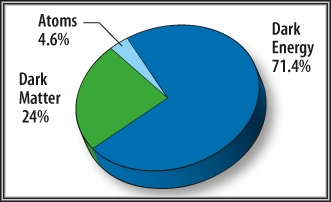
For more than 20 years, scientists have presented in their publications and articles a “composition of the universe” pie chart. By presenting such a chart, they are purporting that they understand the makeup or composition of the universe. The typical “composition of the universe” pie chart looks like this:

dogmatic overconfidence

Notice the precision in the chart, including the claim that exactly 71.4% of the universe consists of dark energy. You would never suspect from such precise numbers that such numbers are just shots in the dark or wild guesses. But that's exactly what they are. No one has ever observed any particles of dark energy or any particles of dark matter. Scientists have been searching for such particles for many years, without success. Neither dark matter nor dark energy has any place in the Standard Model of particle physics. 

Claims that dark matter exists are based mainly on the fact that existing theories of gravity do not explain observed behavior of stars as they revolve around the center of the galaxy. The hypothesis of dark matter is only one of many possible explanations for such a discrepancy. There are alternate explanations such as the idea that gravity may work in ways more complicated than we imagine. We don't actually know whether dark matter exists.

Claims about the existence of dark energy are based on evidence that the expansion of the universe is accelerating. It was in the late 1990's that there first arose the belief that the expansion of the universe is accelerating. Around 1998 two groups announced that after studying supernova explosions in distant stars, the groups had come to the conclusion that the expansion of the universe was accelerating. It was claimed that we must believe in dark energy to explain this acceleration of the universe's expansion. Such a claim was always suspect, as dark energy is only one theoretical way to explain why a universe might have an accelerating expansion. But nonetheless, members of these groups (Perlmutter, Schmidt and Riess) won the 2011 Nobel Prize in physics.

But now Subir Sarkar and his colleagues have written a paper (accepted for publication) calling the evidence for dark energy into question. Sarkar and his colleagues have re-analyzed the supernova data, and have concluded that the expansion of the universe is probably not accelerating. The scientists claim that there is a motion of our local region of space that was not recognized by Perlmutter, Schmidt and Riess, and that such a motion caused the scientists to reach the wrong conclusion. Sarkar and his colleagues say, “Thus the cosmic acceleration deduced from supernovae may be an artefact of our being non-Copernican observers, rather than evidence for a dominant component of ‘dark energy’ in the Universe.” If Sarkar and his colleagues are right, two of the top 10 claims of cosmologists (that dark energy exists and that the expansion of the universe is accelerating) are unfounded.  

The issues are highly technical, and it will be some time before the dust settles and we find out which group is right on this matter. For the time being, I may merely note that this seems to be further evidence of the strong tendency of scientists and science writers to start declaring certain things as facts long before any very clear proof has appeared for the things they are calling facts.

In the article here, we have an example of such overconfidence and dogmatism. Fraser Cain (publisher of the Universe Today web site) claims that scientists “know” that dark energy exists. He claims that there are “multiple lines of evidence,” and lists some space probes (Wilkinson and Planck) that studied the cosmic background radiation. He states:

“NASA’s Wilkinson Microwave Anisotropy Probe studied the Cosmic Microwave Background Radiation of the Universe for 7 years, and put the amount of dark energy at 72.8% of the Universe. ESA’s Planck spacecraft performed an even more careful analysis and pegged that number at 68.3% of the Universe. Astronomers know that dark energy exists. There are multiple lines of evidence.”

But Sarkar is quoted in Physics Today as stating that the cosmic background radiation “does not directly measure dark energy” and that the idea that it does is a “widely propagated myth.” On this point he is right. The idea that we can understand the composition of the universe by studying the cosmic background radiation makes no sense at all. Being uniform to about 1 part in 10,000, such radiation teaches us very little.

There are quite a few “widely propagated myths” spread about by scientists, whose teachings are often the unproven dogmas of their cherished belief system. Cain has made the mistake of thinking that we can know something is true merely because “there are multiple lines of evidence.” Each of multiple lines of evidence can be weak, and they may add up to no convincing basis for believing in something.  A hundred different dubious beliefs can be supported by "multiple lines of evidence" if there are enough people trying to look everywhere for such evidence.  For example, if you believe that extraterrestrials are currently visiting us, you can point to "multiple lines of evidence" such as UFO sightings, alien abduction stories, strange cattle mutilation incidents and crop circles. 

Cain has also failed to see that an estimate of something is not a determination of something. The fact that two teams of scientists estimated a particular level of dark energy did not mean that they had done anything to establish that such a level exists. An examination of the paper on dark energy published by the Planck team should give you no confidence that the team has any kind of good understanding of how much dark energy there is.  The paper merely claimed to be studying "the implications of Planck data for models of dark energy," not to be providing evidence that dark energy exists.  

When asked about the composition of the universe, the only honest answer for a scientist or a science writer to give is to say that he does not understand such a thing. But instead our scientists have again and again spoken as if they knew things they did not know: that dark energy exists and that dark matter exists. Such dogmatic overconfidence takes a particularly absurd form when we see graphs like the one at the top of this post, in which scientists make claims such as the claim that the universe is “71.4% dark energy,” when they are not even sure that dark energy exists. That's kind of like saying that your girlfriend will live as your wife for 40.7 years before you even ask her to marry you.

Monday, October 24, 2016

Dogma Doom: Two Bullets for Dark Matter, One Bullet for Dark Energy?

Our scientists are often giving us visual displays designed to impress us with their grasp of nature. Such visuals should sometimes be taken with a large grain of salt, as they are often examples of dubious dogma. An example is the type of “composition of the universe” pie graph that shows the universe as about 71% dark energy, 24% dark matter and 5% regular matter. But as I discussed in my previous post “A Second Bullet in the Chest of Dark Matter?” the case for dark matter is wobbly, and two recent findings are hard to reconcile with standard accounts of dark matter. Commenting on one of these findings, an astrophysicist has said, “Nothing in the standard cosmological model predicts this and it is almost impossible to imagine how that model could be modified to explain it, without discarding the dark matter hypothesis completely.”

In my previous post I suggested that we should replace the dogmatic “composition of the universe” pie chart with a table listing the universe's contents as ? % dark matter, ? % dark energy, ? % atoms, and ? % unknown. Coincidentally, a few days after making this post, there appeared a news science story that seems to further shatter all confidence that we understand the composition of the universe.

The new science story dealt not with dark matter but dark energy. No one has any idea what dark energy is, but there is a vague idea that the vacuum of space may be filled with dark energy. The case for dark energy seemed to solidify when scientists announced that the expansion of the universe is accelerating. Scientists said that only dark energy in the vacuum of space could account for this acceleration. We were told that dark energy has a kind of expansive pressure, rather like the gas pressure that keeps a helium balloon from collapsing, and that this is causing the universe's expansion to accelerate.

But now dark energy may have taken its own bullet in the chest. It comes from this paper dealing with supernova explosions. The conclusion that the universe's expansion is accelerating was based largely on an analysis of the star explosions called supernova explosions. The new paper also analyzes supernova explosions, but uses a more sophisticated technique and a larger database. The new paper says, “We find, rather surprisingly, that the data are still quite consistent with a constant rate of expansion.”

As discussed here, the new paper casts doubt on the claim that the expansion of the universe is accelerating. In doing so, it seems to undermine the main evidence for dark energy.

Ouch! It looks like our swaggering, strutting cosmologists may have little idea about what they are talking about when they pontificate about the composition of the universe. But we shouldn't be surprised by such dogmatic overconfidence, seeing how extremely common it is in the fields of physics, biology and neuroscience. Should we tear out those pages of the astronomy textbooks that have dogmatic “composition of the universe” pie charts? Perhaps instead we can print up some candid stickers resembling the visual below, and paste them over such “composition of the universe” pie charts. The figure in the white coat represents a scientist with the proper degree of intellectual humility. 

composition of universe
 Postscript: Some news reports said that the authors of the new paper on supernova explosions had said that the expansion of the universe is not accelerating. But their paper was actually entitled "Marginal evidence for cosmic acceleration from Type Ia supernovae." They merely claimed that the evidence for an accelerating universe was marginal. Their paper is rebutted by this paper from today, entitled "Is the expansion of the universe accelerating? All signs point to yes."

Saturday, February 22, 2014

Which Great Scientific Mysteries Are Likely to Be Solved in the Next 50 Years?

As discussed in this blog post, there are many great mysteries that baffle scientists and philosophers. But what are the chances that these mysteries will be solved in your lifetime? Let us look at particular mysteries, and estimate the chance that we will have a solution within the next fifty years.

The Mystery of the Big Bang

The main mystery involving the Big Bang is what caused it. We are extremely unlikely to ever resolve this mystery in the next fifty years. When we look to the edges of the universe, billions of light-years away, we are looking back in time. But no matter how powerful our telescopes might be, we can never look back to the first 380,000 years of the universe's history. In the first 380,000 years after the Big Bang, matter was so densely packed that photons of light could not travel for more than the shortest length before colliding into a proton or electron. This basically means that light from the earliest stage of the universe is effectively blocked, and we are forbidden from looking back to the first 380,000 years of the universe's history.

We can study the cosmic background radiation, dating from this time about 380,000 years after the Big Bang. We have already launched two satellites to do this, the most recent being the Planck satellite. But the observations made by that satellite have offered no new breakthroughs. The chance that we will find the answer to the cause of the Big Bang by studying the cosmic background radiation further is almost negligible.

I estimate that there is less than 1 chance in 100 that scientists will solve this mystery in the next 50 years. Super-fast computers will be of no help in solving this mystery. 


The Mystery of Dark Energy

Dark energy is the mysterious energy that is believed to make up about 68% of the universe's mass-energy. Scientists have no clear idea of what it is, although they have a vague suspicion that it may have to do with virtual particles created in the vacuum of space.

The hugely expensive Large Hadron Collider has not got us any closer to unraveling the mystery of dark energy. Next year the LHC will begin new activity that will greatly increase the energy of its collisions. It is still very unlikely that this will produce anything helping to solve the mystery of dark energy.

As discussed here, there are plans for a 60-mile long successor to the Large Hadron Collider, one that will be completed in 2035. There is not much reason to be hopeful that this will solve the mystery of dark energy, although it may shed some light on it.

Super-fast computers will be of little help in solving this mystery. I estimate that there is less than 1 chance in 10 that scientists will solve the dark energy mystery in the next 50 years.

The Mystery of Dark Matter

Dark matter is believed to be a mysterious type of matter that makes up more of the universe than ordinary matter. The problem with dark matter is that it cannot be directly observed through ordinary methods. So it is very unlikely that we will understand it very well any time in the next few decades. About the most we can hope for are some type of observations that clearly nail down the fact that it really exists.

I estimate that there is less than 1 chance in 3 that scientists will solve the dark matter mystery in the next 50 years, in the sense of getting a clear idea of what type of particles it is made of. 
 
The Origin of Life

Very little progress has been made in discovering exactly how life originated on Earth billions of years ago. There was a ray of hope when Stanley Miller did his famous experiments back in the 1950's, but since then progress has been very slow.

The prospect of vast strides in supercomputers offers some hope that some progress may be made in helping to solve this mystery. Conceivably vastly improved supercomputers might do some kind of simulation involving billions or trillions of chemical combinations, a simulation that might throw new light on the mystery of the origin of life and the origin of the genetic code. We can also imagine that there might be robotized chemistry laboratories that might help to resolve the issue.

I can optimistically estimate that there might be as much as 1 chance in 3 that this mystery will be solved in the next fifty years.

The Mystery of Existence

The mystery of existence is the age-old mystery of why there exists something rather than nothing. It is a perplexing problem, because nothing seems more natural and plausible than simplicity, and the simplest possible state of existence is complete nonexistence – no God, no matter, no energy, no universe, just absolutely nothing, forever and ever. So why didn't such a perfectly simple state of existence (complete eternal nonexistence) occur?

I see no real chance that any new scientific observations can solve this problem, and it isn't likely that supercomputers will help us solve it. There is some chance that we might be able to resolve this mystery by increasing our intelligence, and increasing our ability for philosophical reasoning. We might then be able to understand some reason for existence that we failed to grasp before.

But that would require a major increase in human intelligence, which is probably a long way off (the assurances of singularity enthusiasts notwithstanding). I therefore estimate that there is less than 1 chance in 10 that we will resolve the mystery of existence in the next fifty years.

The Mystery of Whether We Are Alone in the Universe

There are two ways in which this mystery might be resolved: negatively or positively. We would resolve this mystery negatively if we were to somehow prove that we are alone in the universe. We would resolve this mystery positively if we somehow found out that we are not alone in the universe.

There is zero chance that we will resolve this mystery negatively in the next fifty years, and zero chance that we ever resolve this mystery negatively. This is because the universe is too big. Our galaxy has billions of stars, and there are billions of galaxies. Even if we somehow create spaceships capable of traveling instantaneously (something most unlikely), it would still take millions of years to survey all the planets in our galaxy, determining that none had intelligent life. By the time such a job were finished, we still could not say we are alone in the galaxy, because during those millions of years intelligent life could have still have evolved on planets when we were not checking them. And that's just the difficulty of determining that we are alone in the galaxy – the job of determining we are alone in the universe would be billions of times more difficult.

When it comes to the possibility of resolving this mystery positively (determining that we are not alone in the universe), we have an entirely different situation. We have a decent chance of doing that in the next fifty years. All we would need to do would be to pick up a radio transmission from another civilization.

This is one area where advances in supercomputers might help. Such advances may allow us to scan millions of frequencies for radio signals more efficiently.

I therefore optimistically estimate that there is about 1 chance in 2 that we will resolve the mystery of whether we are alone in the universe in the next fifty years.

The Mystery of Cosmic Fine-Tuning

The mystery of cosmic fine-tuning is the mystery of why the universe seems to be so exquisitely calibrated to allow the existence of intelligent creatures such as us. Anyone doubting that there seems to be such fine-tuning should read this post and this post.

It is most unlikely that we will discover any final answer to this mystery in the next fifty years, as unlikely as you becoming a lottery millionaire. Despite the misguided enthusiasm of multiverse enthusiasts (who imagine a huge collection of universes, each with different characteristics), there is basically zero prospect of ever being able to confirm such an idea – unless you wish to imagine some machine for transporting a man or a robot into different universes, an idea even more implausible than a machine for sending a man back in time.

The Mystery of Consciousness

The mystery of consciousness is the mystery of how consciousness arises from matter, something that seems to be entirely different from consciousness. Philosophers have long pondered this question. We currently have no understanding of how this occurs. There are various exotic theories, such as Roger Penrose's theory involving quantum effects in microtubules.

Some think that solving the mystery of consciousness is just a matter of increasing the resolution of brain scanners. Some optimists think that if we can only scan neurons with ever more detail, and understand more precisely the exact chemistry and physics of brain actions, we will one day understand the mystery of how the brain produces consciousness. Others think that no matter how much progress we make in understanding the brain, we will never be able to understand exactly how consciousness is produced by it. They point out that we can never imagine seeing some high-magnification photograph from an electron microscope or a diagram of a chemical reaction or a printout of brain electricity, and then really understanding how consciousness could arise from that.

Because such reasoning seems powerful, I estimate that there is no more than 1 chance in 5 that we will solve the mystery of consciousness in the next fifty years.

Conclusion

Most of the great mysteries of nature are not things we should expect to see solved in our lifetimes. Get used to living in a mysterious universe, for it is most unlikely that more than one or two of the deepest mysteries will be cleared up in your lifetime. There will be fantastic advances in computing power and robotics in your lifetime, but that will do us very little good in solving most of the great mysteries that face us.

As far as how we can best spend our money to help solve age-old mysteries, the technology with the best chance of producing results is probably not hugely expensive particle colliders costing many billions, but instead relatively inexpensive radio telescopes that can be constructed with only millions of dollars. Besides offering the hope of solving the age-old mystery of whether we are alone in the universe, such devices might allow us to receive radio signals from beings vastly older than us. Conceivably they might give us the answer to cosmic mysteries that might take us many thousands of years to solve on our own.

Thursday, December 26, 2013

We Do Not Understand How the Universe Came to Look This Way

From the time of the Big Bang nearly 14 billion years ago, the universe has undergone an amazing evolution. Imagine if you had been there at the beginning, to witness the hot smooth density, in which supposedly all of our universe was packed into a microscopic size. If you knew nothing about the eventual outcome, you would not have been optimistic about what would have resulted from this explosive event. Your best bet might have been a mess of disorganized space junk, with no more order than the debris resulting from a hydrogen bomb explosion.

But almost 14 billion years later, we have a universe of remarkable order. Matter is organized into superclusters of galaxies consisting of clusters of galaxies consisting of galaxies consisting of solar systems. A large fraction of the galaxies are the particularly beautiful type called spiral galaxies. Do scientists really have a firm grip on how this improbable evolution occurred?

Difficulties in Explaining the Seeds of Structure

Scientists say that the current structure of the universe evolved from what are called primordial density fluctuations. They can see tiny fluctuations in the cosmic background radiation, which is uniform to about 1 part in 100,000. But how did those fluctuations get there?


Cosmic Background Radiation

The most common explanation is that the fluctuations began as quantum fluctuations (matter popping into existence in accordance with Heisenberg's uncertainty principle), and that these quantum fluctuations were then amplified by a period of cosmic inflation (exponential expansion) that occurred for a fraction of a second when the universe was less than a second old.

The difficulties in this explanation are many. For one thing, no one has ever actually observed a quantum fluctuation that caused matter to appear out of nowhere, not even a fluctuation big enough to produce an atom. Secondly, there are currently serious credibility issues associated with the theory of cosmic inflation, issues that have been highlighted by Princeton physicist Paul Steinhardt in this review. Among those issues are what Steinhardt calls an “unlikeliness” problem, plus the problem of creating an inflation theory that both begins and ends an inflation phase while remaining consistent with observations. Cal Tech physicist Sean Carroll says here, “When perturbations are taken into account, inflation only occurs in a negligibly small fraction of cosmological histories,” and then spells that out as a fraction less than 1 in 1.000,000,000,000,000,000,000,000,000. The leading cosmologist Roger Penrose has described cosmic inflation as a thermalization process, and has stated, “There is, however, something fundamentally misconceived about trying to explain the uniformity of the early universe as resulting from a thermalization process.” He states that any thermalization process doing anything would have “been even more special before the thermalization than after” (The Road to Reality, page 755).

Third, the inflation theory requires a severe fine-tuning of its model parameters in order to perform the trick of inflating these quantum perturbations to be the right size. As one scientist puts it here:

A lumpiness of about 10-5 is essential for life to get a start. But is it easy to
arrange this amount of density contrast? The answer is most decidedly no! The
various parameters governing the inflating universe must be chosen with great
care in order to get the desired result.

In short, we do not yet have a good plausible explanation of how these “seeds of structure” appeared. The only explanations are ones that resort to extensive parameter tweaking, rather like in the graphic below.


Explaining the Growth of Structure: More Nebulous Fudge Factors

Scientists have done calculations regarding the formation of galaxies and the preservation of galactic structure, and have come up with the resounding conclusion that the gravity of visible matter is completely insufficient to explain the origin and persistence of galactic structure.

Consequently cosmologists have come up with some “fudge factors” to help explain things. The two biggest fudge factors are called dark energy and dark matter. Scientists say that dark matter is a mysterious type of matter that is invisible. Dark energy is supposed to be a mysterious unseen energy that pervades all of space. Scientists guess that the universe's mass-energy is 68% dark energy, 27% dark matter, and 5% regular matter.

Total unambiguous observations of dark matter: 0
Total unambiguous observations of dark energy: 0

It's not as if scientists haven't tried. They have spent many dollars and much time with some very fancy observation techniques, but have still come up short. But that hasn't stopped cosmologists from creating a “lambda cold dark matter” theory (called LCDM) designed to explain cosmic structure.

Besides the fact that it relies on dark matter (the existence of which has not been verified), there are problems in this LCDM theory. One of the main problems is that it predicts way too many satellite galaxies. The paper here describes the problem. According to this link the LCDM theory predicts that our galaxy should have thousands of satellite galaxies, but instead it only has about 26.

Another problem with the LCDM theory is that it predicts that almost all galaxies should have have large bulges in the center or be spherical. But between 58% and 74% of disk-shaped galaxies do not have a bulge.

Another problem with the LCDM theory is the difficulty of getting it to produce not just galaxies but a universe with as many beautiful spiral galaxies as we have in our universe.

A spiral galaxy

As this site says, "Cosmological evolution simulations do not generally produce universes containing large spiral galaxies. Rather they produce clumps of matter making up roughly spherical amorphous galaxies without anything like the broad disks and extended arms of a typical spiral galaxy." 

Strange Anomalies

In this story a scientist comments on strange findings he has discovered by studying deep space:

"The dark matter seems to 'know' how the visible matter is distributed. They seem to conspire with each other such that the gravity of the visible matter at the characteristic radius of the dark halo is always the same...It's like finding a zoo of animals of all ages and sizes miraculously having identical, say, weight in their backbones or something...It is possible that a non-gravitational fifth force is ruling the dark matter with an invisible hand, leaving the same fingerprints on all galaxies, irrespective of their ages, shapes and sizes."

Perhaps this is some strange cosmic conspiracy, or perhaps just a reason why we may need an explanation other than dark matter. Another strange finding is the discovery of a Vast Polar Structure (VPOS), which is basically about 26 dwarf galaxies above and below our galaxy, without any matching structure on the other two sides of our galaxy. This structure does not at all seem to be what we would  expect from a dark matter theory of the origin of structure (and may be hard to explain even with alternate theoretical models). If gravity alone is creating structure, why don't these companion galaxies exist in more of a sphere around our galaxy?

The limits of our understanding of cosmic structure may also have been highlighted by the recent discovery of the planet HD 106906 b, a planet 11 times the mass of Jupiter. HD 106906 b orbits its star at a distance 650 times the average distance between Earth and the Sun. That puts the planet 20 times farther away from its star than the planet Neptune is from the Sun. This finding seems to be quite incompatible with current theories of solar system formation. HD 106906 b is being called “the planet that shouldn't exist.”

Particle Physics Makes the Situation Even Worse

When we look in the world of particle physics for help with these problems in explaining large scale structure, we get no help.

The prevailing theory of large structure formation (the Lambda Cold Dark Matter theory) is based mainly on the hypothesis of dark matter, but dark matter is totally unaccounted for in the Standard Model of physics. Dark matter has no place in that model. That leaves dark matter as a kind of nebulous “some kind of something.” Do we know how many dark matter particles there are, or how much mass any dark matter particle has? We sure don't.

Modern quantum physics does predict that dark energy should exist. The problem is that quantum field theory predicts that the dark energy should be at least 1060 times (a trillion trillion trillion trillion trillion times) larger (and probably 10120 times larger) than the maximum value that it can be, according to observations. This is known as the vacuum catastrophe problem or the cosmological constant problem. Quantum field theory predicts that every cubic meter full of vacuum should contain more energy than the maximum amount that the observable universe can contain.

In light of all these considerations, the graphic below summarizes the current very shaky state of our current understanding of the formation of cosmic structure.