Header 1

Our future, our universe, and other weighty topics


Showing posts with label Mars. Show all posts

Monday, August 24, 2026

Unimpressive "Mars Jellyfish" Goes Viral, While Far Stronger Photos of the Spooky Are Ignored by Mainstream

I am seeing in my news feeds these days articles about a photographic anomaly on Mars. An example is an AOL article that appeared on the Yahoo site and also on Google's Science News page. It was entitled  "Jellyfish" Spotted In NASA Mars Photo Sparks Frenzy As People Dig For Explanation." 

We read that people on social media are getting all excited about a photo taken by the Curiosity rover "on August 20, 2023, during Sol 3924 of its mission while exploring Gale Crater on Mars." In any report like this, it is essential to look for the original NASA page containing the photo. That page is the one here.  That page has a 1024 by 512 image of the surface of Mars. The page has a Download button, but in this case the button is unnecessary, because when you click that button you get the same 1024 by 512 image displayed on the page. 

The 1024 by 512 image showing the photographic anomaly is the one below:

Mars jellyfish

If you look in the bottom left, you may notice a little anomaly. Below is a crop of that portion of the photo, a crop that is 77 pixels by 71 pixels:

77 pixels by 71 pixels

You should not be impressed by this, given that the anomaly in the middle consists of a handful of pixels. The anomaly is maybe 10 pixels in width and 10 pixels in height. A good rule of thumb when dealing with anomalies in photos is: ignore any anomaly that consists of only a very small number of pixels in a photo, particularly if it is an anomaly that only appeared once. There are 1001 mundane reasons why you can get such "handful of pixels" anomalies. 

The NASA page here allows you to see other photos taken on the same day. Other photos from the same angle on the same day fail to show the anomaly. For example, one is below.

Can we think of a natural explanation for the anomaly appearing in the first photo shown above? We certainly can. The anomaly looks rather like something known to frequently occur on Mars: what is called a dust devil. Observed on both Earth and Mars, dust devils are fleeting little mini-storms that cause dust to rise in the air. Dust devils are thought to be more common on Mars, which is covered in fine, lightweight dust. The Google Gemini infographic below explains what causes dust devils on Mars. 

dust devils on Mars

So in this case we have a known natural phenomenon on the surface of Mars (dust devils) that can easily be the cause of the so-called "Mars jellyfish." There is no need to assume that there's some weird undiscovered life form on Mars, merely because a photo shows on the horizon of Mars something that looks like a dust devil.  Another possibility is that a tiny bit of dust got on the camera lens, and was blown away by the time the next photo was taken. Because the surface of Mars is so abundantly filled with fine dust, such a thing would be not very improbable. 

We have three glaring failures of the "Mars jellyfish" photo to qualify as good evidence of the paranormal:

(1) The photo is a "one shot" affair, with there being only one photo showing the anomaly. 

(2) The photo is a "handful of pixels" affair, with the anomaly showing up as only a very small number of pixels (and almost all such "handful of pixels" things are dubious). 

(3) There is a known natural phenomenon on Mars (dust devils) that can produce something like what we seem to see in the "Mars jellyfish" photo. 

It is ironic that social media and mainstream sites get all excited about low-quality evidence such as a photo showing only a few spooky-looking pixels, while far more impressive photographic evidence of the spooky continues to be mostly ignored by social media and mainstream sites.  Back in my most productive days as a photographer of the anomalous, I got two types of very spooky anomalies that were very worthy of attention, but which were ignored by mainstream sites: (1) photos of dramatically repeating stripe patterns in mysterious orbs, taken under clean, dry conditions, and (2)  photos of dramatically repeating patterns in mysterious orbs, taken during photography of falling water drops. 

To read about the details of the first of these two things, you can read my post here or my post here. The visual below shows 36 types of repeating patterns I got in mysterious orbs I photographed in clean, dry air. The number under each photo is the number of times I photographed an orb with the stripe pattern shown. For example, under the first photo (showing an inverted Y pattern) we see "x11." That means that 11 times I photographed a mysterious orb with such a pattern. See my post here to see the photos that are the basis of this summary infographic. 

recurring orb patterns

Almost all of these pattern repetitions would occur on different days, with in-between photos showing no such pattern. So, for example, the photos below (showing the same pattern) were taken on the different days shown in the caption and documented in the posts here and here and here, and there were very many other photos taken on the same days and days in-between these days, showing no such pattern:

mysterious orb patterns

 And the two repetitions of the "ballet dancer" pattern below occurred on different days mentioned in the caption below, with many in-between photos showing no such pattern:

repeating pattern in mysterious orbs


 In the two photos above there was a most astonishing double pattern repetition, with both a "ballet dancer" pattern being repeated, and also below that a "vertical stripe" pattern being repeated. 

Altogether over the span of several years I got more than 800 photos of mysterious striped orbs, while photographing in clean dry air. You can conveniently see all of these photos using the link here, which takes you to a free online book which you can read by finger-swiping, after clicking on the [] icon at the bottom of the book viewer. The striped orbs appeared in a variety of colors. So, for example, I got 69 photos of striped blue orbs, 15 photos of striped pink orbs, 19 photos of striped purple orbs, 24 photos of striped red orbs, 15 photos of striped yellow orbs, 37 photos of striped green orbs, and 23 photos of striped orange orbs. 

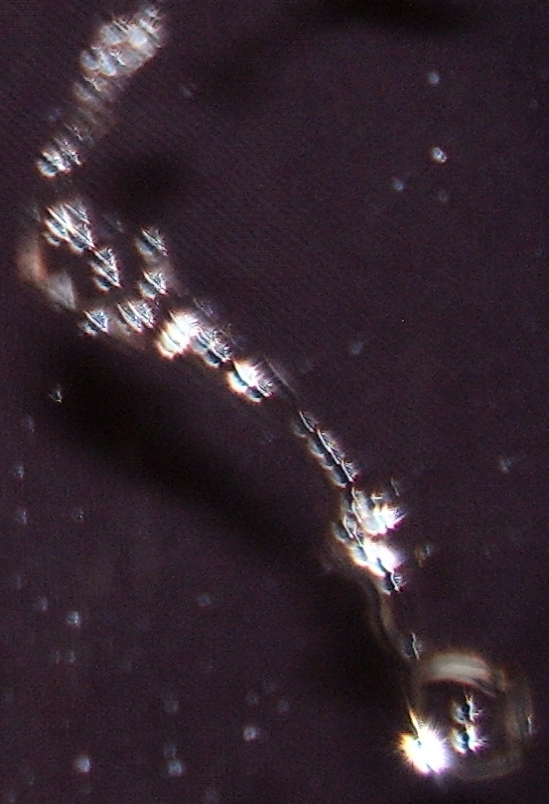
A different type of very spooky photo anomaly I got in the most enormous abundance over the course of several years was the appearance and persistence of inexplicable and massively occurring orb patterns while I photographed ordinary drops of clean, pure water falling in front of a black, featureless background. Something like this would happen on very many different days. I would be photographing ordinary drops of pure, clean water falling in front of a black featureless background, using the protocol I describe in the second half of my post here. After quite a few photos showing nothing very notable, there would suddenly appear most mysteriously an unexpected pattern, repeating many times in circular shapes appearing in the photos.  An individual photo might show five or more very clear repetitions of the pattern. And exactly the same pattern would persist for many consecutive photos, often hundreds. 

The most convenient way to examine my photos of this phenomenon is to use the link here, which takes you to a free online book of 1495 pages, my book "Vast Precision of the Orb Patterns" which can be very conveniently read by finger-swiping, after the user has pressed the [] icon at the bottom of the book viewer. 

Some choice examples of the patterns I got with very great repetition can be seen in my summary posts here and here. On one day while doing photography of only ordinary drops of pure clean water falling, I photographed many hundreds of orbs with face-like details, such orbs appearing in most of hundreds of consecutive photos. Below is one example showing seven occurrences of the same face-like pattern.  At the link here you can see a video of my camera viewfinder while I took photos such as the one below and the next photo after it. See here and here for similar photos from the same day.

aquatic mega-patternization

On another day while doing photography of only ordinary drops of pure clean water falling, I photographed  a series of hundreds of consecutive photos that almost all showed multiple instances of a breast-like shape, with this breast-like shape appearing a total of more than 1000 times.  Below is one example (see here and here and here for others).  At the link here you can see a video showing my camera viewfinder while I took many of these photos. I got a similar pattern on this other day.

aquatic mega-patternization

On another day while doing photography of only ordinary drops of pure clean water falling, I took more than a thousand photos showing face-like details as we can see in the photo below.  Additional examples can be seen here.  A video showing my camera viewfinder while I took some of these photos can be seen here.


paranormal faces


Striped orbs would often dramatically appear in great abundance when I photographed falling drops of pure, clean water. On one day I got the pattern shown below. We see 25 striped orbs in a single drip of pure, clean water.

paranormal water drip

On another day I got the pattern shown below while photographing only pure, clean water falling against a featureless background. 

mysterious water


On one day I got the two-part pattern below, which persisted through almost all of hundreds of consecutive photos. I can't explain how these colors showed up when photographing only pure, clean falling water drops. 

orb two-part pattern

On one day while doing photography of only ordinary drops of pure clean water falling, I photographed a "snowman" motif consisting of a smaller circle on top of a larger circle, both on the right side of an orb.  Such a "snowman" motif appeared more than 5000 times in most of 1600+ consecutive photos I took, with the "snowman" motif appearing at least several times in most of these photos.  Below are two examples (see here for more). I photographed a similar pattern on this day.

aquatic mega-patternization

All kinds of patterns would appear during such photography of falling drops of pure, clean water. A particular pattern might have up to seven  different parts. Below (from my post here) is an example of a five-part pattern that mysteriously arose one day while doing photography of only ordinary drops of pure clean water falling, with many repetitions in consecutive photos:

five-part orb pattern

On another day I got the seven-part pattern shown below, which persisted through almost all of more than forty consecutive photos, appearing multiple times in most of such photos. 


seven-part orb pattern

On one day while doing photography of only ordinary drops of pure clean water falling, I got the photo below showing a motif repeating nine times.

aquatic mega-patternization

The photographs I describe here are not "handful of pixels" stuff like the crummy 10-pixel by 10-pixel affair that makes up the anomalous part of the so-called "Mars Jellyfish" photo. The photos I describe above are high-resolution photos in which each anomaly involves many pixels. And while the "Mars Jellyfish" photo can easily be naturally explained by assuming that a distant dust devil was photographed, or that a little of the super-abundant Mars dust got on the camera lens for a while,  we have no such convenient explanation for the photos of mine I have described above. They are shockingly anomalous, and seem to be suggestive of some mysterious power capable of making inexplicable manifestations with the most enormously precise power of repetition and persistence. A person adequately studying biology should not be too surprised by such a phenomenon, because within each of our bodies there occurs every day a million miracles of high-speed assembly (as described here), in which "molecular machine" protein complexes needed for our continued lives are mysteriously assembled with the most enormous precision, by some means that scientists do not understand. 

The photos of mine I refer to above were published online over a span of seven years between about 2015 to 2022, long before there were any good AI image generators invented. No trick photography or Photoshop-like product was used to make any of these photos, which looked the same to my eyes when I first saw them as they appear above and in the sources above.  You can see the photos in their original posts by browsing through my "Orb Pro" blog here. The Wayback Machine at www.archive.org has taken many snapshots of that blog over the years, documenting the photos were published during that period. My several long youtube.com videos showing my camera viewfinder during the photography of such wonders help to show the authenticity of these photos. Two examples of such videos are below. 


Among my photos have been 1500+ photos of mysterious blue orbs. An example of one is the photo below I published in 2015 in the post here. The size of the blue anomaly in the photo is roughly 200 pixels by 200 pixels. That's an anomaly photo area of roughly 40,000 square pixels, which is roughly 400 times larger than the anomaly photo area of merely 100 pixels in the "Mars jellyfish" photo. My photo here (taken with a different camera) shows an equally striking anomaly with a size of about 60,000 square pixels. 


Why has the unimpressive "Mars Jellyfish" photo gone viral, while so much better photos of the spooky have been ignored by the mainstream? You can explain it in terms of people getting excited about something that fits in with their worldview, while ignoring something conflicting with their worldview. Our media is largely controlled by an academia-centered "Ministry of Materialism" that wishes to propagate materialist ideas (to use a metaphorical phrase I coined in a post).  Those who serve that ideology want very much to believe that life arose on Mars, a place incredibly inhospitable to life. Life on Mars (particularly large macroscopic life) might show that blind evolution may have a great power to beat the most prohibitive odds, producing wonders of biology. 

But the same powers controlling such a "Ministry of Materialism" do not want to believe that there can be a mysterious unseen power acting here on planet Earth, capable of somehow producing the most astonishingly repetitive spooky manifestations with the most enormous precision. So even when the most abundant evidence of such a thing has been published, such an ocean of evidence may be ignored by those controlling the articles that appear in our news feeds. Playing "phenomena amnesia," the same information overlords ignore two hundred years of convincing written evidence for the paranormal, very much of it written by scientists and doctors, as well as an enormous body of evidence conflicting with their cherished "brains make minds" ideas.  

It's kind of a situation where the operating principle is rather like this: "a few drops count as an ocean, if it seems to support what I believe; but an ocean of evidence doesn't even count as a few drops, if it seems to conflict with what I believe."

Monday, April 27, 2026

When Science News Stories Mislead, the Paper Author May Be the Culprit

 Sometimes you may read some moonshine in the science news, some bunk article promoting the latest science paper, and then ask yourself: who is to blame for this baloney, this BS? Is it one or more of the paper authors, or is it the author of a university press release, or is it some science journalist working from the press release and the paper?  So you have a kind of "figure out the culprit" challenge that is a bit like playing the board game Clue. 

Who was the confusion culprit?                      

Tuesday April 22, 2026 was a banner day for hype and groundless boasts in the science world. There was a press conference announcing some findings regarding Mars. It was announced that some organic molecules had been found in Mars, but only simple molecules that existed in a very low concentration of a few parts per billion.  Most of the science news headlines used the phrase "building blocks of life," although such a headline was entirely unjustified, as no such thing had been found. All that was found (in very low amounts) was what are called "organic molecules." That term is used for any molecule containing carbon. Most types of organic molecules found in space have no relevance to life. 

The misleading press accounts were heralding the scientific paper here. None of the chemicals reportedly found on Mars (trimethylbenzene, tetramethylbenzene, naphthalene, and benzothiophene) is actually a building block of life in any sense. So our clickbait-hungry science press was deceiving us very badly on this topic. 

Using the term "nmole" to mean nanomoles, the paper states, "Molecular abundances in the SAM TMAH experiment range from 0.1 ± 0.0 to 1.7 ± 0.3 nmol, consistent with the range of abundances of individual molecules identified by SAM from other Gale crater outcrops." This means the chemicals were found at a very low level of very roughly 1 part per 100,000,000. This amount is correctly described as a negligible trace amount. 

The building components of life are proteins and nucleic acids, both of which are extremely complex molecules -- so complex that it is always misleading to call them "building blocks" (as blocks are things of very low complexity). Given just the right arrangement of a large number of proteins and nucleic acids, you might have a cell capable of self-reproduction.  But an organic molecule is simply any molecule containing carbon, one that may either be very simple or one that may be complex. The very term “organic molecule” is a poor one, because many of the so-called organic molecules have nothing to do with life. 

It is true that proteins and nucleic acids are organic molecules, but that doesn't mean you have found anything like a building block of life merely because you have found an organic molecule. The building blocks of an opera company are string musicians such as violinists, and singers such as tenors, sopranos and baritones that can sing Italian. All of these are organisms. But it would make no sense to say, “I have some building blocks of an opera company because I have two mice in my cage, and they are organisms.” It makes equally little sense to say that you have some building blocks of life merely because you have simple organic molecules.

But if the organic molecules found on Mars are not the building blocks of life, are they at least the building blocks of the building blocks of life? No, they are no such thing. The building blocks of proteins are amino acids. The building blocks of nucleic acids are chemicals called purines and pyrimidines. None of these has been found on Mars. So not only have we not found the building blocks of life on Mars, we haven't even found on Mars the building blocks of the building blocks of life.

Related to coal tars, the reportedly found chemicals (trimethylbenzene, tetramethylbenzene, naphthalene, and benzothiophene) are neither building blocks of life nor the building blocks of the building blocks of life.  So the science news sites were misleading us badly by describing the finding as a finding of "building blocks of life."

The Guardian story here gives us an example of the carnival barker BS and baloney that was occurring. The story has the  hogwash headline "‘Is it life? We can’t tell’: Nasa’s Curiosity rover finds organic molecules on Mars." The paper's lead author (Professor Amy Williams) says, " “Is it life? We can’t tell, based on this information.” That statement is  baloney.  Living things are not made from any of the chemicals found, so you sure can tell that no life is being detected. 

Later on Williams gives us this mostly false statement:

" 'There are several steps between what we found and DNA,' Williams said. 'It is definitely a building block to how DNA is made now. But it is truly just the bricks, not the house. You can generate these molecules geologically.' "

The statement is mostly untrue. DNA is not made from any of the chemicals that the scientific paper claimed to find. DNA is made from entirely different chemicals, called nucleobases, phosphate groups and sugars. So there's no truth to Williams'  claim "it is definitely a building block to how DNA is made now." Nowhere in nature is DNA being made from  the chemicals the paper reports finding (trimethylbenzene, tetramethylbenzene, naphthalene, and benzothiophene). The paper does not even use the term "DNA," and refers to nucleic acids only in a tentative passing comment about a "possibility" involving nucleic acids. 

The Guardian's story is bunk, but here we must absolve the story author, who got a bum steer from a science paper author making misleading claims about her research. 

Later in the Guardian article Williams gives us this unbelievable "magic meteorites" tall tale: "The same stuff that rained down on Mars from meteorites is what rained down on Earth, and it probably provided the building blocks for life as we know it on our planet." Why would anyone claim that chemical constituents of the earliest life came from meteorites, when you can more simply imagine them coming  from Earth's surface, without evoking falling meteorites?  Similarly, it would be pretty silly to speculate that your dinner date did not show up  because a  meteorite ruined his car, when you can just as easily claim that he got a flat tire by driving over something sharp. 

One of the news articles tried to make it sound like the discovery of these biologically irrelevant chemicals was a discovery of life on Mars, an inhospitable wasteland where neither life nor its building components have been found. The clickbait-hungry hucksters of the dysfunctional "Science News" infosystem tend to follow a rule of "give us an inch, and we'll take a mile." So when scientists issuing papers misstate and misspeak, they are planting seeds that very quickly grow into the poison fruit that is Fake News. 

Mars hype

Postscript: The issue of earthly contamination throws great doubts on the credibility of all reports of finding something on Mars in the tiniest trace amounts, as anything detected in some tiniest trace amount might have been on the scientific equipment when it left Earth. The same contamination issue undermines the credibility of all claims to have detected amino acids in samples retrieved from asteroids. In that case the contamination possibilities are doubled, because the tiniest "1 part in 100,000,000" microscopic traces of some chemical could have  come from the spacecraft involved in the retrieval or from an earthly laboratory analyzing the retrieved sample. A recent article by an astronomer tells us that scientists got excited about claims that glycine (the simplest amino acid) was detected in space through spectroscopic analysis. But she says "astrochemists now generally agree that glycine had not been found in star-forming nebulae." If we cannot even find by spectroscopic analysis the simplest amino acid in outer space, it seems we should have little confidence in the claim by Williams that " meteorites ...probably provided the building blocks for life as we know it on our planet." 

Monday, March 23, 2026

NASA's Diminished Credibility on the Topic of Extraterrestrial Life

We hear these days quite a bit about "AI slop," error-containing output from AI programs. But it seems that an even worse problem is what we can call "science slop," and define as unbelievable news stories showing up on web sites or web pages claiming to give "science news." 

science slop

In September 2025 NASA made an utterly groundless boast of having discovered "potential biosignatures" on Mars. NASA had a press conference that received the most massive press coverage, even though it announced nothing new. All that was being discussed was the same utterly unimpressive find announced the previous year.  

The NASA press conference was devoted to trying to get people excited about the unimpressive-looking rock below, called the Cheyava Falls rock, which has no visual signs of life. The spot circled and called a "leopard spot" looks nothing like a leopard spot, and could have been formed by any of 1001 lifeless processes. 

Credit: NASA

The press conference was called to publicize a scientific paper about the Cheyava Falls rock and nearby rocks scanned in 2024. That paper has the dull title "Redox-driven mineral and organic associations in Jezero Crater, Mars." We hear no mention of any amino acids being found. Trying to boost excitement about something that is very probably no indication of life, the paper states, "In summary, our analysis leads us to conclude that the Bright Angel formation contains textures, chemical and mineral characteristics, and organic signatures that warrant consideration as ‘potential biosignatures’, that is, 'a feature that is consistent with biological processes and that, when encountered, challenges the researcher to attribute it either to inanimate or to biological processes, compelling them to gather more data before reaching a conclusion as to the presence or absence of life.' " 

The building components of one-celled life are many types of protein molecules, and the building components of protein molecules are twenty types of amino acids. Protein molecules used by living things are built from long sequences of twenty types of amino acids. Most types of protein molecules require a very special sequence of hundreds of amino acids. No amino acid used by life has ever been found on Mars.  It is therefore extremely misleading and arguably deceptive to be referring to something not looking like life found on a planet without any discovered amino acids, and to be calling such a thing a potential biosignature. 

I can give an analogy for how deceptive the use of such language is. Suppose you sent a spacecraft to orbit around some moon of a planet such as Jupiter and Saturn. Suppose you saw a little crater-like hole in the surface of the planet, something looking rather like this:


There would be three possibilities here:

(1) The feature might have been caused by some meteorite hitting the surface, the most common cause of craters. 

(2) The feature might be a sinkhole, caused by a sinking in of a little bit of the surface, as often is observed on our planet. 

(3) Or, maybe the feature was created by intelligent beings who were trying to start building a house, and were excavating as part of building the foundation of the house, and maybe the feature is a "potential signature" of purposeful engineering. 

In order to consider whether item (3) is a reasonable possibility, you would need to ask questions like this:

(1) Is this moon a place that can reasonably be postulated as a place where intelligent agents live, agents who might be starting to build a house for themselves?

(2) Are there any signs of building materials around or construction equipment around, things like shovels, bricks, pipes or boards?

If the answer to both of these questions is no, then there would be no reasonable chance that the observed feature is a potential signature of purposeful engineering. In that case anyone calling the feature a "potential signature of purposeful engineering" would be a deceiver, someone whose word should not be trusted. 

The situation I have described is analogous to what went on with the NASA press conference. Specifically:

(1) Just as the moon described in my analogy is a place profoundly hostile to life, Mars is a place profoundly hostile to life. 

(2) Just as the crater feature described in my analogy is at a place where there are no construction materials around lending credence to the possibility of a deliberate construction job, Mars is a place where no amino acids have ever been found, a place where none of the construction components for life have ever been found. 

The scientists and NASA personnel trying to persuade us that a "potential biosignature" had been found seemed as misleading as a scientist getting a photo of a mere crater, and describing it as potential signature of extraterrestrial intelligence. 

What has happened is predictable. The clickbait-hungry "science news" infosystem has followed their usual "give us an inch, and we'll take a mile" policy in its treatment of the NASA press conference. Now the Internet is filled with bogus stories groundlessly claiming or insinuating that life was discovered on Mars. 

Almost certainly NASA knew this would happen. The bogus stories are presumably exactly what it wanted, so that a Mars sample return mission would be funded. 

Without any warrant at all, NASA and some scientists have claimed "potential biosignatures," thereby misleading us very badly. If they had been honest they would have said something like this:

What we found could have been caused by life, but also could have been caused by lifeless geological processes. Given that we have searched hard for the lowest building components of life on Mars, and never found them, failing to ever find amino acids on Mars, we must reluctantly assume that almost certainly what we found is not any sign of life.

But they did not say that. Instead they used misleading language trying to cause people without any good warrant to believe or suspect that life had been found on Mars. This is not at all the first time this happened. NASA was involved in a similar affair of "crying wolf" during the 1990's, when it got the US President at that time (Bill Clinton) to do a press conference issuing a false claim that life had probably been found on Mars. 

So we should no longer regard NASA as an authority that has great credibility on the topic of extraterrestrial life. If the Mars sample return mission is funded, and NASA announces that the returned samples contain traces of life, we should be skeptical about what they tell us. We should instead suspect that anything found is the result of earthly contamination, or pareidolia by overeager NASA scientists. Ditto for NASA's missions to moons of Jupiter or Saturn. If NASA scientists ever announce they find life from any such missions, we should just roll our eyes, and say to ourselves, "On this topic you can't trust these guys as far as you can throw them." 

I now read that the Mars sample return mission has apparently lost its funding. NASA's attempt to whip up interest in the mission has failed to yield the desired funding. The failure to obtain the funding suggests that executive powers may have realized the "potential biosignatures" boast was unfounded.  Scientists have voiced relatively little protest about the cancellation. We can be rather sure that if scientists thought there was a good chance of detecting life by returning the Mars samples, that the scientific community would "scream bloody murder" about the cancellation. But the protest of the cancellation seems to have been faint, rather as if scientists realized the "potential biosignatures" boast was unfounded.  

Meanwhile, while an immoral and illegal war of aggression is raging in the Middle East courtesy of an unprovoked attack by the White House, NASA has a Big New Task it is eagerly working on: an Artemis II mission to have  astronauts go in orbit around the moon. This is something that was already accomplished quite a few times more than 50 years ago, when US astronauts not only orbited the moon, but walked on the moon, and drove around the moon in a little vehicle rather like a golf cart. The question we must ask about this  new Artemis II mission is the same question we must about the Iran war misadventure: why the hell are they doing that? 

In a 2022 post I pointed out that NASA's web page promoting the Artemis program miserably failed to articulate a convincing rationale for the program. But at least there was a page on the NASA site entitled "Why We Are Going to the Moon."  It was a fumbling, bungling attempt to explain a sound basis for the program -- but at least it was an attempt. Looking at the latest versions of the NASA pages promoting the Artemis program, I can't seem to find such a "Why We Are Going to the Moon" page. It seems that these days the guys in the Executive Branch of the US government are not very good at explaining reasons for their behavior.

Seeing that we cannot have much faith these days in the credibility of proclamations coming from the horribly-renamed US Department of War, should we have great faith in any proclamation of metaphysical significance coming from NASA? 

Postscript: Just after this post was published, I read a headline saying this:

"NASA to spend $20 billion to build a base on the moon

The agency is canceling plans to deploy a space station in lunar orbit and ​will instead use its components to construct the ‌base, NASA chief Jared Isaacman said."

We get rather an impression of minds that keep switching their plans. Replacing a space station orbiting the moon with a base on the surface of the moon is a case of replacing one boondoggle with another. I also read recently of a NASA plan to send a nuclear-powered spacecraft to land unmanned helicopters on Mars, supposedly for the sake of scouting around for a good landing site for a manned mission. It's another plan that makes me ask: why the hell are they doing that? The surface of Mars has already been thoroughly mapped, and we already know of quite a few places that would make good landing sites for a manned mission.  

Sunday, February 22, 2026

"Mirror Life" Risk Means You Just Might Get Killed by a Mars Sample Return Mission

 Scientists and doctors have a long history of paying inadequate attention to very serious risks that are hard to quantify. Here are some examples. 

  • When the first atomic bomb was being developed,  there were concerns that its explosion would cause an uncontrollable chain reaction that would set the Earth's atmosphere on fire. Anyone familiar with the way in which an atomic chain reaction occurs may understand why such a concern was reasonable. A nuclear chain reaction occurs in a way roughly comparable to how a fast-spreading virus spreads, with the reaction passing on very quickly between nearby units, which themselves cause the same reaction to be passed on to other nearby units, and so on and so forth. It was reasonable to fear that an atmosphere filled with oxygen molecules might allow a nuclear chain reaction to pass on endlessly from one molecule to the next. Chapter 17 of Daniel Ellsberg's book The Doomsday Machine makes quite clear that physicists still thought there was a significant chance of such a planet-killing event when the first atomic bomb was exploded in July, 1945. At one point Enrico Fermi estimated the chance at 10 percent, according to one source. Scientists basically shrugged off the risk that the whole atmosphere might burn up when the first nuclear bomb exploded, and approved the first atom bomb test. It was like playing Russian roulette with the survival of mankind. 
  • After nuclear weapons were invented, there were all kinds of concerns about the testing of nuclear weapons. Critics said that the tests were creating radioactivity that would increase the cancer risk for very many people. Scientists assured us incorrectly that the risks were very small. This post  states that there were between 340,000 to 690,000 US deaths caused by atomic testing. The result was probably more US deaths than from the bombs dropped on Japan. 
  • Many people pointed out the hazards of scientific experimentation modifying the genomes of viruses and bacteria. But scientists recklessly kept up "gain of function" experiments.  Three US intelligence agencies have concluded that the COVID-19 epidemic surging in early 2020 was caused by a lab leak from a laboratory doing gain-of-function research. 
  • A health resource web page states this: "For over two decades, the United States has experienced a crisis of substance abuse and addiction that is illustrated most starkly by the rise in deaths from drug overdoses. Since the year 2000, over 1 million people died from drug overdoses in the United States. The annual number of drug deaths exceeded 100,000 for the first time in 2021, beginning a disturbing trend that has continued in both 2022 and 2023." How did this happen? For many years, doctors not paying adequate attention to the risks of opioid medicines went about casually writing prescriptions for such drugs, acting like they were blind to the risks of overdoses and prescription drug addiction. 
  • The radiation hazards of CT scans were obvious from the beginning. But countless millions were encouraged to get such scans, often where there was no clear medical necessity for such a scan. Referring to CT scans in the United States, a scientific study stated, "The 93 million CT examinations performed in 62 million patients in 2023 were projected to result in approximately 103, 000 future cancers." Extrapolating, we can assume that millions of people worldwide have got cancer because of unnecessary CT scans. 

Scientists have recently discussed a type of risk that few have imagined previously. It is the risk called "mirror life."  To understand the idea, you have to understand the important idea of homochirality. 

homochirality

A protein molecule typically has hundreds of amino acids. Chemicals such as amino acids and sugars can be either left-handed or right handed. A left handed amino acid looks like a mirror image of the right-handed amino acid, and a right-handed sugar looks like the mirror image of the left-handed sugar. Homochirality is the fact that in living things essentially all amino acids are left-handed, and all sugars in DNA are right-handed. But when such things are synthesized in a laboratory, or produced in experiments simulating the early Earth, you see equal amounts of left-handed and right-handed amino acids and equal amounts of left-handed and right-handed sugars.

But what if life had arose on Mars long ago? Such life might have a type of homochirality the exact opposite of the type we see in earthly life. For Mars life it might be that all proteins used right-handed amino acids, and all sugars were left-handed.  Such a theoretical form of life is called "mirror life." Recently articles have pointed out a great danger in trying to create such mirror life through laboratory experiments. If such mirror life escaped a lab, it might act like an unstoppable virus. Theoretically if mirror life were unleashed in the earthly biosphere, it might wipe out all or a large fraction of earthly life. 

So there is a danger in returning samples from Mars that might contain life. Such life might be mirror life. And if such mirror life escaped the lab, it might act like some unstoppable virus. The result might be a pandemic that might make the COVID-19 pandemic look like "a walk in the park" in comparison. 

The possibility I am mentioning is not some weird speculation I dreamed up myself. The possibility of a mirror life pandemic was raised recently in an article published in the Bulletin of the Atomic Scientists. The article had the title "Black swans from the Red Planet—Could NASA bring back 'mirror life' from Mars?" The subtitle read this:

NASA and the European Space Agency plan to bring samples back from Mars. Could they harbor a type of life that scientists warn could trigger mass extinctions on Earth? 

Later in the article we read this: "With perhaps a 50-50 chance that any Martian life developed from a mirror biology, the return of samples from Mars has transformed from a scientific opportunity to a potential existential risk."

The possibility of a mirror life pandemic after a Mars sample return mission is another reason why such a mission should not be funded. The main reason is the very low likelihood of detecting life or traces of dead life, given that no type of amino acid has ever been detected on Mars. Amino acids are the building components of protein molecules, which (along with protein complexes)  are the building components of the simplest one-celled life. 

A more intelligent approach would be to send to Mars robotic instruments with whatever equipment is sufficient to detect life, if it exists. Or, simply wait until a manned expedition reaches Mars, a mission including a competent biologist with all the tools needed to detect whether life on Mars exists or ever existed. 

extraterrestrial virus
Oops, it was deadly "mirror life"

Sunday, November 16, 2025

"Crying Wolf" Astrobiologists Are Squandering Their Credibility

Charles Darwin never had any decent explanation for any of the more impressive organization marvels of biology. The claim that he had such an explanation is a socially constructed triumphal legend. I call it the Lamest Legend, because of the cobweb weight of Darwin's appeals to insanely lucky luck, and also because most of the more hard-to-explain wonders of biology (such as gigantic amounts of fine-tuning and component interdependence and information-rich organization in cells and biochemistry) are things Darwin knew nothing about. So telling the legend that Darwin explained the wonders of biology is like telling the legend that the ancient philosopher Plato explained the electronic wonders of television sets. 

When such triumphal legends are socially constructed, what typically occurs is that stakeholders with vested interests begin endlessly reciting boastful  narratives that serve their ideological needs and economic interests. If you were an  atheist biologist in the second half of the nineteenth century, it very much served your economic interests to start telling the story that biologists are Grand Lords of Explanation who have an answer to deep mysteries such as how the human species originated. And if you were such an atheist biologist, it very much served your ideological interests to start telling the narrative that human origins had been naturally explained by processes understood by scientists. 

This year we saw an attempt to socially construct the triumphal legend that NASA found some sign of life on Mars. The boast that such a sign of life was found is as groundless as the boast that Charles Darwin figured out how species originated or how mankind originated. The claimed evidence for life on Mars is about as weak as any evidence you could find. Zero evidence has been produced of any biological complexity. All that was found was some slightly funny-looking rock or rocks with features that could easily be the result of mere lifeless geological processes.  But using "give us an inch, and we'll take a mile" tactics, NASA and the ever-credulous "science news" press has attempted to exaggerate this finding into some "sign of life." 

astrobiologist lying

The original claim was that a "potential biosignature" was found. It means very little to have something that you can call a "potential biosignature." I will give an example. Suppose a crater is observed on the Moon. There are three possible explanations:

(1) Maybe some meteorite hit the Moon ages ago, producing the crater. 
(2) Maybe some geological process produced a kind of sinkhole effect to create the crater. 
(3) Or, maybe there are living beings on the Moon, and maybe the crater was caused when they were digging up an area while trying to lay a foundation for a house. 

So a crater on the Moon qualifies as a "potential biosignature." But that means basically nothing. In this case the non-biological explanations are far more plausible. A crater is no sense at all a "sign of life" on the Moon. 

In such cases, you have to factor in the habitability context. The Moon is an airless rock in which no signs of life or any building component of life has ever been found. So within the habitability context, we must say: while a crater on the Moon could conceivably have been dug by extraterrestrials, it almost certainly was not, given how inhabitable the Moon is. 

And in regard to Mars, we must do the same factoring in of the habitability context. Mars is an inhabitable planet with only the thinnest atmosphere. An enormously important fact is that amino acids have never been found on Mars. Amino acids are the building components of protein molecules, and many types of proteins are required for life to exist. The non-discovery of amino acids on Mars is an extremely strong reason for thinking that life never existed on Mars.  Properly factoring in the habitability context in this case, we must say: with extremely high likelihood, the claimed "potential biosignatures" on Mars were not produced by life, and are not any signs that life ever existed on Mars. 

Just as the social construction of the Darwinist triumphal legend was fueled by the economic and ideological vested interests of those who helped build up this groundless legend, the social construction of the "signs of life " triumphal legend was fueled by the economic and ideological vested interests of those who helped build up this groundless legend.  The vested interests are these:

(1) Before the press conference announcing the "potential biosignatures" on Mars, NASA was in a position where it looked like funding was going to be cancelled for its proposed 10-billion-dollar mission for returning soil samples and rock samples from Mars. What better way to gin up interest in such a future mission than by announcing without a sound basis that "potential biosignatures" had been found on Mars?
(2) Atheist scientists have for a very long time had an ideological yearning for the discovery of extraterrestrial life, particularly in some inhospitable place such as Mars. They have claimed that if such life was discovered, it would show that the accidental origination of life is "inevitable" rather than some special event requiring divine guidance. 
(3) The web sites driving the social construction of the groundless "sign of life found on Mars" legend have a very big economic motivation to produce "science news" web pages ginning up such a legend. Headlines such as "NASA finds signs of life on Mars" are an example of clickbait. When you click on such headlines, you will go to ad-filled pages that generate revenue for the web sites that show such pages. 

The latest example of credibility-squandering "crying wolf" astrobiologists can be found in a New York Post story with this clickbait headline:

" 'Phenomenal’ new evidence reveals Saturn’s moon ‘ticks all the boxes’ for alien life: scientists"

In a pun, the story says that scientists are "over the moon" about something they observed. But it's just another example of scientists getting groundlessly excited over "nothing special" results. What happened is that the Cassini space probe made a reading after flying by Saturn's moon Enceladus. Nothing of any great interest was found. The results are reported in the scientific paper here. None of the chemical constituents of protein molecules were found, because no amino acids were found. None of the chemical constituents of DNA or RNA were found, because no nucleobases acids were found. The paper confesses that no amino acids have ever been found on or near Enceladus, because it says this: " Black boxes refer to compounds that have not yet been detected on Enceladus, but would be significant either in the context of astrobiology (for example amino acids) or as intermediates between other detected compounds (for example cyanoalkynes)."

All that were found were some carbon-containing molecules that are not any of the building components of living things. "Ticks all the boxes?" More like: "ticks none of the boxes." 

Acting just the author had no understanding of the key point that "organic molecules" merely means "containing carbon" and not "related to life," the Guardian has a similar groundless hype article, one entitled "Prospect of life on Saturn’s moons rises after discovery of organic substances." We have this "give me an inch, and I'll take a mile" quote from a scientist:

"Dr Nozair Khawaja, a planetary scientist at Freie University Berlin and lead author of the work, said the results increased the known complexity of the chemistry that is happening below the surface of Enceladus. 'When there is complexity happening, that means that the habitable potential of Enceladus is increasing right now,' he said."

No, it sure as hell means no such thing. Life is incredibly complex, but discovering something a little more complex than what you had previously found at some outer space location does not by itself mean that the habitability of a moon or planet is increased, nor does it increase the likelihood of life arising there. For example, the surface of a lifeless moon may be smooth, but meteorite falls over a billion years may add lots of craters, making the surface of that moon more complex. That does nothing to increase that moon's habitability. It is not just complexity that leads to life, but the most enormously specialized and well-arranged and well-engineered complexity. 

There is nothing very new in the latest story on Enceladus. It is little more than just a repeat of what was reported in 2019. In a 2019 blog post I reported on very similar groundless hype, describing how an analysis of water plumes from Enceladus had failed to show any amino acids, but was being wrongly described by the press as being a promising indicator suggestive of life. Astrobiologists keep doing the same old "crying wolf" tricks of trying to make a mountain out of a mole hill, and our ever-credulous "science news" press keeps falling for this baloney. 

The lying about life in outer space grows ever more brazen. One recent story claimed that Enceladus "shows major signs of life." That is a complete fiction. The molecules supposedly detected are not components of life, and are in no sense whatsoever signs of life. 

Similar fictions were present in a recent press account about the observation of ethanol in the Large Magellanic Cloud, a satellite galaxy of our galaxy. The headline of the story referred to the discovery of "ingredients of life," a claim very misleading, as creatures such as humans do not need ethanol, but may merely drink it in an alcoholic beverage. The text of the article then went into downright deception, by referring to the chemicals as "building blocks of life." None of the chemicals mentioned were any type of building components of living things. 

What we have these days is a "science news" ecosystem that incentivizes poor science scholarship and scientific illiteracy displayed by so-called science journalists. An example was how the Fake News headline "Human DNA detected in 2 billion year old meteorite" appeared on Yahoo News, grossly misinforming countless people.  The reported discovery involving the tiniest microscopic traces (along the lines of 1 part in a billion) was a mere report of a discovery of amino acids. The writer apparently did not know the difference between human DNA and the tiniest amino acids. The headline involves the same type of stupidity and science illiteracy as you might be guilty of you claimed that trees contain inside them bestseller novels, on the basis that bestseller novels are printed from paper made from wood pulp made from trees. 

Like so much of the Fake News that we see on our "Science News" sites, the story was not any actual news at all, but an absurdly bungled discussion of a paper co-authored by Glavin that appeared almost a year earlier, in January 2025. The paper claimed to have detected only the most minute traces of amino acids in a sample a spacecraft gathered from an asteroid (Bennu).  The most abundant protein-related amino acid found (glycine) was found at a level of only 44 nanomoles per gram, a negligible amount of only about .00000004 moles per gram.  All other protein-related amino acids were found at a level of less than 5 nanomoles per gram. I discuss in my post here why the reported levels of amino acids and nucleobases are so low that we can have no confidence at all that any amino acids and nucleobases were detected in the asteroid Bennu. When the reported levels are so low, a more likely explanation is that they all come from earthly contamination; and the paper states that "laboratory contamination is a possible explanation." Here is a quote from that post:

"The paper here ("OSIRIS-REx Contamination Control Strategy and Implementation") tells us about methods to prevent microbes and amino acids from existing on the Osiris/REx spacecraft that gathered the sample from the asteroid Bennu. It claims, 'To return a pristine sample, the OSIRIS-REx spacecraft sampling hardware was maintained at level 100 A/2 and <180 ng/cm2 of amino acids and hydrazine on the sampler head through precision cleaning, control of materials, and vigilance.'  This is a mention of some standard of cleanliness that was a target level, and we have no guarantee that such a target level of cleanliness was actually obtained. Moreover, the standard of cleanliness mentioned is less than 180 nanograms per square centimeter.  Under such a standard, we might expect that you would get tiniest trace amounts results as reported by Glavin  (no better than 44 nanomoles per gram) from trace amounts from Earth that were left on the spacecraft when it reached the asteroid Bennu. Or, if such a standard had been followed after samples had been returned, we might have easily got the tiny trace amounts of amino acids reported by Glavin, purely from earthly contamination after the samples had been returned."

If you want another example in the recent headlines of a scientist "crying wolf" about extraterrestrial life,  you can probably find it in the professor whose claims about a particular comet have been so dubious that I am tempted to call them Cambridge Comet Comedy. It's kind of a deal where all the other astronomers see a comet, but this guy tries to make it sound like a spaceship. The guy I refer to is the same guy who launched an expedition to dredge up tiny specks of metal from the ocean, and who called this little sea voyage an "interstellar expedition." The specks he dredged up were the most ordinary run-of-the-mill little metallic specks, but he tried to suggest that they were remnants of an interstellar spaceship. Apparently this guy thinks that super-advanced extraterrestrials capable of traveling between stars would be so stupid that they would not have their spaceship come within 150 million miles of the only inhabited planet in a solar system they were exploring.