Header 1

Our future, our universe, and other weighty topics


Showing posts sorted by date for query stealth religion. Sort by relevance Show all posts

Tuesday, September 9, 2025

Earthly Immortality Fantasists Are Poor Scholars of the Human Body's Gigantic Fine-tuned Organization and Complexity

The Reuters news agency is 173 years old, and Reuters is about as reliable a mainstream news source as you can find. A recent news article published by Reuters is entitled "Hot Mic Picks Up Putin and Xi Discussing Organ Transplants and Immortality." It seems that when Vladimir Putin (the leader of Russia) recently met with Xi (the leader of China), a microphone picked up a conversation between them discussing the prospects of 150-year lifespans and earthly immortality. 

The article states this:

"As Putin and Xi walked toward the Tiananmen rostrum where they viewed the parade with Kim, Putin's translator could be heard saying in Chinese: 'Biotechnology is continuously developing.'

The translator added, after an inaudible passage: 'Human organs can be continuously transplanted. The longer you live, the younger you become, and (you can) even achieve immortality.' 

In response, Xi, who was off camera, can be heard responding in Chinese: 'Some predict that in this century humans may live to 150 years old.' "

Later in the article we read this:

"Putin confirmed later that he and Xi had discussed the subject on Wednesday.

'I think when we went to the parade, the chairman talked about it,' Putin told reporters in Beijing when asked about the leaked conversation.
'Modern means of health improvement, medical means, even surgical ones related to organ replacement, they allow humanity to hope that active life will continue differently than it does today,' he said."
The statement of Xi is not objectionable. It is true that "some predict that in this century humans may live to 150 years old. " The statement from Putin's translator is a nutty-sounding one. It obviously is untrue that "the longer you live, the younger you become." That's the opposite of the truth, which is that the longer you live, the older you become. 
The article makes Putin sounds like an earthly immortality fantasist. The earthly immortality fantasist is one who thinks that breakthroughs in medical science will discover some way for a human to keep living on Earth indefinitely, with a lifespan of greater than 1000 years. 
The people who have such fantasies tend to be materialists, and they also tend to be very poor scholars of the human body and its enormous heights of physical organization and component interdependence and fine-tuned functional complexity. The more you study such topics, the less likely you will be to believe in the possibility of humans ever achieving physical immortality on this planet. The better you understand how there had to occur a thousand miracles of hard-to-achieve fine-tuning and accidentally unachievable component interdependence for there to exist a normal human lifespan, the less likely you will be to believe that human medicine will be able to reverse the endless types of biological deterioration that occurs as people age. Similarly, someone who does not understand the complexity of a jet aircraft might think that a few modifications might allow a jet aircraft to keep flying forever. 
Human bodies have enormously high levels of organization. A human body is built from organ systems and a skeletal system; organ systems are built from organs and other extremely complex components; organs are built from tissues; tissues are built from cells; cells are enormously complex units built from organelles; organelles are built from proteins and protein complexes;  protein complexes (often so complex they are called molecular machines) are built from various types of protein molecules; protein molecules are very special arrangements of hundreds or thousands of amino acids; and amino acids are built from about twenty atoms.   The human body has a more impressive degree of organization and complexity than any machines humans have ever manufactured. 

interdependence of biological components

A long-standing characteristic of materialism and Darwinism is a failure to adequately describe the enormous organization and fine-tuned functional complexity of living organisms, and the huge interdependence of their parts. There is a reason why materialists and Darwinists have habitually tended to avoid describing the human body in a way that adequately depicts the enormous levels of organization in the human body.  The reason is that the better job you do at describing such organization, the less plausible materialism and Darwinism appear to be.  

The Darwinist materialist wants you to believe that human bodies arose because of blind accidental processes.  Most of us can intuitively realize a principle that I have called the first rule of accidental construction. In a previous post I defined that rule as follows:

The first rule of accidental constructionthe credibility of any claim that an impressively organized final result was accidentally achieved is inversely proportional to the number of parts that had to be well-arranged to achieve such a result, and the amount of organization needed to achieve such a result.

I can illustrate the principle with a simple example. A person throwing some cards into the air might accidentally achieve a "house of cards" consisting of one card diagonally resting against another. But the larger the number of well-arranged cards, the smaller the chance that the result could be the work of chance. You might believe someone if he said he threw some cards into the air and produced a result like this by mere chance:


But you would be a fool if you believed someone who told you that he threw a deck of cards into the air, and it produced the result shown below (which would never be produced by chance even if 1,000,000,000,000,000,000,000 times a deck of cards was thrown into the air). 


The more well-arranged parts something requires, and the greater the variety of the part types, and the greater the complexity and interdependence of the parts, and the higher the number of systems the thing requires, the less likely that thing could be the result of unguided processes. So because materialists want us to believe that human bodies arose from unguided processes, they tend to poorly describe the organization and functional complexity of human bodies. A materialist may say "you're just some meat" or "you're just some flesh" rather than correctly describing your body as a fine-tuned whole that is a set of enormously complex systems that are themselves built of enormously complex systems that are themselves built of enormously complex systems.

In the world of materialism you are constantly inhibited and steered away from engaging in proper scholarship of biological organization and biological complexity and the interdependence of enormously well-arranged biological components. This results in what we might call biocomplexity ignoramuses. And such biocomplexity ignoramuses may believe in the possibility of earthly immortality, which they may think is "not too much of a stretch." 

The idea of earthly immortality is utterly unbelievable. Human bodies look just like unfathomably complex systems that were deliberately designed to wear out and fail after about 70 or 80 years (with a slim possibility of a few decades more of earthly life). There are countless factors that limit the human lifespan. There are no little tweaks that will transform such bodies into systems that can live on Earth for centuries. 

A fundamental fact of biology limiting human lifespans is something called the Hayflick limit. The wikipedia.org article on the topic explains the concept well. A Nobel Prize winning scientist (Alexis Carrel) had maintained that human cells can reproduce pretty much endlessly. The scientist Leonard Hayflick did research refuting the idea. Hayflick showed that human cells can only reproduce about 50 or 60 times. The limit is called the Hayflick limit. 

There are about 200 types of cells in the human body. Many types of cells in the human body have limited lifespans. For example:
  • Intestinal cells have a lifetime of only four days. 
  • Skin cells only last days to weeks. 
  • Fat cells only last about 8 years. 
  • Liver cells only last about 10 to 16 months. 
  • Pancreas cells only last about a year. 
  • Red blood cells only last about 120 days. 
  • White blood cells only last between hours and years. 
The Hayflick limit is one of many reasons why there is a built-in limit to the human lifespan. The main reason is that the human body is such a miracle of superbly arranged organization, intricate fine-tuning and just right biochemistry, dynamism and component interdependence  that there are endless opportunities for things to go wrong, and endless possibilities for gradual deterioration.  The longer a person lives, the smaller the chance of escaping the endless ways that superbly intricate and enormously fine-tuned systems in the human body can break down. Similarly, if a man plays Russian Roulette every year, firing a gun with 1 chance in 6 of killing him, then with each passing decade his chance of surviving will diminish.

The software industry has a great expression: "It's not a bug, it's a feature." We can say that about the limited human lifespan. But that limit should be no cause of concern for the person who has adequately studied the evidence for paranormal phenomena and life after death, the extremely many reasons for disbelieving that the human mind and human memory can be explained by the brain, and the very many reasons for thinking that we live in a purposeful universe in which  human beings are no accident of nature, but instead creatures who are here on purpose as part of some grand plan.  

The world's religions have very many diverse forms, and only some of them involve a belief in a deity. It was pointed out by anthropologist Clifford Geertz that you can have a religion without any belief in a deity. The communism of the Soviet Union in the 20th century was a kind of stealth religion, and its features met Geertz's anthropological definition of religion.  He defined a religion as " a system of symbols which acts to establish powerful, pervasive, and long-lasting moods and motivations in men by formulating conceptions of a general order of existence and clothing these conceptions with such an aura of factuality that the moods and motivations seem uniquely realistic." In its transhumanist form today's Darwinist materialism seems to be clearly a religion, as I point out in my post " Transhumanism Puts the Finishing Touches on the Materialist Religion," which you can read here.  Below are features of the transhumanist form of Darwinist materialism, which are also hallmarks of organized religions (read the post for how all of these boxes are checked in the case of the transhumanist form of Darwinist materialism):

Darwinism as religion

When self-described scientific thinkers start teaching an eternal life eschatology based on technological fantasies requiring poor scholarship about human bodies and human minds, it becomes all the more clear that we are dealing with a religion. That has funding consequences.  We are told that the US constitution prohibits any funding in support of a religion, but what about when the religion is a religion-in-all-but-name, a kind of stealth religion? Why should billions of federal dollars be going to support such a stealth religion, with no similar funding for religions that call themselves religions? As for the idea of a very old man being kept alive by receiving an  organ taken from a younger man, it is in general morally abhorrent, particularly whenever the donor did not die a natural death or whenever there are younger people waiting for transplants of the same organ. Medicine should be focused on allowing people to live full and happy lives to about the age of 70 or 80, rather than being focused on getting very old people to live to be older and older and older. 

Friday, August 16, 2024

Our Current Intellectual Overlords Are Much Like Their Ecclesiastical Predecessors

Recently I watched on TV the 2015 film "The Hunger Games -- Mockingjay Part 2."  The film has a fascinating plot twist near its end (spoilers ahead), although to properly understand the plot twist you have to watch the last part of the film very carefully.  

The movie involves the participation of the hero of the film series (Katniss) in the overthrow of the tyrant Coriolanus Snow, who started the "Hunger Games" rather resembling the games of the old Roman Colosseum.  Katniss (played by Jennifer Lawrence) works with a rebel leader named Alma Coin to try to achieve the overthrow of the tyrant Snow. A large crowd of rebels surrounds Snow's palace. We see a scene in which what looks like gift packages are dropped from the air, the packages hanging from balloons. Children run towards the gift packages, which then explode, killing many including the sister of Katniss, and leaving Katniss unconscious. 

When Katniss wakes up, she is told the regime of the tyrant Snow has been overthrown. It seems the bombing of the children was so terrible that Snow's men revolted against him. Katniss meets the captured Snow, who says that he did not order the bombing (which did nothing to help him), but that it was instead ordered by the rebel leader Katniss has been working with: Alma Coin. He says Coin ordered the slaughter to whip up sentiment against Snow, to help defeat him. 

Later at a meeting including Katniss we see Alma Coin urging that the horrible Hunger Games be restored, this time using the children of Snow's henchmen as the participants.  In an implausibly quick insight, Katniss seems to realize the sad truth: that the supposedly virtuous Alma Coin is really just another tyrant like Coriolanus Snow, the tyrant she has replaced.  It's a situation that can be described by the old saying, "Meet the new Boss, very much like the old Boss." 

The Hunger Games series is fiction, but the situation we see at the end of the film is like a situation that has tragically occurred again and again in history:  a hated regime is replaced by some supposedly superior regime that ends up having most of the faults of the old regime. So, for example, when the ruthless regime of the Russian Czars was replaced with the regime of the Communists, the Russians ended up with a regime as cruel as the regime that had been replaced (and actually far crueler). 

It often happens that a hated political regime is replaced by some new political regime that ends up having most of the same faults as the regime it replaced. It may also happen that an old ideological regime (a reigning structure of belief) gets gradually eclipsed by some new ideological regime that brags about its intellectual virtues, but which ends up having most of the same faults as the old ideological regime it superseded. 

To describe a particular system of belief that gained some ascendancy,  we may use the term "ideological regime."  An ideological regime is some structure of belief and related social structures and habits that have become popular in a particular place.  In a particular country there may exist more than one ideological regime.  For example, in the United States there are currently multiple ideological regimes, such as these:

(1) the belief tradition and social structure of Catholicism;

(2) the belief tradition and social structures of Protestantism, taking several different forms;

(3) the belief tradition and social structures of Darwinist materialism;

(4) the belief tradition and social structures of what we may call money-centered consumerist capitalism.

It seems that in today's press the ideological regime of Darwinist materialism has gained ascendancy. Such an ideological regime is centered around four unproven dogmas:  the dogma of the accidental origin of life, the dogma of the  accidental origin of species by so-called “natural selection,” the dogma that  brains are the source of minds or that mind activity is the same thing as brain activity, and the dogma that brains are the storage places of human memories. The average person has heard these claims so many times that he may think of one or more of them as "facts of science," but none of them is a fact. There are actually strong reasons for doubting each one of these dogmas. In particular:

  • Scientists discovered the genetic information in all cells around 1950, but it is now the year 2024, and no has ever used a microscope to discover any stored memory information in a brain of a human being, even through brain tissue has been examined at resolutions vastly greater than the resolutions sufficient to discover DNA in cells. 
  • Many humans (both children and adults) have had half of their brains removed to stop very bad and frequent epileptic seizures, but when such surgery is done, it has little effect on intelligence or memory, with learned knowledge being well preserved. 
  • Many humans can remember very well things they learned or experienced 50 years ago, but the average lifetime of the proteins in synapses (claimed to be the storage place of memories) is 1000 times shorter than 50 years (less than two weeks). 
  • Humans are able to form new memories instantly, in contradiction to all theories of brain memory storage, which typically postulate "synapse strengthening" that would take at lease quite a few minutes.
  • Even though the brain has no physical characteristics that might help allow any such thing as instant memory retrieval (something like an indexing system or a position notation system or coordinate system that might allow stored information to be quickly found), humans are able to retrieve learned information instantly upon hearing some person name or event name or place name, even if they haven't heard such a name in many years.
  • Very many humans (as many as 10 percent or 20 percent of the population) report floating out of their bodies, and observing their bodies from above them in space. 
  • Inside brains there is very severe noise of several different types that should prevent humans from being able to reliably recall large bodies of information stored in a brain, but it is a fact that many people (such as actors playing the role of Hamlet) can recall very large bodies of textual information with perfect accuracy. 
  • There are hundreds of documented cases of people who saw an apparition of someone who died, but who they did not know was dead, only to soon learn that the person had died about the time when the apparition was seen. 
  • There are also very many cases of apparitions seen by more than one person at the same time, something we should expect to never or virtually never happen if a mere brain hallucination was causing the sighting of the apparition. 
  • Instead of having some vastly greater brain connectivity that might help explain the superiority of the human mind, a study found that brain connectivity is about the same in all mammals; so we have about the brain connectivity of mice. 
  • As discussed hereherehereherehereherehere and here, there is two hundred years of written evidence (often written by very weighty figures such as scientists and doctors) for the reality of clairvoyance, an ability that is not explicable under any theory that minds are created by brains. 
  • Quite a few people who have lost  half of their brains due to disease or epilepsy surgery have average or above average intelligence; and the physician John Lorber showed that some people have above-average intelligence despite having the great majority of their brain tissue destroyed by disease. 
  • Besides a wealth of narrative evidence that some humans can have ESP (an ability inexplicable as a brain effect), there is abundant robust laboratory experimental evidence for ESP (discussed herehere and here). 
  • No one has any credible detailed theory of how a brain could ever store learned information (such as academic information) or episodic memories as neuron states or synapse states; and if such a thing were happening, it would require a whole host of very specialized memory-encoding proteins, which have never been discovered (along with some not-yet-discovered encoding scheme millions of times more complicated than the genetic code discovered around 1950). 
  • Brains show no signs of working harder during heavy thinking or memory recall, and brain scan attempts to find signs of such greater activity merely report variations such as half of one per cent, the kind of variations we would expect to get by chance, even if brains don't produce thinking or recall. 
  • Because of numerous severe slowing factors such as the cumulative slowing effect of synaptic delays and dendrites, signal transmission in the brain should be way too slow to account for the blazing fast thinking speed of some people able to do mathematical calculations at incredible speeds, and also the instant memory recall humans routinely show. 
  • People with dramatically higher recall of episodic memories or learned information seem to have no larger brains or brain superiority that could explain this.
  • Contrary to the dogma that brains produce minds, ravens with tiny brains can do as well on quite a few mental tasks as apes with large brains; and also tiny mouse lemurs do just as well on quite a few cognitive tests as mammals with brains 200 times larger. 
  • As discussed here and here, scientists have very well documented inexplicable physical effects occurring around some people, suggesting they either have powers that cannot be explained in terms of brains and bodies, or are somehow in contact with others who have such powers. 
  • There are numerous reasons for suspecting some source of a human soul or spirit outside of the human body, including the sudden unexplained origin of the universe with just the right expansion rate to allow eventual planet formation, the very precise fine-tuning of fundamental physical constants and laws of nature needed for biological habitability, the origin of life so hard to credibly explain as an accidental chemical event, the extremely hierarchical organization of biological organisms, the great abundance of complex fine-tuned protein molecules in organisms (each seeming to involve a vast mathematical improbability), the great abundance of immensely organized biological forms that are not explained by genomes that merely specify low-level chemical information, and abundant photographic evidence for paranormal effects that seem to suggest some unfathomable intelligence beyond any human understanding (see here and here for examples). 
  • People (sometimes called autistic savants) with very serious brain defects sometimes have astonishing powers of memory almost no one else has. 
  • Dying people commonly report seeing apparitions of the dead (usually their relatives), as reported herehere, and here; people having near-death experiences very frequently report encountering their deceased relatives; and widows and widowers frequently report voices or apparitions corresponding to their deceased spouses -- all just exactly as we would expect if we have souls that survive death. 
  • Many decades ago Leonora Piper was studied at great length for many years by scientists and scholars, and for many years she reported information about deceased people that should have been unknown to her. 
  • Human beings have many subtle and refined mental abilities (such as philosophical imagination, artistic creativity, musical ability, and subtle spirituality) that are inexplicable as results of brain evolution, such things having no value in increasing survival or reproduction. 
  • Despite more than seventy years of experiments trying to reproduce a natural origin of life from non-life, all such experiments have failed to produce anything living, and have also failed to produce any of the main components of microscopic living things (functional protein molecules). In fact, all experiments realistically simulating the early Earth have produced neither the "building blocks" of microscopic life (functional protein molecules, things vastly more organized than mere building blocks) nor the building blocks of the building blocks of microscopic life (amino acids). There are multiple reasons why the famed Miller-Urey experiment (producing amino acids) was not a realistic simulation of early Earth conditions.  
  • Claims that we have an explanation for the physical origin of species tend to be made by those who have not paid adequate attention to two supremely important considerations: the matter of functional thresholds and the matter of interdependent components, as I discuss here

Once we understand that the four main teachings of Darwinist materialism are belief dogmas rather than scientific facts, we can start to understand how this currently dominant ideological regime  acts today largely as a kind of stealth religion, pretty much as a kind of church-in-all-but-name. Religions have many different forms, only some theistic, and it is possible to reasonably define religion in a way that applies to many diverse systems of belief and dogma. For example, anthropologist Clifford Geertz defined a religion as " a system of symbols which acts to establish powerful, pervasive, and long-lasting moods and motivations in men by formulating conceptions of a general order of existence and clothing these conceptions with such an aura of factuality that the moods and motivations seem uniquely realistic." 

Using a definition similar to that of Geertz, I have previously defined a religion as " a set of beliefs about the fundamental nature of reality and life, or a recommended way of living, typically stemming from the teachings of an authority, along with norms, ethics, rituals, roles or social organizations that may arise from such beliefs." This definition covers Christianity, Islam, Taoism, Confucianism, Buddhism, and Scientology, religions which stem from authority figures such as Jesus, Muhammad, Moses, the writers of the Bible, Lao-Tzu, Gautama Buddha, Confucius, and L. Ron Hubbard. Interestingly, using the same definition of religion, it seems we should also classify Darwinist materialism as a religion. It is a fundamental way of looking at the nature of life, stemming from the teachings of an authority figure (Charles Darwin).

The table below gives some reasons why Darwinist materialism is like Roman Catholicism.


Darwinist Materialism

Roman Catholic Church

Physical Bases

University buildings, high schools, natural history museums

Churches, monasteries, convents, seminaries, Catholic schools

Old Revered Texts

Books of Charles Darwin

The Bible and works of the Church Fathers (Augustine, Aquinas, etc.)

Sacred Dogmas

Accidental origin of life, accidental origin of species by “natural selection,” brains as the source of minds, brains as storage places of memories

The Trinity, the resurrection of Jesus, the divine inspiration of the Bible, papal infallibility, dogmas about Mary, mother of Jesus

Lower Prestige Workers

High school biology teachers, experimental subjects, paid lab workers

Nuns, deacons

Middle Prestige Workers

PhD candidates, college instructors, assistant professors

Priests

High Prestige Workers

Tenured professors

Bishops

Highest Prestige Persons

National Academy of Science members, Royal Society members, Nobel Prize winners

Cardinals, the Pope

Arcane Speech

Jargon-filled scientific papers

Jargon-filled theology papers, Holy Mass language

Indoctrin-ation Meetings

Biology classes, psychology classes

Sunday sermons, Sunday school

Financial Base

Countless billions in old university endowments, tuition, government funding, with $800 billion in US university endowments alone

Billions in old endowments, church property,  Sunday donations, tithes

Rituals


PhD dissertations, experiments (often poorly designed and implemented), science conferences, rituals of science paper writing, countless legend and dogma recitations

Sunday Mass, baptisms, weddings, First Communion, funerals

Speculations

Abundant

Abundant

Persecution or Libeling of Heretics

Frequent (currently non-physical, including gaslighting, slander, libel, accusatory insinuations, and stereotyping of ideological opponents and witnesses of the paranormal)

Frequent in the past

Censorship

Massive “soft” censorship and repression of undesired observations such as witnessing of paranormal phenomena and successful ESP experiments 

Once very frequent, such as Legion of Decency

Speech Taboos

Very many (including fair discussion of the paranormal or evidence for design in nature)

Very many

Miracle Stories

Accidental origin of life, and accidental origin of billions of types of protein molecules in the animal kingdom, most having hundreds or thousands of well-arranged parts, requiring many miracles of accidental organization, like hundreds of falling logs forming into extensive log cabin hotels or a row of fifty tall sand castles forming from random wind and waves

Miracle stories involving Jesus, Catholic saints and the Virgin Mary (Fatima, Lourdes, etc.)

Officials in Fancy Robes?

Yes (professors during graduation ceremonies)

Yes

Despised Deviants

Witnesses of the paranormal, Darwinism critics, teleology theorists, those having spiritual experiences

In previous years, Protestants and gays

Chanting?

Very much, such as “blind evolution explains it all” chant and “it's all just brain activity” chant

Very much, such as Hail Mary prayers and the chants of monks

Art Forms

Materialist science fiction

Sculpture, painting, sacred music, sacred architecture

Saints

Many science figures whose work is described reverently

Many canonized saints

Catechisms

College textbooks and biased Wikipedia articles

Official catechisms teaching Catholic dogma

Legends

Many “just so” legends such as the legend of trans-Atlantic rafting monkeys, and many achievement legends such as the legend Darwin explained biological origins

Many legends about saints and their miracles or legends about miraculous healings or the Virgin Mary

Helper Workers

Unquestioning conformist science journalists

Laymen volunteers

Iconography

Sparse iconography including endlessly repeated side-profile “Evolution of man” diagram with four or five figures facing right

Vast iconography

science is like a religion

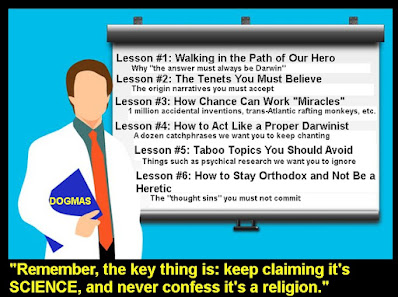
The enormous current success of Darwinist materialism in getting people to believe in its main dogmas comes from a failure of people to perceive that Darwinist materialism is pretty much a kind of stealth religion, basically a kind of church-in-all-but-name that has infiltrated the halls and rooms of our universities.  Once you recognize the strong similarities between Darwinist materialism and an organized religion such as the Roman Catholic Church, there is a kind of "Toto pulling back the Wizard's curtain" effect in which we can suddenly see how much bluffing and bluster is going on when unproven belief community dogmas are marketed as scientific facts.
Darwinism as religion

The research communities of scientific academia and the clergy of religions both are what can be called ideological enclaves. An ideological enclave is some small subset of the population in which some particular belief system is required. The diagram below illustrates how ideological enclaves get new members and keep the enclave committed to its ideology:

ideological enclave

An expert existing in some "echo chamber" ideological enclave may be filled with dogmatic overconfidence about some opinion that is popular within his little ideological enclave. He may think something along the lines of: “No doubt it is true, because almost all my peers and teachers agree that it is true.” But the idea may seem senseless to someone who has not been long-conditioned inside this ideological enclave, this sheltered thought bubble. 


academia dogmatism

Do you want to read some of the "ignored conflicting evidence" depicted at the left of the visual above? Read the posts of this blog and this blog. To read more about the resemblance of biologists to clergy, read my post "Scientists and Clergy Have Much in Common."  

Academia serves as a kind of "Ministry of Materialism" that has quite a few similarities with the structure of organized religions.

professor priesthood

The hierarchical structure of Darwinist materialism is depicted below. The structure maintains its dominance because it is funded by gigantic sums that we may call "Darwin dollars" and "materialist money."

church-like structure of science

In the table above I claim that censorship is common in scientific academia. This conclusion is backed up by a
paper "Prosocial motives underlie scientific censorship by scientists: A perspective and research agenda."  We read this:

"A recent national survey of US faculty at four-year colleges and universities found the following: 1) 4 to 11% had been disciplined or threatened with discipline for teaching or research; 2) 6 to 36% supported soft punishment (condemnation, investigations) for peers who make controversial claims, with higher support among younger, more left-leaning, and female faculty; 3) 34% had been pressured by peers to avoid controversial research; 4) 25% reported being 'very' or 'extremely' likely to self-censor in academic publications; and 5) 91% reported being at least somewhat likely to self-censor in publications, meetings,...In a 2023 survey of academics in New Zealand, 53% reported that they were not free to state controversial or unpopular opinions, 48% reported that they were not free to raise differing perspectives or argue against the consensus among their colleagues, and 26% reported that they were not free to engage in the research of their choice."

The paper gives us a great visual, looking like the one below. We see how censorship and bias by peer reviewers and self-censorship by scientists can cause the scientific literature to present a false version of reality, leading us to think that something is true when it is not true. This is just what is happening in the world of neuroscience. Innumerable facts and observations defying the "brains make minds" dogma are excluded from scientific papers, particularly observations of the paranormal. 

scientific censorship
In previous centuries, Roman Catholicism or Protestantism were the dominant ideological regimes.  In today's world Darwinist materialism seems to be the dominant ideological regime. But it's a "meet the new Boss, very much like the old Boss" situation. Darwinist materialism sold itself as something intellectually superior. In reality it is a dogmatic belief system that suffers from most of the same flaws of the ecclesiastical regimes of thought that preceded it.  But we all love myths with a flavor of "Progress Marches Gloriously Onward." So it's hard for people to realize that our current intellectual overlords have chained us to a tyranny of dogmas as oppressive as those in medieval times. 

slow progress of science

That's why the conference scene near the end of "The Hunger Games -- Mockingjay Part 2" is so implausible. In an instant flash of insight, Katniss seems to realize that the new regime she has served is something with the same glaring defects as the old regime that it superseded. Such an insight comes only after lengthy deep thought and analysis, not in some flash of insight that instantly occurs as an epiphany.  The movie then follows with a semi-final scene that has dramatic impact but fails as a moral example and also by suggesting the misguided and unrealistic idea that regrettable regimes can be overthrown merely by a little muscle action.  

Tuesday, May 7, 2024

Professor Priestly Versus Professor Precise

Across the world religions take very many extremely diverse forms, only some of which involve a belief in God. The anthropologist Clifford Geertz defined a religion as " a system of symbols which acts to establish powerful, pervasive, and long-lasting moods and motivations in men by formulating conceptions of a general order of existence and clothing these conceptions with such an aura of factuality that the moods and motivations seem uniquely realistic."  Under this type of anthropological definition, some of the systems of beliefs that are not usually thought of as a religion may reasonably be considered religions. 

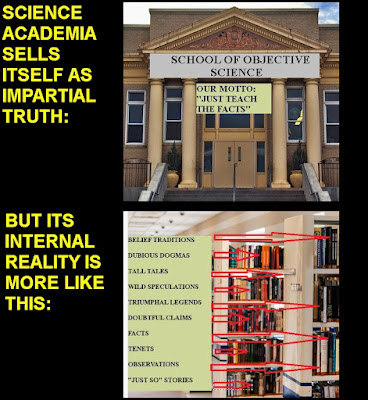
Scientific academia acts today largely as a kind of stealth religion, pretty much as a kind of church-in-all-but-name. The table below gives some reasons why scientific academia is like Roman Catholicism.


Scientific Academia

Roman Catholic Church

Physical Bases

University buildings, high schools, natural history museums

Churches, monasteries, convents, seminaries, Catholic schools

Old Revered Texts

Books of Charles Darwin

The Bible and works of the Church Fathers (Augustine, Aquinas, etc.)

Sacred Dogmas

Accidental origin of life, accidental origin of species by “natural selection,” brains as the source of minds, brains as storage places of memories

The Trinity, the resurrection of Jesus, the divine inspiration of the Bible, papal infallibility, dogmas about Mary, mother of Jesus

Lower Prestige Workers

High school biology teachers, experimental subjects, paid lab workers

Nuns, deacons

Middle Prestige Workers

PhD candidates, college instructors, assistant professors

Priests

High Prestige Workers

Professors

Bishops

Highest Prestige Persons

National Academy of Science members, Nobel Prize winners

Cardinals, the Pope

Arcane Speech

Jargon-filled scientific papers

Jargon-filled theology papers, Holy Mass language

Indoctrin-ation Meetings

Biology classes, psychology classes

Sunday sermons, Sunday school

Financial Base

Countless billions in old university endowments, tuition, government funding, with $800 billion in US university endowments alone

Billions in old endowments, church property,  Sunday donations, tithes

Rituals


PhD dissertations, experiments (often poorly designed and implemented), science conferences, rituals of science paper writing, countless legend and dogma recitations

Sunday Mass, baptisms, weddings, First Communion, funerals

Speculations

Abundant

Abundant

Persecution or Libeling of Heretics

Frequent (currently non-physical, including gaslighting, slander, libel, accusatory insinuations,  stereotyping and discrimination)

Frequent in the past

Censorship

Massive “soft” censorshipand repression of undesired observations such as witnessing of paranormal phenomena and successful ESP experiments

Once very frequent, such as Legion of Decency

Speech Taboos

Very many (including fair discussion of the paranormal or evidence for design in nature)

Very many

Miracle Stories

Accidental origin of life, and accidental origin of billions of types of protein molecules in the animal kingdom, most having thousands of well-arranged atoms, requiring many miracles of accidental organization, like hundreds of falling logs forming into extensive log cabin hotels or a row of fifty tall sand castles forming from random wind and waves

Miracle stories involving Jesus, Catholic saints and the Virgin Mary (Fatima, Lourdes, etc.)

Officials in Fancy Robes?

Yes (professors during graduation ceremonies)

Yes

Despised Deviants

Witnesses of the paranormal, Darwinism critics, teleology theorists, those having spiritual experiences

In previous years, Protestants and gays

Chanting?

Very much, such as “blind evolution explains it all” chant and “it's all just brain activity” chant

Very much, such as Hail Mary prayers and the chants of monks

Art Forms

Materialist science fiction

Sculpture, painting, sacred music, sacred architecture

Saints

Many science figures whose work is described reverently

Many canonized saints

Catechisms

Very biased college textbooks and very biased Wikipedia articles

Official catechisms teaching Catholic dogma

Legends

Many “just so” legends such as the legend of trans-Atlantic rafting monkeys, and many achievement legends such as the legend Darwin explained biological origins

Many legends about saints and their miracles or legends about miraculous healings or the Virgin Mary

Helper Workers

Unquestioning conformist science journalists

Laymen volunteers

Iconography

Sparse iconography including endlessly repeated side-profile “Evolution of man” diagram with four or five figures facing right

Vast iconography

science is like a religion

The dogmatism of professors strongly resembles the dogmatism of priests.

The behavior of scientist professors has very much in common with the behavior of priests and ministers.

scientific priesthood

Many types of science professors (such as cosmologists, evolutionary biologists and neuroscientists) act like members of some priesthood-in-all-but-name. 

academia dogmatism

Let us imagine one of these professors, and refer to him as Professor Priestly, to help clarify that the professor is acting like a priest in the Roman Catholic religion. We can contrast the statements of such a professor with the statements of a more careful-speaking professor we can call Professor Precise.  Professor Priestly tends to always speak in a way that promulgates the belief traditions of the belief community he belongs to. Professor Precise has no interest in conforming to such traditions, but is interested very much in not going beyond what is proven by the facts, and also interested in paying attention to every relevant observation that has been made.  Below is how the professors might speak differently on a variety of topics. 

The Origin of the Universe

Professor Priestly:  "Scientists have a successful detailed theory of the origin of the universe. Within the tiniest fraction of a second, the universe began expanding at a super-fast exponential rate. It was what we call primordial cosmic inflation. After only the tiniest fraction of a second of primordial cosmic inflation, the universe kind of switched gears, and suddenly started expanding at the normal linear rate of expansion we observe now."

Professor Precise:  "Scientists have reasons to believe that the universe suddenly began about 13 billion years ago in an event called the Big Bang, and that the instant after such an origin the universe was incredibly hot and incredibly dense. We don't understand what caused this, and we don't understand any exact details of what went on.  The claim that there occurred primordial cosmic inflation (a brief instant of exponential expansion) is a speculation that has never been verified. We can't ever verify it, because we will never be able to look back to the beginning of time or even the first 100,000 years of the universe, because of the early density being so great all telescopic observations of the first 100,000 years are forever blocked. Although there are some weighty reasons for thinking something like the Big Bang occurred, the Big Bang theory is not actually yet a successful scientific theory. The Big Bang theory predicts a universe with equal amounts of matter and antimatter, and that's not what we live in." 

The Origin of Life

Professor Priestly: "To get life started, you just need to have the right type of building blocks. The building blocks of life are carbon molecules.  We know that there are carbon molecules all over the universe. So the building blocks of life are common in outer space. Because the early Earth was often hit by comets that are rich in such building blocks, the early Earth must have had kind of a primordial soup rich in the building blocks of life. All that was needed was sufficient time. Given a billion years or so, the most improbable things will happen. So it's not too surprising that life naturally arose on the early Earth." 

Professor Precise: "The term 'building block' implies something real simple, like a brick. Contrary to the nonsense you so often hear, the simplest living thing (a self-reproducing cell) is not built from simple components that can be called building blocks. A cell is made from very complex components called organelles; and such components are made from very complex components called protein complexes; and protein complexes are made from very complex components called proteins. Most types of proteins require thousands of well-arranged atoms, equivalent to hundreds of well-arranged amino acids that have an average of about 20 atoms each.  There is no warrant for believing that anything like a 'primordial soup' rich in amino acids ever existed in the early Earth. Amino acids have been found in space, but only in the rarest amounts such as 1 part in a billion.  The much cited Miller-Urey experiment involved some very special glass apparatus unlike anything that would have existed in the early Earth, so it does not support the idea that amino acids would have been common." 

"Building blocks can be arranged in any order, but it's totally different  for the amino acids that make up proteins, which must be arranged in a very special way to get functional protein molecules, just as letters must be arranged in a very special way for you to get a functional understandable paragraph. For life to get started, you need at least 100 types of protein molecules, each a very complex invention requiring thousands of well-arranged atoms.  The probability of such a molecule accidently arising is about the same as that of a useful, grammatical and correctly spelled paragraph of text arising from an ink splash.  It isn't true that given a billion years any improbability will happen. Given something sufficiently improbable (such as a new type of functional protein molecule arising by chance or an ink splash producing a well-written functional paragraph), such a thing will never occur even given a billion years for it to occur and a billion trillion planets. Consequently we lack any current understanding of how life could have naturally arisen from non-life. All attempts at creating life (or even a single one of its major components) from non-life in experiments realistically simulating the early Earth have been dismal failures. Therefore the concept of abiogenesis is not currently a scientific concept in any real sense." 

building blocks of life

The Origin of Species

Professor Priestly: "The problem of the origin of species was a 'tough nut to crack,' but scientists finally succeeded in the nineteenth century when Charles Darwin wrote his monumental work The Origin of Species. Darwin realized that living things are always being born with different types of natural variations, some of which improve their survival value, and some of which decrease their survival value. Darwin also realized that nature tends to preserve and proliferate those variations that increase survival value, and discard variations that decrease survival value.  Darwin realized that these two facts can be combined to make the idea of natural selection. We know that all of the great stuff in living things arose from this natural selection. At various times over the eons, nature selected new adaptions such as eyes, ears, wings, hearts and feet.  And that's basically how we got all of the different types of species."

 Professor Precise: "The idea of evolution by natural selection was created at about the same time by Charles Darwin and Alfred Russel Wallace. Within a decade Wallace started explicitly denying that the theory was capable of explaining the human mind. Later in life Wallace also abandoned the idea of a natural origin of species, and argued that supernatural agency was required, clearly stating such an in idea in his book 'The World of Life: A Manifestation of Creative Power, Directive Mind and Ultimate Purpose.'  The term 'natural selection' is a misnomer, as Darwin confessed. Selection refers to an act of choice, but Darwin did not believe that any such act was involved when so-called natural selection occurred."

"In Darwin's time there was a very large reason for doubting that his theory could explain biological innovations. It was well-known in his time that the more impressive biological innovations require a coordinated special arrangement of many parts, with half-implementations being almost always useless. So Darwin lacked any credible explanation for why the initial stages of a complex biological innovation would occur. In Darwin's time this was called the problem of 'incipient stages,' and Darwin never credibly answered it.  In the century after Darwin this 'incipient stages' problem became almost infinitely more severe. Biologists learned that living things are built from many thousands of types of complex inventions called protein molecules, most requiring a very special arrangement of thousands of atoms. Since protein molecules are in general very sensitive molecules that are not functional when half-completed, the problem of incipient stages seems vastly worse than it did in Darwin's time.  We are left with no credible Darwinian explanation for the vast majority of types of biological innovations in the human body and in the animal kingdom." 

Human Development and Morphogenesis

Professor Priestly: "How does a speck-sized zygote progress to become the very high state of organization that is the human body? Long story short: it's because of your DNA. DNA has a blueprint for making the human body.  The cells read that blueprint, telling them what to do, and a human body thereby arises."

Professor Precise: "We have long been taught various ideas about DNA: that DNA is a blueprint for making a human body or that DNA is some program for making a human body. Such ideas are myths. Human DNA has been thoroughly analyzed by the huge project called  the Human Genome Project, completed about 2003. The genomes of thousands of species have been cataloged. No one ever found a blueprint for making an organism in DNA or its genes. DNA does not tell how to make a human body, any human organ or even any of the roughly 200 types of cells in the human body. DNA does not even specify how to make any of the organelles that are the components of cells. DNA only specifies low-level chemical information such as which amino acids make up particular proteins.  It's just as false to claim that DNA is a recipe for making the human body, and such an analogy is very misleading, because the human body is vastly organized, unlike the unorganized things made from recipes. So how does something as organized as the human body ever arise from a speck-sized zygote? That's something scientists are light-years away from understanding."  

The Human Mind

Professor Priestly: "The human mind is just a product of the brain. Your mind is something that kind of rises up from the bubbling electrical activity of the brain, kind of like how the scent of soup rises up from the soup cooking in a pot.  The brain is basically a big computer. Just as a computer produces outputs after it receives inputs, the brain produces outputs such as thought and subjective experiences after it gets the inputs of sensory information. And when you learn something, that's just synapse strengthening. "  

Professor Precise: "The human mind and human mental experiences are a reality of oceanic depth and the most gigantic diversity, not something simple like the scent of a soup. We lack any understanding of how a brain could give rise to the human mind and all its enormously diverse capabilities and experiences. The brain is nothing like a computer, and does not have any of the things that computers have that allow them to compute. Computers compute by means of an operating system, application software and a CPU for sequentially processing instructions. Nothing like such things exist in the brain. As for subjective experience, nothing like it is produced by a computer, so you can't explain it by claiming it is an output of a brain that computes like a computer. Humans can learn new facts instantly, and we can't explain that by synapse strengthening, which is a sluggish physical process taking many minutes at least. Synapses are made of proteins which have an average lifetime of a few weeks or less, so it would seem impossible to explain human memories that can last for 50 years by imagining mere synapse strengthening.  And how can humans instantly recall some information about a person as soon as you mention his name? We know how computers can instantly retrieve information: by using systems that involve addressing, sorting and indexes.  But the brain has no addressing, no sorting and no indexes. So how could a brain ever instantly recall anything?  We know of no brain mechanism for writing or reading learned information. So how could someone ever instantly learn or instantly remember anything by using a brain?"