Header 1

Our future, our universe, and other weighty topics


Monday, January 24, 2022

Anatomically Uninformative DNA, Nonfunctional Intermediates and Useless Early Stages Are Why Gradualism Does Not Work

Biologists teach the doctrine of gradualism, the idea that every species appeared because of very many tiny random changes that gradually took place over long periods of time. There are several very large reasons why gradualism is not a credible general theory of biological origins.  Each is a fatal difficulty. 

Fatal Difficulty #1: No Explanation for Why Any Useless Early Stage Would Appear in a Population of Organisms

In general Darwinism fails to explain the first stages of useful structures. This was pointed out very clearly in Darwin's time by the biologist Mivart, who wrote the following at the beginning of Chapter II of his book On the Genesis of Species: "Natural Selection utterly fails to account for the conservation and development of the minute and rudimentary beginnings, the slight and infinitesimal commencements of structures, however useful those structures may later become."  Mivart devoted Chapter II of that book to many examples of "incipient stages" that Darwinism could not explain well, including the first small part of any limb such as an arm or leg or the first small part of a wing or the first small part of a mammary gland.

Darwinists have told many a tall tale to try to account for such things, such as suggesting that maybe wings grew out of wing stumps that were used to catch insects. Such tales are typically unbelievable.  Two of the attempts that Darwin made to suggest such stories are now believed to be erroneous (biologists now reject his "maybe mammals come from marsupials" explanation for the incipient stages of mammary glands, and also reject his "lungs come from swim bladders" explanation for the incipient stages of lungs). 

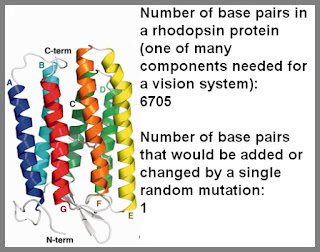
Consider the case of the biological implementation needed to produce vision. We can call this a vision system, and it requires much more than just an eye. Below are four requirements of a vision system.
  1. Some type of eye.
  2. An optic nerve leading from the eye to the brain.
  3. Extremely complicated proteins used to capture light, such as rhodopsin.
  4. Very complex brain changes needed to allow for a vision effect that is useful for an organism.
Now if an organism had only or two of these things, it would receive no benefit. For example, merely having an eye and an optic nerve would not be useful unless the eye had the protein molecules needed for vision, and unless the eye also connected to changes in a brain needed to make use of visual inputs. And if there were only such proteins and such brain changes, and no eye and no optic nerve, that would not be beneficial.

vision complexity

The general principle that the first stages of an implementation are not beneficial can be stated as the principle of preliminary implementations. We can state this principle like this:

The principle of preliminary implementations: in almost all cases, with few exceptions, preliminary or fragmentary implementations of very complex organized things by themselves yield no benefits or rewards.

This principle holds true in general life (as the examples above show), and also in regard to biological implementations. So if we are speaking of some complex biological innovation requiring a certain number of parts organized in the right way, we should not at all assume that the first stages of such an innovation will provide a benefit. A benefit will occur only when a certain degree of complexity and functional coherence has been achieved. In other words, no benefit will come unless some functional threshold has been reached. Such a functional threshold will typically require that several or many parts are arranged in the right way. The diagram below illustrates the point.

uselessness of early stages

The same principle is illustrated by the diagram below:


evolution problem


The reason why Darwin's ideas do not work to credibly explain the origin of biological innovations was rather well explained by scientist Gustave Geley in his monumental work From the Unconscious to the Conscious.  He mentioned "embryonic organs" that are "merely adumbrated" to refer to some mere useless preliminary fragment of an organ. He stated the following: 

"It is not difficult to show that neither the Darwinian 
nor the Lamarckian hypothesis enables us to understand 
the origin of characteristics that constitute a new 
species...In order that any given modification occurring in 
the characteristics of a species or an individual, should 
give to that species or to that individual an appreciable 
advantage in the struggle for life, it is evident that this 
modification must be sufficiently marked to be utilizable. 
Now an embryonic organ, a modification merely 
adumbrated, appearing by chance in a being or a group 
of beings, can be of no practical use and give them no 
advantage....Now an embryonic 
wing, appearing by chance, one knows neither how nor 
why, in the ancestral reptile, could not give that reptile 
the capacity or the advantage of flight, and would give 
it no superiority over other reptiles unprovided with the 
unusable rudiment. It is therefore impossible to attribute 
to natural selection the transition from reptile to bird. 
...Rudiments of legs and lungs would give no 
advantage to a fish...It is  indispensable that its heart, lungs, and organs of locomotion should be already sufficiently developed to allow it to live out of the water."

We can imagine some useless early stage of a useful innovation appearing in a single member of a species because of some random variation. But because such a useless early stage would provide no survival value, it would not spread around from a single organism to reach most members of a species in subsequent generations in a "selective sweep" occurring because of "survival of the fittest" reasons. 

In fact, useless early stages would often be not just useless but actually detrimental to the survival chances of an organism.  An example would be a not-yet functional appendage that was the beginning of a wing.  Such an appendage would slow down an organism that had it, and make an easy target for predators to bite.  Another example would be a rudimentary not-yet-functional eye lens, which would tend to block light and reduce sight until it became a sophisticated functional lens. 

Darwin attempted to answer the problem of useless early stages by speculating on some examples of useful early stages. But far from being answered by his speculations, the problem of useless early stages has grown gigantically larger after Darwin because of what we have discovered about the great complexity and fragility of protein molecules, something Darwin never knew about. We now know that the animal kingdom contains millions of different types of protein molecules, each its own separate complex invention, typically with hundreds of amino acids that have to be arranged in just the right way for the molecule to be functional.  In the human body there are roughly 20,000 different types of protein molecules, each its own separate complex invention. Experiments have repeatedly shown that protein molecules are fragile, and become nonfunctional when only a small fraction of their amino acids are removed.  A biology textbook tells us, "Proteins are so precisely built that the change of even a few atoms in one amino acid can sometimes disrupt the structure of the whole molecule so severely that all function is lost." And we read on a science site, "Folded proteins are actually fragile structures, which can easily denature, or unfold." Another science site tells us, "Proteins are fragile molecules that are remarkably sensitive to changes in structure." Protein molecules are not functional if only a half or a third of their amino acids exist.  Typically we have no credible explanation for why the first half or the first third of any protein molecule would have ever originated. So what we have learned about protein molecules causes the problem of useless early stages to loom a hundred times larger than it did in Darwin's time. 

Typically when materialists talk about evolution, they make claims that do not involve adequate thinking about the sky-high requirements for a natural appearance of new types of biological innovations. For example, materialists may speak most absurdly as if a benefit to survival or reproduction would be produced by every little mutation needed for some biological component. The truth (pretty much the exact opposite) is illustrated in the diagram below. 

requirements threhsolds


Besides protein molecules that are not useful when only half of the molecule exists, there are countless larger features of organisms that are not useful when only half of such features exist.  Some of these features are mentioned by biologist , Richard Goldschmidt, who wrote the following on page 6 of his book The Material Basis of Evolution:

"I may challenge the adherents of the strictly Darwinian view, which we are discussing here, to try to explain the evolution of the following features by accumulation and selection of small mutants: hair in mammals, feathers in birds, segmentation of arthropods and vertebrates, the transformation of gill arches in phylogeny, including the aortic arches, muscles, nerves, etc.; further, teeth, shells of mollusks, ectoskeletons, compound eyes, blood circulation, alternation of generations, statocysts, ambulacral system of echinoderms, pedicellaria of the same, cnidocysts, poison apparatus of snakes, whalebone, and, finally, primary chemical differences like hemoglobin vs. hemocyanin, etc. Corresponding examples from plants could be given.” 

The diagram below illustrates how a protein molecule can be made nonfunctional by a very small mutation involving a change in only one or a few of the protein's amino acids. The lack of a credible natural explanation for the origin of protein molecules becomes all the more apparent when we ponder the need for most types of protein molecules to have very special sequences of hundreds or thousands of amino acids that have to be almost exactly right for the molecule to function. 

protein fragility

Below are some relevant statements by scientists:

  • "It seems clear that even the smallest change in the sequence of amino acids of proteins usually has a deleterious effect on the physiology and metabolism of organisms." -- Evolutionary biologist Richard Lewontin, "The triple helix : gene, organism, and environment," page 123.
  • "Proteins are so precisely built that the change of even a few atoms in one amino acid can sometimes disrupt the structure of the whole molecule so severely that all function is lost." -- Science textbook "Molecular Biology of the Cell."

Fatal Difficulty #2: The Great Rarity or Nonexistence of Nonfunctional Adult Features That Are Merely the Initial Stages of Biological Innovations

If you do a Google search for "incipient organ" or "nascent organ" or "incipient appendage," you will get many matches. But the search results matches will be talking about incipient organs and incipient appendages that arise during morphogenesis and embryonic development, long before an organism reaches adulthood.  The matches will not be discussing nonfunctional adult features that are merely the initial stages of biological innovations that may occur later in the evolution of a species. 

If it were true that gradual random changes led to very complex visible biological innovations, then we would see all over the place (in the animal world) adult organisms with not-yet-functional biological innovations existing in rudimentary form: what can be called incipient organs, nascent organs, incipient appendages or nascent appendages. But we see no such thing. We do not see any adult organisms containing not-yet-functioning organs that are the initial stages of organs that will be functional in future generations. We do not see any adult organisms with not-yet-functioning appendages that are merely the initial stages of appendages that will only be functional in future generations. Inside the bodies of organisms we see no protein molecules that are presently useless but which are the first half or the first third of some molecule that will be highly functional in future generations.  

The point that I make here was forcibly made in pages 24-26 of Douglas Dewar's book Difficulties of the Evolution Theory.  Dewar states this: 

"Better evidence of the assertion that for the last fifty years biological textbooks bring to light only that which is favourable to evolution and pass over unnoticed all that is unfavourable could scarcely be adduced than the fact that these volumes contain many references to vestigial organs, but none to nascent organs....Thus, although the anatomy of thousands of species of animals has been carefully studied, it is impossible to adduce a single structure in any species which is indubitably or even probably in a nascent condition."

Fatal Difficulty #3: Nonfunctional Intermediates

It is typically true that we cannot imagine a transition between two very different and highly-functional biological things without a passage through an intermediate state that is nonfunctional.  For example, if over very many thousands or millions of years one specialized protein molecule changed gradually to become some other specialized protein molecule with a different function, there would have been an intermediate non-functional state; but in such a state such a molecule would have tended to have fallen out of a gene pool, preventing the imagined transition.

Let us consider an elementary example of nonfunctional intermediates during a transition from one functional thing to another. Suppose I have a red "stop" sign, and I wish to modify this to serve another function: the function of being a "tow zone" sign. I can do this in three steps:

(1) I use red paint to cover the "s" and the "p" in "stop."
(2) Painting where the "p" was in "stop," I paint a "w."
(3) I then paint "zone" under what was originally the word "stop."

Now I have changed my functional "stop" sign to be a functional sign saying "tow zone."  The visual below illustrates the steps:


nonfunctional intermediates


Yes, a functional stop sign can be gradually changed into a functional "tow zone" sign. But if you do this, you will have to pass through two stages that are nonfunctional.  Both stages 2 and 3 shown above are nonfunctional intermediates. If we get a nonfunctional intermediate when doing such a simple transition,  we should suspect that nonfunctional intermediates would occur all over the place in a gradual transition between two complex biological units such as protein molecules. 

Let's imagine another gradual transition, this time using something more complex.  Let's imagine you were to try to gradually change an automobile so that it became a functional boat. You could do this through the following steps.

(1) Open the car's hood and yank out everything connected to the engine block. 
(2) Then remove the entire engine block. 
(3) Remove the car's wheels and axles.
(4) Remove the car's steering wheel.
(5) Remove the car's exhaust system. 
(6) Remove the car's two front seats

You would now have a car so light that it might well float if tossed into the ocean.  So it's quite possible that an automobile could be gradually changed to become a crude boat.  But the problem is that in the middle of such a transition there would be nonfunctional intermediates. At some point during this transition, we would have something that was neither a functional car, nor something light enough to be a functioning boat. 

There would be nonfunctional intermediates all over the place during the type of gradual biological transitions imagined by proponents of gradualism. The problem with that is according to Darwinist theory, when a nonfunctional state is reached, then evolution should discard something.  As Darwin put it, "Natural selection is daily and hourly scrutinizing, throughout the world, the slightest variations; rejecting those that are bad, preserving and adding up all that are good." So the imagined Darwinian process of so-called natural selection can never pass through nonfunctional intermediates while on some long process of producing a functional result. It can only produce some final good result by some long sequence such as this:

  1. Good result.
  2. Some later result that is also good.
  3. Some still later result that is also good.
  4. Final good result. 

It can never produce some final good result by some long process such as this:

  1. Good result.
  2. Some later result that is also good.
  3. Some later nonfunctional result that does no good.
  4. Final good result. 

Fatal Difficulty #4: Anatomically Uninformative DNA

Perhaps the greatest problem with gradualism arises from the lack of any such thing as a specification for making an organism in the body of that organism.  If we knew that there was such a thing as a specification for making an organism somewhere in the organism, we might imagine that such a specification had gradually changed over vast lengths of time. But inside an organism there is no such specification for making an organism.  The DNA in an organism merely specifies low-level chemical information such as how to make the polypeptide chains that are the beginning of protein molecules. DNA does not specify how to build the overall structure of an organism, nor does it specify how to make any organ of an organism, nor does it even specify how to make any of the cells of an organism. Humans have about 200 different cell types, and DNA does not specify how to make any of those types of cells.  Containing no information about anatomy or how to construct the cells or bodies of organisms, DNA is correctly described as anatomically uninformative. 

So we cannot at all credibly imagine that over a huge length of time one species gradually changed into some other very different species with a very different anatomy, because of random mutations that produced gradual changes in DNA.  This is such a problem for gradualism that biologists have repeatedly tried to cover up the problem by telling us the lie that DNA is a blueprint or recipe for making an organism.  When the proponents of an idea have to resort to telling us an outrageous lie to try and cover up problems with their theory, this should be a very big warning sign that something is very, very wrong with their thinking.  

Read the end of this post for quotes by more than twenty distinguished biology authorities very clearly stating that DNA is not a recipe or blueprint or program for making an organism or a human.  For example, on the web site of the well-known biologist Denis Noble, we read that "the whole idea that genes contain the recipe or the program of life is absurd, according to Noble," and that we should understand DNA "not so much as a recipe or a program, but rather as a database that is used by the tissues and organs in order to make the proteins which they need." At the same link we read statements by Sergio Pistoi (a science writer with a PhD in molecular biology) who tells us, "DNA is not a blueprint," and tells us, "We do not inherit specific instructions on how to build a cell or an organ"; and we read the director of a biology research lab tell us that "genomes are not a blueprint for anatomy." "The genome is not a blueprint," says Kevin Mitchell, a geneticist and neuroscientist at Trinity College Dublin. "It doesn't encode some specific outcome."  His statement was reiterated by another scientist. "DNA cannot be seen as the 'blueprint' for life," says Antony Jose, associate professor of cell biology and molecular genetics at the University of Maryland. He says, "It is at best an overlapping and potentially scrambled list of ingredients that is used differently by different cells at different times." 

Even if there existed a blueprint in DNA for making an organism, that would not explain the origin of adult bodies, for the elementary reason that blueprints don't build things. Buildings get built because there are intelligent construction workers who read blueprints and carry out their instructions. If there were to exist in DNA fantastically complicated instructions for building a human body with its gigantically complex hierarchical organization (which would have to be instructions more complex than any humans have ever written), we know of nothing in the human body (below the neck) capable of acting on and carrying out such instructions if they happened to exist.  The idea that adult human bodies arise because of a reading of a DNA blueprint is therefore one that is false and very childish,  as silly as the idea that a balloon could take you to the moon. A child imagining that a balloon can rise to the moon fails to consider the elementary "show-stopper" fact that a balloon would stop rising once it reached the vacuum of space. A gradualist imagining  that adult bodies arise because of a reading of DNA blueprints fails to consider the elementary "show-stopper" facts that DNA has no blueprint for building a body and that blueprints don't build things. 

So how is it that an adult human body (with its many levels of hierarchical organization) arises from the billion-times-simpler state of a speck-sized egg existing just after conception? Our biologists do not understand this great mystery of progression, which is a thousand miles over their heads. An article in the journal Nature states this: "The manner in which bodies and tissues take form remains 'one of the most important, and still poorly understood, questions of our time', says developmental biologist Amy Shyer, who studies morphogenesis at the Rockefeller University in New York City."  No one lacking an explanation for this great mystery has any business claiming he understands the origin of humanity; for if you do not understand the origin of even a single adult body, what business do you have claiming that you understand the origin of the whole human race?  That would be like claiming that you understand the origin of cities when you don't even understand the origin of buildings. When we consider that our biologists also lack a credible account for the origin of individual adult minds, their boasts about understanding human origins seem all the more hollow. 

Gradualism (the idea that every species appeared because of very many tiny random changes that gradually took place over long periods of time) does not work as a credible explanation for the origin of species.  To credibly explain in some natural manner organisms that have incredibly high levels of organization all over the place, what you would need (at the very least) is some theory credibly explaining why there occurred so often vastly impressive feats of purposeful biological organization. Gradualism is no such thing. 

Gradualists frequently commit in their thinking a common logic error that is known as the fallacy of composition. The fallacy of composition is the fallacy of assuming that each part in a whole must have some property that the whole possesses.  An example of this fallacy is found is this statement: "A big bag of sand is heavy, so each of its parts must be heavy." No, that's wrong.  The parts of a big bag of sand are millions of grains of sand, and a bag; and none of those things is heavy. 

There are millions of different types of functional protein molecules in the animal kingdom, each its own separate very complex invention. The human body contains more than 20,000 types of protein molecules, each a very complex invention.  The median number of amino acids in a human protein molecule is about 375.

Pondering some thing such as a protein molecule (consisting of hundreds of amino acids arranged in just the right to achieve a functional result), our gradualism believer assumes that each of hundreds of mutations that might have combined to produce the useful molecule would produce a benefit.  That is the fallacy of composition.  Typically the property of being beneficial in the protein molecule only arises "late in the game" when hundreds of the amino acids appeared and were organized in just the right way to produce a functional protein molecule, something that would be as unlikely to occur by chance as typing monkeys producing a useful paragraph of hundreds of characters. It is absolutely fallacious to assume that each little mutation would itself be beneficial, as fallacious as thinking that each of the hundreds of pixels that make up a functional sentence produces a benefit because the sentence produces a benefit.

Thursday, January 20, 2022

Spooky Stuff Soviet-Style

The book Psychic Discoveries Behind the Iron Curtain by Sheila Ostrander and Lynn Schroeder is a fascinating account of paranormal events and parapsychology in countries of the Warsaw Pact, mainly the Soviet Union. Among the most interesting accounts is the tale of Wolf Messing, a Soviet psychic who is all but unknown in the West, but who was apparently very famous for many years in the Soviet Union. 

On page 43 we hear that Messing was summoned by Joseph Stalin, the dictator of the Soviet Union. We are told Stalin had heard of Messing's reputed ability to influence minds in some paranormal manner. He commanded that Messing go to a bank and try to perform a bank robbery by mentally commanding a bank teller to give him money. Messing claims that he went to the bank, handed the teller a blank sheet of paper, and then mentally commanded the teller to give Messing 100,000 rubles.  Messing says the teller complied, and that after Messing showed two witnesses that the money had been successfully extracted, he returned the money to the bank teller (who had a heart attack upon realizing he had given away such a large amount of money).  

On page 44 we are told Messing passed another experiment designed by Stalin: being able to enter Stalin's dacha without a pass and without permission (which is rather like some unauthorized visitor strolling into the Oval Office of the White House).  Messing says that he telepathically suggested to the guards that he was Beria, the head of the secret police, who frequently visited Stalin's dacha. 

It seems to be a well-established fact that Messing was given permission to tour the Soviet Union with an act that was mainly based on demonstrations of telepathy, and that such an act was wildly successful for many years, making Messing a "household name" in the Soviet Union.  Typically Messing would ask random people in the audience to write down some command they wanted Messing to do, with the sealed instructions being delivered to some "jury" selected by the audience.  The people writing down the instructions would think of their instruction, and Messing would be remarkably successful in performing what they had wished, having never seen their written instructions.  Messing had previously performed such demonstrations in many different countries. 

On page 104 we read a chapter discussing many examples of so-called "telepathic knockouts." During such events it would appear that a person was put into a state of deep sleep or unconsciousness solely because of the mental suggestion of some other person.  We read, "The ability to put people to sleep and wake them up telepathically from a distance of a few yards to over a thousand miles became the most thoroughly tested and perfected contribution of the Soviets to international parapsychology." After reading of countless successful experiments of such an effect, we read of such a test being successful at a distance of a thousand miles.  At a scheduled time, one scientist mentally commanded a subject a thousand miles away to fall asleep. We are told, "A thousand miles away Ivanova lost consciousness on schedule as she talked to Dr. Doubrovsky."  Since electromagnetic waves diminish with distance, the test seemed to prove that ESP does not work by some transmission of electromagnetic waves. 

While such accounts are shocking to the average person in the West, they may not shock careful scholars of the very deep topic of hypnotic phenomena and trance phenomena.  It was often claimed by hypnotists that a person could be put into a hypnotic trance purely by the hypnotist's mental suggestion. First, some verbal technique or physical technique such as hand movements might be used to put someone into a hypnotic state. A hypnotist would sometimes report that after such a thing had succeeded, it would later be possible to almost instantly put the subject into a hypnotic state, purely by a mental command of the hypnotist (which might or might not be accompanied by a purposeful stare). 

On page 117 we hear a leading Soviet ESP researcher (Leonid Vasiliev) state he has gathered hundreds of "reliable cases" of spontaneous telepathy.  On the same page we have an account by a mother who says she saw the face of her son (at a distant location),  only to have the apparition vanish. She said she knew that her son had died. She later found out her son had died "at this very time." 

On the next page we hear of a similar occurrence. A Russian composer and conductor named Anton Rubinstein made a pact with his student William Nichia, that whichever died first would try to appear to the other one, to show his survival. Six years later Nichia saw an apparition of Rubinstein, and found out the next day that Rubinstein had suddenly died, apparently on the same day the apparition was seen. 

Anton Rubinstein

These are just additional examples of a phenomenon often reported in the West: that of someone seeing an apparition of a person he did not know had died, and later finding out that the person had died on the same day. You can read of hundreds of such cases by reading my posts below:

An Apparition Was Their Death Notice

25 Who Were "Ghost-Told" of a Death

25 More Who Were "Ghost-Told" of a Death


On page 170 the book has a chapter on the topic of "Eyeless Sight." We read of Rosa Kuleshova, who developed an ability to read or detect colors while blindfolded, merely by touching reading material or objects with her hands. Kuleshova held up very well to a long series of scientific tests. The same phenomenon was reported decades earlier in France, by Jules Romains in his book Eyeless Sight (discussed here). A 19th-century work states this: " Although  blind,  this  girl  can  read  by  passing  her  fingers  over  the  printed or  written  page,  and  can  describe  persons  whose  pictures  were  handed  to  her."

An edition of the EdgeScience magazine (#47) published by the Society for Scientific Exploration has an article "Seeing Without Eyes" (page 9) which discusses evidence for clairvoyance like that gathered by Romains. It mentions work by Carol Ann Liaros in the 1970's, saying, "Liaros discovered that blind people could see the images on black-and-white photos (and could see the photos when they were turned over, face-down, and even their reallife colors)."  We read about many other examples of ESP and clairvoyance similar to that reported by Romains, most occurring in recent decades. 

A long article in the June 12, 1964 Life magazine was entitled "Seeing Color With the Fingers." It reported a great number of observations very similar to those reported by Romains.  You can read the article here, by scrolling down to page 102.  In 1964 Life magazine was as mainstream and respectable as the New York Times, and had been a trusted mainstream source for decades.  Just as there is now a gigantic New York Times building in New York City, an equally sized skyscraper was once called the Time-Life building.  

In the Life magazine article of June 12, 1964, we read a very long account of Rosa Kuleshova's paranormal ability and how it was demonstrated in a long series of tests with different Soviet scientists. Below is an excerpt:

"Rosa, securely blindfolded, could read headlines in newspaper and magazines, and the large type in children's books, just as rapidly as if her eyes were open. She could read ordinary newspaper type, too - more slowly, but still correctly. She was able to describe illustrations in popular publications like Ogonyok and Krokodil as well as on cigaret packages and postage stamps. And she had no trouble at all singling out black, white, red, orange, yellow, blue and green samples of colored papers, colored pencils, aniline dyes, as well as cotton threads and fabrics."

The phenomenon has sometimes been called dermo-optical perception. The 19th-century literature on hypnosis contains many similar accounts of such an ability occurring during hypnosis. The term "transposition of the senses" was often used to describe the ability. A nineteenth century work by William Gregory (a chemistry professor at the very prestigious University of Edinburgh) describes this phenomenon on page 148:

"I have not hitherto noticed, save in passing, a phenomenon which occasionally presents itself, but which is not by any means uniformly present in a marked form; I mean, transference of the senses to some special part of the body.... But it sometimes happens, that the power of seeing, not the ordinary sense of sight, but the clairvoyant power, is located in some special part. It has been observed to be located in the pit of the stomach, in the tips of the fingers, in the occiput as well as in the forehead, or on the top of the head, and in one case which I heard of from a scientific gentleman who tested it, in the soles of the feet. The books and journals which treat of Animal Magnetism teem with similar facts; and the head, hand, and epigastrium, seem to be the usually selected parts, probably from the proximity to the brain in the first, the great development of the nerves of touch in the second, and the presence of the great sympathetic plexus of nerves in the third. The fact itself is beyond all doubt, and it is quite unnecessary to accumulate cases. In one form or other, the power of dispensing with the eyes, and yet perceiving color, &c. quite plainly, is found in every good subject. The same thing frequently happens with hearing. Thus E.  when on her travelling state or stage, is utterly deaf to all sounds, save those which are addressed to her by speaking with the mouth in contact with the tips of her fingers. This fact I have myself verified. I believe she would not hear a pistol fired at her ear, in that state."

Going back to the Psychic Discoveries Behind the Iron Curtain book, we read on page 173 of previous accounts of abilities similar to Rosa Kuleshova's. For example: 

  • A Russian Journal of Neuropsychological Medicine had described a case similar to that of Kuleshova; 
  • Leonid Vasiliev had got a hypnotized man to be able to read the newspaper Pravda with his hands only; 
  • A Dr. Novomeisky had found that with a half hour of practice, every sixth person could distinguish two colors only by touching them.  

One of the most sensational cases discussed in the book is the case of Ninel Sergeyevna Kulagina, who was sometimes referred to under the pseudonym of Nelya Mikhailova, and also referred to as Nina Kulagina.  The book starts telling the story of Nelya/Nina in a chapter entitled "Have the Soviets Found the Secret of Mind Over Matter?' I will use the name Nelya that is used in the text of the book. We are told of scientists and film-makers gathering to test Nelya. After a long period of intense concentration by Nelya, they filmed a compass needle spinning in front of Nelya, along with the whole compass spinning.  They also filmed a number of matches mysteriously moving below her outstretched hand, along with a matchbox.  You can see some of the footage here.  A transparent plexiglass cube with one face removed was placed over some objects on a table,  and Nelya was tested under such a setup which should have ruled out any fakery. The objects within the cube still moved. 

We are told this:

"Nelya's discovery of her new talents soon led her to one of the greatest physiologists in Russia, Dr. Leonid Vasiliev. Dr. Vasiliev carried out painstaking tests of her ability and had her demonstrate her paranormal ability before scores of scientists. In 1964 a special conference of scientists was called to observe Mikhailova's demonstration and, according to the January issue of Smena, it was a success."

On page 81 we read an eyewitness report by a Dr. Rejdak (published in a newspaper) in which he discusses observing Nelya thoroughly in 1968 during successful tests of psychokinesis, in which there mysteriously moved a compass needle, the entire compass, a gold ring, glass objects, a cigarette, a matchbox and twenty matches.  Rejdak says he shredded the cigarette, and found nothing unusual in it. He also says the matchbox and the matches were provided by him, and that Nelya had no chance to prepare them in any way.  The movement of such non-metallic objects cannot be explained by hidden magnets. Rejdak says, "Tests with special instruments failed to show any indication whatever of magnets or any concealed object."

Skeptics try to discredit Nelya by pointing out that she was charged with a crime by Soviet authorities. But the crime was merely selling money on the black market, an offense almost as common during the Soviet Union as speeding is in the West.  Such an offense does nothing to discredit the reports about her psychokinetic abilities. 

In the 1977 book "Advances in Parapsychological Research" we read on page 116 the following written by CUNY psychology professor Gertrude R. Schmeidler (which  uses PK to mean psychokinesis or mind-over-matter):

"Since 1968 special interest has attached to a middle-aged Soviet woman, Nina Kulagina, who seems able to make small objects move by PK. Movies show her near but not touching objects on a table before her, and then shows the objects moving as she sits tensely and makes small hand movements. Both Soviet and Western scientists have tested her under more of less formal conditions and have confirmed the effect. A full summary (Keil, Ullman, Herbert, and Pratt, 1976)  of these reports indicates that there is good reason to accept them as authentic PK. Typical of the most striking changes is a series of observations on objects that would not be influenced by concealed magnets, such as a cigarette. The investigator brings in the objects, puts them on a table sometimes covered with a cloth, and sometimes covers the assembly, for example, with a small transparent dome. Observers tell of -- and film records show -- movement of one or several adjacent objects, typically in jerks, over a few centimeters. The movements are sometimes bizarre: an upright cigarette, for example, stayed upright as it moved." 

The case of Ninel Sergeyevna Kulagina (aka Nina Kulagina aka Nelya Mikhailova) is sometimes dismissed on the grounds that no other person has shown such abilities. But similar abilities have been reported from subjects in the West, in India, and also subjects in China (as described here).  Many exclude ideas such as mind-over-matter on an impossibility basis, claiming there is no way that a brain could produce such an effect.  But there are very many reasons (including many neuroscience reasons) for rejecting the claim that the human mind is mainly the product of the brain, so we need not assume that our minds are mainly the product of our brains.  Once we have got on the right track, by realizing that our minds are some mysterious reality that cannot be explained by the contents of brains, then the door of possibilities becomes unlocked, and swings wide open.  We know the kind of limitations a mind would have if it were merely the product of a brain. We know very little about the limitations of our minds under the assumption that we are souls that arose nonphysically. 

These reports of dramatic parapsychology successes in the Soviet Union are corroborated by "a Department of Defense Intelligence Document prepared by the Foreign Technology Division, Air Force Systems Command and approved by Assistant Vice Directorate for Science and Technical Intelligence of the Defense Intelligence Agency."  The document was entitled "PARAPHYSICS R&D-WARSAW PACT." Paraphysics is a term similar to parapsychology.  You can read about the results in that document by reading my post here. The document discusses results similar to the results discussed in Psychic Discoveries Behind the Iron Curtain by Sheila Ostrander and Lynn Schroeder.

Let me cite an experiment in England similar to results reported above. A paper called "Consciousness and the Physical World" available at the Cornell physics paper server is a record of a 1978 symposium. The paper includes essays by a variety of authors, most of whom parrot the same old talking points of materialism, many of them misconceptions. But within the long paper you will be surprised to read some evidence for psychokinesis, similar to that discussed above. We read the following statement on page 163 by Suzanne Padfield:

"For the purpose of aiding scientific understanding, I have in the past demonstrated some psychokinetic effects under controlled conditions.Most of these experiments took place at the Paraphysical Laboratory, Downton, Wiltshire, with Dr. Benson Herbert, and the principal experiment involved a piece of apparatus known as a light mobile system. This apparatus consisted of a single strand of polyester fibre, the polymer known as polyethylene terephthalate, 25 cm long and 16 microns in diameter (chosen for its high tensile strength and low electrical and thermal conductivity because of its low moisture content). A straw beam 8 cm long was attached to one end of the fibre by means of sealing wax and the other end attached by the same means to a cork which fitted tightly into the neck of a large glass bottle in which the straw became suspended horizontally. The straw was balanced by two differently coloured pieces of plasticine, one at either end, and the sides of the bottle marked with vertical lines, enabling the angle of rotation of the straw to be observed accurately.

The system was placed on a vibration-free surface in a room free from disturbances and left for 24 hours, being monitored during that time to ensure that none of the known factors which might produce an effect on the straw beam were in operation. At the selected time for the experiment (no detectable movement of the beam, i.e. less than half a degree movement,  having been recorded for 24 hours) I would enter the room quietly and stand 5 or 6 ft away from the system. I always wore a visor to reduce effects of heat radiation from my face and electrostatic charge from my hair.‘ I would then commence to 'direct' the beam a certain number of degrees towards or away from me, either by free choice, having stated the number of degrees of rotation and direction beforehand, or at the command of the experimenter who was also present in the room but only near enough to the system to allow accurate observation, usually 10-12 ft. The experiment was successful about 70 per cent of the time and the straw beam would rotate the required number of degrees and remain still until a further direction or degree of rotation was chosen. A series of up to fifteen runs of psychokinetic influences could be accomplished during one experimental period with successful deflections of the beam from 5 to 90 degrees, fatigue usually deciding when the period would end. This particular experiment was carried out almost weekly for a period of nine years, and various refinements were made at different times."

The same person describes success with psychometry, stating this on page 165:

"In the case of psychometry I am aware of a feeling of scanning the past events of the object I am holding and am aware of sequences or memory tracks, some of which become actual events and others which existed only as possible events. Both are explored and the actual events are singled out and emphasized in the same way as one might retrieve a memory trace."

Postscript: The page here gives a quite lengthy and thorough rebuttal of skeptical speculations that Nina Kulagina used magnets and wires. As discussed above, the mysterious movements of objects near Kulagina were often of non-metallic objects that could not respond to a magnet. We can only imagine how careless observers would have to be to fail to observe a tested subject using wires to move some object on a table in front of the subject. Instead of being tested by such "most careless observers ever," all indications above are that Kulagina was successfully tested by very careful observers looking out for signs of fraud.   

Sunday, January 16, 2022

Futile Speculative Contortions of the Fine-Tuning Dodgers

Around about 1978, cosmologists (the scientists who study the universe as a whole) were puzzled by a problem of fine-tuning. They had figured out that the expansion rate of the very early universe (at the time of the Big Bang) seems to have been incredibly fine-tuned, apparently to about one part in ten to the sixtieth power. This dilemma was known as the flatness problem.

Around 1980 Alan Guth (an MIT professor) proposed a way to solve the flatness problem. Guth proposed that for a tiny fraction of its first second (for less than a trillionth of a trillionth of a second), the universe expanded at an exponential rate. The universe is not expanding at any such rate, but Guth proposed that after a very brief instant of exponential expansion, the universe switched back to the normal, linear expansion that it now has. The theory was devised to get rid of some fine-tuning, but it turned out that the theory required fine-tuning of its own in multiple places. So we had a kind of "rob Peter to pay Paul" situation in which it was unclear that the need for fine-tuning had been reduced. A recent paper says this: "It actually requires much more fine-tuning for the Universe to have inflated than for it to have been placed in some low-entropy initial state (Carroll & Chen 2004)." The paper also refers to "the highly fine-tuned initial conditions required for inflation to work."

There was never any observational evidence for the idea of primordial exponential expansion (typically called the cosmic inflation theory), and the idea was very far-fetched from the beginning, depending on the existence of a never-observed "inflaton field." But despite such flaws, Guth's idea became very popular among the small tribe of cosmologists.   Between 1980 and 2020 the Guth-following cosmologists spent decades cranking out many hundreds of different versions of the cosmic inflation theory, which appeared in thousands of different speculative physics papers.  It's actually a big sign of weakness when theorists have to keep grinding out countless different versions of a theory.  Good theories usually don't have to go through hundreds of iterations. 

It is now the year 2022, and there is still no evidence for the theory of cosmic inflation.  Supporters of the theory sometimes claim that the theory predicts this or that which has been observed.  The fact that a theory may predict something that was observed does nothing to show that the theory is correct.  Many false theories predict (without any great precision) something that was actually observed.  A theory is only supported by successful predictions if the theory uniquely predicts something correctly (being the only theory predicting that thing) or correctly predicts things with high numerical precision (such as when a gravitational theory correctly predicts that some asteroid will crash into Jupiter in exactly 32 days,  7 hours and 23 minutes).  

For many decades cosmologists have been lost in a strange little world of fantasy whenever they dealt with this cosmic inflation theory. As different versions of the theory have kept failing, cosmologists have kept producing new versions of the theory; and by now there are many hundreds of versions of it, making predictions all over the map.  All attempts to provide some empirical support for cosmic inflation theory have failed.  

The main prediction of cosmic inflation theories have been that there would be observed something called primordial gravitational waves, gravitational waves coming from the very early history of the universe. Although non-primordial gravitational waves have been detected (arising from times when the universe was already billions of years old), nothing has come from searches for primordial gravitational waves, which have gone on for years with ever-more-fancy and ever-more-expensive equipment.  A 2019 article states, "Models such as natural and quadratic inflation that were popular several years ago no longer seem tenable, says theorist Marc Kamionkowski of Johns Hopkins University."  A late 2021 article (based on this paper) is entitled "Primordial Gravitational Waves Continue to Elude Astronomers." But rather than discarding a theoretical approach that isn't working, our  cosmologists keep tying themselves into knots by spinning out more and more speculative ornate versions of the theory (which already has many hundreds of different versions).  This has all been a giant waste of time, without any real success. 

It is interesting that when scientists release papers telling us that they still can't find any sign of something they have long been looking for,  something predicted by some theory they cherish, the scientists often use paper titles that don't mention any failure, and try to give their observational failure some kind of positive sound. The latest big paper announcing that nothing has been found in the search for primordial gravitational waves has a title mentioning "improved constraints on  primordial gravitational waves," and the "improved" makes it sound like something positive has happened, although the observational result is purely negative. 

Another "high priest of speculation" professor comparable to Guth is Edward Witten of Princeton. For many years Witten was a leading champion of the empirically unsuccessful theories called supersymmetry and string theory.  They are both wildly speculative theores that have no observations supporting them. 

Like the cosmic inflation theory, the supersymmetry theory arose as a speculative attempt to explain away (or kind of sweep under the rug) a case of cosmic fine-tuning that bothered scientists. The issue of the fine-tuning of the Higgs mass (the mass of the Higgs boson) was skillfully explained by physicist Ben Allanach in a previous article at the Aeon site: 

"Behind the question of mass, an even bigger and uglier problem was lurking in the background of the Standard Model: why is the Higgs boson so light? In experiments it weighed in at 125 times the mass of a proton. But calculations using the theory implied that it should be much bigger – roughly ten million billion times bigger, in fact....Quantum fluctuations of ultra-heavy particle pairs should have a profound effect on the Higgs boson, whose mass is very sensitive to them....One logical option is that nature has chosen the initial value of the Higgs boson mass to precisely offset these quantum fluctuations, to an accuracy of one in 1016. However, that possibility seems remote at best, because the initial value and the quantum fluctuation have nothing to do with each other. It would be akin to dropping a sharp pencil onto a table and having it land exactly upright, balanced on its point. In physics terms, the configuration of the pencil is unnatural or fine-tuned. Just as the movement of air or tiny vibrations should make the pencil fall over, the mass of the Higgs shouldn’t be so perfectly calibrated that it has the ability to cancel out quantum fluctuations. However, instead of an uncanny correspondence, maybe the naturalness problem with the Higgs boson could be explained away by a new, more foundational theory: supersymmetry."

In an article in Symmetry magazine, we have a similar explanation:

"To understand what’s fishy about the observable Higgs mass being so low, first you must know that it is actually the sum of two inputs: the bare Higgs mass (which we don’t know) plus contributions from all the other Standard Model particles, contributions collectively known as “quantum corrections.” The second number in the equation is an enormous negative, coming in around minus 1018 GeV. Compared to that, the result of the equation, 125 GeV, is extremely small, close to zero. That means the first number, the bare Higgs mass, must be almost the opposite, to so nearly cancel it out. To some physicists, this is an unacceptably strange coincidence."


How big a coincidence? The Symmetry article later quotes physicist Lawrence Lee Jr. as saying “the conundrum with the Higgs mass, which would require fine-tuning on the order of 1-in-1034,” which is a coincidence like the coincidence of you correctly guessing the full phone numbers of three consecutive strangers. 

Scientists should have just accepted this case of very precise fine-tuning in nature.  But instead, many of them made a long, quixotic, futile attempt to overthrow it (like someone trying to overthrow the observation that the sun is hot, with some elaborate theory trying to explain how the sun isn't really hot).  Why did they do that? Because they had a motivation, an ideological motivation rather than the motivation of simply discovering truth. Their ideological motivation was related to a belief that the universe should not be anything that looked like a product of design. This ideological motivation is clearly stated in the Symmetry 
article by physicist Lee, who states it as follows: “In general, what we want from our theories—and in some way, our universe—is that nothing seems too contrived.” If you want for the universe to not "seem too contrived," then you may twist yourself into knots trying to explain away cases of apparent fine-tuning in the universe. 

An article this year makes it rather clear that the supersymmetry theory was mainly motivated by a desire to get rid of a case of fine-tuning, and make the universe look like it was a little less lucky, a little less  providentially blessed. We read this:

"For example, the small mass of the Higgs boson is notoriously difficult to explain—its calculation requires subtracting two very large numbers that just happen to be slightly different from each other. 'But if you add supersymmetry, this takes care of all these cancellations such that you can get a light Higgs mass without needing to have such luck,' says Elodie Resseguie, a postdoc at the US Department of Energy’s Lawrence Berkeley National Laboratory."

Like the cosmic inflation theory originated by Guth, the supersymmetry theory championed by Witten was a case of "twist yourself into knots trying to explain away a case of apparent fine-tuning in the universe." It advanced elaborate speculations about undiscovered "superpartner" particles that might help sweep under the rug the fine-tuning involving the Higgs mass or Higgs boson.  Just as the cosmic inflation theory has failed all empirical tests (with its predicted primordial gravitational waves never being found), the supersymmetry theory has failed all tests.  It was hoped that the Large Hadron Collider would find evidence of these "superpartner" particles predicted by supersymmetry theory, but it has found no such thing. 

Just as there is no evidence for the supersymmetry theory championed by Witten, there is no evidence for the string theory speculations he has advanced. But for decades physicists have wasted time cranking out thousands of speculative papers on string theory and supersymmetry theory. For decades physicists regarded Witten as kind of the High Priest of string theory, and they kept saying he was the smartest physicist. But what has come from all these string theory papers? Just a lot of speculation and mathematical gymnastics. 

A recent interview with Witten is a sad affair with a "sound of failure" ring to it.  He rather seems to acknowledge the failure of supersymmetry, saying that "it has been very hard to find a conventional natural explanation of the dark energy and hierarchy problems," and that "it seems that the ideas of naturalness that we grew up with are failing us in at least these two cases." He mentions two great fine-tuning problems, one the Higgs mass fine-tuning problem, the other the dark energy fine-tuning problem, involving even greater apparent fine tuning. Both involve involve apparent fine-tuning of greater than 1 part in 1030, as does the fine-tuning of the universe's initial expansion rate.  Witten seems to throw his hands up and reluctantly express sympathy for the idea of the multiverse "landscape," under which there are an infinite or near infinite number of universes, each with different physics.  He says he resisted this idea before, but is now warming to it.  The idea was dreamed up by another string theorist (Leonard Susskind), specifically for the purpose of evading evidence for design in the universe (we can tell this from the title of a book Susskind wrote introducing the term "landscape" for such an imagined multiverse).  

Such a multiverse is a "when all else fails" type of last-resort fallback. Physicists and cosmologists will try desperately to explain away various types of cosmic fine-tuning, speculating like crazy, and trying to come up with some scenario that helps sweep some of the fine-tuning under the rug. When after decades of fiddling with such flights of fancy, they find all such efforts flopping and failing everywhere, their desperate last resort is to "grasp at straws" by appealing to some "all possibilities realized" multiverse. 

Resorting to such a thing is futile.  The issue is why our universe would have such almost infinitely improbable favorable conditions. You do not increase the probability of such a thing by even 1% by imagining some infinity of universes, each with different conditions. Such a multiverse may increase the likelihood of some universe being habitable, but does nothing to increase the likelihood of our universe being habitable.  Similarly,  I do not even increase by 1% the chance that I will get ten consecutive royal flushes when playing poker if I postulate that there are an infinity of poker players.   

Our multiverse theorists are guilty of the most elementary error in logic, failing to distinguish between a "some universe" likelihood and an "our universe" likelihood, or conflating the two. Below are some good principles to remember:

(1) Never assume that because some person is very smart and has learned very much that he would not commit the most elementary and obvious error in logic. 

(2) Never assume that his "singing from the same choir book" colleagues (spellbound by groupthink and hero idolizing) would fail to recognize such an elementary and obvious error in logic.

(3) Never assume that because some person is very smart and has learned very much that he would not advance some theory that is  absurd or groundless, and utterly unworthy of belief.

(4) Never assume that any theory lacking a sound observational basis is science rather than ideology mixed up with speculative narration or mathematics, what we may call metaphysics wearing an "I'm science!" T-shirt.  

science ideology

From the standpoint of advancing human knowledge, theories such as the cosmic inflation theory (not to be confused with the more general Big Bang theory), supersymmetry and string theory have been futile flops.  They went viral, but were never validated by observations.  There is only one standpoint from which such theories have been successful: they have provided a type of lucrative busy work for physicists and cosmologists, who have received tons of government money for the armchair activity of writing wildly speculative papers.  A similar thing would have gone on if the government had paid theologians very many millions to speculate about the living conditions of angels and the visual characteristics of heaven.  

The latest Symmetry magazine article on supersymmetry gives us some quotes that should cause a chuckle, such as this one:

"The lack of evidence for supersymmetry at the LHC does not signify a death knell for the idea. Nevertheless, 'now the community is going off in a large number of different directions,'  Peskin says. 'We’re all pretty confused right now.' ”

The article also makes it clear that the supersymmetry faithful will cling to their cherished speculations for a long, long time, kind of like some religious community waiting for centuries for its promised messiah. We read this:

"It could be decades before physicists know the truth about supersymmetry. If superpartners exist, Gates says that up to a century could pass before their discovery. But 'we know how to be patient as a community,'  Herwig says."

Wednesday, January 12, 2022

Was It Better Afterlife Evidence Than the "Cross Correspondences"?

The Bigelow Institute for Consciousness Studies (funded by the very wealthy businessman Robert Bigelow) recently published a series of prize-winning essays attempting to answer the question of what is the best evidence for life after death. You can read the essays (many of them almost book-length) by going to this page, and you can read my review of some of the long essays on this page. 

Many of the essays mention a case called the "Cross Correspondences" case, which some consider one of the best cases supporting the idea of life after death. I have never got around to the chore of describing such a case,  partially because I regard the case as being so complex that it is very hard for the average person to follow.  The case involves different persons getting little scraps of text by apparently paranormal means, with the scraps supposedly fitting together like pieces of a puzzle, to produce some very convincing result. Unfortunately, the case involves so many subtle and obscure classical references and esoteric literary references and interlocking pieces that it taxes the patience of a reader to try and follow it. 

A much easier case to follow is the case described in Chapter XVIII of the very interesting 633-page book "Psychical and Supernormal Phenomena, Their Observation and Experimentation" by Dr. Paul Joire, which you can read here.  The chapter describes experiments conducted by the Society of Psychic Studies of Nancy, France.  The experiments involved five people at a table, at which was seated a very young medium and also Dr. Joire. Mysterious raps were heard on the table, and attempts were made to query unseen agents. We are told queries were made "using the alphabet as usual," and presumably this was a system by which the alphabet was repeatedly recited and a table rap after a particular letter was counted as standing for a particular letter of the alphabet.  The plan was that experimenters attempted to get as many pieces of factual information they could from these mysterious rap signals, and they then attempted to verify whether there was any truth to the information provided.  

In quite a few cases, the experimenters were able to verify claims made during these seances. Below are some examples.

Bertolf  de  Ghistelles

The question and answer session went like this (I'll give a partial excerpt):

"Question.  Bertolf  must  be  a  Christian  name.  Have  you any  other  name  ?
Answer,  Bertolf  de  Ghistelles.
Q.   Were  you  French  ?
A.  Flemish.
Q,  Will  you  tell  us  the  name  of  the  locality  where  you lived  ?
A,  Dunkerque.
Q.  Have  you  been  a  long  time  in  the  Beyond  ?
A.  Yes.
Q.   In  what  year  did  you  die  ?
A.  In  1081.
Q.   What  were  you  ?
A,  Husband  of  a  Saint.
Q.  Do  you  mean  that  your  wife  is  honoured  as  a  saint, that  she  has  been  canonised  ?
A,  Yes.
Q.   What  was  her  name  ?
A,  Godeleine  de  Wierfroy.     Can  she  forgive  me  ?
Q,   You  did  her  harm  ?
A.  Yes.
Q.   You  killed  her  perhaps  ?
A,  I  had  her  strangled...
Q,  Have  you  found  any  members  of  her  family  ?
A,  Heinfried  and  his  wife  Ogine,  her  father  and mother.    They  have  forgiven  me.
Q.  Is  the  festival  of  your  wife  celebrated  anywhere  ?
A.  Yes.
Q.   On  what  date  ?
A,  July  6th.... 
Q,  Did  you  die  in  a  tragic  manner  ?
A,  No,  in  a  monastery.     I  remained  there  nine  years.

The experimenters attempted to verify this information, and found a reference that stated the following, consistent with the claims above (but with the man's name being spelled differently):

"Godelive,  Godelieve,  or  Godeleine  of  Ghistelles  (saint), born  near  Boulogne  in  1040,  died  at  Ghistelles  in  1070. She  married  Berthold,  Lord  of  Ghistelles,  near  Bruges, who,  after  having  subjected  her  to  odious  treatment,  had her  strangled  and  thrown  down  a  well.  Berthold  became  a  monk... Godelive  is  specially  honoured  at  Bruges  on  July  6th."

The page here from the Catholic Encyclopedia lists the husband of this saint as "Bertolf," matching exactly the spelling given at the seance.  It gives details matching those in the answers above. 

Gabriel Garcia Moreno

The question and answer session went like this (I'll give a partial excerpt):

"Question.  What  was  your  profession  ?
Answer,  President.
Q.  President  of  what  ?
A.  The  Republic  of  Ecuador.
Q.  At  what  age  did  you  die  ?
A,  53  years,  Friday,  August  6,  1875.     Dio  ni  muere  !
Q,  Why  those  words  ?
A.  I  spoke  them  as  I  fell.     I  died  a  Christian.
Q.  Will  you  be  kind  enough  to  translate  them,  because we  do  not  know  Spanish  ?
A.  They  mean  'God  does  not  die.'
Q.  Of  what  illness  did  you  die  ?
A.  (by  violent  raps)  Assassinated  by  Rayo  and  his accomplices  in  front  of  the  Government  palace  at  Quito.
Q.  What  weapon  was  used  ?
A.  The  machete.
Q.  What  is  the  machete  ?
A.  A  Mexican  knife.
Q.  Are  you  happy  ?
A,  I  have  caused  the  death  of  some  men.
Q.  For  what  reason  ?
A.  To  repress  a  conspiracy.
Q.  Do  you  regret  it  ?
A.  Yes.
Q.  Who  was  the  instigator  of  the  conspiracy  you repressed  ?
A.  General  Maldanato.

The experimenters attempted to verify this information, and found a reference that stated the following, consistent with the claims above:

" Moreno  (Gabriel  Garcia),  President  of  Ecuador,  assas- 
sinated at  Quito  in  1875.  Exiled  in  his  youth,  he  went 
to  Paris  and  London,  where  he  studied,  returned  to 
Ecuador,  took  up  the  profession  of  chemist,  married  the 
daughter  of  General  Flores  and  became  chief  of  the 
conservatives  at  Quito.  President  of  the  Republic  from 
1861  to  1865,  and  again  from  1869  to  1875,  he  was 
scheming  to  become  president  again  when  he  was  assas- 
sinated." 

A wikipedia.org article on Moreno confirms these claims, and tells us the assassination of Moreno at Quito occurred when he was "struck down with knives and revolvers," a statement consistent with the seance claim that death occurred by machete (a machete being a large knife).  The wikipedia.org article also says that Moreno's last words were "God does not die," matching the seance claim.  The page here confirms that statement about Moreno's last words, and states that "in the afternoon of August 6, Garcia Moreno was attacked by an assassin with a machete and three accomplices armed with revolvers on the porch of the Presidential Palace."

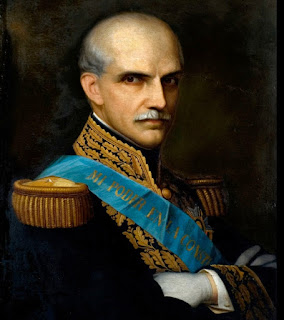
Gabriel Garcia Moreno

Henry  Charles  Montagne

In the next case the mysterious raps identified their source as Henry Charles Montagne, saying that this person (the son of Edouard  Montagne) had died ten years earlier, on his birthday at the age of 31, being attacked by a tiger, and that this person was buried at Pere-Lachais. 

The researchers wrote to some distant office, trying to get verification for some of this information. They received this reply in 1906:

"Dear  Sir  and  Colleague,— Yes,  Henry  Montagne was  the  son  of  a  former  delegate  of  the  Societe  des  Gens de  Lettres,  Edouard  Montagne,  the  immediate  predecessor of  M.  de  L.  He  was  killed  by  a  tiger  at  Nha-Trang (Annam),  on  July  9,  1896.  His  body  was  brought  to Paris  on  September  26th,  and  was  buried  on  the  28th at  Pere-Lachaise,  in  the  family  vault,  &c."

This account was in agreement with the tale told by the mysterious raps, the only difference being that one source lists the funeral as occurring on September 28th, and the other source lists the funeral as occuring on November 28th. 

Henri  Thomas

In the next case the mysterious raps identified their source as Henri Thomas, with the conversation going like this:

"Q.  Have  you  been  dead  for  long  ?
A.  Two  years  and  a  half.
Q,  How  old  were  you  ?
A.  Twenty  years.
Q.  Do  you  know  of  what  illness  ?
A,  Accident.
Q.  What  is  the  name  of  the  place  where  you  lived  ?
A.  Gondrecourt.
Q.  Were  you  born  at  Gondrecourt  ?
A,  No.     At  Demange-aux-Eaux.
Q,  Had  you  a  profession  ?
A,  Yes;  teacher."

After a letter was sent to a school official at Gondrecourt, the following reply was received:

"Thomas  (Henri)  was  born  at  Demange-aux-Eaux (Mouse)  on  October  10,  1883.  He  entered  the  Normal School  at  Commercy  on  October  1,  1899,  and  left  on July  20,  1902,  with  the  higher  certificate.  On  October 1st  of  that  year  he  took  the  position  of  probationary teacher  at  Gondrecourt,  about  four  miles  away  from  his family.  He  was  a  very  good,  kind  master,  somewhat timid,  conscientious,  and  of  very  good  conduct.  On Thursday,  November  26, 1903,  at  7  p.m.,  he  placed  himself in  front  of  a  train  on  the  line  from  Bar  to  Neufchateau.  We learned  of  his  tragic  death  on  the  following  day.  All  who knew  him  were  profoundly  astonished  by  it."

The information received was all consistent with the information coming from the mysterious raps, including the claim that Henri died at age twenty and worked as a teacher, except that the postal reply lists the death as a suicide, and the raps indicated death by accident.  It is possible that an accidental death from a train was incorrectly thought to be a suicide. 

Maurice Bouche

The raps produced a claim to be Maurice Bouche, and produced this statement: "I  died  three  years  ago,  at  Lille,  on  the  scaffold."  A subsequent inquiry produced this result:

"He  told  me  that  Maurice  Bouche  was  a young  man  of  good  family,  who  was  ruined  through  bad company.  Falling  lower  and  lower,  he  ended  by  joining some  robbers.  One  day  he  was  arrested  for  complicity  in the  assassination  of  an  old  lady  of  property,  and  was,  in fact,  executed  at  Lille  about  three  years  previously."

Viry

The raps produced a claim to be a weaver named Viry, who was born in Geradmer, who lived in Gerbepol, and who had died on November 26, 1877, at age twenty, "outdoors," because of consumption.  An inquiry then produced this response:

"I  have the  honour  to  inform  you  that  there  is  not  in  our  town any  relative  or  connection  of  young  Viry,  weaver,  born at  Gerardmer,  who  died  at  Gerbepol  on  November  26, 1877,  aged  nearly  twenty  years...This  young  man  was  found  dead  in  the  snow."

Madame Duchene

The raps claimed to be a Madame Duchene, someone who had once been a teacher, who  died  at  the  age  of  seventy-eight  years at  Vendresse, two and a half years ago.  An inquiry on this topic to a mayor produced this statement (dated June 16, 1906):  " In  reply  to  your  inquiry,  I  have  the  honour to  inform  you  that  Mme.  Duchene,  widow...died  at  Vendresse  on  September  7,  1903,  and  that  she bequeathed  all  her  fortune  to  M.  L.,  formerly  schoolmaster."  The difference between the dates of September 7, 1903 and June 16, 1906 is roughly two and a half years.  

Augustin-Louis Cauchy

The raps claimed to be a person named Augustin who died on May 17, 1857. When asked for "some  information that  will  help  us  to  establish  your  identity," a reply was given of "Beatus  qui  intelligit  super  egenum  et  pauperem," with a claim that such was written on the person's tombstone, in the "Sceaux  cemetery." The phrase in Latin means "Blessed  is  he  who  understands  the  poor  and  has pity  on  the  unfortunate."  The raps claimed to be from someone who had been a professor at the Sorbonne. 

The investigators made an inquiry to the keeper of the Sceaux cemetery, and received a reply by mail stating that after a search (and finding a gravestone covered with weeds), a tombstone was found with the following engraving:

Augustin-Louis
Baron  Cauchy
Died  at  Sceaux  May  23,  1857
Beatus  qui  intelligit super  egenum  et  pauperem

The Latin line the cemetery keeper quoted from the tombstone exactly matches the Latin line given during the seance.  The only discrepancy is a difference of six days between the two dates of death.  Wikipedia.org has a long article on Augustin-Louis Cauchy, with the details matching the details given in the seance (with the exception of the same six-day difference about the date of death).  The article describes him as a staunch Catholic, matching the impression given in the seance quotations. 

How to Explain?

If all of these details were to have been provided orally by a seemingly entranced medium,  we have a possible explanation for these results by hypothesizing some extremely elaborate and very hard-to-prepare fraud in which a medium learned and meticulously memorized very many details about deceased figures (some not famous), and then orally recited those details, only pretending to be entranced.  But in this case we have the fact that all of the details came from mysterious table raps, with the raps spelling out letters.  The total number of raps needed to spell out the details above (with one rap per letter) would have been many hundreds, occurring spread out over a long time.  We can imagine no medium manually producing so many hundreds of raps at a table where five people were seated, without being detected by the investigators. 

There is still one narrow possibility for the skeptic wishing to deny this evidence. He can simply believe that the whole affair was completely fraudulent, that no such mysterious raps ever occurred, and that Dr. Paul Joire simply made up the whole account.  But a reader studying Joire's massive 633-page book "Psychical and Supernormal Phenomena, Their Observation and Experimentation" will be unlikely to suspect  so serious a scholar of that type of chicanery.