Header 1

Our future, our universe, and other weighty topics


Tuesday, April 15, 2025

Fake Physics Salesmen Will Not Help Us Avoid Fakery in Science Research

An article from not long ago discusses fraud in science research. We read this shocking statement (I'll boldface part of it):

"The U.S. financial system is hardly the greatest edifice of justice in the world. Yet, it demonstrates a basic level of self-policing, effort to uphold professional standards, and accountability to the rest of society. Academic institutions fall far short of these minimal standards. Known serial frauds are sheltered by their bosses and feted by their peers. The culture encourages this at every step of the way, starting with PhD candidates ordered to produce a positive result by any means necessary, continuing with coauthors and grantmakers who can’t be bothered to look at the data and check whether it makes any sense, all the way to department heads and famous bestsellers being widely cited even after they’ve been caught. Those who do not commit fraud themselves usually tolerate it in their peers. The minority who will not tolerate frauds usually weed themselves out quietly. I have lost count of how many friends of friends entered a PhD program, had an adviser who tacitly or explicitly demanded they commit fraud to get publishable results, and quit in disgust without raising a public stink. What that says about those who remain is not encouraging....With some honorable exceptions, most academics don’t care very much about the capital-T Truth....More likely, fraud will grow more and more common as young scientists realize that lies are the best way to advance their careers and that serious punishment is about as likely as being struck by lightning."

Towards its end, the article suggests that "hope rests with truthseekers outside academia." The author states this:

"More likely, reform will come through circumvention from outside the academic system. There is no shortage of people who pursue the sacred quest for Truth. Increasingly, they are not pushing forward the frontiers of knowledge in peer-reviewed journals and university campuses, but in fringe niches of internet discourse. Because the internet commentariat’s intellectual elite is more attentive to an argument’s substance than whether it observes the bureaucratic forms, these circles are much less vulnerable to the problems which afflict academia."

The article then refers us to a blogger that it claims as a great example of a truth-seeker.  I started reading his posts at the blogger's site. I was not very encouraged by the first posts I read, in which the blogger lectures us at great length about rationality, and tries to pass himself off as a rationalist. My experience has been that people lecturing you about rationality are often people clinging to irrational dogmas.  Often lectures about rationality are excuses for avoiding observational reports that conflict with someone's worldview such as a materialist worldview. The self-described "rationalist" will claim that 1001 types of things are "irrational," on the grounds that they do not fit in with his idea of how nature works.  That's a defective approach. It's much better to closely study observations that defy your expectations about how nature works, and modify such expectations and assumptions when necessary, rather than throwing away such observations and calling them "irrational." 

In one post the blogger repeats one of the most glaring errors of today's Darwinism. He states, "Evolution is powered by a systematic correlation between the different ways that different genes construct organisms, and how many copies of those genes make it into the next generation. " Genes do not construct organisms.  Genes only specify the amino acids sequences that make up protein molecules.  Genes have no specification of anything larger than a protein molecule. An organism is built out of a skeletal system and organ systems. Organ systems are built from organs and other components. Organs are built from tissues, which are built from cells, which are built from organelles, which are built from protein complexes, which are built from individual protein molecules.  By claiming that genes construct organisms, the blogger is saying something as wrong as claiming that nails and screws construct apartment buildings. 

Later in the same essay the blogger refers most erroneously to "fox genes which construct foxes" and "rabbit genes which construct rabbits." Genes do not construct visible things, and have no specification of any anatomy or cells. In the same article we have very nonsensical shadow-speaking in which humans are described as the faintest shadows of themselves. The blogger states, "We are simply the embodied history of which organisms did in fact survive and reproduce." Oops, our "rationalist" has given us the silliest kind of irrational shadow-speaking, in which humans are depicted as a billion times less than what they are. 

reductionist nonsense

In another essay the blogger repeats the same errors, erroneously claiming that "DNA constructs protein brains." DNA is an inert molecule with no power of construction, and no specification of anything bigger than a protein molecule. DNA does not even have a specification of a neuron or any of the organelles that make up a neuron. 

A big section of the blogger's blog posts is devoted to selling reductionism. Very strangely, he states in one of his posts, "Ultimately, reductionism is just disbelief in fundamentally complicated things." It is rather obvious that we do not have here a careful student of biology, which everywhere presents us with examples of mountainously complex and enormously complicated things. Nowhere at the site do we get a sign that this blogger is a very thorough scholar of biology or any of the sciences.  It sounds as if he is relying mainly on armchair reasoning rather than in-depth investigation of facts and observations.  

In a later essay, the blogger makes this confession:

"So by the laws of science, if psychic powers are discovered, non-reductionism wins. I am therefore confident in dismissing psychic powers as a priori implausible, despite all the claimed experimental evidence in favor of them."

The blogger is apparently a psi denialist, one of the many so-called "rationalists" who refuse to study and accept two hundred years of compelling written evidence for the existence of telepathy and clairvoyance.  Nowhere in his very many blog posts do we have any sign  that the blogger has studied the evidence for paranormal phenomena. 

In another long section on the site, the blogger starts giving us posts trying to sell one of the most absurd and extravagant pieces of nonsense that humans have ever constructed:  the Fake Physics of Hugh Everett's "many worlds" theory that there are an infinite number of copies of you in parallel universes. Supported by zero evidence, this Fake Physics lunacy is as irrational as any doctrine ever taught. It is also the exact opposite of reductionism. Instead of stripping things down by reducing, the believer in Everett's "many worlds" theory is doing the worst conceivable extravagance in needlessly postulating an infinity of unobservable things. 

After reading this section, it becomes crystal-clear that the recommended blogger is neither a rationalist nor a reductionist. No one who tries to get us to believe in about the most irrational doctrine ever constructed can claim to be a rationalist, unless we define that term so that it includes the most irrational thinkers.  And no one claiming that there are an infinite number of copies of you in parallel universes can credibly claim to be a reductionist. The blogger loses all credibility when he most ludicrously states, " I write as if the existence of many-worlds were an established fact, because it is," referring to the doctrine of parallel universes, which is not supported by the slightest speck of evidence. The blogger in question lacks even a high-school diploma, so we need not take seriously his opinion on this matter, which is a matter related to the most abstruse quantum mechanics he does not understand. 

Materialism at its maddest, Everett's fake physics "many worlds" lunacy is morally destructive nonsense. It is morally destructive because anyone believing in it will tend to lose any basis for moral action. For example, if you are driving in winter, and you see a small child without a coat wandering on the road, you may say to yourself, "There are an infinite number of parallel universes in which that child will survive, and an infinite number of parallel universe in which she freezes to death, so I need not bother to help the child."  Never expect moral behavior from anyone who believes in this loony nonsense. Always expect dishonest speech from such people, who tend to supply us with abundant examples of their deceptive speech. 

For  the blogger to teach this most nonsensical of doctrines and also to try and pass himself off as a rationalist and reductionist is the most laughable farce. We should classify all believers in Everett's "many worlds" nonsense as being the most irrational of thinkers, and also thinkers engaged in something the exact opposite of reductionism.  

The author of the article with the opening quote gave us a good article exposing the problem of fraud and misconduct in today's scientific research. But near the end of the article he has given us a very big bum steer by mentioning a particular blogger as someone outside of academia we should go to for guidance. We should seek out diligent scholars outside academia; but we won't help fight the problem of fake research in academia by reading the posts of Fake Physics salesmen such as the recommended blogger. 

fake physics

Postscript: A recent scientific paper informs us about how universities and colleges are covering up evidence of fraud and researcher misconduct:

"The vast majority of misconduct investigation reports, however, remain hidden from view. While summaries from the ORI and the US National Science Foundation’s (NSF’s) Office of Inspector General are useful, they are not very detailed, and in the case of the NSF are carefully anonymized....And while public universities like Ohio State are subject to laws pertaining to the disclosure of public records, in our experience, such statutes in many states are not helpful for these types of records even for public universities. Some exempt investigation reports because they are considered personnel records; others require requesters to be residents of the relevant state; and still others consider all investigation reports to be drafts by claiming they are subject to revision until some final — and often malleable — decision by a state or federal agency... Universities often use exorbitant charges, based on the costs of legal review of relevant documents, to win their wars of attrition against requesters. And private universities are not subject to public records laws at all, of course....Recent experience suggests that in many cases, science is failing to self-regulate, prioritizing self-interests — on the part of both institutions and individuals — over reform. The existence of schemes such as citation cartels, paper mills, rigged peer review, and other abuses are clear indications many scientists are willing to take steps to game the publishing system. The rapid encroachment of artificial intelligence into the production of journal articles poses perhaps the largest threat yet to the integrity of scientific research."

Saturday, April 12, 2025

Scientist Flubs and Flops, #2


scientist double standard


scientists refusing to study paranormal

failure of scientists to explain memory

fake news about Mars

money-centered scientist


misleading claims about brain scans

scientist ties to pharmaceutical industry


science news hype


                Press button to watch video


cosmologist guessing

  • "The origin of the amniotic egg and the amphibian - reptile transition is just another of the major vertebrate divisions for which clearly worked out evolutionary schemes have never been provided. Trying to work out, for example, how the heart and aortic arches of an amphibian could have been gradually converted to the reptilian and mammalian condition raises absolutely horrendous problems....The living world is full of innumerable other systems, particularly among the insects and invertebrates, for which gradual evolutionary explanations have never been provided."  -- Michael Denton, MD and biochemistry PhD, "Evolution: A Theory in Crisis," 1986, page 219.
  • "Major transitions in biological evolution show the same pattern of sudden emergence of diverse forms at a new level of complexity. The relationships between major groups within an emergent new class of biological entities are hard to decipher and do not seem to fit the tree pattern that, following Darwin's original proposal, remains the dominant description of biological evolution. The cases in point include the origin of complex RNA molecules and protein folds; major groups of viruses; archaea and bacteria, and the principal lineages within each of these prokaryotic domains; eukaryotic supergroups; and animal phyla. In each of these pivotal nexuses in life's history, the principal 'types' seem to appear rapidly and fully equipped with the signature features of the respective new level of biological organization. No intermediate 'grades' or intermediate forms between different types are detectable." -- Biologist Eugene Koonin, "The Biological Big Bang model for the major transitions in evolution" (link).
  • "This is the basic story of evolution, as recounted in countless textbooks and pop-science bestsellers. The problem, according to a growing number of scientists, is that it is absurdly crude and misleading." --Stephen Buranyi, science writer, "Do We Need a New Theory of Evolution?" in The Guardian. 
  • "I may challenge the adherents of the strictly Darwinian view, which we are discussing here, to try to explain the evolution of the following features by accumulation and selection of small mutants: hair in mammals, feathers in birds, segmentation of arthropods and vertebrates, the transformation of gill arches in phylogeny, including the aortic arches, muscles, nerves, etc.; further, teeth, shells of mollusks, ectoskeletons, compound eyes, blood circulation, alternation of generations, statocysts, ambulacral system of echinoderms, pedicellaria of the same, cnidocysts, poison apparatus of snakes, whalebone, and, finally, primary chemical differences like hemoglobin vs. hemocyanin, etc. Corresponding examples from plants could be given." -- Biologist Richard Goldschmidt, "The Material Basis of Evolution," pages 6-7
  • While scientists are still working out the details of how the eye evolved, we are also still stuck on the question of how intelligence emerges in biology.” -- Scientists Rafael Yuste and Michael Levin, an article in Scientific American. 
  • "Biological systems have evolved to amazingly complex states, yet we do not understand in general how evolution operates to generate increasing genetic and functional complexity." -- four scientists, "Adaptive ratchets and the evolution of molecular complexity."
neuroscientist confession

brain is not a computer

Wednesday, April 9, 2025

Scientists Almost Seem to Have Given Up on Trying to Explain the Origin of Proteins and Genes

Scientists like to make various types of big boasts about their knowledge of things, such as the boast that they understand the basics of how the human species appeared. But various types of unsolved problems act as antagonists to such boasts. It's kind of like this:

Scientist: I understand how life originated.

Boast antagonist problems: No, you sure as hell do not.

Scientist: I understand how a human mind arises.

Boast antagonist problems: No, you sure as hell do not. 

Scientist: I understand how the human species arose.

Boast antagonist problems: No, you sure as hell do not.

In regard to the origin of life, the boast antagonist problems include the problems of the origin of DNA, the origin of the genetic code, the origin of genes, the origin of the first protein molecules, and the origin of homochirality.  In regard to the origin of large organisms, the boast antagonist problems include the problems of the origin of eukaryotic cells, the origin of most of the proteins used by mammals, the origin of protein complexes, the origin of multicellular life and the origin of bipedalism.  In regard to the origin of man, the boast antagonist problems include the problems of explaining morphogenesis, the origin of language, the origin of higher abstract reasoning, and the problems of explaining instantaneous memory creation, instant memory recall and the persistence of memories for 50 years

There are different ways scientists can act when faced with such boast antagonist problems. A healthy response to such problems is to spend great amounts of time trying to resolve them. Another healthy response to such problems is to modify and restrain your boasts of knowing grand things, on the basis that there are too many related unsolved problems for you to make such boasts. An unhealthy response to such boast antagonist problems is to pretty much ignore them, to mention them as little as possible, and to hope that people don't pay attention to them. There is a reason for thinking that scientists are largely guilty of this type of unhealthy response. The reason I refer to is that when we search for US federal funding for research on these boast antagonist problems, we find that some of the biggest of these problems are getting scant research. 

The web page here allows you to search grants that have been approved by the National Science Foundation:


If you type in "cancer" as the search string, and press the Search button, you will get 750 results.  The number of results is not directly listed. But by multiplying the part of the page showing results per page by the part of the page showing how many pages of results were returned, you can figure out the total number of results. For example, in the search result below, we have 30 results per page, and 25 pages of results. So apparently there are about 750 National Science Foundation projects that have some involvement with cancer:


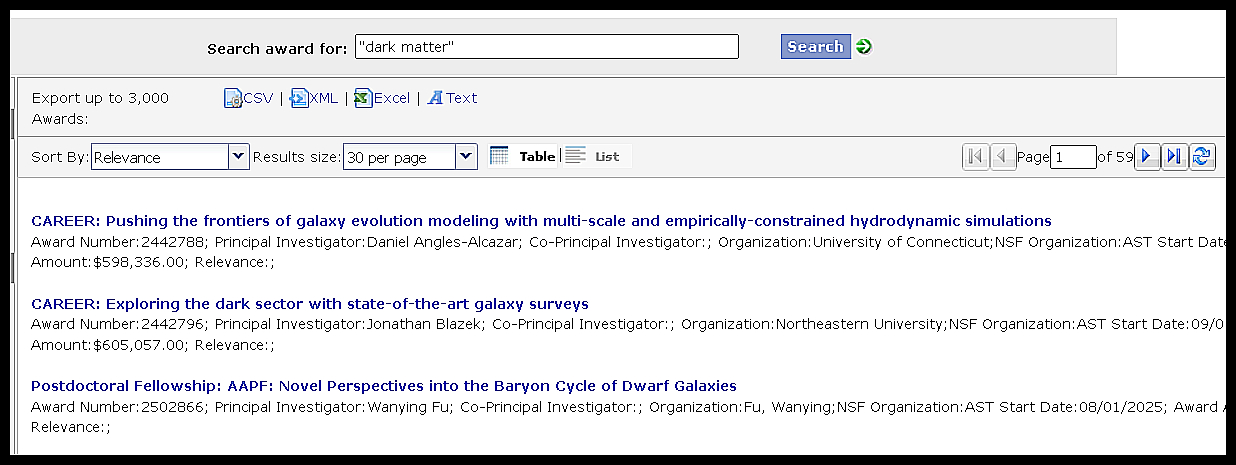
You can also find a huge number of research results searching for topics that have no practical value. Below is what the search term "dark matter" produces:


dark matter projects funded

We get 55 pages of results, with 30 results per page, giving a total of something like 1650 federally funded projects relating to dark matter. That's an amazing result, given that dark matter has never even been directly observed; and we don't even know if it exists. 

Now, let's try a different search. We will look for funded research projects relating to the origin of protein molecules. The problem of the origin of protein molecules is one of the boast antagonist problems I referred to above. Inside each human body there are more than 20,000  different types of protein molecules, each a different type of complex invention requiring a very special arrangement of thousands of atoms.  Scientists lack any credible theory for the origin of protein molecules. 

Protein molecules require very special arrangements of amino acids as hard-to-achieve by chance as it is hard for ink splashes to produce useful functional paragraphs. Because protein molecules are in general very sensitive to small changes, with their functionality typically being broken if you change only 10% or less of their amino acids, protein molecules have very high organization thresholds for them to be functional, meaning that they are not credibly explained by gradualist ideas such as Darwinism. The difficulties in explaining the origin of protein molecules is one of the biggest reasons for rejecting boasts that biological origins are successfully explained by ideas of Darwinian evolution. The issue is discussed at much greater length here and here

Below is the result I get when I search for the phrases "origin of protein molecules" and "origin of proteins" and "origin of protein" using the National Science Foundation grant query tool (the visual combines three different search results):


The search for research projects using the term "origin of protein molecules" produced no results. The search for research projects using the term "origin of proteins" produced no results. The search for research projects using the term "origin of protein" produced only two results. Both of those results were projects related to Alzheimer's disease, neither of which had anything to do with explaining the origin of any protein molecule. 

There's another way we can search for research projects related to the origin of protein molecules. We can search using terms such as "origin of genes" and "origin of gene."  Each type of protein molecule has its amino acid sequence specified by a particular type of gene. So research into the origin of genes is pretty much equivalent to research on the origin of proteins. 

Below is the result I get when I search for the phrases "origin of genes" and "origin of gene" using the NSF grant query tool:


The results are extremely scanty. A search for the phrase "origin of genes" produced only one result, and it is a project completed in the year 2000.  A search for the phrase "origin of gene" produced only four results. The first result is a project that ended in 2023.  The other three results are all projects that ended in the year 2007. 

Another topic related to the origin of genes and proteins is the origin of the genetic code. The genetic code is the system of representation used by genes, in which certain combinations of nucleotide base pairs stand for certain types of amino acids. This system of representations is shown below:


A search for the phrase "origin of the genetic code" on the NSF grant query tool produces only the three results shown below:


All of these projects have already been completed. 

Another of the boast antagonist problems I mentioned was the origin of protein complexes. Most or a large fraction of all proteins seem to be useless when acting alone. Most or a large fraction of all proteins only become functional when they act as team members within groups of proteins called protein complexes. Why such protein complexes arise so conveniently in the body is a major unsolved problem of biology. Below are some relevant quotes:

  • "The majority of cellular proteins function as subunits in larger protein complexes. However, very little is known about how protein complexes form in vivo." Duncan and Mata, "Widespread Cotranslational Formation of Protein Complexes," 2011.
  • "While the occurrence of multiprotein assemblies is ubiquitous, the understanding of pathways that dictate the formation of quaternary structure remains enigmatic." -- Two scientists (link). 
  • "A general theoretical framework to understand protein complex formation and usage is still lacking." -- Two scientists, 2019 (link). 
  • "Most proteins associate into multimeric complexes with specific architectures, which often have functional properties like cooperative ligand binding or allosteric regulation. No detailed knowledge is available about how any multimer and its functions arose during historical evolution." -- Ten scientists, 2020 (link). 
  • "Protein assemblies are at the basis of numerous biological machines by performing actions that none of the individual proteins would be able to do. There are thousands, perhaps millions of different types and states of proteins in a living organism, and the number of possible interactions between them is enormous...The strong synergy within the protein complex makes it irreducible to an incremental process. They are rather to be acknowledged as fine-tuned initial conditions of the constituting protein sequences. These structures are biological examples of nano-engineering that surpass anything human engineers have created. Such systems pose a serious challenge to a Darwinian account of evolution, since irreducibly complex systems have no direct series of selectable intermediates, and in addition, as we saw in Section 4.1, each module (protein) is of low probability by itself." -- Steinar Thorvaldsen and Ola Hössjerm, "Using statistical methods to model the fine-tuning of molecular machines and systems,"  Journal of Theoretical Biology.
Below is the result we get using the phrase "origin of protein complexes" on the NSF grant query tool:


The query produces no results. If you change the query to "formation of protein complexes," you will get only five results, all referring to projects already completed. None of those projects generally addressed the problem of how protein complexes form. 

The queries above suggest that scientists almost have given up on trying to explain the origin of genes, protein molecules and the genetic code, and that scientists have almost given up on trying to explain the formation of protein complexes.  The problems of trying to explain the origin of such things are some of the biggest unsolved problems in science. But as long as you stay chained to the ball and chains of Darwinism and materialism, there is basically no hope of making progress on such problems. So rather than giving us continued demonstrations of how bad a job Darwinism does at explaining the origin of genes, proteins and the genetic code, scientists seem to be taking a kind of "hands off" approach to such problems, hoping that people won't notice their gigantic failure to credibly explain such things. 

Darwinism does not hold water

By their failure to "put two and two together" in realizing the implications of their failure to credibly explain the origin of protein molecules, genes, protein complexes, the genetic code and homochirality,  today's biologists remind me of Lois Lane in the Superman comic books, TV shows and movies.  I am currently watching on HBO Max reruns of the TV series "Lois and Clark: The New Adventures of Superman." The series has excellent romantic chemistry between Superman/Clark Kent (very well-played by Dean Cain) and Lois Lane (very well  played with comic flair by Teri Hatcher).  

In the series Lois Lane is a bright woman, but when it comes to figuring out Superman's secret identity (that Superman is really Clark Kent), Lois just cannot put two and two together (to use an English expression meaning to reach a very obvious conclusion). Lois frequently sees Superman right next to her, and every day she sees  Clark Kent, who looks and talks exactly like Superman, the only difference being that Clark Kent wears glasses. Also, Lois never sees Superman and Clark Kent together. And it seems that in half of the episodes, whenever some danger arises when Lois and Clark are together, Clark suddenly disappears and Superman suddenly appears to save the day. Figuring out that Superman must be Clark Kent is just a matter of putting two and two together, but Lois just cannot bring herself to do that.  Similarly, faced with a biosphere in which all the big organisms look as well-designed and precisely fine-tuned and information-rich and well-organized as anything could look, our biologists just cannot bring themselves to put two and two together and reach the obvious conclusion that follows from such realities.

Sunday, April 6, 2025

Psychic Experiences in the News, Part 4

 Here is the latest in a series of videos I am making about newspaper accounts of ESP, precognition, prophetic dreams, out-of-body experiences and near-death experiences. 


If you have any difficulty viewing this video, try the link here. 

To see another video as long as this one, with the same type of newspaper clippings, see Part 1 of this video series using the link here, or see Part 2 of this video series using the link here, or part 3 of this video series using the link here.