Header 1

Our future, our universe, and other weighty topics


Wednesday, March 16, 2022

Some Experts Gave Us the Long Terror, and Other Experts Worsened It

Global anxiety has worsened after the deplorable invasion of Ukraine by Russia. There has been some discussion of the possible use of nuclear weapons somehow occurring as a result of the Ukraine invasion, through some "match thrown in the tinderbox" effect. Supposedly there has been a big spike in sales of potassium iodide pills providing partial protection against radiation. The Ukraine invasion has caused many to remember something that the average person rarely remembers: that Russia and the US are armed with many thousands of nuclear weapons, which at any time could bring the civilized world to ruins. 

It is astonishing that so many stopped thinking about nuclear weapons after the collapse of the Soviet Union in late 1991. Between 1960 and 1990 the existence of huge nuclear arsenals was like some huge dark cloud that loomed large in the average person's mental sky.  The 1962 Cuban Missile Crisis was widely regarded as a high point of nuclear tension. However, at that time the risk of an all-out nuclear war may not have been so high, because the United States had many times more nuclear weapons than the Soviet Union, making it likely the Soviets would avoid a full-scale conflict.  But between 1960 and 1980 the Soviet Union produced so many nuclear weapons that it caught up with the United States in terms of its total nuclear arsenal.  By about 1980 there were about 50,000 nuclear weapons in existence.  The peak came around 1985, when the total number of nuclear weapons climbed to about 65,000. 

The threat of nuclear war was on the radar of most informed persons living during that decade. I remember all the publicity that occurred in November, 1983 surrounding a TV movie called The Day After, depicting the horror of a nuclear holocaust. I was so spooked I couldn't watch the whole film, except for turning into one harrowing scene near the end.  The scene showed a couple who had been engaged to be married, and the woman had radiation burns all over her face.  As I remember it, she was saying to her fiance something like "you can phone me," but the fiance was saying that there were no longer any phones. 

The threat of nuclear war loomed large during the rest of the 1980's, but in late 1991 the Soviet Union broke up. Around that time, communism collapsed in Russia, and soon thereafter communism started declining in China. Despite the persistence of a party calling itself communist, communism faded in China, with capitalism flourishing.  By the time Bill Clinton was elected US president in 1992, it seemed that the Cold War was over. People began to forget about the world's huge stockpiles of nuclear weapons. The global stockpile of nuclear weapons went down from about 60,000 in 1990 to about 25,000 in the year 2000, reaching only about 10,000 in the year 2010.  

Somehow people largely seemed to forget that there were still enough nuclear weapons to destroy civilization many times over.  You don't need an exchange of 50,000 nuclear weapons to create some new Dark Age. An exchange of a mere 1000 weapons would do the trick just fine. 

Who is to blame for the decades of terror, in which every young person would frequently wonder whether the current year was his last? The people who got things started were the politicians and the physicists. 

The book The Doomsday Machine by Daniel Ellsberg is a gripping and frightening look at how militarists have put the world not far from destruction by creating machinery of nuclear devastation that has often had inadequate safeguards. Chapter 17 deals with how American nuclear scientists gave the go-ahead for testing a nuclear bomb even though they seemed to have thought there was a real possibility that the bomb might destroy all earthly life by setting the entire atmosphere on fire.

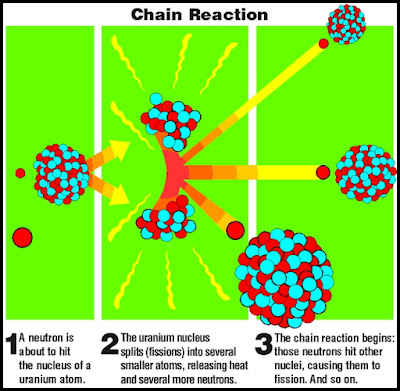
The idea may seem absurd today, but that's only because so many nuclear bombs have been tested, without such a thing happening. Let's consider a scientist judging the question in 1943 or 1944. The idea behind a nuclear bomb is to start a chain reaction. The neutrons of one atom are stripped off by the explosion, and these neutrons travel out into space, hitting other atoms, causing those atoms to lose their neutrons. The process continues over and over again. But when would this chain reaction stop? Before the first atomic bomb was exploded, scientists didn't know.


chain reaction

A scientist in 1944 could have been certain that a nuclear bomb exploded in space would have only caused a limited chain reaction, because eventually neutrons traveling out from the explosion would run into the vacuum of space, causing the nuclear chain reaction to stop. But the earth's atmosphere is not a vacuum. It has many atoms of oxygen and nitrogen. So a scientist around 1944 must have been worried about a terrifying possibility: that a nuclear bomb exploded in the atmosphere would cause a chain reaction that would keep spreading throughout the atmosphere, being fueled by the atoms of oxygen and nitrogen in the atmosphere.

One scientist named Hans Bethe thought that such an ignition of the atmosphere was impossible. But we are told on page 276 of Ellsberg's book, “[Enrico] Fermi, in particular, the greatest experimental physicist present, did not agree with Bethe's assurance of impossibility.” On page 279 Ellsberg states, “Nearly every account of the problem of atmospheric ignition describes it, incorrectly, as having been proven to be a non-problem – an impossibility – soon after it first arose in the initial discussion of the theoretical group, or at any rate well before a device was actually detonated.” On page 280 Ellsberg quotes the official historian of the Manhattan Project, David Hawkins:

"Prior to the detonations at the Trinity site, Hiroshima, or Nagasaki, Hawkins told me firmly, they never confirmed by theoretical calculations that the chance of atmospheric ignition from any of these was zero. Even if they had, the experimentalists among them would have recognized that the calculations could have been in error or could have failed to take something into account."

The second part of this quote makes a crucial point. Anyone with engineering experience knows that there is usually no way that you can prove on paper that some engineering result  will happen or will not happen. The only way to have confidence is to actually do a test. An engineer can go over some blueprints of a bridge with the greatest scrutiny, but that does not prove that the bridge will not collapse when heavy trucks roll over it. A software engineer can subject every line of his source code to great scrutiny, but that does not prove that his program will not crash when users try to use it. When you are doing very complex engineering, the only way to discover whether something bad will happen is by testing. So the idea that the nuclear engineers did some calculations to make them confident that the atmosphere would not explode is erroneous. They could have had no such confidence until a nuclear bomb was actually tested in the atmosphere.

According to one source Ellsberg quotes on page 281, Enrico Fermi  (one of the the top physicists working on the atomic bomb) stated the following before the test of the first atomic bomb, referring to an ignition of the atmosphere that would  have killed everyone on Earth:

"It would be a miracle if the atmosphere were ignited. I reckon the chance of a miracle to be about ten percent."

Apparently the atomic bomb scientists gambled with the destruction of all of humanity. There is no record that the scientists ever informed any US president about the risk of atmospheric ignition. What the scientists should have done is to refuse to do the finalizing work on the atomic bomb on the grounds that they could not rule out the possibility that igniting an atomic bomb would have destroyed the atmosphere. If they had taken such an approach, nuclear weapons might have never been tested. The atomic bomb was never even necessary for the defeat of Japan. By the time it was used, the US had a naval blockade of Japan and relentless bombing of Japan by conventional bombers, with fire bombing raids so severe that more that 50,000 died on a single night, the night of March 10, 1945. Such non-atomic military pressure would have led to a Japanese surrender (particularly if Japan was informed it could keep its emperor, which the US was late in doing).

After the first atomic bomb was tested in 1945, scientists got busy working on a vastly more lethal weapon: the hydrogen bomb. When the first hydrogen bomb was exploded in 1952, with a destructive force a thousand times greater than that of the first atomic bomb, the ignition of the entire atmosphere (or some similar unexpected side-effect) was again a possibility that could not be excluded prior to the test. Again, our physicists recklessly proceeded down a path that (for all they knew) might well have destroyed every human.  Even if you ignore the risk of an atmospheric detonation, there was a whole other reason why scientists were gambling with mankind's destruction: the fact that there is always a risk of a nuclear holocaust in a world packed with H-bombs.

For at least 30 years (between about 1962 and 1992) there occurred what can be called the Long Terror.  The Long Terror was the large threat of nuclear war in a world that was accumulating more and more nuclear weapons.  It is obvious the physicists and politicians created the Long Terror. What is not so obvious (although rather clearly true) is that biologists  and psychologists were guilty of making the Long Terror more of a terror. 

Put yourself in the shoes of a person named Jack who reached the age of 18 around 1980 or 1984.  Jack may have feared very much that he would never reach the age of 25 or 30, because of the large chance of a nuclear war starting.  But if Jack had been  properly educated in matters of biology and psychology and the history of human mental experiences,  such a terror might have been greatly lessened.  

Jack might have learned facts about the enormous organization and functional complexity and fine-tuning of biological organisms, which may have led him to think that he is part of a purposeful universe rather than some mere accident.  Jack might have learned about a host of observations by groups such as the Society for Psychical Research, observations that will tend to lead someone to believe he has an immortal soul that survives death.  Jack might have learned about many reasons for believing that the brain is utterly inadequate as an explanation for human mental phenomena such as consciousness, understanding, thinking, memory acquisition and instant memory recall.  Learning such things, Jack would not have been so terrified during the period of the Long Terror.  He might have been worried that his earthly lifespan might be cut short because of the threat of nuclear war. But he would have tended to believe that he was a soul who would survive death. 

But during the period from 1960 to 1990 our biologists and psychologists did their best to prevent people from learning such things.  Our biologists taught the ludicrous legend that some man in the nineteenth century had figured out that earthly biological effects are all accidental. Because this man knew nothing of the complexity and organization of cells and protein molecules, this legend was as absurd as claiming that the ancient philosopher Plato explained all of our modern electronic devices (something Plato had no knowledge of).  Teaching us fables that were never justified by facts, our biologists and psychologists told us that the brain was responsible for all human mental phenomena, hiding from us  a great many observations inconsistent with such a dogma.  Our biologists and psychologists did their best to hide from us a thousand important and relevant observations contradicting their opinion that humans are merely accidents of nature and their opinion that mind and memory are purely products of the brain.  They made sure no such observations were mentioned in their textbooks and essays (or mentioned only in some unfair, misleading way). The diagram below illustrates part of what went on.  Our biologists and psychologists should have told us about the blue observations, but told us only about the green observations, using some silly "nothing spooky allowed" rule as their justification.  Many of the blue observations were those suggesting that the mind of a human will not perish at death. 

scientist cherry picking

The result of all this was that the Long Terror was made so much worse.  Learning only cherry-picked observations selected by dogma-spouting professors, many millions of misinformed and authority-indoctrinated people who never should have feared death ended up fearing death, and also feared that some nuclear war might soon kill them and end their minds forever. But thankfully shortly after the Soviet Union collapsed, we saw the rise of the Internet.  It became easier and easier for people to search for information.  Now people can easily discover information that our biologists and psychologists have tried to prevent them from learning about, observations that defy the socially constructed dogmas of such professors.  

If biologists and psychologists had properly educated us about the most important facts of biological phenomena and mental phenomena (many of which are very inconsistent with the dogmas of current biologists), the Long Terror's fear might have been lessened.  But instead, some biologists got busy with their own risky research programs involving tinkering with genes and playing around with viruses. Some have wondered whether the risk from such research programs may eventually be as high as the risk from nuclear warfare. 

The Long Terror persists, and will persist as long as there are thousands of nuclear weapons in the world (or virus-tinkering labs which may pose a comparable risk).  Those who fathered or intensified the Long Terror (including those who made it so much more psychologically oppressive) were or are largely professors of academia and other PhD's. 

Teachings about the basic nature of life have consequences. Raise a man in a communist regime in which he is taught "the ends justify the means" and that he will never have to answer to some transcendent authority for his actions, and that man may feel free to make some immoral decision such as ordering the invasion of Ukraine.  Teach a man that his thoughts are  merely chemical activity and that his self is merely the arrangement of some neurons and synapses and that his species is a mere accident of nature, and he may a thousand times tremble at the idea of his earthly death, an idea that would not terrify him if he were better educated.  Teach a man to regard some other man as a set of genes rather than a soul, and he may let his mind get stained by racism, and he may even slaughter his fellow humans, claiming his act was a gene-pool improvement. Teach a man the malignant nonsense that he has no free will, and he may cheerfully commit the most horrible crimes, believing that he is not to blame because he had no choice but to act as he acted. 

Saturday, March 12, 2022

Cheap Shot: Scientific American's Recent Article on COVID-19

"What we have seen with the lab-leak controversy is experts responding to this state of affairs not with the kind of humility the situation calls for, but by forcing consensus to create the appearance of certitude in order to preserve their social and political authority. The misrepresentation of the state of our knowledge regarding Covid’s origins was therefore not simply a misstep or institutional failure. It was a perversion of the norms that scientific institutions and experts are supposed to uphold."  -- M. Anthony Mills, article in The New Atlantis

The COVID-19 pandemic began spreading worldwide early in the year 2020, after originating in Wuhan, China, the site of two major virus labs. In February 2020 a letter appeared in the British medical journal The Lancet entitled "Statement in support of the scientists, public health professionals, and medical professionals of China combatting COVID-19." The statement denounced as "misinformation" and "conspiracy theories" suspicions that "COVID-19 does not have a natural origin."  It stated the following:

"The rapid, open, and transparent sharing of data on this outbreak is now being threatened by rumours and misinformation around its origins. We stand together to strongly condemn conspiracy theories suggesting that COVID-19 does not have a natural origin."

The authors suggested that "conjecture" on this topic should be repressed for the sake of "unity," stating, "We support the call from the Director-General of WHO to promote scientific evidence and unity over misinformation and conjecture." 

The Daily Mail quotes a scholar of COVID-19 origins (Jamie Metzl) as speaking very unfavorably about the February 2020 Lancet letter orchestrated by Daszak:

"Jamie Metzl, who sits on the World Health Organization's advisory committee on human genome editing and is a former Bill Clinton administration staffer, said Dr Daszak's letter was a 'form of thuggery'. He said: ‘The Lancet letter was scientific propaganda and a form of thuggery and intimidation. By labelling anyone with different views a conspiracy theorist, the Lancet letter was the worst form of bullying in full contravention of the scientific method.' "

Metzl was using a little hyperbole, as no literal thuggery (no literal physical violence) was involved, and mere words are never "the worst form of bullying," which is physical violenceIt is rather hard to judge exactly how much of an effect the February 2020 Lancet letter had. But it did rather seem in early 2020 that the letter had "worked like a charm" to tell scientists that no heresy was allowed from the prevailing view on this topic.  Throughout that year scientists acted as if they were thinking, "We got the memo: it is a taboo to question the purely natural origin of COVID-19." 

But in the year 2021, things started to change. Article after article in the mainstream press began to treat respectfully the lab leak hypothesis as an alternate theory of COVID-19 origins. An example is the article here in the widely-read science review site Inference. In the press around the middle of 2021 we heard quite a few scientists say that in retrospect it was a mistake to brand those in favor of the lab leak hypothesis as "conspiracy theorists." The lab leak hypothesis is  mainly a theory of human error and human overconfidence, not a theory of some sinister conspiracy.  Quite a few scientists said something along the lines that going forward, there should be a calm scientific debate about the alternate ideas of a purely natural origin of COVID-19 and a laboratory-related origin, without people mudslinging those who took either of the positions. 

But mainstream scientists have been very bad about living up to such pledges. Soon after we heard such pledges, mainstream scientists returned to their bad old ways, and resumed techniques of stereotyping, smearing and weaponized psychology against those advancing the lab leak hypothesis. 

The latest example is an absurdly ad hominem article published in Scientific American.  The article has three authors: 

  • a virologist who tries to make a case for the purely natural origin of COVID-19 (one that withholds a crucial piece of evidence);
  • a climate scientist who is there so that a senseless comparison can be made between global warming denialists and those who are skeptical about whether COVID-19 had a purely natural origin;
  • a cognitive scientist who seems to be the chief instigator in an application of weaponized psychology, which is when ad hominem psychology verbiage is used for the sake of "poison-the-well" defamation of someone who holds some opinion you do not share or made some observation you do not want to accept.
The article has the absurd title "The Lab-Leak Hypothesis Made It Harder for Scientists to Seek the Truth." The claim is not at all true.  The hypothesis that COVID-19 may have arisen from a lab accident has not done anything to make it harder for any scientist to seek the truth. 

The article repeatedly tries to draw illegimate associations between those who favor the lab leak hypothesis and various unrelated parties who the authors regard as unsavory. Specifically:

(1) The article again and again unfairly tries to paint supporters of the lab leak hypothesis as conspiracy theorists.  You need not believe in any conspiracy theory to think that COVID-19 may have arisen from a lab leak when overconfident scientists were not as careful as they should have been. A theory of human error and overconfidence is not a conspiracy theory.  
(2) By having a photo showing people opposing vaccine mandates, the article tries to link people opposing vaccine mandates and those who think COVID-19 may have originated when some lab leak occurred. These are two different unrelated opinions. 
(3) Most ridiculously, the article tries to link those disbelieving in man-made global warming with those supporting the lab leak hypothesis. Those two opinions have no connection, and in one sense are rather the opposite. A global warming denialist is often saying "it's all just natural, not man-caused" about global warming, while a lab leak theorist may typically say "it's not all just natural, it was man-caused" about COVID-19.  

Climate scientists do not enhance their credibilty when they author or co-author ad hominem attacks trying to smear people who have some opinion which has nothing to do with the climate, by making extremely strained and implausible comparisons between such people and global warming denialists, like someone trying to say parapsychology lab researcher professors are like tarot-card fortune tellers, or like someone trying to suggest critics of gene splicing research are like flat earth believers.  To the contrary, when climate scientists become involved in that type of unfair mudslinging,  such scientists may diminish their own credibility.  

Discussing the intelligence review of the lab leak hypothesis made by government agencies, the Scientific American article resorts to some deplorable information withholding. The article tells us only this:

"The so-called lab-leak hypothesis gained sufficient rhetorical and political force that President Joe Biden instructed the U.S. intelligence services to investigate it. Although the interagency intelligence report update, declassified in October 2021, dismissed several popular laboratory-origin claims—including that the virus was a bioweapon and that the Chinese government knew about the virus before the pandemic—it was unable to unequivocally resolve the origin question."

The report in question (which you can read here)  stated the following, using "IC elements" to mean government agencies such as the FBI and the CIA involved with intelligence analysis:

"Four IC elements and the National Intelligence Council assess with low confidence that the initial SARS-CoV-2 infection was most likely caused by natural exposure to an animal infected with it or a close progenitor virus—a virus that probably would be more than 99 percent similar to SARS-CoV-2. These analysts give weight to China’s officials’ lack of foreknowledge, the numerous vectors for natural exposure, and other factors.  One IC element assesses with moderate confidence that the first human infection with SARS-CoV-2 most likely was the result of a laboratory-associated incident, probably involving experimentation, animal handling, or sampling by the Wuhan Institute of Virology."

So the result was: no conclusion on COVID-19 origins were made  with high confidence, and the only conclusion made with medium confidence was a conclusion in favor of the lab leak hypothesis. What we needed from the recent Scientific American article on COVID-19 origins was a mention of the fact that is most relevant to discussing COVID-19 origins: that the only US intelligence agency to conclude with medium or higher confidence on this topic concluded with medium confidence that COVID-19 probably came from a lab leak. Instead of telling us this most relevant fact,  Scientific American has given us a fantasy: that the hypothesis of a lab leak is making it harder for scientists to seek truth. 

assessment of COVID origins
A page from the assessment on COVID-19 origins

Unfair stereotyping of opponents is one of the eight classic symptoms of groupthink. The authors of the recent Scientific American article seem like examples of what are called mindguards. In the context of groupthink, mindguards are people who try to prevent some group from being exposed to data or opinions that conflict with its prevalent opinion about something.  Besides stereotyping of opponents, the predominant tactic of mindguards is to suppress any mention of relevant facts or observations conflicting with the group's viewpoint. 
Scientific American has turned into such an "ideology shop" that by now a good principle is: never believe anything merely because you read it in a headline in Scientific American, unless you get confirmation from some other credible source. 

In the New York Times yesterday there was an opinion article with the headline "How Millions of Lives Might Have Been Saved from COVID-19." The article suggests that the entire global COVID-19 pandemic could have been prevented if there had not been a very early coverup conspiracy to suppress news about the politically embarrassing reality of the spread of a novel disease (one of many reasons it makes no sense to speak as if conspiracies never occur). Without naming any names of the bumbling officials guilty of the bungled US response to COVID-19, we get some startling comparisons between competent responses in small countries and incompetent responses in the US. For example, we are told that Taiwan has suffered only 853 COVID-19 deaths, and that "if the United States had suffered a similar death rate, we would have lost about 12,000 people, instead of nearly a million." We are told that South Korea had fewer than1000 COVID-19 deaths in 2020, and that if the US had responded as effectively, it would have lost only about 7000 in the year 2020, instead of losing more than 375,000 in that year. Thus far the COVID-19 deaths of the United States are about 400 times greater than in the attack at Pearl Harbor, but quite a few comparable to Admiral Kimmel have yet to be fired.  

Tuesday, March 8, 2022

The New Yorker's Poor Portrait of Human Cells

For decades the magazine the New Yorker has been famous for its wonderful cartoons, such as the classic cartoons of Charles Addams. But the New Yorker has also long been famous for long essays. A recent essay in the magazine was a long article entitled "A Journey to the Center of Our Cells." It is a good thing that a major magazine should attempt to educate us about the fundamentals of cells, a deep and profound topic that can be a springboard to more intelligent ideas in biology.  Unfortunately, what the article gives us is a kind of shrink-speaking complexity-concealment affair like we so often read, an essay that repeatedly gives us wrong ideas and incorrect impressions.  

Two huge errors occur very early in the essay. The first is in the subtitle, which makes the untrue claim that scientists are learning to build their own cells. No progress has been made in making self-reproducing cells from scratch or from protein components. Then we read, "We accept that each of us was once a single cell, and that packed inside it was the means to build a whole body and maintain it throughout its life." It is very false indeed  to state that a fertilized ovum or human egg contains "the means to build a whole body and maintain it throughout its life." Such a fertilized ovum or egg contains only DNA with low-level chemical information, such as partial instructions for making protein molecules. DNA does not contain any instructions for building bodies or limbs or organ systems or skeletons or cells.  DNA does not even contain instructions for making the organelles that are the components of cells.  So how does a full-grown body with its many levels of hierarchical organization (and about 200 types of cells, most as organized as a factory) arise from a mere speck-sized cell containing no instructions for making such a wonder of functional complexity and vast hierarchical organization? That is a mystery a thousand miles over the heads of today's scientists. 

Just as automobiles are wonders of organization (marvels involving very many parts arranged in the right way to achieve a functional end), cells are wonders of vast organization (marvels involving very many parts arranged in the right way to achieve a functional end).  But you would never know that from reading the New Yorker article. We do not find the words "organized" or "organization" in the article, except for a most dubious reference to "self-organization."  The article refers to cells as "incredibly intricate," but that is not an adequate term to describe cells. "Intricate" means "very complicated or detailed."  Countless non-functional things are intricate. Cells are something much more than intricate: they are incredibly organized, internally dynamic and functionally complex. 
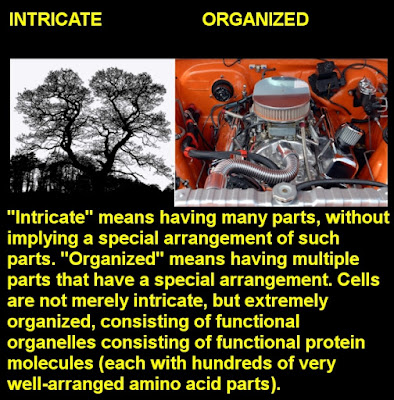
organization of cells

The article mainly speaks of "the cell," as if there was one type of cell. Nowhere are we told about all the different types of cells, except when the article mentions four types, by saying, "The human body contains brain cells and fingernail cells, blood cells and muscle cells, and dozens of species of single-celled bacteria."  Human beings actually have about 200 different types of cells, with characteristics as diverse as the diverse characteristics of the creatures in the Bronx Zoo. Just as each of the roughly 20,000 types of protein molecules in the human body is its own separate very complex invention, each of the roughly 200 types of cells in the human body is its own separate very complex invention. Why the failure to tell us about such a reality? 

The article then tells us, "Several groups of 'synthetic biologists' are now close to assembling living cells from nonliving parts."  This claim is a huge falsehood.  A living cell would be a cell capable of self-reproduction.  Scientists have no understanding of what causes cells to reproduce. So scientists are nowhere close to assembling living cells from nonliving parts.  On a web page entitled "The Mystery of Cell Division," a scientist confesses that scientists don't understand how cells -- with a complexity of "airplanes" -- could self-reproduce.  We read this:

"Scientists have been trying to understand how cells are built since the 1800s. This does not surprise us and, as scientists ourselves, we have always been puzzled at how cells, such complex structures, are able to reproduce over and over again. Even more astonishing is that, despite the frequency of cell division, mistakes are relatively rare and almost always corrected. According to Professor David Morgan from University of California, the complexity that we observe in cells can be compared to that of airplanes."

An M. Pitkanen (who has a PhD in theoretical physics) has written the following about cell division:

"Replication is one of the deepest mysteries of biology. It is really something totally counterintuitive if cell is seen as a sack of water plus some chemicals. We have a lot [of] facts about what happens in the replication at DNA level but how this miracle happens is a mystery. At cell level the situation gets even more complex."

A university press release discusses scientific ignorance about the basis question of cell division. It states the following:

"When a rapidly-growing cell divides into two smaller cells, what triggers the split? Is it the size the growing cell eventually reaches? Or is the real trigger the time period over which the cell keeps growing ever larger?...'How cells control their size and maintain stable size distributions is one of the most fundamental, unsolved problems in biology,' said Suckjoon Jun, an assistant professor of physics and molecular biology at UC San Diego...'Even for the bacterium E. coli, arguably the most extensively studied organism to date, no one has been able to answer this question.' ”

Later the New Yorker article makes the big mistake of equating a cell with its genes. It says, "Decipher the labelled genes and you’d approach a comprehensive understanding of cellular life."  To the contrary, neither DNA nor its genes specify how to make a cell or any of its component organelles; and neither DNA nor its genes specify the incredibly complex biochemistry of cells.  DNA and genes influence cellular behavior, but do not specify it.  Later the New Yorker article makes the unwarranted claim that protein molecules "self-assemble into biological machines." We do not know how incredibly complex organelles, cells, organs, organ systems and bodies arise from the low-level components that are protein molecules, and we should not be pretending to understand such a mystery (a thousand miles over our head) by using the empty term "self-assemble." 

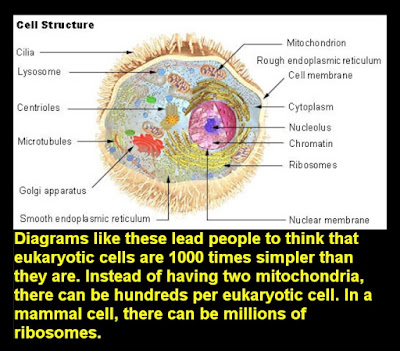
The New Yorker article fails to explain the basic structural reality that a human cell contains thousands of functional components called organelles.  In this sense, a human cell is like some car engine or aircraft carrier engine containing thousands of functional parts arranged in just the right way.  Such a reality will be suprising to those who remember the thousand-fold oversimplified and extremely misleading cell diagrams in biology textbooks, which falsely depict cells as having only a few dozen organelles. 

complexity of cells


Instead of describing this reality of vastly organized cell structure, the New Yorker article rather tries to depict a cell as if it was a mere bag or heap of proteins. It states this:

"If a cell were blown up to the size of a high-school gym, you wouldn’t be able to see across it. It would be filled with tens of thousands of proteins, most about the size of a basketball. Other biomolecules no bigger than your hand, and water molecules the size of your thumb, would fill the spaces between. (To scale, your whole body would be about the size of a ribosome.) The mixture would have the consistency of hair gel."

This is as misleading as describing the US Capitol Building as being kind of a big heap of carbon, oxygen and iron molecules. Hair gell is disorganized. Cells are enormously organized. 

There is a world of difference between the simplest type of cells (called prokaryotic cells) and the type of cells found in the human body (called eukaryotic cells). It has been said that the difference between prokaryotic cells and eukaryotic cells is like the difference between some one-room shack and a billionaire's mansion.  What visual do we see at the top of the "A Journey to the Center of Our  Cells" article in the New Yorker, an article with a title suggesting a discussion of human cells?  Not a visual of a eukaryotic cell, but a visual of a prokaryotic cell.  This is consistent with the whole thrust of the article, which seemingly is to conceal from us the complexity and organization of our cells, and to make us think our cells are vastly simpler than they are. 

Later the New Yorker article approvingly quotes some physicist saying, "This area of understanding how colloidal-scale physics is regulating and orchestrating cell function—this is the frontier."  The statement is very laughable and extremely misleading. Physics does not orchestrate cell function. Cells involve operations as complex as the construction of a skyscraper, and cannot be explained by simple rules of physics. Saying that cell function is orchestrated by physics is like saying the construction of a skyscraper is orchestrated by the law of gravity. 

In the last paragraph, the New Yorker article tries to create the impression that "synthetic life" has been created. It states this:

"Before I left town, Glass gave me a memento. It was a strange-looking cube, a sort of clear plastic paperweight with a pink square suspended inside. Glass explained that the square was a plate of agar on which colonies of the minimal cell had been grown. The colonies were encased in a few inches of resin. It’s on my desk now. Holding it up to the light, I can make out perhaps a dozen pinpricks. I wonder what these colonies—some of the first examples of synthetic life—will come to be seen as initiating."

The impression here is enormously misleading. The work in question by Glass involves stripping genes out of existing living cells, to try and find how many genes can be taken out without destroying a cell's ability to reproduce (rather like experimenting with how many parts can be removed from a mouse without killing the mouse). That isn't anything like creating synthetic life, which would be creating a living reproducing thing from some non-living inert substances. No one has produced any such thing as synthetic life, nor is anyone anywhere close to doing such a thing, which we should not expect to occur in this century. 

Given its very great internal complexity and very high state of functional organization, the reproduction of a cell is a marvel that can be compared to a working automobile splitting up to become two full-sized automobiles.  The author of the New Yorker article seems to have little understanding of how hard it would be to ever explain such a marvel or to cause it by tinkering with lifeless matter. The author fails to even mention cell reproduction, merely referring to cell division, something sounding much less impressive. Inanimate lifeless things like books can be easily divided into two, but they can't reproduce.  At one point the article laughably suggests that scientists may be able to get living cells from scratch after they have spent some more time tinkering with "different ingredients" or by fiddling with part arrangements.   This is like suggesting that if you tinker a little more with a car engine, you can get the car to split into two working cars.  

By referring to "different ingredients" in a cell, the article is using a common technique of complexity-concealing writers trying to make something sound vastly less organized than it is.  Although sometimes defined as a part or a component, the term "ingredient" is a word with a strong connotation implying something within an unordered mixture such as a pot of soup.  The wikipedia.org article on "ingredient" begins by saying, "An ingredient is a substance that forms part of a mixture (in a general sense)."  Cells are very complex functional arrangements of matter that are no more mixtures than the engine of a car is a mixture. 

Instead of giving us some incorrect impression that scientists such as John I. Glass are creating synthetic life, our New Yorker author should have properly analyzed and reported on papers co-authored by Glass such as the paper "Fundamental behaviors emerge from simulations of a living minimal cell." That paper describes "a genetically minimal bacterial cell, consisting of only ... 493 genes on a single 543-kbp circular chromosome with 452 genes coding for proteins (), some of which are subunits of multi-domain complexes." Each of those genes is a complex invention with hundreds of fine-tuned parts that almost all have to be just right. The total number of amino acids that have to be arranged just right in the proteins partially specified by these genes is roughly 150,000. Far from supporting any "life is simple, we can make it from scratch" narrative, such a paper supports the idea that even the simplest self-reproducing cell has a degree of organization and functional complexity greater than the organization and functional complexity of an 80-page technical manual. And even all that information does not give you a self-reproducing cell; it's only a prerequisite for such a cell. 

The extremely misleading give-you-the-wrong-ideas article that is "A Journey to the Center of Our Cells" reminds me of another extremely misleading give-you-the-wrong-ideas article recently published in the same magazine: its "The Science of Mind Reading" article that is debunked here.  The first article attempts to advance the groundless idea that scientists are making some progress in creating synthetic life from lifeless materials. The second article attempts to advance the groundless idea that scientists are making some progress in reading thoughts by scanning brains. 

Friday, March 4, 2022

Quanta Magazine Draws the Wrong Conclusion About Neural Noise and Memories

The online science journalism web site called Quanta Magazine at www.quantamagazine.org is a graphically slick affair, but its articles often are defective, because its writers so often reverently extol or hype or misrepresent dubious studies by scientists, and almost never seem to apply critical judgment when analyzing such questionable work products. Very many times at this site we will read articles on the deepest topics of physics and biology and the human mind, containing dubious or presumptive statements about  the fundamental nature of reality or life or mind or the universe, written by quite youthful-looking writers.  When I look up the biographies of such writers on the site, I sometimes find they lack any stated relevant science education qualifications.  Sometimes the authors have relevant PhD's, but in quite a few cases we have biographies of young adults that may list only a relevant bachelor's degree or maybe not even that.  Many years of independent study on a topic can make up for failing to study that topic very deeply in college, but when I see a youthful-looking face, I tend to doubt that many such years of independent study occurred. 

A recent example of a defective article in Quanta Magazine was an article entitled "New Map of Meaning in the Brain Changes Ideas About Memory."  The article is a credulous treatment of some very dubious neuroscientist studies that are guilty of the same type of  Questionable Research Practices found in a large fraction of all  experimental neuroscience papers these days.  In the article we read repeated claims that some kind of neural representations have been found.  Representation is when one thing represents or stands for another, according to some system of symbols or tokens. All claims of representations in the brain outside of DNA are groundless. We know that the DNA in brain cells (and all other cells) have a form of representation, because certain groups of nucleotide base pairs in DNA stand for or represent particular amino acids, under the representation system known as the genetic code. Other than this, there is no robust evidence of any type of representation anywhere in the human body.  There is zero evidence that there exists any such thing as a "map of meaning in the brain." 

The Quanta article mentioned above refers to this neuroscience paper guilty of the usual Questionable Research Practices so prevalent in the dysfunctional realm that is modern experimental neuroscience. The paper ("A Continuous Semantic Space Describes the Representation of Thousands of Object and Action Categories across the Human Brain") makes this groundless claim: "The brain represents object and action categories within a continuous semantic space." The paper gives no robust evidence for any such representations.  Among the defects of the paper are these:

  • Insufficient sample size. The paper describes some brain scanning of a mere five subjects who watched movies.  Fifteen subjects per study group is the minimum for a modestly persuasive experimental result for studies of this type. A sample size calculation (something necessary for any experimental paper of this type to be taken seriously) would have revealed the shortfall, but no such calculation was done.  According to Table 7 of the paper here, a correlation experiment reporting the effect sizes reported by this paper should have used at least 27 subjects. 
  • No control group was used, quite the serious defect for a study like this. For each of the brain-scanned subjects watching movies, there should have been an equal number of brain-scanned control subjects who were not watching movies. 
  • The study used no blinding protocol (something necessary for any experimental paper of this type to be taken seriously), and neither the word "blind" nor "blinding" appears in the paper. 
  • The study was not a pre-registered study registering before data collection an exact hypothesis and exactly how data would be gathered and analyzed, meaning the authors were free to apply any type of analysis they wished after gathering data, and free to improvise how they gathered data,  in a "fishing expedition" type of affair maximizing the chance they would report finding whatever they hoped to find, possibly after slicing and dicing the data until they got the desired result. 
The same defects (the same Questionable Research Practices) are found in another scientific paper referenced by the Quanta Magazine article mentioned above: the paper "A network linking scene perception and spatial memory systems in posterior cerebral cortex," which has the same problems as listed above, except that the study group sizes were 14, 13 and 6 rather than 5.  The same defects (the same Questionable Research Practices) are found in another scientific paper referenced by the Quanta Magazine article mentioned above: the paper "Natural speech reveals the semantic maps that tile human cerebral cortex," which has the same problems as listed above, except that the main study group size was only 7 subjects.  The same defects are found in a paper discussed last month in a misleading Science Daily article entitled "Key brain mechanisms for organizing memories in time." That paper ("Hippocampal ensembles represent sequential relationships among an extended sequence of nonspatial events") used only 5 mice. The paper relied on machine learning, which is being carelessly used by neuroscientists who fail to realize machine learning has an extremely large potential for finding causally irrelevant meaningless correlations.  An expert on computers and software says, "Perhaps the biggest issue with current machine learning trends, however, is our flawed tendency to interpret or describe the patterns captured in models as causative rather than correlations of unknown veracity, accuracy or impact."  A full discussion of how neuroscientists are abusing machine learning will require a separate post. 

There is zero robust evidence for any such things as semantic maps in the human brain, and zero robust evidence for any kind of representations in the brain other than the "nucleotide base pair combinations representing amino acids" representations found in the nucleus of neurons and all other cells. 

In Quanta Magazine what routinely happens is that some article will discuss some shoddy-science research guilty of Questionable Research Practices, and we will see photos showing some scientist involved in the research, with a big proud grin on his or her face.  Were such photos to show facial expressions matching the quality of the research practices involved, we would see people holding their heads in shame. 

scientist puff piece

A community with very strong ideological motivations, the neuroscientist research community resembles some ideologically-motivated research community dedicated to proving that the ghosts of deceased animals linger in the clouds.  What would happen if such a ghosts-in-the-clouds research community were to follow a very rigorous set of research standards? Conceivably they might get some good evidence in support of their cherished belief that animal ghosts live in the clouds. But what would be the main results if such a community of researchers had bad research practices, and failed to follow rigorous standards? Then what they would mainly produce in their literature are false alarms, such as photos of clouds looking a little like animals.  Similarly, what should we expect to mainly get from a community of neuroscience researchers who are very eager to prove claims that brains produce minds, when such researchers routinely act as if they had almost no experimental research standards, and routinely act as if they were oblivious to sensible rules for producing reliable results?  We should mainly expect to get false alarms. That is mainly what is showing up in the neuroscience articles appearing in Quanta Magazine and other science news sites: mainly false alarms. 

In the 2020 study "Sample size evolution in neuroimaging research: An evaluation of highly-cited studies (1990-2012) and of latest practices (2017-2018) in high-impact journals" by Denes Szucs and John P.A.  Ioannidis we have some facts that illuminate the typically dismal quality of experimental neuroimaging studies.  Analyzing more than 1000 papers, the study found the following:
  • that the median reported sample size for neuroimaging imaging studies is a mere 12 (even though, according to section 4.1 of the paper, a sample size more like 33 or 34 is typically needed for a study to be robust);
  • that even though "publishers and funders should require pre-study power calculations necessitating the specification of effect sizes,"   almost none of the papers had such pre-study power calculations (in which you calculate the number of subjects needed for a robust effect).

Another defective article on neuroscience recently appearing in Quanta Magazine is an article entitled "Neural Noise Shows the Uncertainty of Our Memories."  The article refers us to the paper "Joint representation of working memory and uncertainty in human cortex."  In that paper we find the same Questionable Research Practices listed above: no blinding protocol, no pre-registration of a hypothesis and techniques to be followed, too small sample sizes (only 11 participants for Experiment 1), and the only control group being a way-too-small group of three subjects.  15 subjects per study group (including controls) are the minimum for a modestly reliable experimental result for studies of this type. 

The Quanta Magazine article suggests the laughable idea that neurons use Bayesian mathematics or probabilistic calculations in recognition or memory.  The young author of the article cites some very relevant problems with the related research, but apparently fails to be alarmed by the giant red flags involved, like someone cheerfully driving along while red lights are flashing on his car dashboard.  The article states this:

"Still, 'one thing to realize is that the actual correlations are very low,' said Paul Bays, a neuroscientist at the University of Cambridge who also studies visual working memory. Compared to the visual cortex, fMRI scans are very coarse-grained: Each data point in a scan represents the activity of thousands, perhaps even millions of neurons. Given the limitations of the technology, it’s notable that the researchers were able to make the kinds of observations in this study at all.  Hsin-Hung Li, a postdoctoral researcher in Curtis’ laboratory at NYU, used a brain scanner to measure the neural activity associated with a working memory, then assessed the research subject’s uncertainty about the memory.  'We are using a very noisy measurement to tease apart a very tiny thing,' said Hsin-Hung Li, a postdoctoral researcher at NYU and first author of the new paper."

What the Quanta Magazine writer should have done is to recognize that these confessions are indications that no reliable evidence has been found, and that what we have is some gossamer-thin false alarm results that are being "teased out" by researchers eager to find some particular result, like some eager ghost-in-the-clouds believer enthusiastically scanning the heavens for faint traces of ghosts in the sky. 

The title of the Quanta Magazine article is inaccurate. Neural noise does not show that human memories are uncertain. There is a great abundance of very severe noise all over the place in the brain. But that does nothing to show that human memories are unreliable.  To the contrary, it is a fact of human experience that humans can memorize with perfect accuracy very long bodies of information.  This is shown every time a stage actor plays the very long role of Hamlet (a role of 1480 lines) without committing an error, and is also shown every time a Wagnerian tenor sings the very long role of Siegfried (a role of 6000+ words) without committing an error.  No such feats should be possible if such persons are retrieving memories stored in brains, given how much noise exists in the brain. 

Brains are extremely noisy. Many neurons fire at unpredictable intervals, just as maple leaves fall from a tree in autumn at unpredictable intervals. A scientific paper tells us, “Neuronal variability (both in and across trials) can exhibit statistical characteristics (such as the mean and variance) that match those of random processes.” Another scientific paper tells us that Neural activity in the mammalian brain is notoriously variable/noisy over time.” Another paper tells us, "We have confirmed that synaptic transmission at excitatory synapses is generally quite unreliable, with failure rates usually in excess of 0.5 [50%]." A paper tells us that there are two problems in synaptic transmission: (1) the low likelihood of a signal transmitting across a synapse, and (2) a randomness in the strength of the signal that is transmitted if such a signal transmission occurs. As the paper puts it (using more technical language than I just used):

"The probability of vesicle release is known to be generally low (0.1 to 0.4) from in vitro studies in some vertebrate and invertebrate systems (Stevens, 1994). This unreliability is further compounded by the trial-to-trial variability in the amplitude of the post-synaptic response to a vesicular release." 

The 2010 paper "The low synaptic release probability in vivo" by Borst is devoted to the topic of what is the chance that a synapse will transmit a signal that it receives. It tells us, "A precise estimate of the in vivo release probability is difficult," but that "it can be expected to be closer to 0.1 than to the previous estimates of around 0.5."  Slide number 20 of the 2019 Power Point presentation here has a graph showing that this release probability is often around 0.1 or 0.2, and the same page mentions 0.3 as a typical release probability. 

Another paper concurs by also saying that there are two problems (unreliable synaptic transmission and a randomness in the signal strength when the transmission occurs):

"On average most synapses respond to only less than half of the presynaptic spikes, and if they respond, the amplitude of the postsynaptic current varies. This high degree of unreliability has been puzzling as it impairs information transmission."

It would be almost impossible to overestimate the significance of such facts, which would have the greatest effects all over the place if brains were the storage place of human memories.  Such large levels of neural noise would not just prevent learned information from being accurately stored.  Such neural noise would also prevent learned information from being accurately retrieved.  Imagine if you had a computer so unreliable that each time you saved a file, a particular character (such as a,b,c and so forth) was saved with a likelihood of less than 50%. Imagine the same computer was so unreliable that when it read a stored file, each character would be displayed on your screen with a likelihood of less than 50%.  With such a computer you would never be able to store and retrieve information reliably. We can say the same thing about a brain that has as much noise as the neural noise discussed above.  


signal noise


But the fact is: despite all this neural noise, many humans are able to memorize with perfect accuracy very large bodies of information.  This is shown not just by Hamlet actors (who perfectly recite 1480 lines in one evening) and Wagnerian tenors who perform similar feats, but also by some Islamic scholars who can recite perfectly every line of their long holy book of more than 6000 lines, and also Christian scholars who were able to perform similar feats of memorization (an example being Tom Meyer who memorized twenty books of the Bible). Akira Haraguchi was able to recite correctly from memory 100,000 digits of pi in 16 hours, in a filmed public exhibition. Many equally astounding cases are discussed here and here, such as the case of a mathematician (Euler) who could recite every line of Homer's Aeneid (a work of 9883 lines). 

There is a correct conclusion to draw from the fact of extremely abundant neural noise. That conclusion is that the brain is not (and cannot possibly be) the storage place of human memories. Such a conclusion is consistent with all well-established facts known about the brain, such as the very short lifetime of proteins in the brain (about 1000 times shorter than the maximum length of time that old people can remember things), the rapid turnover and high instability of dendritic spines, the failure of scientists to ever find the slightest bit of stored memory information when examining neural tissue, the existence of good and sometimes above-average intelligence in some people whose brains had been almost entirely replaced by watery fluid (such as the hydrocephalus patients of John Lorber),  the lack of any indexing system or coordinate system or position notation system in the brain that might help to explain the wonder of instant memory recall, the good persistence of learned memories after surgical removal of half a brain to treat severe seizures,  the ability of many "savant" subjects (such as Kim Peek and Derek Paravicini) with severe brain damage to perform astounding wonders of memory recallthe fact of very vivid and lucid human experience and human memory formation in near-death experiences occurring after the electrical shutdown of the brain following cardiac arrest, and the complete lack of anything in the brain that can credibly explain a neural writing of complex learned information, a neural reading of complex learned information, or a neural instant retrieval of learned information. 

If our neuroscientists were to stop wasting so much time on poorly designed experiments failing to follow good research practices,  and were they to deeply delve into the massive evidence for anomalous mental phenomena utterly beyond any neural explanation (a topic they are extremely negligent in studying),  our neuroscientists might find themselves on a path that might lead to some good alternate non-neural theories to explain the basic wonders of human mental phenomena such as understanding, self-hood and memory. 

Today we have another defective story about memory in Quanta Magazine, one with the untrue headline "Scientists Watch a Memory Form in a Living Brain." The story refers to a study that has  inadequate sample sizes (such as 5 and 11), no blinding protocol, and no pre-registration; but it least it used control groups. Fish were supposedly taught something and then synapses were observed. The result did not even match neuroscientist teachings that memories form from synapse strengthening.  We read this:

"The researchers imaged the pallium before and after the fish learned, and analyzed the changes in synapse strength and location. Contrary to expectation, the synaptic strengths in the pallium remained about the same regardless of whether the fish learned anything.Instead, in the fish that learned, the synapses were pruned from some areas of the pallium — producing an effect 'like cutting a bonsai tree,' Fraser said — and replanted in others."

There is zero justification for using the term "replanted" here. Very probably, what was being observed was simply random fluctuations in synapse numbers, the type of fluctuations that would have occurred even if nothing had been learned, and even if an organism had been sleeping.  Referring to TFC (tail-flick conditioning, a type of learning), the paper tells us that learning made no difference in the total number of synapses  (using L to mean learners, PL to mean partial learners, NL for non-learners): 

"When the total number of synapses before versus after TFC was compared for L, PL, and controls (CS only, US only, and NS) over the entire pallium, no significant difference was found. A modest decrease (∼10%) was found for NL (Fig. 4A; P > 0.05 for L, PL, and controls; P < 0.05 for NL, Wilcoxon test). Additionally, synapse numbers did not differ significantly between L, NL, PL, and control fish at either time point (SI Appendix, Fig. S5; P > 0.05, Kruskal–Wallis test). Thus, our data indicate that TFC learning is not associated with a significant change in the total number of synapses in the pallium."

To their credit, the paper authors make no unwarranted claim in their paper title or abstract. The paper title is "Regional synapse gain and loss accompany memory formation in larval zebrafish."  Yes, synapses are gained and lost when you form a memory -- and also when you don't form a memory.  Synapse gain and loss is continual throughout the brain, regardless of memory formation, largely because synapse proteins last for only about two weeks or shorter, and because individual synapses don't last for longer than one or a few years.  Deplorably, Quanta Magazine has reported this result (doing nothing to show that memories are formed in brains) with the groundless headline "Scientists Watch a Memory Form in a Living Brain."