Header 1

Our future, our universe, and other weighty topics


Saturday, April 12, 2014

Cosmic Heartbreak: A Science Fiction Story

Steve noticed her immediately on the first day of the ten-day National Parks tour. Her name was Lyra. She was young, blonde, and gorgeous. He sat next to her on the tour bus, and started up a conversation with her about the places they were going to see. She spoke very gently and rather slowly, in a strange accent Steve had never heard before.

Steve noticed that there were funny little gaps in her knowledge. When she told her he was a computer programmer, she sounded as if she had no idea what a computer programmer does. When he asked her about where she had grown up, she sounded very evasive. But Steve didn't care. All she had to do was look at him with those big beautiful eyes, and Steve would fall into a kind of trance, no matter what she was saying.

They went everywhere together on the tour. They started out at the Grand Canyon, and took a donkey ride near the rim. Then they went on a vehicle that went driving around Monument Valley. In the last half of the tour they hiked through the glories of Bryce Canyon National Park and Zion National Park. Somehow the beauty of the surroundings amplified the beauty of her face. To Steve she seemed like all the beautiful things in the world rolled into one.

By the time the bus started back to Las Vegas, Steve had made up his mind. He decided this was a once-in-a-lifetime thing, and he had to act immediately. After all, he reasoned, Las Vegas is the traditional place for impulsive weddings.

When the tour ended and everyone got out of the bus, Steve begged Lyra to wait for him in front of the fountains at the Bellagio resort. He told her he'd be right back. Spotting a nearby jewelry store, he quickly bought an engagement ring, and rushed back to the fountains outside the Bellagio.

Lyra,” Steve said, “I know we've known each only ten days, but it seems like I've known you all of my life. I know the Real Thing when it comes along, and this is the Real Thing. I've fallen hopelessly in love with you. Will you marry me?”

Lyra looked at him with sad eyes, and then said, “I'm afraid that's not possible.”

Why not?” he asked.

It's because I'm not one of your kind,” said Lyra.

I don't care about your class or your religion or your ethnic background,” Steve said.

No, I mean...I'm not a human being,” said Lyra.

What are you talking about?” he said.

You know I'm a tourist,” said Lyra. “But I'm not just a tourist from another country. I'm a tourist from another planet.”

It took a while before he finally believed this incredible story, but she finally convinced him. She and seven other aliens were here on planet Earth for only a few weeks, for the sake of seeing its most beautiful sites. She had to return soon to a place in the desert where a spaceship would descend from the sky, to take them back to their mother ship orbiting planet Earth. Then the aliens would all leave the solar system forever.

But can't you stay with me here on this planet?” Steve asked sadly. “It's a beautiful planet – we can see all of it together.”

I have taken this human form only temporarily,” said Lyra. “Soon I must return to my original bodily form, or I will die. That form is not one that you could ever love. It is a strange, alien form utterly unlike your own. If you were to ever see my real body, it would fill you with horror and disgust.”

I feel so heartbroken,” said Steve. “The memory of you will haunt me forever. I'll never be able to get over you.”

Do you mean that if one of your species becomes romantically attached to another person,” said Lyra, “and that person goes away forever, then that causes long-term anguish for the first person?”

Of course it does,” said Steve.

That's interesting,” said Lyra. “But don't worry, I can fix that.”

Lyra put her hands on Steve's skull, and she concentrated deeply for ten seconds. Then she took her hands away.

Steve looked around like someone who had awoken from a sleep. How on earth, he wondered, had he got to this location? His memory was all blurry and fuzzy. All he knew was that he was standing next to the most beautiful woman he had ever seen.

Hi, my name's Steve,” said Steve. “Somehow I have the vague feeling that we've met somewhere before.” He kind of winced after saying this, as it sounded like the stalest pick-up line ever. 
 
No, we've never met,” said Lyra, “and I don't talk to strangers.” She walked away and never saw Steve again.

Steve was left with a very puzzled look on his face, wondering how he had spent the last ten days. 


Thursday, April 10, 2014

NASA's Unbelievable Explanations for the Martian "Lights"

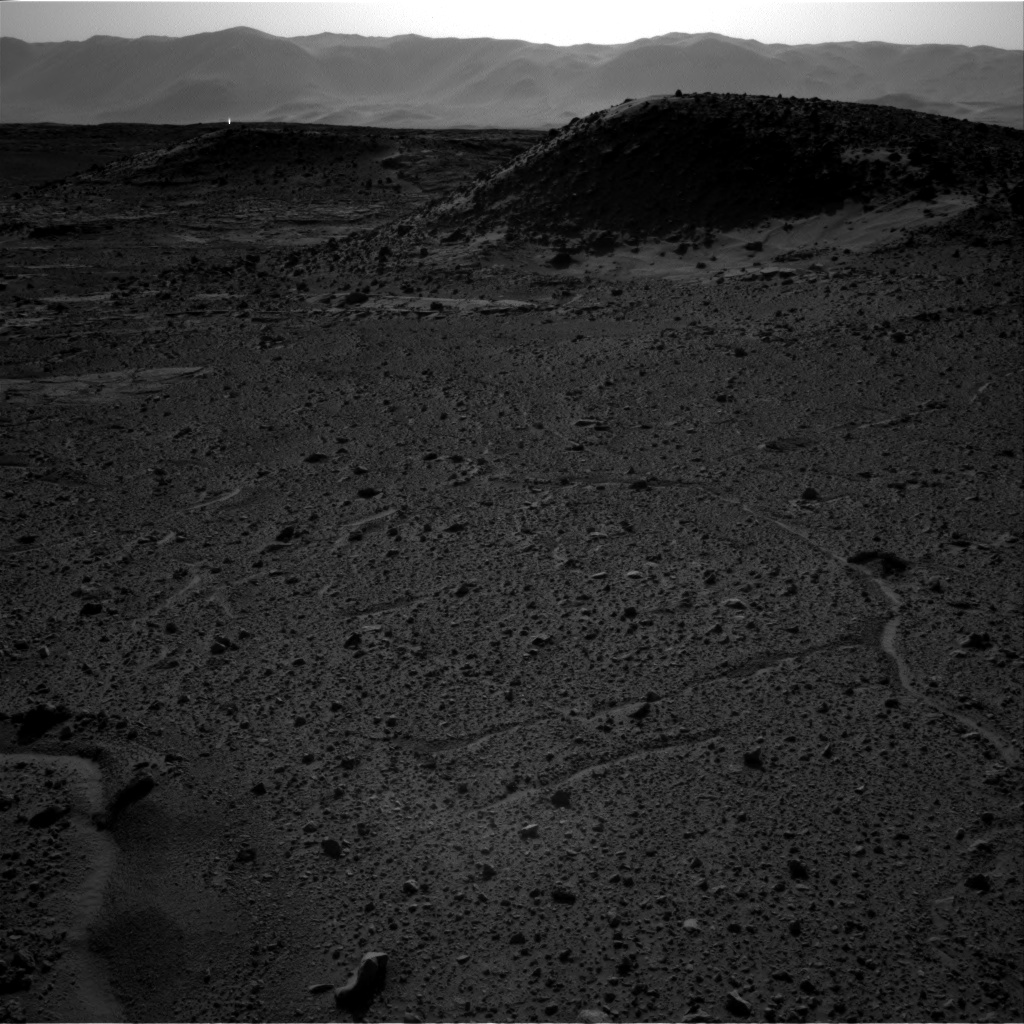
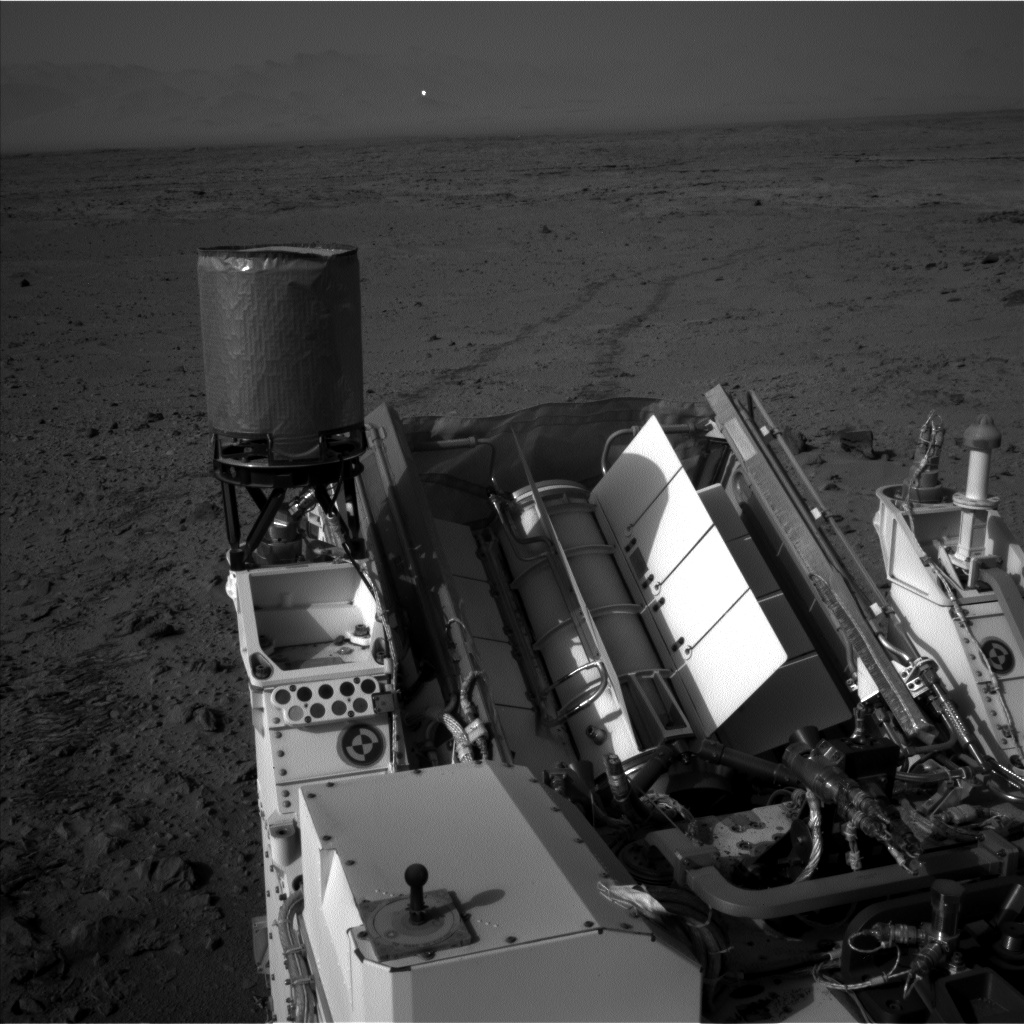
On two consecutive days, photographs from Mars seemed to show an unusual light on the horizon. Let's look at these photographs, and consider whether NASA's explanations for them are plausible.

The first photograph was taken by Navcam: Right B (NAV_RIGHT_B) onboard NASA's Mars rover Curiosity on Sol 588 (2014-04-02 09:04:28 UTC):


Below is a closeup of the unusual part of the image (which appears on the top left corner). 


The second photograph was taken the next day by Navcam: Right B (NAV_RIGHT_B) onboard NASA's Mars rover Curiosity on Sol 589 (2014-04-03 10:00:03 UTC).


Below is a closeup of the unusual part of the image, which appears on the top left corner.


Both photographs show what appear to be flashes of light on the surface of the horizon, with an orientation perpendicular to the horizon. It is as if the lights were shining straight up from the surface in the direction of the sky, without any diagonal slanting.

Three explanations have been put forth for the images by Justin Maki, a NASA imaging scientist. The first explanation is that the lights are reflections from a rock on the horizon. The second explanation is that the apparent lights are caused by a vent hole in the camera apparatus. The third explanation is that the apparent lights are caused by cosmic rays.

First, let's look at the cosmic ray explanation. This was immediately seized upon with great matter-of-fact dogmatic certitude by Nancy Atkinson at the Universe Today site (www.universetoday.com). But it is easy to show that cosmic rays don't work well as an explanation for both of the photographs.

A cosmic ray is a particle from deep space that sometimes appears as a little streak on a photograph. But a cosmic ray can come with equal likelihood from any direction, as suggested by the visual below.

Cosmic rays can arrive from any direction


Also, a cosmic ray might appear as a streak anywhere on a photograph. It is therefore very unlikely that a cosmic ray would cause what looks like a streak of light that appears on the horizon directly perpendicular to the horizon.

One can calculate the chance of this with a little math. Let's divide up the area shown in the photograph into about 50 vertical slices, one of which corresponds to the horizon line. The chance of a random cosmic ray matching the horizon line is therefore roughly about 1 in 50. The chance of the ray having an orientation directly perpendicular to the horizon is about 1 in 20. So the chance of you having a random cosmic ray appearing as something on the horizon and perpendicular to the horizon is about 1 in 50 times 1 in 20, or about 1 in 1000. The chance of such a coincidence occurring on two consecutive days is less than 1 in 1000 times 1 in 1000 (in other words, less than 1 in a million). Not impossible, but very, very unlikely.

Now let's look at the vent hole explanation. This explanation suffers from exactly the same problem as the cosmic ray explanation. If a little vent hole were causing a tiny bit of sunlight to leak into the camera, it is extremely unlikely that we would coincidentally have two consecutive days in which there appeared what looks like a flash of light on the horizon and perpendicular to the horizon.

The vent hole explanation is even more implausible than the cosmic ray explanation, because once you have adopted the vent hole explanation you are then wedded to the theory that there is a camera defect. Such a camera defect would have to keep on showing up again and again in photographs, but there is apparently no evidence of such a defect in photographs after April 3, 2014.

What about the third theory, the theory of a rock that is reflecting light? There are two reasons why such a theory does not hold water. The first is that Mars is much farther away from the sun than Earth. Ask yourself: have you ever seen a rock far away on the horizon reflecting light? You probably never saw that, and your chance of seeing it on Mars is much smaller, as the sun appears as a much smaller object in the Martian sky. Rocks are dull, non-reflective objects that do not reflect light to a significant degree. Glass and metal reflect light well; rocks do not. The only type of rocks that reflect light reasonably well are wet, round rocks like the rocks at the seashore; and such rocks presumably do not exist on Mars.

Try a Google image search for “rock glint” or "rock reflection" and you will find not one single good example of one. When we don't see rocks strongly reflecting sunlight on Earth, how could they be strongly reflecting light on Mars?

Another reason why the rock reflection theory is not plausible is that glints of light caused by reflections typically appear as star-shaped glints, not a straight upward line as shown in the photographs.

In short, none of the three theories that NASA has advanced holds up very well to scrutiny. We do not currently have a good explanation for the images that appear to show lights at the horizon.

I am not suggesting that this necessarily means that the lights are caused by some alien activity. There are numerous unusual possibilities, and not all of them involve aliens. The apparent lights could have been caused by geysers or the geological phenomenon known as a dust devil (a swirling column of dust). There could be some unusual phosphorescence going on, or some unusual outgassing of chemicals. I have no idea what exactly caused these image features that look like lights, but it is clear that the explanations given thus far by NASA are not persuasive. 

Postscript:

We have additional possible photos of lights on Mars in this photo (in the upper left corner)  and this photo.


Tuesday, April 8, 2014

A Physicist Clumsily Ponders the Big Questions

Leonard Mlodinow is a Cal Tech physicist who co-authored the book The Grand Design, a widely read but unconvincing embrace of a particularly extravagant form of string theory which has no observational support. The book ends by assuring us that the theory the authors favor is the theory that Einstein was looking for. That is a lame appeal to authority, rather like arguing, “If Abraham Lincoln were alive today, he would endorse my economic theory.”

Mlodinow has also co-authored the book War of the Worldviews, in which he debates various deep topics with Deepak Chopra, the widely-read author of numerous books. The format of the book consists of alternate chapters by Mlodinow and Chopra, usually taking opposing standpoints on various big questions.

Early in the book (page 17), Mlodinow bombastically asserts, “Science can answer the seemingly intractable question of how the universe came into being, and there is reason to believe that science will eventually be able to explain the origins of consciousness, too.” But he does nothing to back up these statements. There is actually no reason to think that science ever will be able to answer the question of what caused the universe to come into existence, and quite a few scientists have admitted that fact. Later on (page 181), Mlodinow admits, “We still aren't close to discovering the basis of 'mind' or consciousness as an emergent phenomenon based on interactions among neurons,” a statement that undermines his previous statement that “ there is reason to believe that science will eventually be able to explain the origin of consciousness.”

Compare Mlodinow's swaggering statement to the much earlier but far wiser statement by the great scientist Isaac Newton: “I seem to have been only like a boy playing on the sea-shore, and diverting myself in now and then finding a smoother pebble or a prettier shell than ordinary, whilst the great ocean of truth lay all undiscovered before me.” That statement – a statement of great humility – is still appropriate today, as we discover more and more that we don't understand.


In a nine-page chapter on “Is There Design in the Universe?” Mlodinow has a chance to use his physics expertise to rebut those who have argued that the physical constants and laws of our universe seem tailor-made for the appearance of intelligent creatures such as us. But he chooses to say nothing about such reasoning, and does not mention any of the many cases of fine-tuning or cosmic coincidences widely mentioned by other physicists in the context of discussions of the anthropic principle. But what is the reason for the order that allowed us to exist? Mlodinow has an answer (page 116): “The gift of life is not, then, the gift of a god, or of a 'universal consciousness'; it is a gift from the sun.”

This is a laughably weak answer for several reasons. The first reason is that the existence of life and stable matter depend on something a lot more than just the sun: a whole series of coincidences and apparent fine-tuning such as the precise equality of the proton charge and the electron charge (to twenty decimal places), the nearly identical masses of the proton and the neutron, the just-right strength of things such as gravitation, the vacuum energy density, the strong nuclear force, and nuclear resonances. The second reason is that while a sun like ours is a very important prerequisite for life, the existence of our sun depends crucially on various favorable physical constants that existed with their current values billions of years before the sun existed. It has been shown that stars like the sun would not exist if several physical constants such as the speed of light, the gravitational constant, or Planck's constant were slightly different. One does not explain such coincidences by mentioning the sun, something that those coincidences helped to make possible. Our sun is one of the fortunate end results of primordial cosmic fine-tuning, not any explanation for such fine-tuning.

Mlodinow goes on to lamely argue for a version of determinism: “The evidence so far supports the view that the physical arrangement of all atoms and molecules, and the laws of nature that govern them, determine our future actions in the same way that they determine the actions of the sun” (page 131). This is a statement similar to the famous statement made by Laplace in the 19th century, that if one could determine exactly the position and motion of all atoms, one could foretell the exact future of the universe. But such an outlook has been completely invalidated by quantum mechanics, which tells us that there is a huge amount of uncertainty baked into everything on the subatomic level. Modern physics does not support the idea that arrangements of atoms and molecules lock in your future decisions. That's a good thing, because the idea that you do not have a free will is a morally poisonous idea which would have disastrous consequences if everyone embraced it. 

When it comes to the possibility of any such thing as a soul, Mlodinow says this: “All science can really say is that if it existed, we think its effects on the material realm would have been noticed, and that, until now, there has never been any credible evidence for it.”

This is the standard story-line of many a physicist, one in which multiple lines of evidence accumulated over many decades are completely disregarded: evidence of ESP that has been carefully accumulated by scientists for well over 70 years (particularly in recent ganzfeld experiments); evidence of thousands of near-death experiences which have been accumulated for more than 40 years; evidence of remote viewing that was funded by the US government for well over a decade; evidence of an abnormal ability of the mind to influence human health; evidence that humans can inexplicably influence random number generators; as well as evidence of apparitions that have been reported throughout human history (a very-old fashioned phenomenon that simply refuses to go away, and needs some kind of explanation that neither physics nor psychiatry has yet provided).

Like many modern physicists, Mlodinow has a kind of double standard. He dismisses all of the extensive evidence suggesting that there may actually be something like a soul or some paranormal human abilities, because it conflicts with his world view based on reductionist materialism. But he embraces a version of string theory not supported by any evidence, even though such a theory (with its gigantic baggage such as multiverse associations and the idea of many hidden dimensions) ends up being far more extravagant than the simple hypothesis of a human soul.

If Mlodinow aspires to work part-time as a“worldview warrior,” he needs to come up with some more convincing answers.

Saturday, April 5, 2014

Double-Fudging Their Way to the BICEP2 “Breakthrough”

I like a double-fudged ice cream sundae, but I don't like double-fudged scientific studies, particularly when they claim to be of epic importance.

The BICEP2 study was released a few weeks ago to great fanfare. The press release for the study announced breathlessly that it was evidence for the theory of cosmic inflation, the theory that the universe underwent exponential expansion during a fraction of its first second.

But the study involved at least two big fudges – cases in which curves were squashed or stretched unnaturally and unreasonably for the sake of getting observations to fit in with the favored storyline that evidence had been found  for cosmic inflation. Before discussing each of the fudges, let me give a little background information.

The Difficulties of Looking for Primordial B-Mode Polarizations

The idea behind the BICEP2 study is to look for a particular type of radiation called b-mode polarization. Scientists predict that if a period of cosmic inflation had occurred in the universe's first second, it would have produced this type of radiation. But before the BICEP2 study many scientists commented on the extreme difficulty of finding evidence for cosmic inflation through such a process. The main problem is that quite a few other astronomical phenomena can produce this same type of b-mode polarization radiation. Among these other phenomena are: various types of dust, synchrotron radiation and gravitational lensing. 

The problem is illustrated by the graph below. The red line shows the b-mode polarization predicted to occur from synchrotron radiation. The blue lines shows the b-mode polarization predicted to occur from dust. The dotted green line shows the b-mode polarization predicted to occur from gravitational lensing. The solid green line shows the the b-mode polarization predicted to occur from cosmic inflation, using a version of that theory compatible from the most recent findings from the Planck satellite.

From the scientific paper here

The problem is that any lines that are higher-up in this graph are stronger signals that will drown out any signals that are lower in the graph (just as a 100-decibel sound of a passing motorcycle will completely drown out the 30-decibel sound of a child whispering). So if we use the curves in the chart above, there would seem to be basically zero chance of ever being able to confirm a theory of cosmic inflation by measuring b-mode polarizations (the technique used by the BICEP2 study).

To try to overcome such problems, the BICEP2 study resorted to some fudges I will now list.

Outrageous Fudge Number 1: Shrinking the Gravitational Lensing Model

The BICEP2 study has a graph showing a projection of the expected amount of b-mode polarization from gravitational lensing. But the projection is a shrunken, low-ball projection. It is nowhere near as high as the projections made by some previous scientists.

Here is the BICEP2 graph in which they project gravitational lensing (the solid red line):


You have to look closely at the little lines on this logarithmic graph to figure out two things: the assumption being made about where gravitational lensing starts, and the assumption being made about where it peaks. The assumptions being made by the BICEP2 study are these:

Starting point for gravitational lensing: 50 multipole ( l )
Peak of gravitational lensing: .05 (close to 10-1).

The problem is that this is a shrunken estimate, an extreme low-ball projection. The first graph in this post (in which l is the multipole) gives a very different, much-larger projection:

Starting point for gravitational lensing: 2 multipole
Peak of gravitational lensing: .2

In fact, most of the estimates that you will find (made prior to the BICEP2 study) match this much larger estimate for gravitational lensing. Indeed, the most recent POLARBEAR observations support these larger estimates, by showing the peak of the gravitational lensing at a much higher point than the peak in the BICEP2 graph.

Why is this important? If the larger estimate of gravitational lensing is correct, then all of the BICEP2 observations can be explained by assuming gravitational lensing (not cosmic inflation) as the source of the radiation. For example, if the larger projection of gravitational lensing is correct, then we have a model of gravitational lensing similar to the green line below, which can explain all of the BICEP2 observations without requiring any cosmic inflation in the universe's first second.


BICEP2


To force their observations to fit a theory of cosmic inflation, the BICEP2 study chose to present a shrunken, low-ball estimate of gravitational lensing.

Outrageous Fudge Number 2: Shrinking the Dust Projection

When they estimated the amount of b-mode polarization produced by cosmic dust, the BICEP2 team almost admitted that they didn't have what they needed to make an accurate projection:

The main uncertainty in foreground modeling is currently the lack of a polarized dust map. (This will be alleviated soon by the next Planck data release.) In the meantime we have therefore investigated a number of existing models and have formulated two new ones.

The team then present a graph showing some models they selected, models that minimize the amount of dust, and suggest that dust is no big problem when trying to measure signals from cosmic inflation. The low-ball models selected are inconsistent with some previous estimates, which estimate that dust should be blocking all or most of any b-mode polarization produced by cosmic inflation.

See, for example, this scientific paper, which on page 2 predicts a level of dust polarization many times greater than the amount projected by the BICEP2 study (as does this graph from a scientific conference). The relevant graph is shown at the beginning of this blog post.
 
It was almost rather like this:

Previous scientists: How on earth can we find a signal from cosmic inflation with all this cosmic dust all over the places we're looking for the signal, dust that blocks what we're looking for?
BICEP2 scientists: Dust? What dust?

Of course, the BICEP2 study needed to shrink and low-ball the dust projections, to clear the field for their triumphant announcement of evidence for cosmic inflation, and to try to rule out dust as the source of their observations. This was another biased case of artificially stomping on a data curve to get observations to fit a favored explanation of the data.

In an attempt to rule out dust as the source of their observations, and bolster their case for cosmic inflation (in the universe's first second) as the source of their observations, the BICEP2 team ran some simulations (using lots of subjective, hand-picked inputs) that they say show that their observations have characteristics “atypical” of dust. That is very lame and unconvincing reasoning – rather like arguing that a particular light seen in the sky is an alien spaceship because it has characteristics “atypical” of an airplane. The graph of their simulations (Figure 8 in the study) still shows a perfectly decent chance that dust or synchrotron radiation is the source of their observations, not cosmic inflation.

The End Result: A Half Fit

We might expect with these two examples of curve fiddling that the end results would match the favored model exactly. But no: even with these heroic efforts, the BICEP2 graph below only shows 5 out of 9 data points matching the favored model, with several of the data points far off of the model. 

BICEP2

Can We Trust the Claimed Data Points?

When a study is based on simple data observations, you can trust the observer to record the observations correctly, unless you think he might be careless or prone to fraud. For example, if a scientist measures the temperature on a particular day, you pretty much have to trust him, unless you think he might be faking it. But in a case such as the BICEP2 study we have a very different situation. The scientists took raw data, and subjected it to an extremely complicated process of transformations, summaries, and modeling. The process was almost like the process shown in the visual below:

Source: wikiuniversity, Howard Community College


Can we be confident that the BICEP2 team got this extremely complicated process right, and that the data points shown in their final graph are correct? No, we cannot be. This is because it is rather clear from these examples I have shown that the BICEP2 team had a strong experimental bias. Evidently they wanted very much to make their observations match a storyline that the observations came from primordial cosmic inflation. Given this very strong partiality, there are any number of ways in which things could have gone wrong because of experimental bias. At any number of points in the incredibly complicated data transformation process, the scientists may have made decisions influenced by their desire to end up with results favoring a theory of cosmic inflation, decisions that more objective and impartial scientists would not have made.

We need studies like the BICEP2 study to be performed by objective, non-biased scientists without any favored agenda (scientists with an attitude of “let the chips fall where they may”), rather than scientists who seem determined to hammer square pegs into round holes, in order to fit some desired preconceived storyline.

Postscript: See this link for a National Geographic story on how the BICEP2 results may be due to dust, not cosmic inflation. I'm not accusing any on the BICEP2 team of deliberately misleading anyone. I merely think that their desire to have an inflation-related result (good for their own careers) has influenced their paper, leading to some presentation and interpretation decisions that might not have been made by a more impartial set of writers. 

Post-postscript: I didn't originally mention the pathetic way the BICEP2 paper handled the issue of synchrotron radiation.  Synchrotron radiation is a widespread phenomenon that produces the same b-mode polarization observed by BICEP2.  This type of radiation can be produced by many types of high-energy violent events inside and outside of our galaxy. Rather than making any substantial attempt to show that synchrotron radiation is not the source of their observations (which would require many pages), the BICEP2 paper (in sections 9.2 and 9.3) has the skimpiest treatment of the topic, using only 6 sentences to address it. This discussion calls section 9 of their paper "the most ridiculous handwave of all time in the whole history of physics."

Post-post-postscript:  Today a physicist has on his blog a post that says the BICEP2 team made some big error in their dust projection (an error along the same lines as I insinuate in this post). He says, "However, at this point, there seems to be no statistically significant evidence for the primordial B-modes of inflationary origin in the CMB [cosmic microwave background]."


Yet another postscript: see this post for a discussion of a talk at Princeton University in which a scientist gives a presentation that gives a devastating blow to the inflated claims of the BICEP2 study. The scientist gives projections of dust and gravitational lensing which show how such common phenomena (not from the Big Bang or cosmic inflation) can explain the BICEP2 observations.