Header 1

Our future, our universe, and other weighty topics


Thursday, May 25, 2023

Its News App Makes Apple Rather Like Orwell's Ministry of Truth

George Orwell's novel 1984 is a classic of dystopian fiction. It depicts a totalitarian state which requires absolute obedience from its subjects. The citizens of the oppressive regime are kept in control through a wide variety of methods, such as posters everywhere saying "Big Brother Is Watching You," home electronic devices that spy on them, a government agency called the Ministry of Truth that grinds out misleading propaganda, and a government agency (called the Ministry of Love) that tortures citizens who dare to break the rules.  The novel 1984 was referenced by a classic 1984 television commercial produced by Apple, one that ran during the 1984 Super Bowl. 

In the commercial we see a giant screen in which an old authority is lecturing a group of people. The people are all dressed the same, and all have shaved heads. After we see the people marching robotically in lockstep, we see the people all look kind of hypnotized, like unthinking thought slaves. The old authority lecturing the people says this:

"Today, we celebrate the first glorious anniversary of the Information Purification Directives. We have created, for the first time in all history, a garden of pure ideology—where each worker may bloom, secure from the pests purveying contradictory thoughts. Our Unification of Thoughts is more powerful a weapon than any fleet or army on earth. We are one people, with one will, one resolve, one cause." 

Pursued by some kind of police, a young woman runs into the large room. She is carrying a huge sledgehammer. The woman hurls the sledgehammer toward the giant screen, and it is shattered.  We see some text announcing the first Macintosh computer, and a claim that this would show why "1984 won't be like 1984."

You can only properly understand the commercial if you know something about the 1980's competition between Apple and IBM. Often called "Big Blue," IBM was the behemoth of the computer industry in the early 1980's. IBM had enjoyed great success marketing bulky refrigerator-sized computers in the period between 1960 and 1980. In 1981 IBM made its big move into personal computers. Around 1983 the vast majority of personal computers were either IBM computers or what were called IBM-compatible computers, which could run the same software used by IBM personal computers. 

At this time Apple was a kind of a rebellious upstart. To use a Star Wars analogy, it was like IBM was the Galactic Empire of the first Star Wars movie, and it was like Apple was the Rebel Alliance. In Apple's early 1984 commercial alluding to the novel 1984, the old head on the giant screen represented IBM and its near-monopoly on personal computing. The young woman hurling the sledgehammer represents Apple and its rebellious new ways,  which around 1984 included introducing a computer with a graphical user interface, which no IBM computer had at the time.

Now Apple has become the behemoth of computing devices. After enjoying great success in selling personal computers like the Macintosh, Apple's greatest success came in selling smartphone and tablet devices such as the iPad. People love such devices because you can use them while doing little typing. 

I have an Apple iPad, in addition to a personal computer with a regular keyboard.  At the center of the iPad experience is the Apple News app. The News app is something that allows me to access a vast number of articles from many different sources, on many different subjects, without typing anything or using any mouse or menu. 

Let me describe how it works for those who have never used it. When you open the News app, you get five stories at the top of your tablet device. 


Scrolling down by finger-swiping, you can find very many sections called Channels. In addition to sections marked "For You," "Reader Favorites," and "For You in News+," you may see thirty or forty different sections or channels, each of which can be reached just by finger-swiping to scroll the screen down.  A typical channel will show about three to seven stories, each of which has a photo next to it. For example, below we see a "Science Fiction" channel and the first part of a "Biology" channel:

By clicking on any of the channel titles, you will get many articles on the topic you clicked on. So, for example, when I click on the title of the Science Fiction channel shown above, I get many articles about Science Fiction, not just the articles shown below, but many other Science Fiction articles I can reach by using finger-swiping to scroll the screen down:

I can use my finger to read any of these articles; and reading any of them is easy because all I have to do is finger-swipe to scroll the screen down when I come to the bottom of the screen. Once I have finished reading the story, there is a convenient back button allowing me to return to a double-column page like the one shown above. When I want to switch to a different channel, I can use a back button at the top left of the tablet to go back to the main News app page, which allows me to find stories on many different topics. 

This interface is a masterpiece from an ease-of-use standpoint. With this interface I can access many hundreds of stories on 30 or more topics without typing anything and without ever using a mouse. The News app of the Apple iPad is so easy to use, and has access to so many stories that I would imagine a typical iPad user probably spends 30% or more of his iPad time only using the News app. 

But there is a huge problem with Apple's News app. The News app  restricts you to a very limited number of information sources. It therefore acts as a very severe "reality filter," extremely restricting the type of articles that you will read when using its interface, and severely restricting the type of viewpoints you will be exposed to. 

Let's look at the Channels that are available to me. We see below some of them:


If I scroll down more to get more items on this list, I also get these Channels:

If I scroll down more to get more items on this list, I only get this:
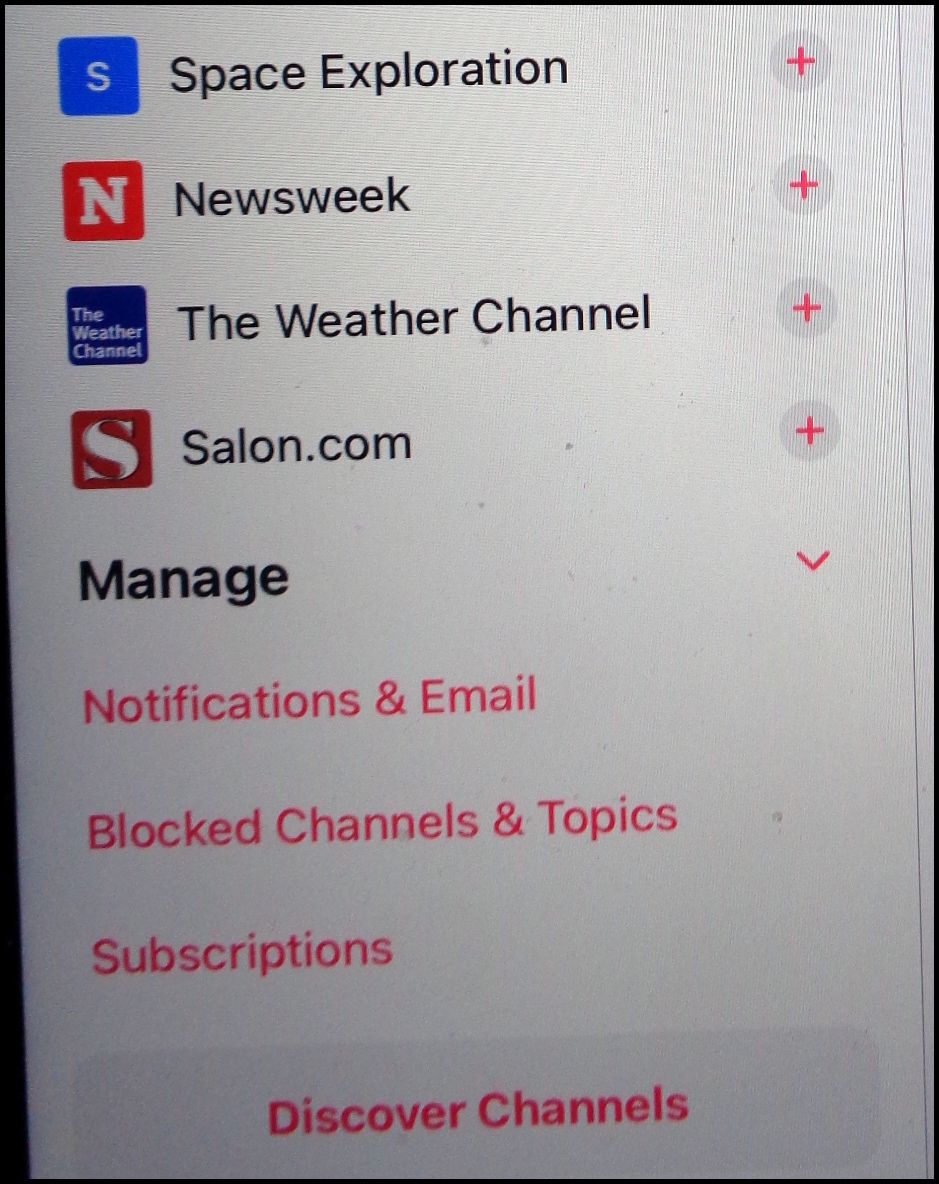


There is a Discover Channels button at the bottom that allows me to add some more sections or channels, each of which will be a particular section showing up in the News feed.  But the choice is only very limited. When I press Discover Channels, I get only 36 possibilities, about half of which are city-specific channels such as a Los Angeles channel. 

Despite the great ease of use, there is something very wrong here. One minor irritation is that the Apple News app is filled with promos for stories that are only available if you have a paid subscription to Apple News+.  If you haven't yet learned the trick of not clicking on stories marked Apple News+ unless you pay for that service, you might find such promo links to be annoying. 

More seriously, this interface has enormously restricted the type of content I can view. I cannot get any Philosophy channel, or any Religion channel. I cannot get any channel on New Age topics, or any channel related to the paranormal. I cannot get any History channel or any Psychology channel or any Viewpoints channel. I can get a Daily Mail channel, but the articles are only the more bland articles from the Daily Mail, not the more provocative articles the Daily Mail regularly publishes that criticize the US government, the US president, or US social trends.  I cannot chose any channel that gives me a critical analysis of the claims made by US science authorities. The articles in the News app have a liberal bias, and tend to favor the current Biden administration. If you ever get a religion-related story in the Apple News app, there's a good chance it will be some "trojan horse" article like a recent article I saw with a title mentioning someone's "far-seeing faith," but which turned out to be an article suggesting that one major religious group had "profound afflictions," and consisted of racist anti-intellectuals.    

What Apple's News app has done is to pretty much restrict me to articles that parrot the "official party line" of America's ruling class of politicians, professors and pundits, and also a vast variety of entertainment articles and articles such as sports articles and real estate articles and celebrity-oriented articles. What's wrong with that? Well, for one thing there is the problem that the stories that I get from the News app are very often stories filled with very bad  falsehoods, misrepresentations and groundless boasts. This is largely because nowadays the articles of so-called "science news" are very often articles filled with errors and misstatements. 

Many branches of scientific academia are currently in a sad state. Professors are judged by how many papers they have written and how many citations such papers have got. With such metrics being used to judge performance, there is a huge incentive for scientists to produce poorly-designed "quick and dirty" studies that are guilty of questionable research practices (called QRP), such as way-too-small study group sizes, lack of pre-registration and a lack of a blinding protocol. In some fields such as neuroscience, the use of questionable research practices is more the norm than the exception. Eager to get as many paper citations as possible, scientists very often make claims in their paper titles and abstracts that are not justified by any observations reported in their papers.  

After a scientific paper has been written up and published, it is announced with a press release issued by the main academic institution involved in the research. Nowadays the press releases of universities and colleges are notorious for making sensationalized claims that are not warranted by anything discovered in the research being discovered. Often a tentative claim made in a scientific paper (basically a "perhaps" or a "maybe") will be stated as if it is was simply a discovery of a definite fact.  Other times a university press release will make some important-sounding claim that was never made in the scientific paper writing up the research.  An example was that when  there appeared a scientific paper merely claiming that "Regional synapse gain and loss accompany memory formation in larval zebrafish," there appeared a great number of press stories repeating the headline of a press release claiming that the formation of a memory had been observed (a claim not made in the paper).  We have every reason to believe that synapse gains and losses occur  continually in the human body, regardless of whether some new memory is forming. 

Authorship anonymity is a large factor that facilitates the appearance of misleading university and college press releases.  Nowadays university and college press releases typically appear without any person listed as the author. So when a lie or misleading statement occurs (as they very often do in university press releases), you can never point your finger and identify one particular person who was lying.  When PR men at universities are thinking to themselves "no one will blame me specifically if the press release has an error," they will feel more free to say misleading and untrue things that make unimpressive research sound important. 
 
Misleading press releases produce an indirect financial benefit for the colleges and universities that release them.  When there occurs untrue announcements of important research results, such press releases make the college and university sound like some place where important research is being done. The more such press releases appear, the more people will think that the college or university is worth the very high tuition fees it charges. 

Besides such press releases, additional exaggerations, distortions, misstatements and hype occur when writers produce articles based on the press release. Such writers are encouraged to behave in such a way, to produce click-bait that is economically profitable. If a web site has an article with an untrue or half-true title that sounds exciting, such an article can entice many people to click on some headline that takes them to a page where there are ads. The web site may therefore get revenue proportional to how many people saw the page. 

Some of the economic and professional factors that encourage misstatements in science papers, science press releases, and science news articles are shown in the diagram below. The Apple News app is part of this profit complex, and I wonder whether Apple richly profits from all the untrue clickbait headlines it has routing you to pages that have advertising, and generate revenue not just for the site that has the page, but the site that routes people to such a page.  

academia cyberspace profit complex

Today's so-called "science news" articles very often contain falsehoods, groundless hype and shameless exaggeration, largely because of economic motivations charted in the diagram above. The diagram above tells only part of the story, failing to even mention two other gigantic factors tending to produce misleading or dubious claims in scientist literature:

(1) how financial influence from the pharmaceutical industry is a major factor leading to junk science studies and junk science news;

(2) how scientist belief communities (such as the neuroscientist belief community, the evolutionary biology belief community, and the dark matter belief community) leads scientists to keep producing research that sounds supportive of the ideology of such belief communities, and the dogmas of particular scientist tribes. 

There are other huge reasons why so many errors and falsehoods occur in what we read in the so-called science news. One reason is a large amount of fraud in experimental research. A recent article in a leading science journal cites a researcher who "estimates up to 34% of neuroscience papers published in 2020 were likely made up or plagiarized."  Another very large reason is that scientists such as neuroscientists and cosmologists and evolutionary biologists are members of belief communities dedicated to the perpetuation of cherished dogmas held by their belief communities. Many of our "science news" articles are written by authors attempting to bolster belief in their favorite belief dogmas. When acting in such a way, which we might call "Sunday school mode," scientists and science journalists can be guilty of very bad errors and very bad misstatements, just as some person zealous to advance his political ideology may make very bad misstatements. 

Because so many scientists are following Questionable Research Practices leading to shoddy research that is not highly reproducible, there is a replication crisis in fields such as psychology and neuroscience. In their 2017 paper "Empirical assessment of published effect sizes and power in the recent cognitive neuroscience and psychology literature," Denes Szucs and John P. A. Ioannidis concluded that the replication crisis in cognitive neuroscience was even worse than in psychology. They concluded that most reported effects in neuroscience were probably false alarms. In their paper we read this:

"Assuming similar true effect sizes in both disciplines, power was lower in cognitive neuroscience than in psychology. Journal impact factors negatively correlated with power. Assuming a realistic range of prior probabilities for null hypotheses, false report probability is likely to exceed 50% for the whole literature."

And don't think for a moment that you can tell good research by looking for some paper published in some "high impact factor"  journal such as Cell or Nature or Science. Those journals very often publish junk research guilty of Questionable Research Practices, and publish papers with titles proclaiming results not matching anything observed or demonstrated in the described research. Referring to statistical power (a measure of how robust and trustworthy research is) the preceding paper made the remarkable claim that "journal impact factors negatively correlated with power."  

Apple's News app reflects all of these very bad problems, without doing anything to mitigate them. Almost every day I read in the News app some headlines that are false or groundless, and "news stories" containing very bad errors. Often very untrue headlines are repeated in multiple different News app stories on the same day, with the misleading headline merely being rephrased, as the same erring press release is covered by different science journalists. I often read some bunk claim made in the headline of some story in the Science channel of News app, and then read an equally bunk headline about the same research appearing in the Biology channel of the News app, and then read an equally false headline in the Neuroscience channel of the News app. 

An example of the false statements we get every week from the Apple News app is an article this week that made the untrue claim that "many lab experiments have successfully reproduced different stages of abiogenesis." No such stages of abiogenesis (an accidental origin of life) have occurred in any lab experiments realistically simulating the early Earth, and not even building blocks of the building blocks of one-celled life (amino acids) have been produced in any such experiments. The article refers to the "iconic Miller-Urey experiment," failing to mention how scientists now believe the experiment used a wrong mixture of gases to try to simulate the early Earth atmosphere (only one of many reasons why the experiement was not a realistic simulation of early Earth conditions).  

Some of the falsehoods I very often read in the headlines and stories of Apple's News app are untrue claims that will give you wrong ideas about who you are, how your species and your mind arose,  and what kind of universe you live in. It seems the curators of Apple's News app are blissfully ignorant of all the problems associated with today's scientific papers and the boastful and untrustworthy press releases promoting them. 

There seems to be no way to customize the News app to reduce such problems. The Apple News service is free for those who have bought a device such as the iPad. There is an Apple News+ paid subscription you can get for 10 dollars a month. But that subscription  only offers the set of sources listed here, which almost never challenge the hype, dogma and groundless claims so often appearing in mainstream sources. There is no such problem on information sources such as Youtube.com. For example, if you search for some videos on near-death experiences or other spiritual topics on www.youtube.com, you will find your subsequent list of displayed videos reflecting the interest in such topics that you previously displayed. Although it is called a News app, the Apple News app often includes pure opinion pieces, which are often atheist propaganda pieces, but almost never opinion pieces challenging any of the more dubious dogmas of today's science professors.

The factors above and the News app's restrictions on independent analysis and viewpoint diversity mean that nowadays Apple's News app is kind of like a Pravda for materialists. Between 1918 and 1991 the newspaper Pravda was the official party organ of the Communist Party that ruled the Soviet Union. During that period whenever a Moscow communist opened up his morning paper, he would find a newspaper telling him that the world was working just exactly the way a Moscow communist would expect it to work. The pages of Pravda contained very many falsehoods, and prevented its readers  from reading about very many things they should have been informed about. And so it is for Apple's News app.  The reader of Apple's News app will always read headlines telling him that the world is working just exactly the way an atheist materialist would expect it to work. Restricted to a filter bubble, such a reader will be carefully prevented from discovering a thousand facts and observer reports that conflict with such ideas. 

In this respect Apple has become rather like the restrictive behemoth it mocked in its early 1984 ad referencing the novel 1984.  The curators of Apple's News app seem rather like the workers of the Ministry of Truth in Orwell's 1984, who only informed the masses of an official party line, one that contained many a falsehood.  Such curators rather seem like people under the control of rules rather like the "Information Purification Directives" mentioned in Apple's 1984 commercial. 

Apple News App

If you look at my posts here, here, here, here, here, here, here, here and here, you will find examples this year of shoddy research or groundless "science news" claims that were promoted in Apple's News app as if they were important science progress. If you didn't realize that Apple's News app is largely a kind of party-line echo chamber filter bubble "Ministry of Truth news feed" affair, it's partially because people who have for many years got defective news streams come to think of them as normal (like 1970's Moscow Pravda readers who didn't notice how bad the newspaper was), and also because Apple did such a good job of mixing up all its ruling class propaganda with entertaining tidbits, glitz, razzle-dazzle and sparkly neon glitter. It's kind of like what goes on in The Hunger Games series, where lots of untruthful government propaganda is delivered by some slick stylish  charming celebrity with the folksy pizazz of a "Tonight Show" host. 

Sunday, May 21, 2023

600 Dreams I Had About the Deceased

In the memorable movie The Sixth Sense, there is a famous line in which a young boy says, "I see dead people." If that boy was the "I see dead people" guy, I guess you can call me the "I dream dead people" guy. Below are about 600 dreams I have had about the deceased since November 2020:

  • 104 dreams involving my late mother.
  • 103 dreams involving my late father. 
  • 31 dreams involving my late sister, the first-born of my siblings.
  • 13 dreams (after her death) of another late sister, the last-born of my siblings. 
  • Three dreams involving one of my late grandmothers. 
  • Five dreams involving my late grandfather on my mother's side. 
  • One dream involving a late grandfather mentioned only as "Grandpa." 
  • A dream involving my late sister-in-law, who lived outside of the US.  
  • A dream involving a late relative named Ursula. 
  • A dream involving a late aunt of mine. 
  • Many dreams in which I saw pets I had previously had, who died (with me sometimes stroking such pets). 
  • A dream in which I heard the late Karen Carpenter singing "For All We Know."
  • Three dreams involving the late actor Richard Burton.
  • Three dreams involving the late actress Elizabeth Taylor.
  • A dream involving the late actor Peter Lorre. 
  • A dream involving the late actor Jack Larson. 
  • A dream involving the late actor Sidney Poitier. 
  • A dream involving the later actor Jack Lemmon. 
  • A dream involving the later singer and actress Carmen Miranda. 
  • A dream involving the late singer Whitney Houston. 
  • A dream involving the late actor Dan Blocker. 
  • A dream involving the late actress Greer Garson. 
  • A dream involving the late hi-tech executive Steve Jobs. 
  • Two dreams involving the late singer and composer John Denver.
  • Two dreams involving the late actor Burt Reynolds.   
  • A dream involving the late German poet Hans Sachs. 
  • A dream involving the late dancer, actor and director Gene Kelly. 
  • A dream involving the late architect Frank Lloyd Wright. 
  • A dream involving the late actor George Peppard. 
  • Three dreams involving the late actress Lucille Ball (in one I could see her very vividly, almost like she was standing in front of me). 
  • A dream involving the late actor George Kennedy. 
  • Three dreams involving the late US president George Washington. 
  • A dream involving the late singer/actor Bing Crosby.
  • A dream involving the late composer and lyricist Stephen Sondheim. 
  • A dream involving the late Icelandic medium Indridi Indridason. 
  • A dream involving the late singer Peggy Lee.
  • A dream involving the late actor James Coburn. 
  • A dream involving the late actor Lee J. Cobb.
  • A dream involving the late actor Sean Connery. 
  • Two dreams involving the late actor Paul Newman. 
  • Two dreams involving the late composer Wolfgang Amadeus Mozart.
  • A dream involving the late composer Ludwig van Beethoven. 
  • Six dreams involving the late singer and actor Mario Lanza.
  • A dream involving the late senator Barry Goldwater.  
  • One dream involving the late labor organizer Cesar Chavez. 
  • Three dreams involving the late US president Richard Nixon.
  • One dream involving the late senator and vice-president Hubert Humphrey.
  • Two dreams involving the late US senator George McGovern. 
  • A dream involving the late actor Robert Culp.
  • A dream involving the late US senator John McCain. 
  • A dream involving the late actor James Mason. 
  • A dream involving the late commedian and director Dick Martin. 
  • A dream involving the late US president Grover Cleveland. 
  • Three dreams involving the late singer and actress Doris Day. 
  • A dream involving the late actor and director Jerry Lewis.
  • Two dreams referring to the late composer Richard Wagner.
  • Two dreams involving the late composer Peter Tchaikovsky. 
  • Seven dreams involving the late president Ronald Reagan.
  • Four dreams involving a famous deceased political leader I won't mention. 
  • Nine dreams involving the late actor Peter Falk.
  • Five dreams involving the late talk show host Johnny Carson.  
  • Five dreams involving the late actor Leonard Nimoy.
  • Three dreams involving the late actor Laurence Olivier.
  • A dream involving the late actor Michael Landon. 
  • Two dreams involving the late singer Perry Como. 
  • A dream involving the late US president Theodore Roosevelt. 
  • A dream involving the late baseball player Ted Williams. 
  • A dream involving the late actor Richard Deacon. 
  • A dream involving the late Prince Phillip, the Duke of Edinburgh.
  • A dream involving the late actor/dancer Fred Astaire.
  • Two dreams involving the late baseball player Babe Ruth.  
  • A dream involving the late singer James Brown. 
  • A dream involving the late painter Rembrandt. 
  • Two dreams involving the late Princess Diana. 
  • Three dreams involving the late US president Lyndon Johnson, and one dream involving his late wife.
  • Two dreams involving the late US senator Robert Kennedy. 
  • A dream involving the late US senator Edward Kennedy. 
  • Three dreams involving the late opera singer Luciano Pavoratti. 
  • Four dreams involving the late actor John Wayne.
  • Two dreams involving the late actor Jimmy Stewart.
  • A dream referring to the late musician Benny Goodman, mentioning "the King of Swing," which is what people called him. 
  • A dream mentioning a very famous historical figure born in ancient times. 
  • Four dreams involving the late actor Gregory Peck. 
  • A dream involving the late actor Dudley Moore.
  • A dream involving the late US president Franklin Roosevelt. 
  • A dream involving the late actor Raymond Burr. 
  • Two dreams involving the late evangelist Billy Graham.
  • Three dreams involving the late Albert Einstein. 
  • Two dreams involving the late Neil Armstrong. 
  • A dream involving the late actor William Holden. 
  • A dream involving the late poet Lord Byron. 
  • A dream involving the late Carrie Fisher. 
  • Two dreams involving the late William Shakespeare.
  • Eleven dreams involving the late US president John Kennedy. 
  • Two dreams involving the late Jacqueline Kennedy Onassis. 
  • A dream involving the Beatles (two of whom are deceased).
  • Three dreams involving the late actor Marlon Brando.
  • A dream involving the late theorist Immanuel Velikovsky. 
  • A dream involving the later actor Charlton Heston.
  • A dream involving the late explorer Christopher Columbus. 
  • A dream involving the late US president Gerald Ford. 
  • Eleven dreams involving the late composer and singer John Lennon. 
  • Twelve dreams involving the late composer and singer George Harrison. 
  • A dream involving the late director and actor Charlie Chaplin.
  • Two dreams referring to the late physicist Isaac Newton.
  • A dream referring to the deceased founders of a large company.
  • A dream referring to the late philosopher Rousseau. 
  • A dream involving the late scientist and writer Benjamin Franklin.
  • A dream involving the late scientist Antoine Lavoisier. 
  • Four dreams referring to the late biologist Darwin. 
  • A dream involving the late actor/celebrity Orson Bean.
  • A dream involving the late actor John Garfield. 
  • A dream involving the late actor Robert Mitchum.
  • Five dreams involving the late opera singer Franco Corelli. 
  • A dream involving the late actor Jimmy Cagney.
  • Two dreams involving the late psychologist and ESP researcher Joseph Rhine.
  • Four dreams involving the late science fiction writer and futurist Arthur C. Clarke.
  • A dream involving the late commentator Rush Limbaugh. 
  • A dream referring to a biographer of English poets, probably a reference to the late biographer Samuel Johnson. 
  • A dream involving the late novelist George Orwell.
  • A dream involving the late Soviet leader Leonid Brezhnev.
  • A dream involving the late medium Margaret Fox.
  • Four dreams involving the late film director Stanley Kubrick. 
  • A dream that was probably a reference to the late novelist Victor Hugo (ta dream in which some man gave me Hugo's novel Les Miserables). 
  • A dream involving the late actress Diahann Carroll. 
  • Three dreams involving the late actress Natalie Wood. 
  • A dream involving the late talk show host Tom Snyder.
  • A dream involving the late actor Walter Pidgeon. 
  • Two dreams involving the late actress Betty White. 
  • A dream involving the late actress Marilyn Monroe. 
  • A dream involving the late actor R. Lee Ermey.
  • A dream involving the late writer Jules Verne.
  • A dream involving the late philosopher  Plato. 
  • A dream involving the late writer James Joyce. 
  • A dream involving the late actor Danny Kaye. 
  • A dream involving the late US Supreme Court judge Ruth Ginsburg. 
  • Two dreams involving the late actor Jim Garner. 
  • A dream involving the late actor Fernand Gravey, mirroring a scene in a 1938 movie in which Gravey was humming a Johann Strauss melody (interestingly, I could not recall the melody the morning after having the dream, but it played exactly right in my dream).
  • Two dreams involving the late actor Christopher Reeve. 
  • Five dreams referring to the late singer/actor Elvis Presley.
  • A dream involving the late actor Richard Basehart.
  • A dream involving the late philosopher John Stuart Mill. 
  • Four dreams involving the late actor Cary Grant. 
  • A dream involving the late actor Eddie Albert. 
  • A dream involving the late actor Andy Griffith.
  • A dream involving the late actor Fred MacMurray. 
  • Two dreams involving the late civil rights champion Martin Luther King.
  • Five dreams involving the late singer/actor Frank Sinatra. 
  • A dream involving the late composer Franz Shubert.
  • A dream involving the late composer Robert Schumann. 
  • Two dreams involving the late singer/actor Dean Martin.
  • A dream involving the late singer Bobby Darin.
  • A dream involving the late writer Voltaire. 
  • Two dream involving the late TV and movie executive Carl Reiner. 
  • A vivid dream involving the late actress Audrey Hepburn. 
  • A dream involving the late actress Kathryn Hepburn.
  • A dream involving the late composer/conductor Leonard Bernstein.
  • Three dreams involving the late US president Thomas Jefferson.
  • A dream involving the late actor Leslie Nielsen. 
  • Three dreams involving the late actor Roger Moore. 
  • Two dreams involving the late dictator Saddam Hussein.
  • Four dreams involving the late actor James Gandolfini. 
  • Two dreams involving the late singer Sammy Davis Jr. 
  • A dream involving the late singer Peggy Lee.
  • Three dreams involving the later actor Robin Williams.
  • A dream involving the late actor Martin Milner.
  • A dream involving the late TV host Allen Ludden. 
  • A dream involving the late actor Burgess Meredith.
  • A dream involving the late gangster Al Capone. 
  • A dream involving the late actor and comedian Bob Saget.
  • A dream involving the late actress Anissa Jones.
  • A dream involving the late actress Angela Lansbury.
  • A dream involving the late evangelist Oral Roberts. 
  • A dream involving the later director and writer Joshua Logan. 
  • A dream involving the late US senator John Warner. 
  • A dream involving the late actor William Frawley. 
  • A dream involving the late US general Douglas MacArther. 
  • A dream involving the late German theologian Dietrich Bonhoeffer.
  • A dream involving the late poet P. S. Shelley. 
  • A dream involving the late actress Valerie Harper (one in which I improbably remembered that she had been fired, a recollection matching her firing from a TV role in 1987). 
  • A dream of the scene in the movie Patton in which General George Patton (played by George C. Scott) was hearing about the famous "Nuts!" reply of General Anthony McAuliffe (the dream therefore managed to refer to three deceased people, Patton, Scott and McAuliffe). 
  • Two other dreams involving Patton, one mentioning the late actors Lee Marvin and Robert Ryan.
  • A dream that may have mentioned the ancient Greek urban planner Hippodamus, a name I had never heard mentioned before the night of the dream (I wrote down the name "Hippodemus" after having the dream). 
  • Four dreams involving the late US president Dwight Eisenhower. (In the last dream Eisenhower was saying that people from Texas could be good presidents. I was not aware when having the dream that Eisenhower was born in Texas.) 
  • A dream involving the late US president George H. W. Bush. 
  • A dream involving the late character actress Alice Ghostley (oddly, I had never learned her name prior to having the dream). 
  • Seven dreams involving Jesus. 
  • A dream involving the late actress Charlotte Rae. 
  • Two dreams involving a late professor Bernard F. Riess.
  • A dream involving the late United Nations Secretary-General Dag Hammarskjöld.
  • A dream involving the late medium Laura Edmonds.
  • A dream on February 20, 2021 involving the late actor Edd Byrnes. 
Last night I had a dream that ended with a teacher telling me, "Call Laura Edmonds." I recognized the name after waking up. Laura Edmonds (the daughter of John W. Edmonds) was a medium, one of the most astonishing figures in the history of the anomalous.

In Volume 2 of the 1855 work Spiritualism by Judge John W. Edmonds (who served as Chief Justice of the New York State Supreme Court), we have a remarkable account of a psychic who is not named. Edmonds says he will give "a brief account of one medium whose whole progress I have witnessed with intense interest." 

First we are told the woman developed powers of clairvoyance. We hear a reference to the sea disaster in which more than 300 people on the SS Arctic died in 1854:

"Since then this faculty of knowing things at a distance has greatly improved. She saw the wreck of the Arctic when it was occurring. She saw and detailed with great accuracy, as subsequent accounts showed, the recent collision on the Canada Railroad, and that a few moments after it happened, and while the dead and wounded were being lifted out of the ruins. She has seen and described the state of things at Sebastopol and its vicinity, and she has frequently described scenes and conversations going on at the moment, at the distance of several hundred miles from her ; and all this, not when she was in a trance, but in a state of mental consciousness to all around her."

The account gets even stranger when we are told that the woman could speak in languages she never learned:

"She next became developed to speak different languages. She knows no language but her own, and a little smattering of boarding-school French. Yet she has spoken in nine or ten different tongues, sometimes for an hour at a time, with the ease and fluency of a native. It is not unfrequent that foreigners converse with their spirit-friends through her in their own language. A recent instance occurred where a Greek gentleman had several interviews, and for several hours at a time carried on the conversation on his part in Greek, and received his answers sometimes in that language and sometimes in English ; yet until then she had never heard a word of modern Greek spoken. About the same time her musical powers became developed. She has repeatedly sang in foreign languages, such as Italian, In- dian, German, and Polish."

On the same page we get this remarkable claim:

"Her next advance was to see spirits and spiritual scenes, and now scarcely a day passes that she does not describe the spirits who are present, entire strangers to her, yet very readily recognized and identified by their inquiring friends. This has of late been witnessed by very many persons, and many an, unbeliever in spiritual intercourse has been overwhelmed with the evidence of identity which thus by sight and by communion has been presented."

On this page of a book by another author, we read that this woman was a  daughter of Judge Edmonds: Laura Edmonds.

"Miss  Laura  Edmonds,  a  daughter  of  the  Judge,  also  pursued  her researches  in  the  same  direction,  and  became  developed  as  an  excellent medium  for  trance  speaking,  the  discerning  of  spirits,  the  gift  of  tongues, including  several  dead  and  living  languages  utterly  unknown  to  herself,  the ability  to  travel  clairvoyantly  to  distant  places,  and  communicate  with  absent friends  by  the  mental  telegraph."

How strange that last night I had a dream telling me to "call Laura Edmonds," when Laura Edmonds was a figure reported to have such astonishing powers of contacting the dead. Just after having the dream, I went into my bathroom, where I again saw something very spooky I have seen about 12 times in the past year. 

Below we see the electrical outlet in the bathroom next to where I sleep. It is a modern-type GFCI outlet that normally shows a green light, except when the circuit is broken. The outlet is about 13 inches above the bathroom's toilet, which is an inch away from the wall containing the outlet. When I go the bathroom in the middle of the night, I see the green light very clearly, because it is the only light source in the bathroom. I don't turn on the regular light in the bathroom when I use the bathroom in the middle of the night, because I have heard that turning on a full light in the middle of the night will make it more difficult for you to fall back to sleep. 

Just after awaking from the dream about the late medium Laura Edmonds, I saw the green light above mysteriously turn off and then turn back on about two seconds later. I have seen this happen about 12 times during the year I have lived at my current location.  

To read more about my dreams, which include 300+ dreams seeming to refer to life after death, see my post here, which I have been updating almost daily for two years. 

Thursday, May 18, 2023

Clump-Fooled Press Calls It Multicellularity Evolution, But It Was Neither

For many decades evolutionary biology has been characterized by language abuse, deceptive speech and misleading practices. Some of the worst abuses over the past 160 years have been the following:

  • More than 160 years of using the misleading phrase "natural selection," which does not actually refer to any selection (selection is a word meaning a choice by a conscious agent). Darwin himself in a letter to Charles Lyell dated June 6, 1860 said, "I suppose  'natural selection' was a bad term ; but to change it now, I think, would make confusion worse confounded." 
  • Many decades of false claims that DNA is a blueprint or recipe or program specifying how to make an organism, claims that are utterly fictional because neither DNA nor the genes in it even specify how to make any of the cells that are the main components of an organism, or any of the organelles that make up such cells.  
  • The use of very deceptive claims that there is no fundamental difference between humans and animals, or only quantitative differences.
  • The frequent use of misleading language trying to make animals sound like they have minds like humans, and trying to make humans sound like beings who have minds like animals. 
  • The frequent use of misleading cell diagrams that depict cells as being thousands of times simpler than they are. A Nature article says that "textbook depictions of the cell’s innards have changed little since 1896," and quotes a scientist saying, "Nothing is drawn the way the cell actually looks."
  • Misstatements about the complexity of protein molecules,  such as documented here and here,  in which an author claims that a typical protein molecule involves only about 100 amino acids, when the median number of amino acids in a human protein molecule is about 431, exponentially harder to achieve than merely 100. 
  • Deceptive appeals to artificial selection (a purposeful guidance of breeding) to try to support claims about so-called "natural selection" (claimed to involve no purposeful agency).
  • Frequent misleading uses of the term "early human" to describe long-extinct organisms without any evidence to show that such organisms had any of the defining characteristics of humans (such as language and the ability to use symbols). 
  • Extremely misleading statements that Darwinian evolution is not random, evoking some special, uncommon definition of the word "random" different from the normal definition of that term: "happening, done, or chosen by chance rather than according to a plan."
  • Misleading claims that when scientists say something is a theory, it means it is well-established (a claim that can be refuted by many examples, such as the common example of the term "string theory" to describe a completely unsubstantiated type of physicist speculation).
  • Deceptive claims about chance protein evolution, such as the assertion by one authority that if you have "trillions" of random protein molecules you can get "any function you want" (because the average amino acid length of a human protein is more than 400 amino acids, and because there are 20 possible amino acids in each position of a protein, such a statement underestimated by about 10 to the 500th power the difficulty of getting by chance "any function you want"). 
  • Frequent appeals to an utterly erroneous principle that any fantastically improbable bonanza of luck can happen as long as there are millions of years of chance events. 
  • Misleading language about natural history, such as failing to describe enormous leaps of organization and complexity as very complex innovations, but merely describing them as "variants" or "diversification."
  • Misleading language using the phrase "missing link," often referring to things that are not credible evolutionary missing links, such as claiming that a type of dinosaur is a missing link between dinosaurs and birds, because it has a triangular membrane on its front similar to a triangular membrane on the back of birds.
  • Misleading claims that evolution might have occurred before life existed, claims evoking a special use of the word "evolution" very different from  normal definitions. 
  • Frequent claims that certain parts of the human body are "vestigial structures" with no current use, despite evidence that such structures do actually have a function. 
  • A massive repetition by Darwinists of a doubtful claim that human genomes and chimp genomes are 98% or 98.6% the same, ignoring a 2005 paper with the title "Eighty percent of proteins are different between humans and chimpanzees." A 2021 study found that "1.5% to 7% of the human genome is unique to Homo sapiens," suggesting the 98% claim may have been much in error.   
  • Misrepresentations involving fossils, often including gluing together (using a mixture such as superglue and baking soda) fossil fragments not known to be from one organism and claiming they are from a single organism.
  • Misleading statements about the quality of evidence for spiritual and psychical phenomena that tend to contradict Darwinist explanations, typically made by people who have never seriously studied such evidence, combined with misleading stereotypical or gaslighting characterizations of the people who have reported such phenomena.
  • Deceptive drawings of embryos such as used by Darwinist zealot Ernst Haeckel, to try to create some impression that a study of embryos supports Darwinist claims, and the use of such drawings in Darwinist literature to the present day, decades after they had been debunked.  
  • Misleading language about the origin of life, such as referring to amino acids as "seeds of life" (which is as misleading as saying bricks are the seeds of cathedrals). 
  • The very frequent use by natural history museums of "fossil exhibits" that are entirely plaster or fiberglass, with countless visitors getting the idea that such things were real fossils.
  • Frequent evocation of an utterly fallacious principle which one Darwinist evoked by saying "let us suppose instead that each step made in the good direction provides a small advantage in terms of survival or fecundity to the being that makes it," a principle extremely erroneous because improvements in survival or fecundity (reproduction) almost always require many coordinated changes before any such advantage is achieved. 
In the press we had recently another example of misleading language about evolution. An experiment was described as telling us something about "multicellularity evolution." The results of the experiment were neither multicellularity nor Darwinian evolution. 

The term "multicellularity" refers to organisms consisting of many different types of cells, organized to have structures such as organs. The origin of multicellularity has always been one of the biggest problems in explaining the appearance of visible organisms. Pretty much the first large appearance of multicellular life in the fossil record occurs around the time of the Cambrian Explosion. The fossil record suggests that large organisms appeared rather abruptly about 540 million years ago, with all or almost all of the main types of animals (called phyla) originating about the same time. How could you ever got so many types of multicellular organisms showing up so suddenly? A jump from single-cell organisms to organisms consisting of very many billions of very well-organized cells (with different types of organ systems and many different types of cells) would have been a transition as baffling and hard-to-explain as a jump from only aquatic organisms to both aquatic organisms and land-based organism, or a jump from only non-flying animals to the existence of both non-flying and flying animals. 

As described in this paper, some experimenters did an experiment with yeast cells in a test tube. Over 600 days they did some manual selection process, saving only the microscopic cells which were largest. Such a thing is called artificial selection. It is the type of manual, purposeful selection that went on when dog breeders made specific decisions designed to produce particular types of dogs. Artificial selection is not so-called "natural selection," which is a purposeless, unguided thing.  Artificial selection is not Darwinian evolution, claimed to be a purely natural process not involving any willful intention. 

What was the result of this experiment? Just some clumps of yeast cells. That isn't multicellularity, which is when you have an organism consisting of many different types of cells.  The yeast clumps were not an organism. They were merely disorganized clumps consisting of many one-celled organisms. 

Following its Standard Operating Procedure of parroting  any insinuations made by scientific papers, no matter how phony-sounding they may be, the press has hailed this experiment. Inexplicably categorizing their article under "Trilobites," The New York Times had an article called "An Experiment Repeated 600 Times Finds Hints to Evolution’s Secrets," with a subtitle entitled "Snowflakes of yeast in a lab offer insights into how life on Earth transitioned from single-celled into multicellular organisms."  No, we got no "insights into how life on Earth transitioned from single-celled into multicellular organisms." because (1) no multicellular organisms were produced, only clumps of one-celled organisms, and (2) what was going on was artificial selection involving constant intentional human fiddling, not natural evolution. 

We are told this about a Ratcliff: "Every day, he swirled yeast cells in a test tube, sucked up the ones that sank to the bottom quickest, then used them to grow the next day’s population of yeast." We hear of nothing to justify the title, merely the production of "clumps," a word the article uses repeatedly in discussing the results. The last two sentences of the article lets us know how misleading the article's title and subtitle were. We read this:

"The team is now exploring whether dense clumps of snowflake yeast might develop ways to get nutrients to their innermost members. If they do, these yeast in their test tubes in Atlanta might tell us something about what it was like, eons ago, when the ancestors of you and many living things around you first began to build bodies from cells. The team is now exploring whether dense clumps of snowflake yeast might develop ways to get nutrients to their innermost members. If they do, these yeast in their test tubes in Atlanta might tell us something about what it was like, eons ago, when the ancestors of you and many living things around you first began to build bodies from cells."

So there's something that could possibly happen in the future, and if that were to happen, it "might tell us something" -- but that thing hasn't yet happened yet. And if the imagined thing were to happen, it would not actually tell us about the origin of multicellular organisms, because the clumps of yeast cells were not multicellular organisms. So why did the New York Times make the untrue claim that this experiment "offer insights into how life on Earth transitioned from single-celled into multicellular organisms" when nothing like that has happened? 

The site phys.org  habitually passes on dubious press releases word-for-word while creating many an untrue headline to hype up the results. The phys.org site gives us an equally misleading headline on this experiment, a headline of "A journey to the origins of multicellular life: Long-term experimental evolution in the lab." No, we didn't get any multicellular life (which means an organism built from many cells of different types), and we didn't get any experimental evolution, because the kind of artificial selection that occurred is not experimental evolution. An example of experimental evolution would be if you built a screened cage housing fruit flies, and you put in some extra radiation, watching the natural results that occurred over multiple generations. 

The web site of the Atlantic magazine (www.atlantic.com) has long been known for its credulous "hook, line and sinker" parroting of the most unbelievable boasts of professors. We typically get gullible "swallow any hype" science journalism from this site.   At the site we have the false headline "One of Evolution's Biggest Moments Was Re-Created in a Year," followed by the misleading subtitle "A unique experiment shows how multicellular organisms might have evolved from single-celled ancestors."  No, there were not any multicellular organisms produced by the experiment, and what was going on was artificial selection, not Darwinian evolution. 

As is so often the case, the blame for these misleading articles should be placed not merely on today's ever-gullible science journalists but on the authors of the scientific paper. We have another example here of what occurs so very often these days: a science paper that has a misleading title. The title of the paper was "De novo evolution of macroscopic multicellularity." There was no real Darwinian evolution (just artificial selection not natural selection), and no real multicellularity (since no multicellular organism appeared). The abstract of the paper makes a statement trying to fool you into thinking that the yeast became 20,000 times larger. No such increase in the size of the yeast cells occurred. The size increase was almost all simply a clumping effect produced by thousands of yeast cells clumping together. Figure 2C of the paper makes clear that after 600 rounds of artificial selection (not actual evolution), the only change in the average individual size of the yeast cells was a change in length of about 200% to 300%. 

The article at the Atlantic site quotes an evolutionary biologist as saying, "This is the most exciting study I've seen in a long time." If making some clumps of yeast cells through 600 rounds of artificial manual manipulation is the most exciting thing evolutionary biologists have to report "in a long time," you can count that as Exhibit A that our evolutionary biologists are lost in the woods. 

evolution experiment

The arising of multicellular organisms with such gigantic levels of hierarchical organization is a mystery a thousand miles over the heads of today's scientists. To properly understand the dismal failure of scientists to explain the arising of multicellular organisms,  simply consider the failure of scientists to explain the origin of any mammal individual. Scientists do not understand the progression from the single cell of a speck-sized zygote to the vast state of organization that is a full-grown human body.  Their failure to explain such a progression is shown by the huge lies they have told on this topic, such as the lie that a human body arises because a blueprint for constructing a body is read from DNA. DNA contains no such blueprint, no recipe or program for building a human. DNA does not have any anatomy construction information, does not specify any cell in the body, and does not even specify how to make the components from which cells are constructed (organelles and protein complexes).  DNA merely contains low-level chemical information such as which amino acids make up a protein. Never think that people telling big lies about something understand that topic. The fact that so many biologists have told us such outrageous lies about DNA and its genes (such as the lie that DNA is a body blueprint or a program for building bodies) is a clear sign of how "lost in the woods" biologists are when it comes to explaining the arising of any mammal body. 

There are many scientists who have confessed the truth about DNA and its genes, telling us that DNA is no blueprint or program or recipe for making a body. The great majority of such scientists have failed to realize the gargantuan implications of such a thing, just like the great majority of neuroscientists have failed to realize the gargantuan implications of the reality that a significant fraction of humans report out-of-body experiences. The lack of any anatomy specification in DNA implies that the origin of every human body (a state of enormously high hierarchical organization) must be a top-down event driven by some enormous causal agency beyond our understanding, not some bottom-up event caused by mechanistic molecular events. Out-of-body experiences and the lack in the brain of any physical characteristics that can explain any of the main powers of human minds (such as instant recall, instant learning, and preservation of memories for half a century) imply something similar, that the origin of the mind of each human is a top-down event driven by some enormous causal agency beyond our understanding, not some bottom-up event caused by mechanistic molecular events.

Monday, May 15, 2023

Six Ways Scientific Academia Is Like the Old Movie "Things to Come"

At www.youtube.com using the link here, you can watch for free the 1936 movie "Things to Come," a science fiction movie that attempted to predict the future. There are six ways in which  scientific academia resembles this old movie. 

#1 Both "Things to Come" and Scientific Academia Had Amazing Successes

No one will doubt that scientific academia has had some stunning  successes, so to justify the statement above I need merely describe some stunning predictive successes of the movie "Things to Come." 

For one thing, the movie pretty much predicted a conflict like World War II, a few years before World War II started in Europe. Also, the movie predicted large flatscreen televisions before anyone had a television in their house. Below is the part of the movie showing a flatscreen TV, and in the movie the boat shown on the TV is moving. 

earliest depiction of TV in movies

Things to Come also predicted tablet devices like the iPad. In the scene below a character is watching a live TV show on the thin tablet device. 

earliest depiction of tablet device in movies

Things to Come predicted very lightweight communication devices, such as the scene below where we see someone telephoning another person using a wristband device:


Things to Come also predicted  helicopters years before the first helicopter was invented. In the movie characters ride in the vehicle below, which has a whirling top rotor blade just like that of a helicopter. 


#2 Scientific Academia Suffers From Huge Conceptual Errors Just Like "Things to Come" 

The Things to Come movie was guilty of a huge conceptual error: the idea that the first mission to the moon would occur by a gigantic space gun shooting astronauts into space:

There was no excuse for this kind of error, because anyone could have figured out that such a gun would have caused acceleration that would kill any astronauts shot out from the gun. Long before 1936, Robert Goddard had done his famous experiments showing that rocketry was a powerful technology for reaching very high altitudes. There was no excuse for the author (H. G. Wells) failing to depict a moon mission as a rocket rather than a firing of a space gun. 

Today's scientific academia is guilty of errors as silly as the moon gun silliness of Things to Come. Science professors continue to teach utterly unbelievable claims that the vast organization and fine-tuned machinery of the human body (more impressive than any invention of humans) arose because of mere accidental factors such as random mutations and survival of the fittest. Science professors also continue to teach utterly unbelievable claims that the human mind is merely the product of brain activity, or the same thing as brain activity. Just as H. G. Wells ignored the obvious reality that a giant space gun would kill anyone shot from it, today's professors ignore a host of reasons for rejecting their claims about brains, including the short lifetimes of synapse proteins, the lack of anything in a brain that could explain instant recall, the unreliability of synaptic signal transmission, the failure of scientists to find any trace of learned information by examining brain tissue, and a host of observational reports indicating that human consciousness can exist when a mind is separated from a body and a brain (near-death experiences and out-of-body experiences). 

#3 Scientific Academia Paints Critics Using Cardboard Caricatures, Just Like "Things to Come"

In the movie Things to Come one of the characters is a critic of some of the work of scientists, a character named Theotocopulos. Theotocopulos is depicted as a cardboard caricature of critics of scientific activity. Theotocopulos makes almost nothing but bad arguments, and is depicted as being opposed to all progress. Talking like no sensible critic of scientist activity would, he states this:

"What is this progress? What is the good of all this progress, onward and onward? We demand a halt. We demand a rest...Is man never to rest?...Make an end to this progress now. Let this be the last day of the scientific age."

Similar to this cardboard caricature depiction of  Theotocopulos, the professors of scientific academia depict their critics in wildly distorted ways. Professors depict those who advise caution in genetic engineering as being anti-progress or anti-science.  Professors try to depict those who reject the boasts of evolutionary biologists as being motivated by scriptural considerations, even when such critics make no mention of scripture but make arguments based solely on the oceanic depths of accidentally unachievable organization, fine-tuning and functional complexity in biological organisms. Professors depict as wild-eyed conspiracy theorists those with reasonable suspicions about lab leaks (supported by the conclusions of some US government agencies).  If you show some serous interest in common and important mysterious human experiences that have been well-documented for hundreds of years (experiences that most science professors senselessly avoid seriously studying), you may be dismissed as a "zealot," "mystic" or "crank" (the latter being a particularly empty epithet meaning nothing other than a source of irritation). We almost never hear a science professor refer to a critic of his dogmas as a scholar, even when such a person has done  more study of the relevant topics than a newly minted PhD. 

#4 Scientific Academia Pushes Scientific Authoritarianism, Just Like "Things to Come"

Doing a Google search for "authoritarianism" produces this definition at the top of the search results: "the enforcement or advocacy of strict obedience to authority at the expense of personal freedom." The movie Things to Come was a sales job for scientific authoritarianism. In the movie the world is taken over by a group of scientists and technocrats called Wings Over the World, one that uses a "Gas of Peace" to achieve its end. At the 39:34 mark of the movie, a representative of this Wings Over the World organization says, "We don't approve of independent sovereign states."  Similarly, scientific academia often pushes a form of scientific authoritarianism, in which the idea is that crucial decisions about how people should live and be educated are to be made by scientists or politicians who follow whatever scientists recommend, and in which people are encouraged to adopt worldviews shaped not by lengthy philosophical and scholarly analysis but by meekly following ideas about themselves, their species and the universe suggested by scientists. The power structure in academia is a hierarchical structure resembling authoritarian power structures such as those of the Catholic Church and totalitarian regimes, with the hierarchy of lecturers, PhD candidates/postdocs, assistant or associate professors, tenured professors, committee chairpersons, department heads, and deans or NAS members resembling the hierarchical organization of the Catholic Church (consisting of levels such as nuns, deacons, priests, bishops, archbishops, cardinals and a pope).  See here for a look at academia's and the NSF's recent aiding online censorship, with the censoring activity or thought diversity suppression activity labeled with noble-sounding slogans such as "fighting misinformation" or "content policing."   

#5 The Heroes of Scientific Academia Can be Guilty of Cold Callousness,  Just Like a Hero of "Things to Come"

In the movie Things to Come the character of Cabal lets his daughter be one of two guinea pig astronauts who will be shot into space using a giant space gun, in an attempt to reach the moon. This is after the same Cabal character says this to someone: "Do you realize there's an even chance of not coming back alive -- a still greater chance of coming back a cripple?" We then have this dialog showing Cabal's icy callousness, and the reference to not coming back is a reference to death in outer space:

Passworthy: "If they don't come back, my son and your daughter, what of that, Cabal?" 

Cabal: "Then, presently, others will go."

As a father this made me shudder. To any parent the death of their child is like the Earth crashing into the sun, not something to be brushed off with an icy "there can be others to do their job" comment. 

The same cold callousness was involved when scientists filled the world with hydrogen bombs, without paying much attention to how such a thing was putting a knife to the throat of mankind. I could give many examples of cold callousness in scientific academia, such as exposing great numbers of subjects (and sometimes the general public) to unnecessary risks through reckless scientific experimentation, which often occurs mainly to advance career goals or private interests of scientists. I have written about the oppression and inhumanity that has arisen as consequences of professors callously depicting humans in dehumanizing ways.  

#6 Scientific Academia Pushes Hubris, Like the Closing Hubris of "Things to Come"

The movie "Things to Come" ends with a speech that epitomizes scientific overconfidence and hubris. We have this dialog:

Passworthy: "Oh God, is there never to be any age of happiness? Is there never to be any rest?"

Cabal: "Rest enough for the individual. Too much, too soon and we call it death. But for man no rest and no ending.  He must go on, conquest beyond conquest. First this little planet with its wind and its ways. And then all the laws of mind and matter that restrain him. Then the planets about him. And at last out across the immensity of the stars. And when he has conquered all the deeps of space and all the mysteries of time, still he will be beginning."

Cabal is guilty here of very great hubris. He thinks that science is something that will allow man to conquer the entire universe. The idea is ridiculous. The universe has billions of galaxies, and there are scientific reasons why travel between galaxies is very probably impossible (the average distance between galaxies being about 10 million light-years). And if there are many other planets with intelligent life, the idea of one planet conquering the universe is hubris as bad as the idea of one nation conquering planet Earth. 

Scientific academia is guilty of similar hubris. The professors of scientific academia keep reciting boastful achievement legends that claim scientists accomplished things they never actually accomplished, such as figuring out the composition of the universe, figuring out how mankind arose, and figuring out how humans have minds. None of these things are understood by professors, who also often speak as if they had some understanding of a mystery a thousand miles over their heads: the mystery of how a speck-sized zygote is able to progress to become the vast organization of a full-grown human body. A proper study of the complexities of nature and the shortfall of current scientist explanatory claims (something requiring very many hours of study) will lead you to a great humility that is the opposite of the hubris of today's professors, a humility in which you recognize that man's knowledge of reality is merely fragmentary.