Header 1

Our future, our universe, and other weighty topics


Friday, December 16, 2022

Examining the Main Book of the Spirit-Seeker of Netflix's "Kardec"

On Netflix I viewed a movie Kardec based on the life of writer Allan Kardec. Kardec was a very influential writer who developed a philosophical system he called spiritism.  Gaining little traction in Kardec's native France, Kardec's philosophy became quite popular in Brazil. So it is no surprise that the movie is a Brazilian production. But you can watch the movie on Netflix with some good English dubbing, as well as English subtitles. 

Spiritism as taught by Kardec is similar to spiritualism, which is mainly the idea that the spirits of the dead survive and that it is possible for humans to sometimes communicate with them, largely through the use of mediums. The main difference between the two is that spiritism teaches a doctrine of reincarnation that most spiritualists reject. Spiritism teaches the dreary doctrine that it is necessary for a soul to undergo many incarnations for the sake of purification or perfection, or as punishment for previous sins.  

Allan Kardec was the pen name of Leon-Denizarth-Hippolyte Rivail, born in France in 1804. The Netflix movie about Kardec starts out with Kardec as a teacher of young boys. We seem to see Kardec encouraging the children to think boldly, based on observations, without clinging to dogmas not supported by observations. Then a dour-looking Catholic cleric enters Kardec's classroom, announcing that now the children will have their weekly instruction in the Catholic catechism.  A catechism is a book teaching the doctrines of a religion in question and answer format. 

We see Kardec strongly complaining about the requirement that the children have to be instructed in the Catholic catechism. He resigns his teaching post. Then apparently having quite a bit of free time on his hands, he begins (roughly around 1850) to look into reports of the paranormal phenomenon called table-turning or table tipping. The depiction of this phenomenon may baffle readers because in Europe and the United States academia has swept under the rug this historical reality, tending to make either no mention of it, or making only brief, distorted, inaccurate depictions of it. 

Table turning (also called table tipping) was reported with very great frequency by a host of distinguished observers in the middle of the nineteenth century. People would get together, put their hands on a table, and the table would very often turn dramatically, or begin rotating, or rise up in the air. The movie correctly suggests how widespread such reports were. At the 10:02 mark some academic authority says, "In cafes, salons, in all of Paris, or rather, in all of Europe, people are going mad over these tables, and now they come to us for explanations." 

Phrases such as "table turning" or "table tipping" do not capture the stranger results, which were very often reports of table levitations.  Attempts by men such as Michael Faraday to explain such results as "involuntary muscle action" were mere hand waving, because they failed to explain any of the more dramatic results very frequently reported, such as tables spinning around when no one touched them, and tables levitating with or without people touching them. As I discuss here and here, scientists such as Harvard chemistry professor Robert Hare, the German scientist Johann Zollner and Count Agenor de Gasparin provided literary works supporting the reality of an inexplicable phenomenon going on in many cases involving table turning or table levitation. 

In the Netflix movie, Kardec begins to investigate table turning, at first very skeptically. At around the 21:45 mark Kardec says, "We need to have rational controlled experiments, observable facts, natural laws." But then he sees things he cannot explain, such as a table levitation. Kardec also has some experiences with mediums who produce writings while in trance. Kardec becomes convinced that it is possible to communicate with spirits. Kardec produces a book that the movie depicts as the outcome of his spiritual investigations. It is a book called "The Spirits' Book."  At the end of the movie we are told that in Brazil the book ended up being bought by 30 million people. 

The story we are told in the Netflix movie is one of Kardec gathering up spirit teaching coming from seances and mediums, and then publishing his magnum opus "The Spirits' Book" to compile such teachings.  We get a depiction of the extreme hostility that Kardec got from conventional scientists, most of whom refused to seriously study the reports people were producing of paranormal phenomena. We also get a depiction of the extreme hostility that Kardec got from the Catholic Church. We have a scene of some Catholic authorities burning large numbers of Kardec's books. 

The Netflix film is clearly made by an admirer of Kardec. Kardec is depicted as a virtuous investigator who plods forward against the intolerant and dogmatic forces of materialist academia and the Catholic Church. But how can we can judge whether Kardec deserved so laudatory a treatment? The best way is to take a close look at Kardec's main book, published in the 1850's, with a Second Edition published in 1857.  Luckily, you can read the full book at www.archive.org (without even having a login) by using the link here. The book is entitled "Spiritualist philosophy : the spirits' book : containing the principles of spiritist doctrine" and is subtitled "THE IMMORTALITY OF THE SOUL: THE NATURE OF SPIRITS AND THEIR RELATIONS WITH MEN: THE MORAL LAW: THE PRESENT LIFE, THE FUTURE LIFE, AND THE DESTINY OF THE HUMAN RACE. ACCORDING TO THE TEACHINGS OF SPIRITS OF HIGH DEGREE, TRANSMITTED THROUGH VARIOUS MEDIUMS, COLLECTED AND SET IN ORDER BY ALLAN KARDEC."

The book makes a very interesting read, so interesting that it is easy to understand why the book sold so many copies. The book is written in a question-and-answer "catechism" format that makes it very easy to read. But it seems that Kardec's method had some serious shortfalls. 

If you make the generous assumption that Kardec did not simply write himself most of the supposed "spirit answers" in his book,  Kardec's method seems to have worked like this:

(1) Gather up writings or statements produced by mediums, or statements produced during seances, in response to questions. 

(2) Arrange these responses into a "question and answer" format. 

(3) Claim the resulting questions and answers are teachings of spirits. On the page here, Kardec claims his book "has been  written  by  the  order  and  under  the  dictation  of  spirits of  high  degree,  for  the  purpose  of  establishing  the  bases  of a  rational  philosophy,  free  from  the  influence  of  prejudice, and  of  preconceived  opinion."

Unfortunately, the technique has some serious shortcomings. In particular we never get any indication of when a particular answer was received, who it came from, or who produced it. We can contrast this with an alternate method in which each and every answer would be followed by a statement of exactly how that statement was received, who produced it, and when it was received. For example, after quoting a particular answer, we might have a statement in brackets such as this: "This answer was received through the table rapping method during the seance of July 12, 1862, at the house of John Hippolyte, there being also present Mary Adams, Frank Peterson and David Waters."  Or after quoting another answer, we might  have a statement in brackets such as this: "This statement was produced by automatic writing, while the medium Jane Franklin was in a state of trance on August 18, 1871."  No such statements appear in Kardec's book. 

He simply gives hundreds of pages of supposed "spirit answers" without ever telling us how any particular one of these answers was obtained. Unfortunately, this means we should have some doubts about the answers given, whenever they seem implausible or unsubstantiated. In particular:

(1) We do not know whether any particular answer came from some process that was so impressive that we should tend to believe that it is actually the production of any spirit not living on Earth. 

(2) We do not know whether some of the answers were mere speculations produced by mediums writing answers.

(3) We do not know whether some or most of the answers were simply written by Kardec himself, possibly while thinking that his pen was "inspired by spirits," or that he could call his own writing an output from a spirit on the grounds that he himself was a spirit or soul. 

(4) We do not know whether Kardec got disagreeing answers while asking his questions to mediums or during seances, and simply chose to preserve whichever answer he liked best, throwing away other answers that disagreed with such an answer. 

You can imagine some type of paranormal communication that might inspire someone to accept on authority some paranormal  communication. Suppose a particular psychic or medium showed numerous times either some miraculous or inexplicable ability to produce mysterious physical phenomena, or suppose that such a psychic or medium seemed to repeatedly show knowledge of many things that should have been unknown to such a person through normal means.  Then, if we could identify particular statements about the nature of reality made by such a psychic or medium, we might have a cause for accepting such statements on some basis of a "special authority." But nothing like that goes on in Kardec's "Spirit's Book" opus. He mainly gives very many supposed "spirit answers" to particular questions, without explaining how he got particular answers to such questions. 

The movie has some depiction of incidents that may have persuaded Kardec that some of the answers that he had got came from spirits. For example, at the 38:25 mark we see two young girls (Julie and Caroline) who are apparently mediums. They claim to be able to see spirits around them.  The two girls write things down supposedly sent by spirits. But we may ask: were these writings from spirits, or just words from the minds of the girls?

Allan Kardac
Allan Kardec

I can give some other reasons for questioning the contents in Kardec's "Spirits' Book" opus:

(1) A wrong answer is given to an astronomical question. The question is, "Are all the globes that revolve in space inhabited?" The answer given is, "Yes."  But we know that globes such as Mercury, Venus and Mars are not inhabited. 

(2) A wrong answer is given to the question "Is  matter  formed  of  one  element  or  of  several  elements?" The answer is, " Of  one  primitive  element." Matter is made up of more than 100 elements such as hydrogen, carbon and oxygen. 

(3) A wrong answer is given to the question, "Do  any  living  beings  come  into  existence  spontaneously at  the  present  day?" The answer given is this:

"Yes  ;  but  the  primal  germs  of  these  already  existed  in a  latent  state.  You  are  constantly  witnesses  of  this  phenomenon. Do  not  the  tissues  of  the  human  body  and  of animals  contain  the  germs  of  a  multitude  of  parasites,  that only  await  for  their  development  the  occurrence  of  the putrid  fermentation  necessary  to  their  life?"

This is the doctrine of spontaneous generation, widely believed around 1850, but  disproved by the eminent scientist Louis Pasteur around 1858. 

(4) The book claims that "according  to  the  statements  of  spirits... Mars  is  stated  to  be  at  a point  even  lower  than  that  of  the  earth,  and  Jupiter  to  be  greatly superior  to  the  earth  in  every  respect."  We read, "The  souls  of  many  persons  well  known  in  this  earth  are  said  to  be reincarnated  in  Jupiter." We now know that Jupiter is an uninhabitable ball of gas.  Citing "the statements of spirits" the book also says, "Venus  is  said  to  be more  advanced  than  the  earth." We now know that Venus is an uninhabitable planet with an average temperature of about 847 degrees F. 

(5) In the book we read the question, "In  the  production  of  certain  phenomena,  of  storms, for  example,  is  it  a  single  spirit  that  acts,  or  a  mass  of  spirits  ?" We get this answer: "A  mass  of  spirits ;  or,  rather,  innumerable  masses  of spirits." Since about roughly the time the kinetic theory of gases was developed around 1860 by scientists such as Clausius, Boltzmann and Maxwell,  scientists have known that storms are caused by mere imbalances of air pressure, not spirits. Wind simply flows from regions of higher air pressure to regions of lower air pressure; and the larger the difference between the pressures, the greater the tendency for very high winds.

(6) On one page the book tells us that there are frivolous spirits who "reply  to  every  question  without paying  any  attention  to  truth." Similarly on another page the book tells us that there are spirits that  "can  give  only  false  and  incomplete  notions  of  the  spirit- world." But if that is true, how can we have confidence in the answers given in Kardec's "Spirits' Book" opus? How could we know that Kardec was not getting some of his most important answers from such frivolous misleading spirits, rather than truth-telling spirits?

(7) The quoted answers (supposedly from spirits) all speak with a literary style seeming to match those of the questions, and also Kardec's smaller-print elaborations of such answers.  This should cause people to wonder whether Kardec was the real author of most or many of these quotations supposedly coming from spirits. 

Kardec's "Spirits' Book" opus ends up being another dogmatic catechism, which ironically is the type of thing Kardec denounces near the beginning of the Netflix movie, where we have a scene where Kardec resigns his teaching position because a dogmatic Catholic catechism is being taught to children. But the book makes an interesting read presenting some ideas well worthy of serious consideration. The long book has a high moral tone, and very much of it is devoted to ethics. The ethical ideas advanced seem in general quite praiseworthy, and are often ahead of their time. Kardec was quite the organizer, and took steps to make sure that his teachings would be widely spread by a society he organized. He died suddenly of an aneurysm in 1869.  

I find some of Kardec's main metaphysical teachings to be quite dreary, and I am puzzled by why so many in Brazil would be attracted to his depressing notions. Teaching that people have to undergo many reincarnations for the sake of purification and sin punishment and making the soul more perfect, Kardec's book teaches that an earthly life need not be followed by immediate reincarnation. As an answer to the question of "what  becomes  of  the  soul  in  the  intervals  between its  successive  incarnations?" we get this answer: 

"It  becomes  an  errant  or  wandering  spirit,  aspiring  after a  new  destiny.     Its  state  is  one  of  waiting  and  expectancy." 

To the next question "How  long  may  these  intervals  last?" we read "From  a  few  hours  to  thousands  of  ages."  This sounds like a doctrine that each person has to experience a cycle of reincarnations, with each reincarnation interrupted by periods of a kind of limbo or purgatory (although some later answers describe such periods in more positive terms).  We can only wonder whether such a teaching was inspired by Catholic teachings about purgatory commonly taught in the country that Kardec was raised (France). The idea above is inconsistent with the testimony of those having near-death experiences, who tend to report brushes with some realm of very great happiness, not some purgatory, and who repeatedly say they were very disappointed when having to go back to earthly life. 

I am skeptical about the doctrine taught in Kardec's "Spirits' Book" that it is necessary for each person to undergo many incarnations by reincarnation.  The book fails to give any weighty or subtle explanation for why such a thing would be necessary, other than the rather shallow-sounding explanation that such a thing is needed for "purification" or "perfection" of the soul, or to punish people for earthly sins (something that could be accomplished without repeated incarnations). In near-death experiences people often report seeing their deceased relatives in some afterlife state of existence, and such observations tend to conflict with ideas that people undergo reincarnation upon death (although they may be consistent with ideas that reincarnation occurs after long interludes between earthly incarnations). I have had more than 300 dreams seeming to suggest the idea of life after death, and none of them ever suggested the idea of reincarnation. Such dreams often suggest a much more cheerful idea that dying results in some great bonanza that is like winning the lottery. 

There are many untrue statements that materialists keep repeating when they discuss paranormal phenomena. One is the simply untrue claim that there is no evidence for such phenomena, which is like saying there is no evidence for meteors or electrocution by lightning.  Another claim frequently made is that we can reject all claims of communications from disembodied spirits, on the grounds that such communications are all childish "twaddle." Kardec's main book shows such a claim is not correct. We have in it a weighty intelligent-sounding philosophical treatise that is on the same intellectual level as a book that a philosophy professor might produce. It is also a book mainly consisting of quotes supposedly coming from spirits.  The only problem is that it is very hard or impossible to tell how much of it came from spirits as Kardec claimed. It could well be that Kardec simply wrote most of the answers himself, after deriving them from speculation; and that he presented such answers as "spirit written" to make his answers sound more authoritative. Since Kardec's believed that he himself was a spirit undergoing an earthly incarnation, he could have described his own written answers to be part of answers from "spirits of high degree" without lying, if he believed himself to be a spirit of a "high degree."  He only claimed that his answers came from spirits, not that they all came from immaterial spirits or spirits living beyond our planet.   

Postscript: On page 165 of the October 1, 1875 edition of The Spiritualist, we have a letter from the famous medium Daniel Dunglas Home, on the topic of Kardec. He states this:

"I think it my duty to say here that in my dressing-room one morning, in the presence of the present Earl of Dunraven, Allan Kardec came and said, ' Je regret d'avoir enseigner la doctrine spirite.' (' I regret to have taught the spirite doctrine.') The fact is that this was the day following his departure from earth, and I was not then aware that he had passed away. I need not explain the difference between ' Spirite' and ' Spiritualism;' of course the former are reinearnationists."

The next edition of The Spiritualist has this critique of the catechism question and answer style of Kardec's main book:

"The chief feature of the method of argument in the book is, that it is exactly the reverse of ordinary scientific procedure in dealing with any truths new or old. A scientific thinker, lecturer, or writer, first collects a great mass of facts and has fierce battles with opponents over nearly every one of those facts, so that a certain number only pass through the fire, and are admitted both by friend and foe to be true and unanswerable. After this preliminary work, which may occupy the time of half a generation, a very few conclusions are drawn from these indisputable facts, which it is impossible lo deny. Allan Kardec, in his hook, reverses this process. He gives us more than. 400 pages of closely-printed assertions, with scarcely a solitary fact;, to prove any one of them, and the few facts he does mention are open to grave question in the matter of reliability. Thus the Spirits’ Book is pre-eminently a theological and not a scientific work; its readers must accept its statements on the ground of authority, or because in their own minds they think that it explains certain problems of life which had never been so clearly elucidated on any other hypothesis...[Kardec] advances numberless assertions in the most authoritative manner, without deigning to give an atom of proof. Some of the disciples of Allan Kardec say that reincarnation is a matter of revelation; that the spirits must know best, and that those spirits who do not teach the doctrine are of a lower order, less intelligent than the others. If the authority of supposed spirit teachings is appealed to, we, who have attended probably more seances with different mediums than anybody in Europe, emphatically pronounce such a position to be most unsafe. Practically speaking, the doctrine has not, up to the present time, been taught through any medium of any kind residing in England, and those doctrines which have been taught here have usually (with a few striking exceptions) been strongly coloured by the opinions of the medium, or those of the sitters ; in short, it may be laid down as a general principle that about ninety per cent, of spirit messages contain more of the thoughts of the medium than of the thoughts of the communicating spirit."

Monday, December 12, 2022

Stupid Answers of Those Billed as "Great Minds"

It sometimes seems like the grand lords of academia never learned such simple virtues as humility and modesty. For example, if you do a Google search for the Science 2.0 (www.science20.com), you will get this tagline:

"The world's best scientists. The internet's smartest readers."

Funny, but looking at today's version of the site, I don't see any articles written by the "world's best scientists." I merely see articles written by little known figures such as W. Glen Pyle, Anton Lucanus, Robert H. Olley, Tommaso Dorigo and Irena Soljic.  There's an odd thing about these "world's best scientists" supposedly working for the Science 2.0 site: they can't even manage to get the sorting right on that website. Whenever you look up the articles in a particular category, you will find the articles sorted in reverse chronological order, with the oldest articles (dating back to 2007) shown first.  Trying to find the latest science news by clicking on a link such as "Neuroscience," you'll always get instead the oldest science news: articles backing back to 2007. 

Then there is a materialist propaganda site which proclaims in large type that it is written by "the world's greatest thinkers," but which very often contains very stupid essays. The list of people listed under this large type proclaiming "the world's greatest thinkers" are a group of people you almost certainly have never heard of:

atheist hype
The world's greatest thinkers? Really?

Hilariously, the error-prone writers at Quanta Magazine  call themselves "the best team in science journalism." 

A 2012 book is entitled "Big Questions from Little People -- And Simple Answers from Great Minds." Sadly some of the answers from these "great minds" were downright stupid.

On page 11 philosopher Alain de Botton attempts to answer the question "How are dreams made?" A wise answer would have been to have said something like, "I don't understand how dreams are made, and I don't even understand how thoughts are made."  Scientists understand neither of these things. Instead the philosopher discusses dubious theories about brains, and ends by saying, "Dreams show us that we're not quite the bosses of our selves."  Dreams don't show us any such thing, and we are the bosses of our selves. 

Asked on page 41 "Why can't animals talk like us," the very smart linguist Noam Chomsky makes the stupid claim that "every animal has some way of talking with other animals of the same kind." Then, as if he had realized how stupid this claim was while writing it, he immediately starts to backtrack on this answer. We do not get the wise answer we should have got, which is that animals cannot talk like us because human minds are vastly superior to the minds of animals. Experts sometimes senselessly claim the opposite, merely for the sake of trying to minimize the unsolved problem of human origins. 

On page 101, neuroscientist Susan Greenfield attempts to answer the bad question "How does my brain control me?"  That is a question that should always be answered by saying something like this: "We do not know that the brain does control you, and have no understanding of how it could control you." Instead Greenfield goes into a recitation of unfounded neuroscientist dogmas, some of which make no sense at all. She then gives this very stupid answer:

"The answer to the question, therefore, is that 'my brain' and 'me' are the same. So one cannot control the other." 

No, your brain is not your self. Many times scientists have performed hemispherectomy operations on people with severe epilepsy, to prevent them from being tortured by very frequent seizures. In such an operation half of the brain is removed. The people who had such operations did not end up with half of their former selves, but with the same selves that they had before. In other cases, the fibers connecting the two hemispheres of the brain were severed, to prevent epileptic seizures. This never resulted in two selves in the same body, but always left us with a single self.  This observational result is profoundly embarrassing for those claiming the brain is the self, and many of them have made deceptive statements about this matter. The evidence is very clear: splitting a brain into two disconnected hemispheres leaves you with a single human self, not two. 

On page 123 evolutionary biologist Yan Wong attempts to answer the question "Do monkeys and chickens have anything in common?" Yang gives us a stupid answer claiming that monkeys and chickens "inherited the same DNA -- the same set of 'building instructions.' " Monkeys and chickens do not have the same DNA, but DNA that is very substantially different (there being much difference between the genome of a chicken and a monkey). And DNA is not "building instructions" for building an organism. The claim that DNA is a blueprint or set of instructions for building organisms is an ivory tower "old wives tale" that many evolutionary biologists keep telling. DNA merely contains low-level chemical information. DNA does not specify anatomy, and does not even specify how to make the cells of an organism. 

Wong uses her answer to push the dubious dogma of common descent, that all organisms have a common ancestor. That was not the question asked. The question was what monkeys and chickens have in common, and Wong failed to tell us.  A wise answer would have been something like this:

"Monkeys and chickens have very much in common. They are both incredibly organized arrangements of matter. Subatomic particles are arranged into atoms, which are arranged into molecules called amino acids, which are arranged into protein molecules consisting of hundreds of well-arranged amino acids; and protein molecules are arranged into organelles, which are arranged into incredibly complex systems called cells, which are arranged into tissues, which are arranged into organs, which are arranged into organ systems, which (along with skeletal systems) make up the physical structure of both monkeys and chickens." 

On page 145 cosmologist Lawrence Krauss attempts to answer the simple question "What am I made of?" Krauss gives the stupid answer of "Stardust." He then immediately shows his lack of confidence in this dumb answer by then adding "Well, sort of." Krauss then gives us a lecture attempting to justify the claim that elements in the human body came from distant stars. In my post "Why 'We Are All Star Stuff' Is a Poor Slogan," I gave three reasons why it is misleading for scientists to be using such a slogan.  One reason is that scientists actually lack any very solid basis for making dogmatic claims about the origins of carbon and oxygen. Claims that such elements came from supernova explosions are speculative and doubtful. Another reason is that given the enormous physical organization of human bodies, it is extremely misleading to be referring to human bodies as "stuff" or to be making claims such as "we are stardust." Dust is disorganized matter. The human body is supremely organized matter. 

People with ideology like that of Krauss like to avoid discussing the extremely important reality that human bodies are vastly organized arrangements of matter, something that is embarrassing to them, given their worldview. An intelligent answer to the question "What are we made of?" would have been an answer like this: 

"Physically, besides the 200+ well-arranged bones in our skeletal systems,  we are mainly made of organs systems, which are made of organs, which are made of fantastically complex units called cells, which are made of extremely complex units called organelles, which are made of very complex things called protein molecules, each of which has thousands of well-arranged atoms. Cells in a way are more complicated than any machine man has made, because one cell can split into two functional cells, but no machine man has made can reproduce itself." 

On page 237 paleoanthropologist Chris Stringer attempts to answer the question "What makes me me?" He gives the following stupid and extremely misleading answer:

"The recipe that said how all the ingredients in your body would be prepared, put together and cooked in different ways, is called your genetic code. It's like a tiny but very long book of instructions for how to make you. This genetic code was in the egg that began your life, inside your mum."

This is the childish and very false answer that Darwinist biologists have told us so many times. The DNA in the fertilized egg that began your life (a zygote) contained no instructions on how to make your body or any of its cells. Such DNA merely contained low-level chemical information such as which amino acids make up the protein molecules in your body. 

I'll quote just a few of more than 25 similar quotes from doctors, biologists and chemists contradicting the Stringer quote above (all 25 can be read at the end of the post here).  Geneticist Adam Rutherford states that "DNA is not a blueprint," a statement also made by biochemistry professor Keith Fox.   B.N. Queenan (the Executive Director of Research at the NSF-Simons Center for Mathematical & Statistical Analysis of Biology at Harvard University) tells us this:

"DNA is not a blueprint. A blueprint faithfully maps out each part of an envisioned structure. Unlike a battleship or a building, our bodies and minds are not static structures constructed to specification."

"The genome is not a blueprint," says Kevin Mitchell, a geneticist and neuroscientist at Trinity College Dublin. "It doesn't encode some specific outcome."  His statement was reiterated by another scientist. "DNA cannot be seen as the 'blueprint' for life," says Antony Jose, associate professor of cell biology and molecular genetics at the University of Maryland. He says, "It is at best an overlapping and potentially scrambled list of ingredients that is used differently by different cells at different times." On page 26 of the book The Developing Genome, Professor David S. Moore states, "The common belief that there are things inside of us that constitute a set of instructions for building bodies and minds -- things that are analogous to 'blueprints' or 'recipes' -- is undoubtedly false."

Thursday, December 8, 2022

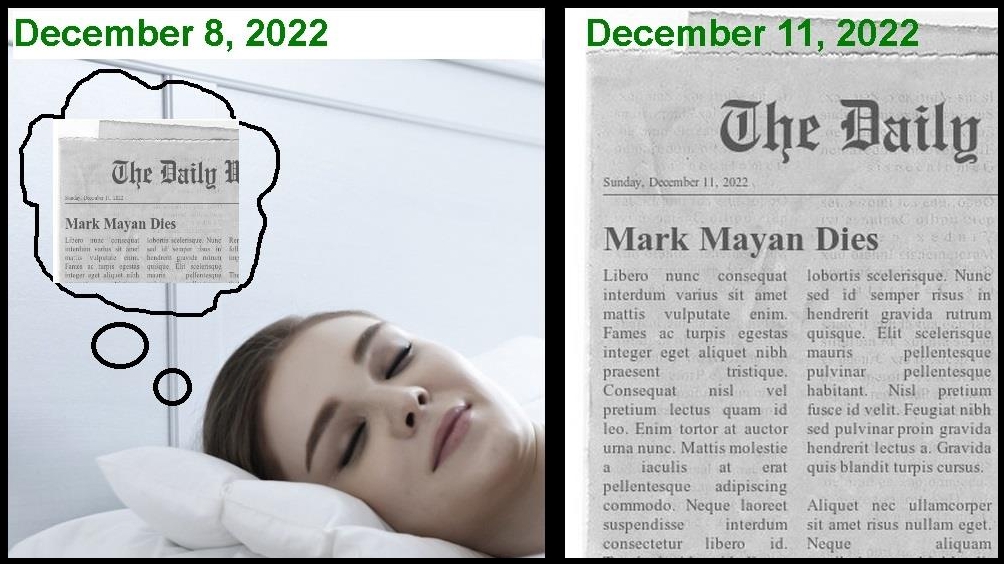
Even More Dreams and Visions That Seemed to Foretell a Death

In the posts below I have given many examples of dreams, visions or eerie voices that seemed to foretell a death:

When Dreams or Visions Foretell a Death

More Dreams or Visions That Seemed to Foretell a Death

Still More Dreams or Visions That Seemed to Foretell a Death

Still More Dreams, Visions or Voices That Seemed to Foretell a Death


Let us look at some additional cases of this type. The account below can be read in its original publication by scrolling to page 211 of the 1910 document here, or (more conveniently) in a 1914 book that quotes the account on the page here: 

"One night my mother woke my father suddenly, saying: 'Oh, Charles! I have had such a terrible dream! I dreamed that John Wilkes Booth shot me! It seemed that he sent me seats for a private box in a theater, and I took some young ladies with me. Between the acts he came to me, and asked me how I liked the play. I exclaimed, 'Why, John Booth! I am surprised that you could put such a questionable play upon the stage. I am mortified to think that I have brought young ladies to see it.' At that he raised a pistol, and shot me in the back of the neck. It seems as if I felt a pain there now.'  After a while my mother fell asleep, and dreamed the same thing a second time. The next morning came the terrible news which plunged the nation into grief and mourning. Almost at the hour of my mother's dream, President Lincoln was assassinated; shot, in the back of the neck, in a private box at a theater, by John Wilkes Booth."

One of the most famous dreams that seemed to foretell a death occurred to Abraham Lincoln. In his book Recollections of Abraham Lincoln, 1847-1865 Ward Hill Lamon (a close associate of Lincoln) tells us on page 114 that he heard Lincoln tell of the dream, and that Lamon wrote down the details:

"But the most startling incident in the life of Mr. Lincoln was a dream he had only a few days before his assassination....I give it as nearly in his own words as I can, from notes which I made immediately after its recital. There were only two or three persons present."

On page 116 (after quoting some preliminary discussion with Lincoln) we read this account in which Lamon quotes Lincoln describing the dream:
 
"I soon began to dream. There seemed to be a death-like stillness about me. Then I heard subdued sobs, as if a number of people were weeping. I thought I left my bed and wandered downstairs. There the silence was broken by the same pitiful sobbing, but the mourners were invisible...Determined to find the cause of a state of things so mysterious and so shocking, I kept on until I arrived at the East Room, which I entered. There I met with a sickening surprise. Before me was a catafalque, on which rested a corpse wrapped in funeral vestments. Around it were stationed soldiers who were acting as guards; and there was a throng of people, some gazing mournfully upon the corpse, whose face was covered, others weeping pitifully. 'Who is dead in the White House?' I demanded of one of the soldiers. ' The President' was his answer ; ' he was killed by an assassin ! ' Then came a loud burst of grief from the crowd, which awoke me from my dream. I slept no more that night ; and although it was only a dream, I have been strangely annoyed by it ever since."

In a 1951 edition of the Journal of the American Society for Psychical Research, page 81, we read the following account of a dream that seemed to foretell a death:

"1. Mrs. Henrietta Block: Percipient had an unusually vivid dream that the manager of the bank where she was a depositor died suddenly of acute indigestion. 'I knew the manager by sight, but nothing of his personal or business characteristics.' She had seen him casually at the bank a week prior to the dream, at which time he seemed to be perfectly well. Because this dream was so vivid, she told her mother about it next morning. Two days later she learned that the bank manager had in fact died very suddenly of acute indigestion at about the time of the dream."

On page 89 of the same document we read another case of a dream that seemed to foretell a death:

"Mr. C. A. Nash: ... I will relate an occurrence that happened to me thirty-four years ago, which I believe saved my life or at least saved me from serious injury. In July, 1916, I was working on the Soo Line wheat elevator which was then being constructed and I worked on the steel gang which did the reinforcing, and most of our work was on ladders and scaffolds, as the elevator rose to a height of 200 feet....I am usually a sound sleeper, but that night I dreamed that I was back on the job and I saw the ladder to the 75-ft. scaffold break and a number of men killed and injured.  I told my folks about my dream Sunday morning and they asked me what 1 had eaten to give me such a nightmare. I even told Clarence Farber, a chum of mine, who worked with me, about the dream, but he laughed it off. We did not work Sunday, but on Monday I heeded the warning and stayed on the ground where I bent rods on the bending table. At 11:45 the foreman ordered me to go up on the dryer tank scaffold and help the men, but I told him that I had only a few rods left to bend and that the noon hour was only 15 minutes away. He excused me and got someone else to help. When the whistle blew for dinner at 12 o’clock, 14 men hurried to come down that ladder. It broke and 2 or 3 were killed and 6 or 7 badly injured. Dr. Noonan, who is still living, was called to the scene. He said that one man had his neck broken and another every bone in his body...The accident happened to the ladder I dreamed about.”

prophetic dream

In the book The Voice Within : Premonitions of Sudden Death in Children by Richard Hardoin, we have some remarkable accounts of dreams, visions or voices that seemed to foretell a death.  We read this account of a mother whose child died of SIDS (Sudden Infant Death Syndrome):

"When I was carrying her, late in my pregnancy, I had a dream. I was asleep, but suddenly I seemed to be awake. I was floating above my body, and a woman wearing all white clothes was next to me. We looked down at my body and swollen belly and she said to me in a voice I will never forget, 'You know, you will not be allowed to keep that baby.' " 

The mother reported later seeing the same woman at the foot of her bed, saying, "It's time."  The woman immediately rushed the baby to the doctor, who found nothing. That night the baby died suddenly at home, from SIDS.  On page 35 we read this account by a mother whose child died suddenly:

"I was wide awake, working in my baby's closet, when I saw her image in a small white casket at the front of our church...The image went away, but recurred ten minutes later...When my daughter died and I went to the funeral home, my baby was placed in a small white casket identical to the one I had seen." 

The account on the next page is similar:

"In dreams that followed, Fran had sensations of a baby going up in the air whom she continually pulled back to earth. In her visions, this occurred in the living room of her own room. Fran's son did die in the exact location predicted in her dreams."

On page 45 we read this account from a mother identified as HD who lost a child to SIDS:

"She viewed her son's funeral during a dream which occurred one week before her baby's death. She stated, '(I) saw a casket being lowered. The top opened and the infant (my son) was inside.' When HD went to the the funeral parlor following the death, the only casket available was one identical to the one in her dream."

On page 51 we read of a mother who on the night of her child's death  saw a vision of the child's name on a tombstone. On page 63 we read of a man troubled by "nightly dreams of planes crashing" shortly before discovering that his daughter had died in a plane crash. On page 72 we read of a mother who had a dream of her son dying a week before the son died. On pages 73-74 we read of a mother who had a dream of someone taking her baby, who was wrapped in a dry cleaning bag. On that day her child suddenly died of SIDS.  On page 75 a parent says this: "Three days before Brian died, I had a dream that he would die on the bed at the  babysitter's house -- exactly where he did die."

On page 90 we have this sad, eerie account:

"Throughout my pregnancy, I dreamed five or six times that the baby's father would die before the baby was born. However, the night my baby died, I was sitting and looking at him in his bouncer, and he smiled at me and seemed to almost change to a bright yellow
color. I started to cry and said to my brother and my friend that I had a feeling he was going to die. I did not know when, and I didn't think that it would occur that evening. But I did feel it. And four hours later, when I woke up, he was dead beside me. Also, his father did die three days later of suicide." 

On page 115 a mother says, "Two nights before Andrew died, I had a vivid dream that one of our twin boys had died."  On page 117 we read, "Author Christopher Anderson, in his book Jacqueline Kennedy Onassis, claims that Jackie had a reoccurring dream in which her son, John Jr., would die in an airplane crash."  That is exactly what happened. 

The paper "End-of-Life Experiences and the Dying Process in a Gloucestershire Nursing Home as Reported by Nurses and Care Assistants" is one that reported dreams that seemed to foretell a death, and many other hard-to-explain phenomena.  What is remarkable is the amount of hard-to-explain phenomena reported in such a small facility. Questions were asked of workers in Kingsley House, a small facility handling no more than 31 persons at a time, and reporting only about 13 deaths per year. We read of these results, coming from the ten who responded:
  • "7 reported unconscious or confused residents who unexpectedly became lucid enough just before they died to interact with relatives and carers," a phenomena sometimes called "terminal lucidity."
  • "6 reported dreams that help to prepare for death, and 2 reported dreams or visions that held significant meaning for the dying to help with unfinished business." The "Dreams" section of the paper on page 200 gives several examples, some involving dreams that seemed to foretell a death. 
  • "5 reported the dying seeing dead relatives visiting just before death, and 4 reported the dying seeing dead relatives sitting on or near the bed."
  • "4 reported the synchronistic appearance of birds or animals around or just before the time of death." 
  • "4 reported a change of room temperature around the time of death," with one saying, "sometimes the room is freezing," and that "at other times it is really, really hot."
  • "3 reported synchronistic events at the time of death, such as clocks stopping and bells ringing in rooms of those who had recently died."
Should you be concerned if you have some dream that may seem to suggest the idea of your own death? I would advise people not to be very worried if that happens. I know that for the past two years I have had very many dreams that very heavily suggest ideas of danger, death and life after death, including more than 300 dreams seeming to suggest the idea of life after death, as I describe here. So it is not true that dreams of this type only occur shortly before death. Furthermore, all of my many years of studies and remarkable experiences (such as what I discuss here, here, here, here and here) leave me very strongly with the idea that death is nothing to fear. But if you are someone with a spouse or children, and if you start to have dreams that seem to hint at the idea of your own death,  and you are young enough to buy it affordably, you might want to buy some life insurance to help the financial security of your loved ones. 

Postscript:  In the atheist-oriented Aeon magazine, we have an article by a writer who dreamed that his mother's friend came to him and reported that she had just died. Two weeks later he found out that this person had died two weeks earlier. We have here a case example of how certain people just throw away clues they should be paying attention to. A reasonable thing to do after having such an experience would be to start researching how often people have such experiences, which might lead you to posts such as this one. But our writer has apparently just discarded the important clue he was given. In his article he writes about other unrelated coincidences, and shows no signs that his experience has caused him to start researching how often other people have had experiences like he had. 

Sunday, December 4, 2022

Scientists Blow Billions Chasing Cherished Chimeras

"A thing that is hoped or wished for but in fact is illusory or impossible to achieve."  -- Google definition of "chimera."

Let us take a look at some Big Science projects which were funded mainly because scientists were very eager to find things that they eagerly hoped to find, things that are probably purely imaginary. 

The first example involves the Large Hadron Collider, a project that has cost nearly 5 billion dollars. Now, you may say that the Large Hadron Collider should not be on this list, because this gigantic machine was built to find evidence of the Higgs Boson, and such evidence was found. But the claim that the Higgs Boson had been discovered was announced in 2012, and the Large Hadron Collider has been running since then, at a very high annual cost that has been estimated at about 1 billion dollars a year.  Why were so many billions spent to keep the Large Hadron Collider running? Mainly to search for some of the cherished chimeras of physicists: the "superpartner" particles predicted by supersymmetry theory. 

The issue of the fine-tuning of the Higgs mass (the mass of the Higgs boson) was skillfully explained by physicist Ben Allanach in a previous article at the Aeon site: 

"Behind the question of mass, an even bigger and uglier problem was lurking in the background of the Standard Model: why is the Higgs boson so light? In experiments it weighed in at 125 times the mass of a proton. But calculations using the theory implied that it should be much bigger – roughly ten million billion times bigger, in fact....Quantum fluctuations of ultra-heavy particle pairs should have a profound effect on the Higgs boson, whose mass is very sensitive to them....One logical option is that nature has chosen the initial value of the Higgs boson mass to precisely offset these quantum fluctuations, to an accuracy of one in 1016. However, that possibility seems remote at best, because the initial value and the quantum fluctuation have nothing to do with each other. It would be akin to dropping a sharp pencil onto a table and having it land exactly upright, balanced on its point. In physics terms, the configuration of the pencil is unnatural or fine-tuned. Just as the movement of air or tiny vibrations should make the pencil fall over, the mass of the Higgs shouldn’t be so perfectly calibrated that it has the ability to cancel out quantum fluctuations. However, instead of an uncanny correspondence, maybe the naturalness problem with the Higgs boson could be explained away by a new, more foundational theory: supersymmetry."

In an article in Symmetry magazine, we have a similar explanation:

"To understand what’s fishy about the observable Higgs mass being so low, first you must know that it is actually the sum of two inputs: the bare Higgs mass (which we don’t know) plus contributions from all the other Standard Model particles, contributions collectively known as “quantum corrections.” The second number in the equation is an enormous negative, coming in around minus 1018 GeV. Compared to that, the result of the equation, 125 GeV, is extremely small, close to zero. That means the first number, the bare Higgs mass, must be almost the opposite, to so nearly cancel it out. To some physicists, this is an unacceptably strange coincidence."

How big a coincidence? The Symmetry article later quotes physicist Lawrence Lee Jr. as saying “the conundrum with the Higgs mass, which would require fine-tuning on the order of 1-in-1034,” which is a coincidence like the coincidence of you correctly guessing the full phone numbers of three consecutive strangers. 

Scientists should have just accepted this case of very precise fine-tuning in nature.  But instead, many of them made a long, quixotic, futile attempt to overthrow it (like someone trying to overthrow the observation that the sun is hot, with some elaborate theory trying to explain how the sun isn't really hot).  Why did they do that? Because they had a motivation, an ideological motivation rather than the motivation of simply discovering truth. Their ideological motivation was related to a belief that the universe should not be anything that looked like a product of design. This ideological motivation is clearly stated in the Symmetry article by physicist Lee, who states it as follows: “In general, what we want from our theories—and in some way, our universe—is that nothing seems too contrived.” If you want for the universe to not "seem too contrived," then you may twist yourself into knots trying to explain away cases of apparent fine-tuning in the universe. 

An article last year makes it rather clear that the supersymmetry theory was mainly motivated by a desire to get rid of a case of fine-tuning, and make the universe look like it was a little less lucky, a little less  providentially blessed. We read this:

"For example, the small mass of the Higgs boson is notoriously difficult to explain—its calculation requires subtracting two very large numbers that just happen to be slightly different from each other. 'But if you add supersymmetry, this takes care of all these cancellations such that you can get a light Higgs mass without needing to have such luck,' says Elodie Resseguie, a postdoc at the US Department of Energy’s Lawrence Berkeley National Laboratory."

All attempts to get evidence for the theory of supersymmetry have failed. The "superpartner" particles that are the core of supersymmetry theory are chimeras that scientists wanted to believe in so badly that they wasted billions in futile attempts to find them. Scientists also wasted countless millions in federally funded dollars spinning out endless different speculative versions of the supersymmetry theory.  A search for "supersymmetry" papers on the Cornell physics paper server gives more than 15,000 matches. Physicists seem to have spent more hours speculating about supersymmetry theories than medieval theologians spent speculating about angels and the Second Coming, with the results being as futile.

Another type of cherished chimera which scientists spent endless effort and countless dollars on was cosmic inflation. Not to be confused with the undisputed reality of cosmic expansion (the expansion of the universe), cosmic inflation is the idea that the universe underwent a very unusual exponential expansion during its first instant. Like the endless versions of supersymmetry theory, scientists have created endless versions of the theory of cosmic inflation, which all have in common the claim that the universe expanded at an exponential rate in its first instant, rather than the normal linear rate of expansion we now observe. 

Just as supersymmetry was invented to try to avoid a very dramatic case of apparent fine-tuning in nature, cosmic inflation theories were created to try to avoid a very dramatic case of apparent fine-tuning in nature: the apparent fine-tuning of the universe's expansion rate at the very beginning of the Big Bang to about 1 part in ten to the fiftieth power. Just as scientists produced endless thousands of papers producing countless versions of the supersymmetry theory, scientists produced many thousands of papers producing countless versions of the cosmic inflation theory. 

cosmic fine tuning denialism

For many decades cosmologists have been lost in a strange little world of fantasy whenever they dealt with this cosmic inflation theory. No evidence has ever existed that the theory is true. As different versions of the theory have kept failing, cosmologists keep producing new versions of the theory; and by now there are hundreds of versions of it, making predictions all over the map.  

All attempts to provide some empirical support for the theory of primordial cosmic inflation have failed. Cosmic inflation theories  predict something called primordial B-modes, but nothing has come from searches for primordial B-modes that have gone on for years with fancy expensive equipment.  A 2019 article states, "Models such as natural and quadratic inflation that were popular several years ago no longer seem tenable, says theorist Marc Kamionkowski of Johns Hopkins University."  But rather than discarding a theoretical approach that isn't working, our  cosmologists keep spinning out more and more speculative ornate versions of the theory (which already has hundreds of different versions).  Cosmic inflation theory is correctly described as tribal folklore, the tribe being the very small band of people who describe themselves as cosmologists. 

Gravitational waves have been discovered, but not the primordial gravitational waves predicted by cosmic inflation theory. Noting the complete failure of searches for the primordial B-modes, a scientist recently stated, "If, however, future measurements continue to find no gravitational-wave signal, it will likely imply that we must seriously reconsider our inflationary models or perhaps dismiss inflation altogether, which would be a significant paradigm shift."  A more candid version of that statement would say something like this: "All these observational failures are making it pretty clear that cosmologists have been wasting their time for forty years messing around with groundless theories of primordial cosmic inflation."   

It cannot be said for sure whether dark matter and dark energy are cherished chimeras that scientists have wasted very many billions looking for. But thus far it seems like such things are merely fond fantasies of astrophysicists. Call them "dark darlings" of the modern cosmologist, who loves them because it allows him to speak as if he understands the composition of the universe and the motion dynamics of stars and galaxies, something cosmologists do not actually seem to understand. Wikipedia.org lists 34 dark matter search missions, all of which have failed. A single 2019 press release mentions a 24 million dollar price tag, and some online sources say hundreds of millions have been spent in the futile quest for dark matter. At the "Dark Matter Crisis" blog (www.darkmattercrisis.wordpress.com), we have a post that looks like this, one that estimates more than half a billion dollars is being spent per year related to the fruitless quest for dark matter:

cost of dark matter searches

The post states the following:

"The dark-matter based models were clearly ruled out already in 2010 (read 'Local-Group tests of dark-matter concordance cosmology . Towards a new paradigm for structure formation') and definitely falsified in 2012 (read 'The Dark Matter Crisis: Falsification of the Current Standard Model of Cosmology'). Today, ten years later, ample time has passed even for the dimmest scientist to be able to catch up. Given that the arguments against dark matter have not been shown to be invalid, and have in fact multiplied manyfold (see the iai piece above), it is simply not to be understood from a rational point of view why we keep expending so many valuable resources into a falsified theory while, at the same time, suppressing a highly interesting and successful alternative [MOND]. The scientists who continue pushing for this falsified dark-matter theory are hurting the sciences and are, by ignoring the falsifications, being unscientific. They appear to behave more like ancient Egyptian priests who fervently guard their particular god(s) to thrive on the citizens by faking the ability for communicating with these imaginary deities. What keeps this system going? The LCDM [lambda cold dark matter] model is a gold of mine for those, the 'LCDM priests', who are able to sell the dark matter and dark energy stories to the funding agencies."

A post by a scientist describes a case of blowing lots of money chasing a cherished chimera, a search for a Weakly Interacting Massive Particle that could be a type of dark matter:

"This scenario became known as the 'WIMP miracle' scenario, because it seems like a miraculous coincidence that putting in these parameters would lead to the expected weak interaction-based cross-section just popping out. For many years, a series of direct detection experiments were conducted, with the hope that the WIMP miracle scenario would turn out to be real. As of late 2022, there is no evidence that this is the case, and the cross-section limits from experiments such as XENON have ruled out the standard WIMP miracle scenario in practically every reasonable incarnation."

DNA anatomy blueprints are another imaginary chimera that scientists spent billions looking for. The cost of the Human Genome Project has been estimated at 3 billion dollars. In the 1990's we were told that this expense was justified, because the project would discover a DNA specification for building humans, a genetic plan for what makes us us. All kinds of groundless claims were made about DNA and genes as part of the sales job for the Human Genome Project.  But no DNA anatomy blueprint was ever found in DNA. The Human Genome Project was completed about 2001. All that was ever found in DNA and its genes was low-level chemical information, such as which amino acids make up particular proteins. No one ever found a blueprint for making a human, or a recipe for making a human, or a specification for the human body, or a genotype that maps a phenotype. We can't quite call this a case of "blowing billions," because at least the human genome (the contents of DNA) was mapped, an accomplishment of some scientific value.  

After the Human Genome Project was finished, our scientists never announced their failure to find the chimera of a DNA anatomy blueprint, something we had been told countless times would be discovered by the project. In government web sites built to hype the Human Genome Project, you can still read the lies that were told to drum up support for the project or to extol the project: false claims that DNA is a specification for how to build bodies. In the Guardian, science writer Phillip Ball says this about the Human Genome Project that ended in 2001:

"But a blizzard of misleading rhetoric surrounded the project, contributing to the widespread and sometimes dangerous misunderstandings about genes that now bedevils the genomic age. So far, there have been few attempts to set the record straight. Even now, the National Human Genome Research Institute calls the HGP an effort to read 'nature’s complete genetic blueprint for building a human being' – the 'book of instructions' that 'determine our particular traits'. A genome, says the institute, 'contains all of the information needed to build and maintain that organism'. But this deterministic 'instruction book' image is precisely the fallacy that genomics has overturned, and the information in the genome is demonstrably incomplete. Yet no one associated with genomic research seems bothered about correcting these false claims...Plenty remain happy to propagate the misleading idea that we are 'gene machines' and our DNA is our 'blueprint'."

Another cherished chimera that scientists have blown hundreds of millions or billions seeking is the engram: a supposed part of the brain offering evidence of memory storage in brains. Over decades neuroscientists have spent billions of dollars looking for some place that offers evidence of physical memory storage in brains, but have found no convincing evidence of such a thing. 

There are claims in the neuroscience literature that engrams have been observed, but all such claims are spurious. No solid evidence has ever produced for the discovery of an engram in any type of organism. Just as there are some unjustified claims to have observed dark matter, there are some unjustified claims to have observed engrams.  I can describe the typical affair that goes on when neuroscientists claim to observe an engram:

(1) Scans will be made of some tiny parts of an animal's brain (typically synapses) before the animal is subjected to some type of learning, typically fear conditioning involving training the animal to fear electrical shocks when it touches some shock plate in its cage. 
(2) The animal will then be subjected to some learning program, such as fear conditioning. 
(3) Scientists will then rescan the animal's brain, looking for some tiny part of the brain (such as synapses) that underwent some very tiny little change, such as synapse strengthening. 
(4) Upon finding such a tiny change in any one region, such as a little strengthening of synapses somewhere, the scientists will triumphantly announce that they have discovered an engram, presuming that the little change that occurred must be an example of physical memory storage. The tiny change found may be called "learning-dependent synaptic modification."

This type of utterly fallacious technique has gone on in quite a few scientific studies. It is easy to explain why the technique offers no good evidence for engrams. The problem is that synapses are constantly undergoing what is called random remodeling or stochastic remodeling. This is partially the result of the very short lifetimes of the proteins that make up synapses. Such proteins have average lifetimes of only a few weeks or less. Also, synapses are attached to units called dendritic spines, which have short lifetimes, typically only weeks or months.  Synapses are rather like the sand of the edge of the seashore, which is constantly being remodeled by the action of wind and waves. 

Accordingly, it is fallacious to search out for some tiny bit of synaptic matter that looks different after some learning occurred, and to claim that this shows that the tiny bit of synaptic matter must have changed because memory storage occurred. Given a brain in which synaptic matter is constantly undergoing random changes, like the constantly remodeling sand at the edge of the seashore, we have no basis for suspecting that some change in the synaptic matter was caused by memory storage rather than mere random changes such as typically occur throughout the synapses of the brain. 

Using the Google NGram Viewer (which can search for the number of occurrences of a search phrase in the vast number of books indexed by Google books), we can search for how often the term "engram" has been used in the past 70 years. The result below is just what we expect if no real progress had been made in discovering an engram. Instead of seeing a rising line, we see a decrease in uses of the term. 

use of engram

Rather than use the term "engram," neuroscientists often push the same idea by claiming that memories are stored in "connection patterns" or "synaptic patterns." A search for the uses of those phrases hints at how they enjoyed a short heydey, followed by a reduction in popularity (just as we would expect if no evidence had been found for memories stored in connection patterns or synaptic patterns):

synaptic patterns

Searches for engrams have failed to produce any convincing evidence for them. What would be a convincing discovery of an engram? It might go something like this: scientists would be able to read memory information from the brain of a dead man. So given the corpse of John Hypothetica, and not told who the person was, the scientists would be able to read some memory information that would only be found in the head of John Hypothetica. For example, they might say, "Upon examining his synapses we found a memory that he had once been married to someone named Violetta."  No such thing has ever happened. A memory has never been read from the brain of a dead man or any organism. And scientists have never been able to extract a memory after removing brain tissue from the brain of a living person.  

Short of finding a memory in the brain of a dead person, one that could be read to discover something about who the person was or what he had learned, the next best thing would simply be to find evidence that brains stored the symbolic tokens that are the hallmark of information storage. Below are some examples of symbolic tokens. 

representational tokens

There are symbolic tokens in the brain, but only the same type of tokens found in almost every cell: the nucleotide tokens in DNA that specify mere amino acids, according to the system of representation called the genetic code.  No other type of symbolic token has ever been found in the brain. Scientists never found human memory information by examining brain tissue, and they have never found any symbolic tokens that could be the basis of some memory representation system they don't understand. Together such facts (and many other reasons discussed here) tell us that the notion of memory engrams in the brain is a chimerical one. We know from computers and from books the type of things found in a system allowing the fast retrieval of stored information, things such as indexing, addressing and sorting. The human brain has no such things. 

The fact is that humans can instantly form complex new memories, a fact completely contrary to the prevailing idea that memories form from "synapse strengthening," a sluggish process that would take many minutes or hours. The fact is that humans can remember things very well for 50 years or more, something completely inconsistent with claims that memories are stored in the synapses of brains, very unstable things subject to constant turnover and remodeling because of the short lifetimes of synapse proteins and the instability of dendritic spines which synapses are attached to. The fact is that given any of very many thousands of one-word prompts such as "Waterloo" or "Dickens," humans can instantly retrieve complex relevant information, something that should be impossible in a brain because of its total lack of the things (addressing, indexing and sorting) that make possible instant information retrieval.  

In a book a neuroscientist (Darold A. Treffert) discussed many marvels of human memory and enormously fast human thinking that should have been utterly impossible for a brain, given its speed limitations, high protein turnover in synapses, and unreliable signal transmission (synapses in the cortex transmit nerve signals with only 10% to 50% reliability).  In many cases Treffert discusses such marvels of memory and blazing fast thinking occurring in people with heavily damaged brains. The items discussed were only some of the marvels of the human mind and memory discussed here, all showing humans thinking so fast and remembering so well that such mental activity cannot be explained by brains.  On page 207-208 of the book the neuroscientist Treffert considers some facts that throw into doubt all claims of memories being stored in brains. He states this about memory storage:

"Is storage electrical? If so, then why aren't memories permanently destroyed during an epileptical seizure, which is truly an electrical storm in the brain -- as can be witnessed by watching an EEG during a seizure? Or, if storage is electrical, why aren't memories permanently affected when a patient receives electroconvulsive therapy (ECT), during which time an electrical current is passed through the brain ? If storage is electromagnetic in the same manner that storage of 'memories' on tape or storage of data on a computer is, then why isn't memory permanently affected by a nuclear magnetic resonance (NMR) brain scan, during which the brain is subjected to tremendous magnetic fields? Try that with some tapes or disks. If storage is an actual physical storage, like grooves on a phonograph disk, why isn't there some clear evidence of that process in microscopic examination of the brain?" 

Alas, our neuroscientist then stumbles by saying that these are "questions I guess we will need to leave for the future." No, rather that "sweeping under the rug" so many facts that conflict with prevailing dogmas by "leaving them for the future," we should instead be drawing an inference from such facts, and countless other facts of neuroscience and human observation, after very carefully studying them by doing things such as reading posts like those you can read at my blog www.headtruth.blogspot.com, or reading up on countless reports of people floating out of their bodies and viewing them from above during near-death experiences.  The inference that follows from such observations and facts is that the brain does not store memories and does not produce the human mind. 

There is a way for scientists to get a very high "bang for the buck" in research. That way is:

(1) Spend a great deal of time analyzing important-seeming observational reports that have already been made, insteading of "sweeping under the rug" and ignoring observational reports conflicting with your cherished beliefs.
(2) Do research looking for more examples and a greater understanding of things that many people have already reported seeing, rather than trying to discover new types of things that no one has ever reported seeing. 

Were scientists to follow such an approach, they would spend far more time and money researching things such as apparitions and near-death experiences and ESP and unexplained healing (all abundantly supported already by observations) than looking for things they hope to find which no one has ever reported seeing (such as supersymmetry superpartner particles).