Header 1

Our future, our universe, and other weighty topics


Saturday, December 31, 2016

Seeing a Canyon Between Animal and Human Minds, They Call It a Little Crack

The origin of the human mind is a great problem for conventional thinking about evolution. The problem is that relatively suddenly there appeared a species with many traits that had never been seen before, things like insight, imagination, spirituality, language, mathematical ability, and abstract thinking. If such things had very gradually appeared over the course of five million years, it wouldn't be such a problem. But such things seem to have appeared rather suddenly at a time about 100,000 years ago. At the time the human population was very small, and the smaller the population of a species, the less likely it is to be beneficially transformed by random mutations. We might call this the “canyon problem.” It is as if the human species magically jumped over a canyon about 100,000 years ago, a vast gulf separating humanity and the other animals.  Exacerbating the problem is the fact (discussed here) that quite a few of the uniquely human mental characteristics seem to be things unrelated to survival value, making their appearance not explicable through natural selection. 

Conventional Darwinists have long had a strategy to try to minimize this credibility problem, a strategy that one might call “trying to shrink the canyon.” The strategy typically follows two general rules: try to humanize the animals, and try to animalize the humans.

The “humanize the animals” part works like this: attempts are made to emphasize human-like characteristics in animals, to make it look as if animals are not all that different from humans. The “animalize the humans” part works like this: attempts are made to depict humans as being quite like animals, rather like apes in business suits and dresses. An example of the “animalize the humans” approach was the best-selling book The Naked Ape by Desmond Morris. An example of the “humanize the animals” approach is the recent book Not So Different: Finding Human Nature in Animals by by Nathan H. Lents, a professor of molecular biology. I find this subtitle to be rather like some title of Finding Lunar Nature Inside the Sun or a title of Finding Canine Nature Inside Humans.

Lents goes wrong on the very first page of his book, by stating, “The thesis of this book is that underneath even our most complex behaviors are rather simple, genetically coded predispositions that we share with many other animals.” That's misbegotten, since our most complex behaviors include things like building rocket ships, creating physics theories, writing books, programming computers, filling out income tax forms, and posting things to the Internet; and it is not at all true to say that underneath such behaviors are predispositions that we share with animals.

Showing that he will rely on a much-criticized and over-hyped line of research called behaviorial genetics, Lents then starts talking about “behavioral programs,” trying to imply that genes code some program for human behavior. They do not. While genes may have some influence on human behavior, anything like a “behavioral program” would require some storage medium using a language vastly more sophisticated than the bare-bones language used by DNA, which is a language merely for stating which amino acids should make up a particular protein.

Here is some very lame reasoning used by Lents to support this idea (he refers to the tendency of newborn ducklings to follow the first organism they see after being born, whether it be a mother duck or a human):

It seems unfathomable that mere DNA and protein could control emotion and behavior, but what else could control them? Anyone who has ever seen a brood of ducklings follow their mother has borne witness to the power of genetically programmed instinct in directing behavior.

This is fallacious “what else could the answer be?” type of reasoning kind of similar to this district attorney reasoning to a jury: “It may seem utterly impossible that the defendant could have committed the murder, but who else could have done it?” We do not understand the cause of animal instincts. But we do know that there could not possibly be any rule in DNA such as, “Always follow your mother,” or “Follow the first thing you see after being born,” because concepts such as “follow” or “mother” or “the first thing you see after being born” cannot be expressed by DNA, which can only state the constituents of proteins. As for the question “what else could control them?” the answer for now must be: “some aspect of biology or nature we don't understand.”

The modern biologist keeps using this dubious “where else could it be?” logic again and again. He will typically assume that memories are stored in the human brain, using “where else could they be?” logic, even though there is no place in the brain suitable for storing memories lasting for five decades (as discussed here), because of factors such as very rapid molecular turnover in synapses. The modern biologist will also typically assume that the body plans of organisms are stored in DNA, using “where else could they be?” logic, even though there are very good reasons why body plans cannot be stored in DNA (as discussed here), such as the fact that the extremely meager DNA language is completely incapable of expressing either complex three-dimensional blueprints, or sequential instructions for making complex three-dimensional objects. You cannot establish that X is in location Y using “where else could it be?” reasoning, in any case where Y is not a place that can feasibly be storing X.

Chapter 2 of Lents' book is entitled “Animal Systems of Justice.” But he does not demonstrate that animals have such a rarefied thing as a “system of justice.” An animal may dole out punishment or reward to another animal, but it is rather laughable to call such behavior a “system of justice,” as if our hamsters, hares and hyenas were Hammurabis constructing codes of justice.

Chapter 5 is a 42-page chapter entitled “Do Animals Fall in Love?” But the chapter is almost all about other things, and does not justify any claim that animals do fall in love like humans.

Other chapters try to show that animals can be jealous, greedy, or capable of grief or fear. This does not add up to a case justifying the “Not So Different” title of the book. For there are still the following differences to consider:

  • Humans use language, and animals don't.
  • Humans have complex abstract ideas, and animals don't.
  • Humans design and build complex things, and animals don't (with the possible exception of beavers, who build dams that aren't very complex).
  • Humans create representational art, and animals don't.
  • Humans feel awe when they look at the stars and wonder when they look at a sunset, and animals don't.
  • Humans form religious ideas, and animals don't.
     
Having read Lents promise at his book's beginning that he would discuss genetic “behavior programs,” I looked at the “G” part of his book's index. Was there an entry for “gene for aggression” or “gene for love” or “gene for building behavior” or anything like that? No, the relevant part of the index looks like this:

geese, 190
genetic diversity 95-97
giraffes, 135-136

That was to be expected, because while the human genome has been exhaustively studied, there has been no series of replicated studies that found a gene specifying a particular complex behavior. There is no aggression gene, no philosophical thinking gene, no creativity gene, no spirituality gene, no sociability gene, no “build things” gene or anything of the sort.

Lents book relies on a foundation of behavior genetics. Below is an excerpt from a review of a book on behavior genetics:

Panofsky’s history of behavior genetics is about a
science gone wrong. It is a science whose proponents
rely on “flawed reasoning and research of people using
counterfactual models of genetic reductionism” (Lerner,
2015b; p. 68). In the end, we are drawn to the
important question raised by Lerner (2006). “Why do
we have to keep reinterring behavior genetics or other
counterfactual conceptualizations of the role of genes
in behavior and development” (p. 337) ? Why indeed,
given the many nails driven into its intellectual coffin
the now classical accounts of Gould (1996) and
Lewontin, Rose, and Kamin (1984) and the more recent
critiques by psychologists such as Douglas Wahlsten
(2012) whose assessment must surely be the final word:
All hope of discovery has been lost.”


This essay by a PhD (entitled “The Crumbling Pillars of Behavioral Genetics”) discusses the failure of behavioral geneticists to deliver on their promises to find evidence of genes that control behavior.  Scientific American columnist John Horgan complains that behavioral genetics has a “horrendous track record.” He points out that claims to have discovered a gene for some particular behavior are not well replicated. Horgan states:

The methodology of behavioral geneticists is highly susceptible to false positives. Researchers select a group of people who share a trait and then start searching for a gene that occurs not universally and exclusively but simply more often in this group than in a control group. If you look at enough genes, you will almost inevitably find one that meets these criteria simply through chance.

Lents ends his book by quoting Darwin, who said, “Nevertheless, the difference in mind between man and the higher animals, great as it is, certainly is one of degree and not of kind.” This assertion itself is certainly false. A human mind that can use abstract reasoning, contemplate the mysteries of existence, design cities, compose symphonies, and create physics theories is obviously a different kind of mind than the mind of an animal; the difference is not at all merely one of degree.

The “canyon problem” I referred to remains, and Lents has failed to shrink the canyon. 

human minds
 Postscript: One of several ways to try to deal with this "canyon problem" is to appeal to the possibility of extraterrestrial interference in human evolution.  The fairly sudden appearance of the more refined human mental traits is probably a better point of favor of such a hypothesis than any of the archaeological items that are frequently mentioned on the Ancient Aliens television show.

Tuesday, December 27, 2016

Pareidolia Can't Explain the Latest Shocking Mars Strangeness

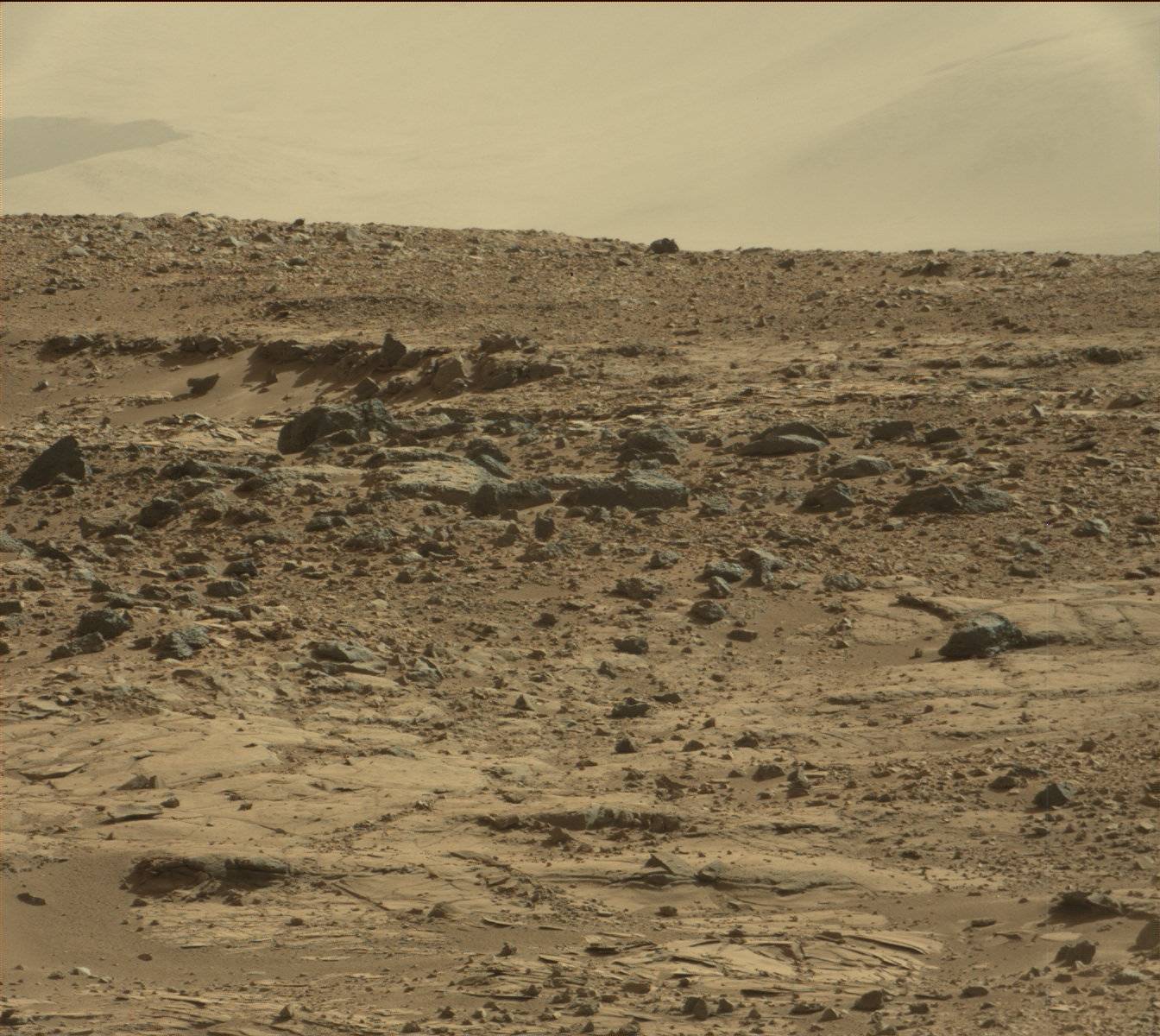
The Mars rovers such as Opportunity and Curiosity have photographed an astonishing variety of anomalous-looking things on Mars. They are discussed in this series of blog posts. You can find more examples by doing a Google image search for “Mars anomaly.”

Two recent examples are the "Mars mouse" shown at the top of this original NASA photo, and the Mars dome shown at the top of this original NASA photo. The composite photo below shows the "mouse" and "dome."

orb face

In September 2015 one of the Mars robotic probes photographed what looks like a long spoon, one that rather seemed to be levitating above the ground. Now a newly examined photo from Mars shows another “long spoon.” Below are the photos side by side. The original NASA photos can be found here and here

 
When such anomalies occur, skeptics are quick to trot out what they call a “scientific explanation”: pareidolia, the supposed tendency of the mind or brain to interpret random pieces of matter as being something familiar, like a face or a spoon.

Is this actually a scientific explanation? No, it isn't. Evoking pareidolia is just another way of saying something is a coincidence. Whenever you say that something is coincidental, you never are giving an explanation; you are instead really indicating that you have no explanation.

Imagine the case of someone who photographs a cloud that looks very much like a human figure. There are two ways in which a skeptic might respond: he might claim that it was just a coincidental arrangement of matter, or he might say that it was pareidolia that the cloud is being compared to a human. But both responses are basically the same thing.

Both responses involve two assumptions:
  1. There was merely a coincidental random arrangement of matter.
  2. The mind interpreted this random arrangement of matter as something meaningful.
If I merely say that it was just coincidence, I am explicitly stating the first of these two, and leaving the second as an unstated, implicit assumption. If I merely say that it was pareidolia, I am explicitly stating the second of these two assumptions, and leaving the first assumption as an unstated, implicit assumption. But it's the same thinking in both cases. So appealing to pareidolia really is just saying “It was a coincidence.” And you never explain something by saying it was a coincidence. When you say, “It was a coincidence,” you are really saying, “I have no explanation.”

Consider these cases:

  • You are gambling with a poker dealer who deals himself five consecutive royal flushes in spades (the highest possible poker hand). When you ask him to explain this astonishing stroke of luck, he says, “It was just a coincidence.”
  • You have a son who comes home five consecutive days with a suitcase of money, which the son claims are casino winnings. When asked to explain how he could have been so lucky on five days in a row, the son says, “It was just a coincidence.”
  • You find out about the scientific fact that the electric charge on each electron in the universe is precisely the same (to twenty decimal places) as the electric charge on each proton in the universe, the only difference being that the sign is opposite. When asked to explain this, a scientist says, “It's just a coincidence.”

Now, are any of these statements actual explanations? No, they are non-explanations. The person appealing to coincidence is always someone saying the equivalent of, “I have no explanation.” An explanation of a physical thing occurs when you mention some causative factor that explains the characteristics of the thing. You do no such when you evoke pareidolia.

Of course, it sounds more appealing to say, “The scientific explanation is pareidolia,” than to say, “The explanation is that I have no explanation.” But when you evoke pareidolia, you are simply saying it was a coincidence; and by saying that you are giving away that you have no explanation. Pareidolia is a non-explanation masquerading as an explanation. 

If scientists were to produce an account of how Mars might have a tendency to produce geological objects looking like long wooden spoons, that would be an actual explanation for the startling pair of spoon-like objects. But no such account seems possible, given that no desert on Earth tends to produce such objects naturally.   

Friday, December 23, 2016

Have Super-advanced Extraterrestrials Become Robots, Or Something Even Weirder?

The universe is billions of years old, and there has been at least a billion years for intelligent life to arise on other planets. But if there are extraterrestrials vastly more advanced than us, what form would they take? Some scientists say they probably look like some protoplasmic life form totally different from ours. But other scientists think that advanced extraterrestrial civilizations have probably advanced “beyond the flesh.” The idea is that the extraterrestrials have evolved into robots. Some scientists have said that if an extraterrestrial spaceship lands on our planet, we should not expect some weird biological form to emerge from the spaceship. We should instead expect to meet nothing but robots coming out to greet us.

Such an idea is advanced in a recent essay by Susan Schneider, who says this:

The transition from biological to synthetic intelligence may be a general pattern, instantiated over and over, throughout the cosmos. The universe’s greatest intelligences may be postbiological, having grown out of civilizations that were once biological. (This is a view I share with Paul Davies, Steven Dick, Martin Rees, and Seth Shostak, among others.)

But while it may seem like a reasonable extrapolation of Darwinian ideas, the idea of a biological race of beings evolving into robots has great difficulties. The main difficulty is that we have no evidence that any type of robot or computer can actually possess the slightest bit of consciousness, understanding, insight or comprehension. Computers are good at information processing, but that's not the same as real understanding. A computer may be able to instantly answer the question,”On what day was the fattest American president born?” But the computer has no actual understanding of what it is to be fat, what it is to be born, what it is to be an American, or what it is to be an American president.

And contrary to those who say, “Computers will start understanding once they get better or faster,” there is every reason to doubt that this will happen. Consider a large modern computer consisting of many chips and many bits of software called subroutines. It is hard to imagine any type of situation like this happening: the machine will have no understanding of anything while it has less than a million chips and a billion subroutines, but once you get to a million and one chips or a billion and one subroutines, then suddenly it will be able to understand for the first time.

Contrary to what you may have heard, we have no understanding of how the comprehension of a mind could arise from nerve cells. Some people reason that even though we don't understand this, we can assume that consciousness and understanding will occur in computer units that might be made so that they are rather similar to nerve cells. This assumption seems no more valid than this reasoning: “Since we know that cracks will occur in a block of ice when we strike it with a hammer, we can assume that cracks will occur in a pond of water when we strike it with a hammer.”

Part of the problem is that we are not actually sure that consciousness does arise purely from the brain itself. It is all too possible that our consciousness involves something much more than the brain – perhaps something like a soul, or some mysterious cosmic infrastructure that enables consciousness. As discussed here, there are reasons for thinking that our bodies or brains are more of a receptacle or a receiver for consciousness rather than the sole generator of it. Considering that we cannot account for how our brains could possibly be storing and retrieving so quickly memories that are decades old (as discussed here and here), it seems all too reasonable to doubt that the brain is the sole generator of our consciousness.

Given all these factors, there seems to be little plausibility in the idea of an extraterrestrial civilization making a transition from a biological state to a robotic state. Biological organisms with consciousness would never want to transition into a robotic state that did not have consciousness (that would be like suicide for them). And if computers and robots never gained consciousness, we would never see the “robots wipe out their creators and take over the planet” type of scenario. A set of robots would never be programmed to wipe out their creators. If they lacked the consciousness necessary for independent initiative and independent ideas, they would not independently come up with the idea of doing such a thing.

In Schneider's essay advancing the “super-advanced extraterrestrials will be robots” idea, she seems to get all mixed up about consciousness, intelligence, and understanding, advancing the very wrong idea that you can have superintelligence without consciousness. She states the following:

Further, it may be more efficient for a self-improving superintelligence to eliminate consciousness. ... A superintelligence would possess expert-level knowledge in every domain, with rapid-fire computations ranging over vast databases that could include the entire Internet and ultimately encompass an entire galaxy. What would be novel to it? What would require slow, deliberative focus? Wouldn’t it have mastered everything already? Like an experienced driver on a familiar road, it could rely on nonconscious processing. The simple consideration of efficiency suggests, depressingly, that the most intelligent systems will not be conscious. On cosmological scales, consciousness may be a blip, a momentary flowering of experience before the universe reverts to mindlessness.

This thinking involves a great confusion. While people sometimes use the word “intelligent” to describe a computer that performs well, such a use is rather metaphorical. A computer has no real intelligence in the sense of understanding or comprehension. When we talk about intelligence, comprehension, consciousness, and understanding, we are largely talking about the same things. So the unconscious “superintelligence” imagined by Schneider would not actually be an intelligence at all. It would be a lot of information processing incapable of actually understanding anything. Actual understanding is something that can only occur in a conscious entity. If Schneider is advancing the idea that you don't need consciousness to be superintelligent, I think that's all wrong, and does nothing to substantiate the idea that an extraterrestrial civilization might evolve to become robotic.

But if we are thinking about far-out ideas about how extraterrestrials might evolve, there's another idea that might be worth considering: the idea that extraterrestrials might have evolved to be beings of pure energy or pure spirit. This would be the ultimate way of achieving immortality. If you are an extraterrestrial with a robot body, you will still have to worry about your electronic or metal parts wearing out one day. But if you are an extraterrestrial that is pure energy or pure spirit, you will have no such worries.

In his novel 2001: A Space Odyssey, Arthur C. Clarke imagined a race of extraterrestrials that first were biological, and then evolved to become robots. But then this race of extraterrestrials eventually evolved into pure energy beings that were “beyond the reaches of time.”

We actually have some evidence from psychic phenomena (such as near-death experiences) suggesting that consciousness can exist outside of the brain. As is very well-documented in the recent book The Self Does Not Die, quite a few people undergoing near-death experiences report floating above their bodies, and observing their bodies, often while medical personnel were attempting cardiac resuscitation. Such evidence may suggest that the idea of a pure energy consciousness or pure spirit consciousness may be quite viable.

When people think about consciousness separating from the body, they typically imagine progression to some afterlife realm. But what if some race of super-advanced extraterrestrials was able to achieve such separations through some technological means? They might stay around their planet, and live as a race of pure energy beings or pure spirit beings. 

We see no sign of any physical tinkering by extraterrestrials in the galaxy. The most promising possible case was the case of Tabby's Star, but a recent analysis suggests that strange star has a natural explanation.  Perhaps this lack of galactic reorganization is a sign that super-advanced extraterrestrials are beings of pure energy or pure spirit. Such entities might have little need to create structures for themselves. 

Extraterrestrials of pure energy or pure spirit might be able to temporarily inhabit different biological bodies or robotic bodies, in a kind of “possession.” Think of the advantages of that. On any day you could try being a male, a female, a flying animal, an underwater creature, a flying car, or a speeding spaceship. When you were bored with that, you could just go back to being an unattached pure energy being.

I may note that the idea that super-advanced extraterrestrials will be robots would seem to imply that there would be extraterrestrial robots all over the galaxy. But we see no signs of such robots in our galaxy. When UFO “close encounters of the third kinds” occur, witnesses virtually never report seeing robots. We do, however, see mysterious energies in our skies, and mysterious orbs that show up in photos. Could such things be signs of pure-energy extraterrestrials touring around our planet? 

extraterrestrial

Monday, December 19, 2016

Why Are We Surprised by the Paranormal in a Universe That Began in the Weirdest Way Imaginable?

Discussions about the plausibility of the paranormal typically involve discussions of whether particular examples of evidence for the paranormal are convincing. But there is a very different way to approach the issue of whether the paranormal is plausible: we can consider the matter from a kind of a priori standpoint. We can ask ourselves: given what we know about the universe (its origin, its composition, its contents, its laws), and what we know about mankind's level of knowledge, should we be surprised to witness paranormal phenomena?

I can imagine someone arguing in a certain way that given what we know about the universe, we should not expect to see the paranormal. The argument would go a little like this:

The universe we see is very orderly, intelligible and predictable. In such a universe we should not expect to see disorderly, mysterious and unpredictable things such as are described in the literature on the paranormal.

Such an argument is fallacious for several reasons. One reason is that you are not entitled to conclude the unlikelihood or non-existence of non-X simply because you have made some observations of X. An example will show this. Let us imagine some African villager around 1700 who has observed only black skins on humans. From such observations, such a villager has no basis for concluding that he should not expect to see humans with white skins. In fact, at any time such a villager might have been abducted and sold into slavery by one of the white slave traders who plagued African villages at this time.

There is another reason why the argument above is fallacious. Within the set of all possible universes, which would include an infinite number of chaotic, messy, disorderly universes, the set of universes that are orderly, lawful, and predictable is presumably a very tiny subset. So if we are in an orderly and lawful universe, this may imply some intelligent agency that helped to bring about such order. If such an agency exists, the door is opened to the paranormal in innumerable ways. There might be miracles or paranormal acts performed by such an agency, or other spiritual agencies that it created. Living in an orderly universe, we might think such things are quite possible; but they might be very unlikely if we somehow lived in a disorderly and chaotic universe. So from the orderliness and lawfulness of nature, we have no basis for concluding that the paranormal is unlikely.

Let's consider another facet of the universe: its size and extent. We live in a planet revolving around one star, a star that is only one of billions of similar stars in our galaxy. There are billions of galaxies similar to our own. The universe is believed to be about 13 billion years old. Do such facts imply anything about the likelihood of the paranormal?

It would seem that such facts should imply a much higher likelihood of the paranormal. Our galaxy may be teeming with intelligent life, and that life may be mysteriously interacting with our planet in any number of ways. Intelligent life that arose many millions or billions of years ago may have evolved into some immaterial or godlike state (Arthur C. Clarke imagined extraterrestrials evolving into a pure energy state). This implies that an incredibly large number of paranormal possibilities might occur. The possibilities are not limited to spaceships appearing in our skies. Perhaps such godlike extraterrestrial entities might interact with us in some mysterious way that we interpret as a psychic phenomenon, an apparition, or an angelic visitation.

If ours was the only planet in the universe, we might rate such possibilities as being very unlikely. But in a galaxy that might be teeming with life, the likelihood of such things occurring may be very high.

Another thing we know about the universe is its beginning. The beginning we have discovered is the strangest beginning imaginable. Scientists say that in the Big Bang the whole universe suddenly popped into existence, and that an instant later the whole universe was some tiny size, almost infinitely hot and dense. We are told that all of the mass-energy of the observable universe was once crunched into the size of a baseball.

This is the weirdest universe origin we can imagine, and in light of such a supreme weirdness we should not be very surprised about observing weird paranormal things. It's rather like this. Suppose you go to a baseball stadium, and you are told that some hitter once a hit a baseball clear out of the stadium. Given such a fact, should you be very surprised to see a hitter hit the ball not so far, merely into the first row of the center-field bleachers? No, you should not be surprised by that. Similarly, in a universe that began in the weirdest way imaginable, should we be very surprised to see some bit of paranormal weirdness (a UFO sighting, an apparition, some telepathic event) that is nowhere near as weird as such a beginning? No, we should not.

Another way to ponder whether we should be surprised by the paranormal is to ask: should we be very surprised by the paranormal, given the current state of human knowledge? It is quite common to try to discredit claims of the paranormal by advancing various types of triumphal narratives in which modern science is depicted as an almost-completed undertaking, and scientists are depicted as those who have “pretty much figured out” nature.

But there's a counter-narrative that's a lot closer to the truth. Modern science is only a few centuries old. Modern computerized science is only a few decades old. Why should we expect scientists to have largely figured things out in such a short time frame? When we make a list of the things that scientists do not know and typically admit that they do not know – for example, the nature of things such as dark matter and dark energy, the cause of the Big Bang, how life originated, how memory retrieval works, and whether life is common or very rare in the universe – we have enough to discredit any claims that scientists have “pretty much figured out” nature. When we add to this list the set all of the things that scientists typically claim to understand but do not actually understand because of their current runaway overconfidence – things such as how species originate and whether consciousness is generated solely by the brain -- we have a list of unknowns so large that any claims that our scientists have things “pretty much figured out” become rather laughable.

In light of such realities, we should regard the paranormal as being far from unexpected. We may also consider the habits of the modern scientist, who by force of social pressure implicitly declares many types of inquiry to be taboo (as shown in this deplorable recent example of censorship). When you are not investigating something, and your community has by custom declared it to be kind of “off limits,” then what business do you have making pronouncements about its likelihood or unlikelihood, its existence or nonexistence? 


Facing the paranormal, the university professor is always ready to chime in with simple slogans such as, “Things like that can't happen.” An equally simple reply can be given: “How the hell do you know?” But a better reply may be: “Things like that can happen, and have been abundantly observed to have happened.”

In the early seventeenth century there was an entrenched orthodoxy which was making some dogmatic pronouncements it had no business making. Moving beyond their field of expertise, some Catholic authorities had declared support for geocentrism, the idea that the earth is at the center of the solar system. But there was a lone investigator, Galileo, who made observations challenging such a doctrine. Galileo had no “big science” culture behind him, no fancy heavy iron instruments. All he had was a little hand-held telescope no heavier than a walking cane.

Now in one way the tables have turned. It seems that our university scientists are now the entrenched orthodoxy sometimes making dogmatic pronouncements they have no proper business making. Moving beyond their sphere of expertise, we sometimes hear such people make pronouncements about the paranormal as unwarranted as the seventeenth century church bishop's pronouncements on the solar system. And these modern experts often fail to examine the paranormal topics they are talking about, in a way reminiscent of the Church authorities who refused to look through Galileo's telescope when he invited them to do so. In defiance of such declarations are individual paranormal investigators armed with things as lightweight as Galileo's little hand held instruments: things such as point-and-click cameras, palm-sized tape recorders or a pack of Zener cards. Are  some of these investigators the new Galileos?