Header 1

Our future, our universe, and other weighty topics


Saturday, January 10, 2015

Drone Ball, a Sport of the Future

As I get set to watch another round of NFL playoffs, I can marvel at how little sports has changed in this country during the past 100 years. American sports has been centered around the same games for the past 100 years: football, baseball, and basketball. What happened to all the futuristic sports we were supposed to have by now? It was supposed to be something a little like the visual below, which imagines a futuristic sport of sky racing.


But in the future, the big three sports leagues may get competition from sports leagues organized around robots. Although there are potentially an infinite number of exotic games one could create using robots and drones, I imagine that robot-based sports will probably be based on human sports. It is easy to imagine one possibility: boxing robots, as already imagined in the film Real Steel.

We can also imagine a new sport in which the players would be robots and drones, rather than humans. The sport would be based on football, and it could be called Drone Ball. Rather than having the sport be an exact clone of football, it would be more interesting if this Drone Ball sport had some new rules that took advantage of the flying abilities of drones. This would open up quite a few new strategic possibilities for game play.

Let us imagine some interesting rules for this sport:
  1. As in football, each team can have no more than 11 players on the field. Six of these players must be ground-based robots incapable of flying. The other five players must be flying drones.
  2. As in football, there is a ball that can be handed off to a running back. A running play by a running back will be considered to be over as soon as the robot ball carrier is touched by a robot of the opposing team (as in touch football). Tackles are eliminated, because of the difficulty of creating robots that can rise up again after being tackled.
  3. A pass by the quarterback may be made to either a robot traveling on the ground, or a drone flying in the air. The forward progress of a drone flying in the air (after catching a thrown ball) will be halted as soon as soon as a drone from the other team touches it. A flying drone may be designed with any hardware that allows it to catch a thrown ball, such as funnel-like attachments, suction tube attachments, or appendages that mimic human hands.
  4. Every drone and robot will contain sensors detecting whether it has been touched by an opposing player, and such sensors will be linked together in a computing system. That computing system will act as the game referee, eliminating the need for human referees. The same computing system will announce any fouls or penalties as soon as they are detected (equivalent to throwing a yellow flag on a football play).
  5. Flying drones may be equipped with rubber deflection projectiles they can fire at flying drones of the other team, to divert them from their selected pass route.  Similarly, wide-receiver drones may fire rubber deflection projectiles at members of the opposite team, to keep them away.
  6. A quarterback robot can have a throwing arm capable of making passes as long as 100 yards, as well as a computer capable of trajectory calculations much better than any human can perform.

One can imagine how many interesting strategic options would be presented in such a game. A “wide receiver” drone designed to catch a thrown ball would not be limited to merely running pass routes on the ground. It could also choose any pass route in the air. The total number of possible pass routes would therefore be many times greater . A spectator watching in the stadium might often see types of pass routes he had never witnessed before, something that virtually never happens today. Such routes might include midair hovering, sudden vertical dives, unexpected vertical ascents, and anything else the drone was physically capable of.

A flying drone on the defending team (the equivalent of a cornerback or safety) would also have some new strategic options. It would not simply be a choice of following a receiver on the other team, or trying to intercept the ball. There would also be the option of whether or not to fire a deflection projectile designed to deflect that wide receiver drone from its current route. If the flying defending drone chose a “zone defense,” it would have to defend not just a two-dimensional region of space like a flat plane, but instead a three-dimensional region of space like a cube. One can only imagine what type of “cubic defenses” the Bill Belichicks of the future might think up.

Spectators of this Drone Ball sport would be required to wear protective helmets such as hard hats, to protect them in the rare case when a mis-programmed drone crashed into the spectator stands.

Wednesday, January 7, 2015

The Laws of Nature Are Mainly Quasi-teleological

Scientists study the laws of nature in great detail, but it is relatively rare for anyone to attempt a qualitative assessment of the laws of nature. We might do such a thing by imagining three different quality categories. If a law of nature seems to serve a good purpose, we might call that law quasi-teleological, a term that means “as if it was intended for a purpose.” If a law of nature seems to serve a bad purpose, we might call it dysteleological, a term that means “as if it was intended for a bad purpose.” If a law of nature seems to serve no purpose either good or bad, we can simply call it neutral.

Let us attempt to judge whether the most important laws of nature fall into any of these three categories. One way to do that it is to make judgments based on random incidents, or incidents chosen to support a particular viewpoint. You would be following that approach if you made statements like this:

I just heard that someone was struck dead by lightning. Damn that awful law of electromagnetism! It's so harmful.

I was hiking yesterday in the mountains, and hurt my leg when I slipped and fell. Damn that stupid law of gravity! It's such a terrible law.

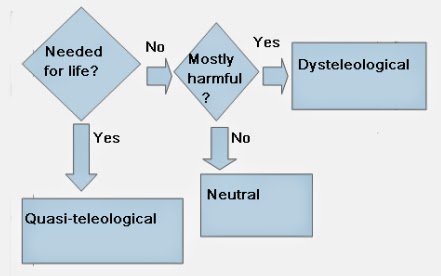
Making assessments of laws of nature based on incidental experiences such as this does not make any sense. What we need is an intelligent general-purpose algorithm for assessing whether a law of nature is quasi-teleological, neutral, or dysteleological. I propose the algorithm shown in the flowchart below.


The algorithm starts by asking: is the law of nature necessary (directly or indirectly) for the existence of living things such as ourselves? If the answer to question is “Yes,” the law is considered quasi-teleological, because it helps to achieve a good purpose (the purpose of allowing creatures such as us to exist). If the answer is “No,” the algorithm then asks whether the law of nature is mostly harmful in its effects. If the answer to that second question is “Yes,” the law of nature should be considered dysteleological (a law that serves a bad purpose). If the answer to that question is “No,” the law is considered to be neutral (meaning that it neither seems to serve a good purpose, nor seems to serve a bad purpose).

Let's try a simple example, and see whether the algorithm seems to make sense. Consider the case of the law of gravitation, the universal law of nature that there is a force of attraction between all massive bodies, directly proportional to the product of their masses, and inversely proportional to the square of the distance between them. Gravitation is (indirectly) absolutely necessary for the existence of living beings, because if it were not for gravitation we would have neither a planet to live on, nor a sun to produce warmth. So even though occasionally gravity produces deaths from falling, the fact that gravitation is absolutely necessary for planets decisively trumps all other considerations. It is therefore absolutely correct for us to consider gravitation as a quasi-teleological law. It serves the good purpose of allowing the existence of planets for living things to exist on. In this case the algorithm seems to steer us to the right answer.

Let us apply the same algorithm to other major laws of nature. Another major law of nature is Coulomb's law (the basic law of electromagnetism). This is the law that between all electrical charges there is a force of attraction or repulsion, directly proportional to the product of their charges, and inversely proportional to the square of the distance between them. It is true that very rarely this law helps to kill people in lightning strikes, but that fact is absolutely trumped by the fact that living things could not exist for even a minute without Coulomb's law. Electromagnetism is what makes chemistry possible, and without chemistry we would all instantly die. If you were to turn off Coulomb's law, our bodies would quickly disintegrate. So again, using the above algorithm, we must classify Coulomb's law as a quasi-teleological law, as it serves the good purpose of allowing the existence of biological organisms.

The table below shows a list of fundamental laws of nature. Most of the laws have commonly used names, but some very important laws do not have any common name, although they should have one. One of the most important laws is one I have designated below as the Law of the Five Allowed Stable Particles. This is simply the law that rather than producing hundreds or thousands of different types of stable particles from a high-energy particle collision, nature makes sure that only five types of stable particles result. Although not important now, the current arrangement of matter in the universe would be hopelessly different (in a very negative way) if such a law had not applied shortly after the Big Bang, when all the particles in the universe were colliding together at high speeds. You can say the same about the other conservation laws listed below.


All of these laws have one thing in common: for various reasons, all of them are necessary for the existence of life. In the case of the law of the strong nuclear force, the Pauli exclusion principle, and the law of electromagnetism, this is glaringly obvious, as we couldn't exist for even a minute if these laws didn't exist. In the case of the law of gravitation, it's almost as obvious that it is required for life, as gravitation is absolutely necessary for the existence of planets. In the case of the law of the conservation of baryon number, this college physics textbook says, “if it were not for the law of the conservation of baryon number, a proton could decay into a positron and a neutral pion.” If such a decay were possible, there wouldn't be any protons around by now, nor would there be any life.

In the case of the law of the conservation of charge, the law guarantees that electrons are stable particles that cannot decay into neutrinos, and thereby assures that we have a universe with plenty of the electrons needed for atoms and life. In the case of the laws of quantum mechanics, we have laws that restrict the states that electrons can take inside an atom, and thereby prevent electrons from falling into the nucleus of an atom (something they would otherwise have a strong tendency to do because of the very strong electromagnetic attraction between protons and electrons). 

As all of these laws are needed for life, we must characterize all of them as quasi-teleological. But other laws of nature should be classified as neutral, because they do not seem to have any bad effect nor any good effect. 

Although the modern materialist scientist may attempt to banish teleology from nature, such an attempt is not at all supported by his subject matter. The quasi-teleological nature of the main laws of nature present a huge problem for those who wish to believe in a capricious universe whose characteristics are the result of blind chance. Such people have not only the huge problem of explaining the universe's fine-tuned fundamental constants, but also the problem of explaining the universe's fine-tuned laws.

Sunday, January 4, 2015

Threading the Needle Holes of Cosmic Habitability

In the new book The Improbability Principle, mathematician David J. Hand looks at the issue of apparent cosmic fine-tuning, the many ways in which the universe seems to be tailor-made for the existence of intelligent beings such as us. Hand attempts to explain this away in keeping with his overall thesis that we should not be surprised when incredibly improbable things happen.

Hand looks at the fact that the existence of stars requires an exquisite balance between two of the fundamental forces of the universe, the gravitational force and the electromagnetic force. He suggests that thinking there is such a balance results from the mistake of considering that just one of the two has been fine-tuned to just the right value. When we consider the possibility of both varying, Hand suggests, then the situation is not so amazing. As Hand says on page 214-215 of his book:

We saw that changing the value of either one of these values would mean that the universe would not be suitable for life. But what if we changed them both? What if we increased the electromagnetic force a little, to match the increase in the gravitational force? Do this approximately, and the equilibrium within stars is maintained, so perhaps planets still form and life evolve. Fine-tuning, yes, but with much, much more scope for a pair of values which will lead to life than if the forces must separately take highly specific values.

Hand's reasoning is incorrect. When we have a case in which two fundamental constants of nature are exquisitely balanced, there is no greater likelihood that both will balance if we allow for the possibility of both of them varying. We can see this clearly by considering the case of the proton charge and the electron charge.

There is an exquisite and unexplained balance between the proton charge and the electron charge, in that all protons have a charge of exactly 1.602176565 X 10⁻¹⁹ coulomb, and all electrons have a charge of exactly -1.602176565 X 10⁻¹⁹ coulomb (which is quite amazing given that each proton has a mass 1836 times greater than the mass of each electron). As the astronomer Greenstein has pointed out, there are reasons why stars and planets would not be able to exist if the absolute value of the proton charge and the electron charge differed by even 1 part in 1,000,000,000,000,000,000. Since electromagnetism is a force more than a trillion trillion trillion times greater than the gravitational force, even a tiny change in either the proton charge or the electron charge would mean that electromagnetic effects acting on a large body would overwhelm gravitational effects, and gravitation would be insufficient to keep stars and planets together.

But suppose we imagine random changes in both the electron charge and the proton charge. Would that increase the probability of the two of them matching in the way that is necessary for stars and planets to hold together? No, it wouldn't. If we imagine both constants randomly changing, it is true that this would open up many new possibilities that might be compatible with the existence of stars and planets, such as one in which the proton charge was 3.378921 X 10⁻¹² coulomb and the electron charge was an exactly opposite value of -3.378921 X 10⁻¹² coulomb. But the overall likelihood of an exact match when both constants vary is not any greater than if one allows only one constant to vary.

Similarly, imagine I am playing a casino "million dollar jackpot" game of chance, and start with one random number between 1 and a million. To win, I have to get from the casino another number that matches the first number. If only the second number varies, the chance of success is 1 in a million. Now the casino employee may tell me: increase your chances by letting both numbers be random. But that's a fallacy – my chances of success will not be increased. The probability of getting a match if you start with one number and then get a random number is 1 in a million. The probability of getting a match if you get two random numbers is one million out of a trillion (because there are one million possible matches of two numbers between 1 and a million, and a trillion different possible combinations of two numbers between 1 and a million). But one million out of a trillion is a probability exactly the same as 1 in a million.

Hand then asks us to consider another possibility – that there may be some hidden reason why a change in one fundamental constant might cause a corresponding change in another very different fundamental constant. This might help to explain the exquisite balances within nature, Hand suggests. But this suggestion is an appeal to an imaginary possibility, and Hand provides no facts to back up such a suggestion. To the best of our knowledge, fundamental constants on which life depends (such as the speed of light, the gravitational constant, Planck's constant, the proton charge, and the electron charge) are entirely independent. There's no reason to think that having one such constant be compatible with life would increase the chance that other such constants would be compatible with life.

Hand tries to pass off his groundless imaginary idea as an example of what he calls the “law of the probability lever.” Similarly, if a husband had failed to save enough money for retirement, and his wife complained, the husband could imagine that fairies will give him a million dollars when he reaches the age of 62, and he might call such a fantasy “the law of the fairy contributions.” Imaginary concepts for which there is no factual basis should not be referred to as laws.

Hand then refers to a scientific paper in which one physicist claimed to show that it's not all that unlikely that stars should exist in random universes. Hand summarizes the paper by Adams as follows:

Fred C. Adams, of the Michigan Center for Theoretical Physics, investigated varying the gravitational constant, the fine-structure constant, and a constant determining nuclear reaction rates. He found that about a quarter of all possible triples of these three values led to stars which would maintain nuclear fusion – like the stars in our universe. As he said, “[We] conclude that universes with stars are not especially rare (contrary to previous claims).”

The previous claims Adams referred to are numerous claims made in the scientific literature along the lines that the chance is incredibly low of a random universe allowing stars like ours. There are some reasons why such claims were actually correct, and why Adams is wrong on this issue.

The first reason is that to have any stars at all you need to have a fine-tuning of not just the three constants Adams considered, but other constants he did not consider. For example, Adams completely fails to consider the very precise match between the proton charge and the electron charge needed for the stability of large bodies like planets and stars (previously discussed), a match that would not occur by chance in 1 in 1,000,000,000,000 universes in the parameter space he considers.

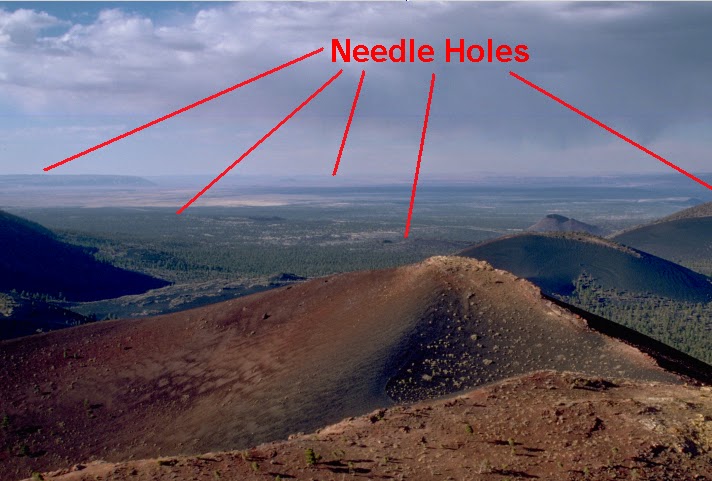
The second reason is that the real question is not the likelihood of some type of stars, but yellow stars like the sun, which offer better prospects for the evolution of intelligent life than other types of stars such as red dwarfs or blue giants. Scientists such as Paul Davies have concluded that very small changes in the fundamental constants would preclude the existence of stars like the sun. It's kind of like this: nature must thread one needle hole for there to exist some type of stars, but nature must thread a much tinier needle hole for there to be stars like the sun.

The third reason is that Adams is guilty of a fallacy that we might call the fallacy of the “ant near the needle hole.” Consider an ant that somehow wanders into your sewing kit. If it were smart enough to talk, the ant might look at the eye of a needle hole in your sewing kit, and say, “Wow, that's a big needle hole!” Such an observation will only be made if you have a perspective looking a few millimeters away from the needle hole.


Similarly, Adams has given us graphs in which his “camera” is placed a few millimeters from the needle hole that must be threaded for stars to exist. He has imagined a parameter space in which fundamental constants are merely tripled. But physicists routinely deal with a difference of 40 orders of magnitude (10,000,000,000,000,000,000,000,000,000,000,000,000,000), which, for example, is roughly the difference between the strength of the strong nuclear force and the gravitational force. So if we are imagining a parameter space of alternate universes, we must imagine a parameter space infinitely larger than the relatively microscopic parameter space Adams considered. Rather than just imagining a possible tripling of the fundamental constants Adams considers, we should imagine that any of them could vary by a trillion times or a quadrillion times or a quintillion times.

Taking that correct perspective, we can see how marvelous it was that nature managed to thread the needle holes necessary for our existence. You can visualize it this way. The parameter space is the vast Sahara desert. The needle holes that nature needed to thread for a habitable universe are in different random positions scattered throughout that vast desert. The likelihood of those needle holes being threaded successfully by chance is therefore infinitely smaller than the probability figure reached by Adams.

Thursday, January 1, 2015

Unwelcome Visitors: A Science Fiction Story

It happened with no warning, like a bolt out of the blue. One morning a UFO appeared in the sky over Washington, D.C. It moved to the center of the Ellipse, a huge expanse of grass near the White House. For one day it hovered in the sky at that spot. Then it slowly descended to the ground, and landed in the middle of the Ellipse. At the same time, astronomers noticed that a gigantic spaceship had started to orbit Earth. Pundits speculated that the small UFO had come from the much larger spaceship that orbited the planet.


The US military responded promptly. A ring of awesome firepower assembled around the perimeter of the Ellipse. It included Apache helicopters, M1 Abrams tanks, and companies of infantry armed with laser-guided missiles. The President of the United States walked the short distance from the White House to the Ellipse, to take charge of the situation.

Upon reaching the Ellipse, the President asked a general for a briefing.

“So what are these guys – friends or foes?” asked the President.

“We have no idea,” said General Holsen. “We've received no radio communication whatsoever.”

Finally a lone figure emerged out of the UFO, and stood next to it. It was rather clear that the visitor was expecting someone to walk toward the center of the Ellipse, so that a meeting could take place.

General Holsen suggested that an armed soldier walk up to greet the alien visitor, but the President would have none of it.

“I'm going out there myself,” said the President. “And I'm going alone.” The President knew that if he survived the meeting, he would be hailed for his courage, and it would help him win re-election.

The President walked slowly toward the center of the Ellipse. He saw next to the spaceship a figure about one meter larger than a man. The creature had a brain far larger than a man's. The extraterrestrial had huge blue eyes, a tiny slit for a nose, and a small mouth without lips.

“We come in peace,” said the alien. “We are here to welcome you into the galactic society of civilizations. Do not worry, our society abolished all traces of war 500,000 years ago, so there is no chance that we will harm you.”

“Welcome to our planet,” said the President. “We greet you as equals.”

“You greet us as equals?” said the alien, suppressing a giggle. “No, you've got it all wrong. You see our society is eons older and more advanced than yours. We come here to help you, like a human might help a little puppy lost on the street. And we come here to teach you a few great cosmic truths that your tiny little minds can understand. But almost all of what we have learned is far beyond the grasp of your minimal intelligence.”

“So your race is much smarter than ours?” asked the President.

“Yes, we are to you as you are to the bugs at your feet,” said the alien. “But don't worry, we can still teach you some tiny fraction of the mighty truths we have learned over the eons. But only if you give up all of your preconceptions, and sit down before us like a little child on its first day in kindergarten. If you do that, you can learn from us some of the greatest truths of the ages, secrets of time and space that took us many thousands of years to learn.”

“I understand exactly,” said the President. He walked away from the spaceship, and returned to the perimeter of the Ellipse.

“What happened?” asked General Holsen.

“They're invaders!” screamed the President. “Destroy them!”

The full military power of the mighty ring of weapons was unleashed on the UFO at the center of the Ellipse. All the M1 Abrams tanks fired their uranium-tipped shells All the Apache helicopters launched their Hellfire missiles. The soldiers launched their laser-guided missiles. The UFO was shattered into a thousand smoldering pieces. The damage was so great that biologists who later examined the wreckage were unable to find any trace of biological material that had not been burned to a cinder.

The large spaceship orbiting Earth then departed, never to be seen again.

The President was hailed as a hero, and won re-election in a landslide. The human race stumbled onward in its benighted ignorance.