Header 1

Our future, our universe, and other weighty topics


Friday, November 8, 2024

Did Their Trances Give Them Trips to Heaven?

Very many people are familiar with the typical account of a near-death experience. A person may have some close brush with death.  The person may report that he floated out of his body, or passed through some mysterious tunnel, or encountered a Being of Light. The person may report visiting some mystical or transcendent realm in which he saw a deceased relative or some religious figure. 

There are some old newspaper accounts suggesting that something similar may happen not during a close brush with death, but in a trance.  For example, there is the account below from 1897, discussing the experience of Tillie Faith:

trance trip to heaven

The account is from the old newspaper page below:

https://chroniclingamerica.loc.gov/lccn/sn86086632/1897-06-05/ed-1/seq-3/

There is also the account below from 1903 (click on the image to read it more clearly). The girl is apparently named Mary A. Kidder. 

trance trip to heaven

You can read the account on the newspaper page here:

https://chroniclingamerica.loc.gov/lccn/sn85042224/1903-11-27/ed-1/seq-9/

An account of the same person is told below. We get more details about how she reported learning things on her trance trips that she had not previously learned while awake, details that were later confirmed:

trance trip to heaven

You can read the full newspaper account below:


Below is another newspaper account of someone claiming to have visited heaven while in a trance. The witness is Lulu Mae Satterlae. 

trance visit to heaven

The link below shows the original page on which this account was published:

The image below gives part of a 1907 news story describing a teenager's accounts of visiting heaven during trances. The witness is Mae Mutchlar. 

trance visit to heaven

You can read the full story using the link below:


An 1868 newspaper account of a trip to heaven in a trance is below. We should keep in mind that we have no direct quotes from the young teenager, so when the author uses phrases such as "heaven," "hell" and "the Savior" we don't know whether such phrases were used by the woman herself. 

"The people living in the vicinity of Whiteland, Johnson county, have recently been very much excited over a matter which, to say the
least, is very strange. Several weeks since, Miss Van Arsdale, a young woman about seventeen years old, living at the house of a family near Whiteland, in the capacity of servant, was taken sick with something like hysterics. She had been confined to her bed a little over a week, when, to all appearances, she died. The body, however, did not entirely lose its warmth, and a very slight pulse remained. The people with whom she was living supposed that she was dead, and were making preparations to bury her, when the physician interfered, forbidding any such step. After remaining in this state twelve hours, consciousness returned, and the girl pronounced herself much better.

She then went on to describe her sensations and experiences during the trance, averring that she had visited heaven and hell, and had
conversed with the Savior, and many persons whom she had known on earth. She spoke of seeing persons in both places who had recently died; in heaven a young man named Quinn, who, although at one time a professor of religion, had, in the last year or two of his his, led a bad life; in hell the two men, Hatchell and Patterson, who were lynched at Franklin on the night of Oct. 31st, for the murder of
Lyons at Greenwood. Miss Van Arsdale sent for a number of persons in the neighborhood, and not only imparted to them news of lost
friends, but told of sins committed by them, supposed to be unknown by any one. 

Among others, was a man who had participated in the execution of the men named above. She told him that he had been there that night (which he acknowledged), and had in the sight of God committed murder. Previous to this, the names of the band had been kept a profound secret, and this man had not even been suspected. She narrated a good many tragic things, relating mainly to individuals both in this world and the other, many of which would have been almost impossible for her to have invented.

But the strangest part of the story is yet to come. A few hours after the expiration of the first trance, she predicted that she would have
another, and told to a minute the time at which it would commence and at which it would end. Everything turned out as she had
said; at the exact time she fell into the same state. In an ordinary trance, or cataleptic state, respiration is not suspended, but in this
case breathing could not be observed. She was, to all appearances, dead; but the pulse beat faintly, and the body was not cold. All
sensation was gone. The physician made numerous experiments, pricking the body, opening veins, and so forth, to discover if there
could be any deception. In the end he was perfectly convinced that there was none. At the expiration of the time set by herself, she
came to, and in a few hours was well enough to leave her bed and go about the house. The story of her experience, in the second trance,
was similar to the first one, and was confined almost wholly to individuals. She seemed unable to describe the places she had been in, but gave histories of events and persons with remarkable minuteness. She also said that she would never have a recurrence of the trance unless she should commit some flagrant sin;
her authority for this prediction was that the Lord himself had told her so. 

This is certainly a strange thing. The girl is uneducated, and has lived about as a servant ever since she was able to work. She has always borne a good character for truthfulness, and is a member of a church. She is almost the last person in the world to have manufactured such stories, and one thing especially noticeable is the fact of her sending for persons to whom, before her illness, she would have been afraid to have spoken, and conversing with them without the least restraint, and telling them stories and facts not the most palatable to worldly people. She was visited by a great many people, some of them eminently respectable, who vouch for many of the statements of her illness. The physician in attendance is positive as to her condition during the whole time ; and had it not been for him, she would have been buried alive."

The full account can be read using the link below:


The report below is from 1906, and the witness is Mrs. S. A. Griffin. 

trance trip

The account can be read on the newspaper page below:


Below we read a description of the trance experience of Sophie Fowler:

trance trip to heaven

You can read the account here. 


Monday, November 4, 2024

Elections Would Work Much Better If Things Worked Like This

We are near the end of another cycle in the very diseased system known as the American political system. Most of the winners in tomorrow's election will be those with the most money, the most insider cronies, and the most corporate connections. One can have little hope that this sick system will get better anytime soon. But perhaps one can have a little fun imagining this: how might elections work in some future republic (here or in another continent) with a much fairer political system? Below are some characteristics that such elections might have.

Characteristic 1: seats in Congress would be exactly proportional to population, so that any two areas of the republic with the same population would have the same degree of representation in the government.

The United States government does not have this characteristic. There are two houses of Congress, and in one of those houses (the Senate), each of the 50 U.S states elects two senators. But the tiny states of Rhode Island and Delaware each get to elect the same number of senators (two) as the huge states of California and Texas. And Wyoming (with a population of only about 584,000) has the same number of US senators (two) as each of the states of New York, Florida, California and Texas, which each has tens of millions of residents (using a rounded-up figure for New York).  

What this means is that under the US constitution, residents of California, New York, Florida and Texas are basically second-class citizens with a much lower degree of representation, and the residents of the low-population states Vermont, Wyoming and Alaska are specially privileged citizens with a higher degree of representation. Under the current US voting system, residents of the District of Columbia (the city of Washington D.C.) are effectively third-class citizens, because they do not get to vote for any US senator. Given the high black population in Washington D.C., this amounts to structural racism in the US voting system. 

Geographical Unit

Population (2023)

US Senators

Effective Status of Citizens, Given Their Influence on US Senate

California

38,965,193

2

3rd-class or 2nd-class citizens

Texas

30,503,301

2

3rd-class or 2nd-class citizens

Florida

22,610,073

2

2nd-class citizens

New York

19,571,216

2

2nd-class citizens

Wyoming

584,057

2

1st-class citizens

Vermont

647,464

2

1st-class citizens

Alaska

733,406

2

1st-class citizens

Washington, D.C.

678,972

0

3rd-class citizens

So let us imagine that in our future republic, there is only one house of Congress, and that congressional election districts are divided in such a way so that each has roughly the same population. This means that geographically speaking, each citizen of the republic gets equal representation in Congress.

underpowered voters

Characteristic 2: Congressional representatives would serve a single term of 4 years, with 50% of their terms expiring every two years.

The designers of the US constitution imagined that if congressional representatives in the House of Representatives did not look out for the average man, they would soon be tossed out by the voters. The founding fathers failed to anticipate our current political landscape, in which it typically happens that representatives who do not well serve the common man continue to be re-elected year after year, because they have spent much of their time in office courting crony connections and raising money from the rich and corporations.

The best way for a future republic to avoid this problem would be to limit every congressional representative to a single term. The whole concept of re-election would be abolished. Congressional representatives would focus on passing good laws, rather than spending half of their time doing things related to their re-election, such as seeking political donations from fat cats.

It might be argued that you need congressional representatives who have been around a long time, to help handle all the intricacies of legislation. But the fine details of government could be delegated to bureaucracies to keep things simple enough so that people recruited from other occupations could serve as congressional representatives. There is no reason why a Congress needs to be passing bills with thousands of pages, when most of these details can be decided by appointed bureaucrats. With a system under which half of Congress was replaced every two years, there would always be “old timers” around with two years experience, who could “show the ropes” to new representatives.

Characteristic 3: A system would exist making sure that Congress consisted of persons from each major occupation, with the makeup of Congress mirroring the number of people in those occupations. Such a system would issue people invitations to make a fully funded run for office for a single term, with the invitations being randomly generated by lottery from particular occupational classes.

The United States Congress has way too many lawyers and professional politicians. When almost all of its members are used to earning large incomes each year, one can hardly expect Congress to look after average people very well. One way to remedy that would be to have a system that guarantees that Congress consists of people drawn from the general public, with each major occupational class getting equal representation.

This could be accomplished by a system in which a lottery is used to issue invitations to make a fully funded run for Congress. The invitations would be issued in such a way so that major occupational classes got an equal number of invitations. For example, if 10% of the people in the republic were information workers, then 10% of the invitations issued would go to information workers; and if 5% of the people in the republic were farmers, then 5% of the invitations would go to farmers. The invitation system and funding would be paid for by taxes.

Under this invitation system, you might, for example, be working as a restaurant chef, and you might one day be surprised to get an official government invitation inviting you to make a fully funded run for Congress. You would be told that your name had been randomly selected from a list of those in your occupation. You would know that there would be only a few other competitors for the congressional seat you could run for, because only a few other people would get such an invitation to run for that particular congressional seat.

The invitations issued would be adjusted so that the population of Congress always mirrored the occupational background of the general republic. So, for example, if 5% of the population were farmers, and farmers tended to lose elections or decline an invitation to make a fully funded run for Congress, then there would be a temporary increase in the number of invitations to farmers to make a fully funded run for Congress (so in one year the number of invitations might exceed their percentage in the population). Eventually things would balance out, and Congress would well reflect the occupational percentages of the general public.

The best result of this system would be that Congress would be made up almost entirely of the common people, and would be far more likely to pass laws favoring the common people. This would be a great improvement over our current system of government of the rich, by the rich, and for the rich.

Some will say: come on, you couldn't have a system in which crucial decisions on people's futures are made by randomly selected citizens from all walks of life. But we already have one such system which works well: the jury system.

Characteristic 4: Instead of the current system where there is rarely more than 2 viable candidates for an office, there would be 5 fully-funded randomly selected candidates for each congressional seat.

How many times have you anticipated voting, and thought to yourself: none of the above. This problem could be partially eliminated by a system like the one described previously, a system that would guarantee that there would be five fully funded candidates for each Congressional seat.

Assuming that half of the people are conservative, and half are liberal, a random lottery invitation system would have only about 1 chance in 32 of producing a slate of all liberals or all conservatives in a particular voting district. This would probably be better than under the current system, where your odds of having no real choice in a particular congressional district is probably greater than 1 in 32 (since so many Democrats are barely distinguishable from Republicans, and many seats are uncontested).

Characteristic 5: Only those who had received the randomly generated invitations could run for Congress.

Under such a rule, it would not be possible for a rich ambitious person to appear on the ballot for Congress because he had used his own funds to gather a sufficient number of signatures supporting his candidacy. There would be no way for the rich to buy their way into Congress.

Characteristic 6: There would be an “instant runoff” system of voting wherein you list a first, second, and third choice.

Our current system of voting creates many strange paradoxes, and the evil of “strategic voting,” in which you often end up voting for someone other than the person you prefer most. In a race with three contestants, when going to vote, you may favor candidate X; but you may worry that if you vote for candidate X you will help throw the election to candidate Y (who is in a tight battle with candidate Z, who you like a little more than Candidate Y). So you end up voting for candidate Z, who is not really the person you want to win. Such strange effects can be eliminated by an “instant runoff” system in which you specify a first choice, a second choice, and a third choice. In this case you would specify candidate X as your first choice, and candidate Z as your second choice. You would not worry that your vote would have the effect of being a vote for candidate Y, because under the instant runoff system if candidate X loses, you have not enhanced the chances of candidate Y winning.
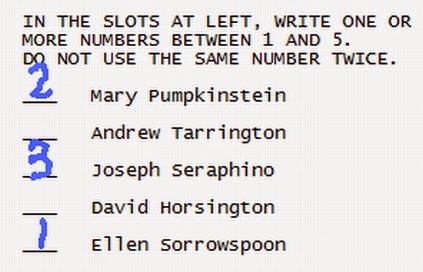
An "instant runoff" ballot for voting

Characteristic 7: A president of the republic would be directly elected, without anything like the electoral college.

The “instant runoff” system would be used to elect a president of the republic, with the winner being whoever got the most total points. By avoiding any electoral college system, there would be no possibility of any candidate losing the election to another candidate who got more popular support, due to some electoral fluke such as occurred in 2000 when Gore lost to Bush even though Gore got more votes nationwide.
The same thing happened in the year 2016, when Hillary Clinton got more votes, but lost to Donald Trump, who got fewer votes. 

Characteristic 8: Anyone would be able to vote without any prior registration.

It is absurd that under our current system people are barred from voting because they didn't remember to register weeks earlier. Such a system effectively rules out significant fractions of the populations from voting. There will always be maybe 10% of the population that will be procrastinators who will tend to put off doing things until "the last minute," and such people should not be disqualified from voting. 

It is easy to imagine advanced technology that could make this possible. There could, for example, be a retina scanner or fingerprint scanner that would upload to a national database. If anyone tried to vote twice on the same day, a computerized system would immediately prevent the second attempt to vote. Simple systems are used in other countries to prevent anyone from voting twice, such as applying a thumb dye on each voter's thumb, one that wears off after a few days.  

Characteristic 9: The voting age would be lowered to age 16.

We currently put our lives (and the lives of our children) in the hands of teenagers of age 16, by allowing them to get driver's licenses. But we do not allow the same people to merely vote. Anyone old enough to drive is old enough to vote.

Characteristic 10: Political contributions by corporations would be forbidden, and contributions by individuals would be limited to a small amount.

To prevent corporations from having influence over elections to favor their selfish ends, in our fairer future republic it would be illegal for a corporation to make contributions to anyone's election campaign. There would also be a limit on how much any individual could contribute during a particular election, a limit such as 500 dollars. This would prevent rich people from heavily influencing elections for the sake of their own selfish ends.

-----

Some of the characteristics described above could be achieved by simple amendments to the US constitution. Changing things so that there is only one house in Congress rather than two would  require a major rewrite of the US constitution. An alternative to such a large change would be a simple constitutional amendment having changes such as these:
  • Reduce by 1 the number of US senators in each state with fewer than 1.5 million residents, so that  Wyoming, Vermont, Alaska,  North Dakota, South Dakota, Delaware, Montana, Rhode Island, Maine, New Hampshire and Hawaii each has only 1 US senator.
  • Give a single senator to the District of Columbia (Washington D.C.).
  • Change the constitution so that California has 6 senators, Texas has 5 senators, and New York and Florida each has 4 senators.  
This would leave you with a US senate with 101 senators, only one more than the current total.  With such a change states such as California, Texas and New York would still have smaller senate representation per 5 million citizens than in quite a few other US states. But at least you would greatly reduce the "2nd class citizen" effect in which you have ridiculous injustices such as we now have, where a state with 39 million people (California) sends to the US senate only the same number of senators (2) as states with a population of less than 700,000 (Wyoming and Vermont).  

Thursday, October 31, 2024

Skeptics of the Paranormal Masquerade as Serious Scholars of the Spooky

Tonight, October 31, is Halloween, a night for masquerades.  Little girls are dressing up as princesses and little boys are dressing up as superheroes. We also see the masquerade of skeptics that always appears around Halloween, when we see a bunch of stories online with titles such as "Why Your Brain Causes You to Believe in Ghosts" and "How Your Brain Causes You to Hallucinate a Ghost."  When they author such stories, denialist skeptics masquerade as serious scholars of the paranormal, and they masquerade as people who understand some neural basis for belief or some neural basis for hallucinations in normal people. 

scientist pretending to know things he does not

In general, our skeptics are not apparition scholars, and are not scholars of human observations of the paranormal or human reports of the anomalous. The literature on human reports of the paranormal is a vast body of literature consisting of so many books and publications you would need a large public library to hold all the books and publications.  In general our skeptics show no sign of having read any such books, other than a few books written by fellow skeptics. They do not busy themselves reading the classic observational reports of apparition sightings. They do not study the countless volumes of the Journal of the Society for Psychical Research or the Proceedings of the Society for Psychical Research, even though such volumes can be very conveniently obtained online at sites such as www.archive.org or this site.  They show no signs of having read any of the fifty main works on the paranormal that a serious scholar should read before writing about it (such as books listed here). 

But in their articles appearing around Halloween in which they attempt to debunk apparition sightings, our skeptics try to masquerade as scholars of the paranormal.  We can tell they are no such thing by their lack of references to the relevant scholarly and observational literature. We can also tell their lack of scholarship on such topics by their incorrect generalizations about apparition sightings. 

A skeptic describing an apparition sighting will tell us all kinds of imaginative narratives that do not match the observational characteristics of apparition sightings.  He may say that you went to some spooky house and got scared, and that fear caused you to hallucinate seeing a ghost. Or he may say that you were filled with grief, so your brain caused you to see the ghost of some person you wanted to believe has survived.  He will not typically provide narrative examples of such cases, because there are so few of them. 

What our skeptic will not tell you about is a type of apparition sighting far more common, that he cannot explain.  In this type of apparition sighting, a person who is in a completely normal state of mind will suddenly be surprised to see an apparition of someone he did not know was dead or even close to death; and will then soon learn that the same person died about the same time the apparition was seen.  There are hundreds of cases of such apparitions, which you can read about in my posts below.

n Apparition Was Their Death Notice

25 Who Were "Ghost-Told" of a Death

25 More Who Were "Ghost-Told" of a Death


Our skeptic will typically not know about such cases, because he is not actually a scholar of human reports of the paranormal, but merely masquerades as such a thing. Another very common type of apparition sighting is when the same apparition is seen by multiple observers.  Examples can be found in the posts below:

Because he has not actually made a scholarly study of apparition reports, our skeptic will continue to advance his lame "fear or grief causes hallucinations" theory, even though such a theory totally fails to explain any of the more interesting reports of apparition sightings,  which occur to people when they are not afraid or grieving, and often involves more than one observer seeing the same apparition, which could never happen from brain hallucinations.  Our skeptic will not cite any scientific experiments supporting his theory, because it is a fantasy without experimental support. 

If there was some tendency for people to hallucinate when they were afraid or grieving, it would be very easy to prove such a thing with experiments. For example, you could test 100 subjects with an experiment in which you told them something terrifying, such as that a tornado or earthquake will soon strike the building they are in.  Then ask such people to describe what they saw, to see how many of them hallucinated. Or you could tell 100 subjects a lie that some beloved figure or one of their relatives had died.  Then ask about their observations, to see how many of them hallucinated from grief. Of course, there are no experiments supporting the fanciful notion that fear or grief causes hallucinations of apparitions. And there are almost no reports of apparitions seen at funerals, the meetings where you have the greatest concentration of grieving people. 

Besides masquerading as scholars of the paranormal, our skeptical writers of Halloween stories about apparitions will engage in other types of masquerades.  They will masquerade as people who understand some neural basis why normal people would hallucinate seeing human forms. No one understands any neural basis of why a normal person would report seeing a human form in front of him that was not there.  Or, our skeptic may masquerade as someone who understands some neural basis for belief.  No one has any real understanding of how a brain could create an idea or form a belief or store a belief.  Just as no one can give a credible explanation of how a brain or neurons could either store a memory or remember something for decades or instantly retrieve a memory,  no one can give a credible explanation of how a brain or neurons could derive or deduce a belief or preserve a belief or store a belief.  So when skeptics write articles with titles such as "Why Your Brain Causes You to Believe in the Paranormal," they are masquerading as people who know something they do not know.  No one can explain why your neurons or your brain could ever handle any such thing as forming a belief or having a neural representation of a belief or preserving a belief; but we do know a little about why some people may think they understand things that are a hundred miles over their heads.  It has to do with the fact that the mind can take pleasure from such intoxicating but groundless conceits.

When someone imagines that there are memory traces in your brain of the sensations you had years ago, he is at least suggesting an idea based a tiny bit on reality (the reality of you having such sensations long ago); but it is an idea ignoring the neural reality of short protein lifetimes that should prevent any such traces from surviving for more than a few months (the brain replaces its proteins at a rate of about 3% per day).  But the idea of beliefs stored in brains is not based on any neural reality. If I one day think to myself, "If there came to our planet lizard men from outer space, they would be evil," and then that thought becomes a belief in my mind, this is nothing based on any neural reality, since I have never even had a sensation of lizard men. If there were any neuroscience understanding of how a belief could be stored in a brain, we would sometimes read very concerned writers talking about the grave danger of some government or neurologist changing your beliefs or political views or religion by doing something to your brain or giving you some pill.  We read no such stories.  

The complete lack of any understanding of how a brain could store a belief is shown by the fact that there is not even a word for the concept of a place where a brain stores a belief. There is a word ("engram") for the dubious claim of a neural storage place of a memory, but there is not even a word in neuroscience literature for an alleged neural storage place for a belief.  The lack of such a word is Exhibit A that there is no real scientific basis for the claim that brains store beliefs. 

Almost inevitably when we read the Halloween season articles of skeptics, we get the most glaring evidence of people who never did their homework and never made a decent study of the evidence for paranormal phenomena. Misstatements and extremely false opposite-of-the-truth generalizations are extremely common in such articles. Such people keep telling the same lies over and over again.  Any serious scholar of the paranormal will very quickly recognize that the writers of such Halloween-season articles have never seriously studied what they are writing about. But for such writers of these "preaching to the congregation" articles that doesn't matter, because their target audience is other people who won't complain, because their knowledge of such matters is equally poor. 

scientist ignoring evidence

Tending to present themselves as Kings of Knowledge, the experts quoted in these Halloween articles about the paranormal are typically neither serious and thorough students of human minds and human mental phenomena nor serious and thorough students of the human brain and its physical shortfalls that discredit all claims that it is the source of the human mind. Were they to do a better job of studying human brains, they would not make some of the statements they make. 

We can use the term materialism fundamentalist to refer to the type of professors and skeptics who are interviewed around Halloween on the topic of the paranormal, and the type of professors and skeptics who write articles on the paranormal around Halloween.  The materialism  fundamentalist will keep telling us that there is no evidence for the paranormal, despite the existence of a vast mountain of two hundred years of convincing written evidence for the reality of paranormal phenomena, very much of it written by doctors and scientists. By showing such total denialism, the materialist fundamentalist is very much like a Bible fundamentalist who claims that there is no evidence that our planet is older than about 6000 years. The materialist fundamentalist will often make use of the worst type of gaslighting and character assassination to try to shame, blame and defame credible honest witnesses. Materialism fundamentalists are among the most evidence-oblivious of denialists, and no amount of evidence that could ever appear (nor any testimony of their own senses) would ever shake their dogmatic convictions.  

oath of a skeptic

For some insight into the attitudes and tendencies of such skeptics, you may read my 2022 science fiction story "Planet of the Blind" here. It's an interesting tale about a man on a planet in which almost everyone is blind. The man is asked to investigate controversial reports that a small number of people have what the man thinks is something utterly impossible: an ability to perceive things by some "fifth sense" that is different from smell, taste, hearing or touch. 

Sunday, October 27, 2024

When "Spirt Writings" Show an Impressive Prowess (Part 3)

 In Part 1 and Part 2 of this series, I examined some cases of claimed "spirit writings" which seemed to show great skill beyond any we would expect from those that put the words down on paper. Since writing these parts of the series, I have become aware of another impressive case of this type: the case of Etta de Camp. I first became aware of Etta de Camp when reading the 1909 newspaper story below:

The story can be read in full using the link below:

https://chroniclingamerica.loc.gov/lccn/sn85066387/1909-08-22/ed-1/seq-7/

The newspaper tells us that Etta de Camp was a business woman who one day tried her hand at automatic writing. A person trying to achieve automatic writing holds a pen or pencil in the hand, next to a sheet of paper, and tries to relax, to see whether the hand might produce some writing that did not seem to be willed by the person.  Trying such a thing, Etta felt an unusual sensation. After producing pages with meaningless scrawls, she began to get intelligible words, and the writing became more coherent. 

On the page here, Etta tells the story of how her attempt at automatic writing began. She says that she started to get more intelligible words after asking whether a spirit was present:

"The third night when I sat again and the hand began to write in the same way, I said aloud: 'If there is a spirit here who would like to communicate with me he must write more legibly.' After that I began to distinguish such words as 'and,' 'the,' 'farm,' etc., and the writing soon became readable and expressed thought. I received messages from one who claimed to be an Indian called 'Blackfoot.' Then messages came from one signing himself 'Lafayette,' whether the well-known Lafayette or another I do not know. For a time I received many messages from another Indian who signed the name, 'Three Feathers.' "

Etta claims this then occurred:

"During the first part of March, I received several messages from my father who had passed away twelve years before. These messages were all to my mother, and concerned many things of which I knew nothing whatever, being absent from home when the events occurred. Later, they were all corroborated by my mother as being true."

Etta claims this then occurred:

"Then the handwriting changed and this was written: 'I am Frank R. Stockton. I have many stories I wish written out. I am glad I can write them through you. I have one I wish to write called 'What Did I Do with My Wife?' We will go on with it now."

Etta later states this about her automatic writing experience:

"When I lay the pencil down all connection is cut off, the same as when one hangs up the receiver of a telephone, and not one word, line or even the names of the stories come to me in any way until the work is again taken up. A remarkable feature of the stories is that during the writing, although days, weeks and even months have passed between the sittings, the pencil has never failed to continue the story without a break, as if no time had intervened."

In the newspaper story above, we have an example of one of the stories arising from such activity, a story which Etta says came from the deceased Frank R. Stockton. It's a pretty good story about a doctor who discovers a collapsed man outside, and begins going through the man's pockets, trying to find some address that the man might be taken to. In the story the man is arrested as a thief, and suffers legal troubles despite having acted only to assist the collapsed man. Frank R. Stockton is known to have been a story writer, and was the writer of the well-known story, "The Lady or the Tiger?" 

Below is a cover illustration of the stories produced under such activity, one depicting Stockton as guiding the writings of Etta:

The book of stories transcribed by Etta supposedly through the spirit inspiration of Frank R. Stockton includes the interesting story "What Became of the Ghost of Mike O'Flynn?" It tells a tale of observations by the disembodied spirit of Mike O'Flynn after his physical death. Below is an excerpt:

"As the carriages drove up and deposited their occupants beside the grave, Mike's ghost, which still stood holding fast to the gates-ajar, had a fine view of the ceremonies from the floral-laden carriage. The first sight of the open grave made him gasp with terror, but this quickly changed to joy as he realized that he did not have to go into the grave with the body which now reposed upon the ground, in the fine mahogany casket. As the words of the burial service fell from the lips of the priest, Mike's ghost for the first time began to feel solemn, and the tears rolled down his cheeks as the casket was lowered reverently into the grave....His feeling of sorrow for his poor old body made the ghost of Mike deaf to the sound of weeping from his mourning family, so he did not get down from his seat to go and comfort them, but remained where he was, lost in thought. He was lifted down with the gates-ajar and placed at the head of the grave, where he adjusted himself comfortably with his back against a tree, his legs crossed and again quickly lapsed into memories of the past. So deep in the reverie was the ghost of Mike that he failed to notice the departure of the funeral entourage. Finally, arousing himself, he realized, with a shudder, that he was alone with the dead and he shivered as he gazed about at the monuments and graves."

The story includes much speech coming from the ghost of Mike, which is written in a thick Scottish brogue. The representation of how a Scotsman might speak is skillful. It's the kind of writing we would not expect from an American such as Etta.

Another story in the book is a long and very interesting fantasy tale entitled "The Widow He Lost." In the tale a journalist named John Blackstone visits ruins at Rome. Ignoring a sign telling him not to proceed any further, he discovers the ruins of some ancient palace. Exploring about, Blackstone is amazed to find some glorious palace inhabited by a Queen and her royal entourage. We read this passage, in which the lowly John gets himself out of trouble by pretending to be a visiting king :

" 'From what strange planet didst thou drop, sir, and how dared thou seat thyself upon my throne?' exclaimed the Queen, haughtily.

To his great joy, Blackstone realized the Queen was addressing him in his own tongue though with a strange arrangement of speech, and a brilliant idea flashed through his brain. He resolved to use it, together with all the wit he had inherited from an Irish mother, in order to save his head from the spears held so dangerously close that he dared not move for fear of being thrust through the neck.

' If it please Your Gracious Majesty to listen to my tale, I will explain, that, being a king in my own country, the sight of your throne made my heart glad, and, being somewhat weary with my long journey, I seated myself without the formality of announcement, for there seemed to be no one about at the time.' " 

Later in the tale Blackstone eloquently describes his homeland to the Queen who apparently knows nothing of it:

" 'I am about to relate a strange tale, fair Queen, and ask Your Gracious Majesty to pardon me if I consume much time in telling it. Many, many leagues away, too far for the falcon to go and return in one day, is a beautiful island of the sea. To the north the snow flies, to the south the sun shines brightly most of the year. Both parts are good for your health at different seasons, providing you do not have to live in either one of them all the year around. In the centre, or between the north and the south, is a country designed by the gods, called England, and in that country a city is built for the favorites of the gods. The city is named London, and is filled with strong, brave men. and maidens with hair of gold, cheeks like the wild-rose, eyes like bits of blue sky, and skin of milky whiteness...Now, in this town, called London, are buildings of wondrous size and castles whose towers reach far upward to the sky. Among these many castles, built by the people for their lords, is one called the British Museum, and in this castle I live, for I am the King, and it is my home. See, here is a picture of it and my credentials, as well.'  And Blackstone took from his pocket a letter with a large seal, and having a picture of the Museum at the head of the page, the seal and signature at the bottom, so that it looked imposing enough for a king." 

On and on the story goes for many pages, telling a well-crafted narrative. Around page 243 and the following pages we get some real character development and pathos, as the Queen (a widow) starts to tell of her attraction to Blackstone, and her pining for some love that might take her beyond her lonely life fulfilling royal duties. Blackstone asks the Queen whether she wants to go to England to see its glories, and the Queen agrees. The story is then neatly wrapped up as an earthquake strikes, leaving Blackstone surrounded by ruins. He is later recovered by a searching party. 

All in all, the roughly 64 pages of "The Widow He Lost" (basically a novella) makes a fine work of romantic fantasy, one that is a very unified and coherent literary work, something much greater than we would expect to appear as some emanation from the subconscious of Etta de Camp. It is therefore not very hard to believe Etta's claim that the story came from the late great story teller Frank R. Stockton.