Scientists like to make various types of big boasts about their knowledge of things, such as the boast that they understand the basics of how the human species appeared. But various types of unsolved problems act as antagonists to such boasts. It's kind of like this:
Scientist: I understand how life originated.
Boast antagonist problems: No, you sure as hell do not.
Scientist: I understand how a human mind arises.
Boast antagonist problems: No, you sure as hell do not.
Scientist: I understand how the human species arose.
Boast antagonist problems: No, you sure as hell do not.
In regard to the origin of life, the boast antagonist problems include the problems of the origin of DNA, the origin of the genetic code, the origin of genes, the origin of the first protein molecules, and the origin of homochirality. In regard to the origin of large organisms, the boast antagonist problems include the problems of the origin of eukaryotic cells, the origin of most of the proteins used by mammals, the origin of protein complexes, the origin of multicellular life and the origin of bipedalism. In regard to the origin of man, the boast antagonist problems include the problems of explaining morphogenesis, the origin of language, the origin of higher abstract reasoning, and the problems of explaining instantaneous memory creation, instant memory recall and the persistence of memories for 50 years.
There are different ways scientists can act when faced with such boast antagonist problems. A healthy response to such problems is to spend great amounts of time trying to resolve them. Another healthy response to such problems is to modify and restrain your boasts of knowing grand things, on the basis that there are too many related unsolved problems for you to make such boasts. An unhealthy response to such boast antagonist problems is to pretty much ignore them, to mention them as little as possible, and to hope that people don't pay attention to them. There is a reason for thinking that scientists are largely guilty of this type of unhealthy response. The reason I refer to is that when we search for US federal funding for research on these boast antagonist problems, we find that some of the biggest of these problems are getting scant research.
The web page here allows you to search grants that have been approved by the National Science Foundation:
If you type in "cancer" as the search string, and press the Search button, you will get 750 results. The number of results is not directly listed. But by multiplying the part of the page showing results per page by the part of the page showing how many pages of results were returned, you can figure out the total number of results. For example, in the search result below, we have 30 results per page, and 25 pages of results. So apparently there are about 750 National Science Foundation projects that have some involvement with cancer:
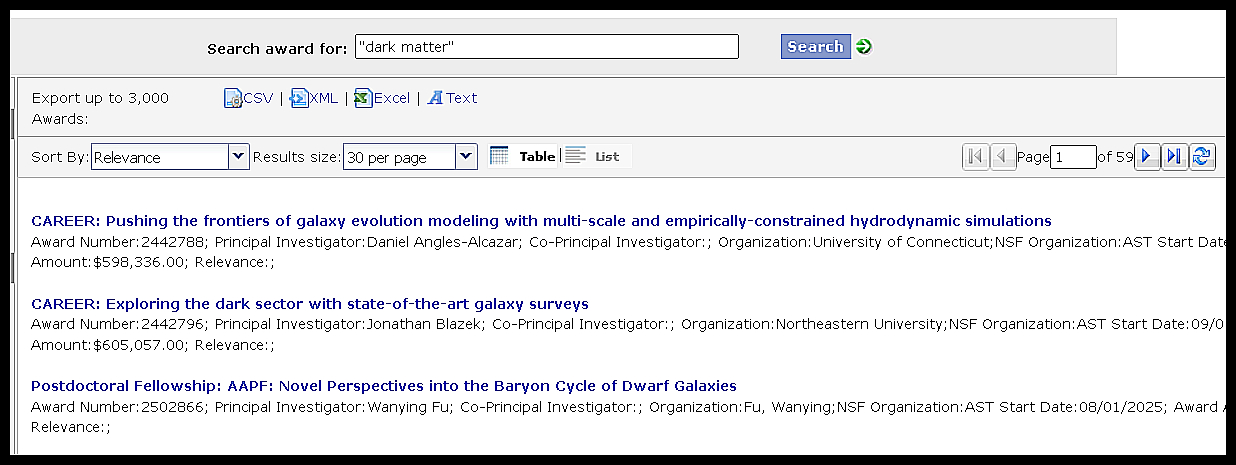
You can also find a huge number of research results searching for topics that have no practical value. Below is what the search term "dark matter" produces:
We get 55 pages of results, with 30 results per page, giving a total of something like 1650 federally funded projects relating to dark matter. That's an amazing result, given that dark matter has never even been directly observed; and we don't even know if it exists.
Now, let's try a different search. We will look for funded research projects relating to the origin of protein molecules. The problem of the origin of protein molecules is one of the boast antagonist problems I referred to above. Inside each human body there are more than 20,000 different types of protein molecules, each a different type of complex invention requiring a very special arrangement of thousands of atoms. Scientists lack any credible theory for the origin of protein molecules.
Protein molecules require very special arrangements of amino acids as hard-to-achieve by chance as it is hard for ink splashes to produce useful functional paragraphs. Because protein molecules are in general very sensitive to small changes, with their functionality typically being broken if you change only 10% or less of their amino acids, protein molecules have very high organization thresholds for them to be functional, meaning that they are not credibly explained by gradualist ideas such as Darwinism. The difficulties in explaining the origin of protein molecules is one of the biggest reasons for rejecting boasts that biological origins are successfully explained by ideas of Darwinian evolution. The issue is discussed at much greater length here and here.
Below is the result I get when I search for the phrases "origin of protein molecules" and "origin of proteins" and "origin of protein" using the National Science Foundation grant query tool (the visual combines three different search results):
The search for research projects using the term "origin of protein molecules" produced no results. The search for research projects using the term "origin of proteins" produced no results. The search for research projects using the term "origin of protein" produced only two results. Both of those results were projects related to Alzheimer's disease, neither of which had anything to do with explaining the origin of any protein molecule.
There's another way we can search for research projects related to the origin of protein molecules. We can search using terms such as "origin of genes" and "origin of gene." Each type of protein molecule has its amino acid sequence specified by a particular type of gene. So research into the origin of genes is pretty much equivalent to research on the origin of proteins.
Below is the result I get when I search for the phrases "origin of genes" and "origin of gene" using the NSF grant query tool:
The results are extremely scanty. A search for the phrase "origin of genes" produced only one result, and it is a project completed in the year 2000. A search for the phrase "origin of gene" produced only four results. The first result is a project that ended in 2023. The other three results are all projects that ended in the year 2007.
Another topic related to the origin of genes and proteins is the origin of the genetic code. The genetic code is the system of representation used by genes, in which certain combinations of nucleotide base pairs stand for certain types of amino acids. This system of representations is shown below:
A search for the phrase "origin of the genetic code" on the NSF grant query tool produces only the three results shown below:
All of these projects have already been completed.
Another of the boast antagonist problems I mentioned was the origin of protein complexes. Most or a large fraction of all proteins seem to be useless when acting alone. Most or a large fraction of all proteins only become functional when they act as team members within groups of proteins called protein complexes. Why such protein complexes arise so conveniently in the body is a major unsolved problem of biology. Below are some relevant quotes:
- "The majority of cellular proteins function as subunits in larger protein complexes. However, very little is known about how protein complexes form in vivo." Duncan and Mata, "Widespread Cotranslational Formation of Protein Complexes," 2011.
- "While the occurrence of multiprotein assemblies is ubiquitous, the understanding of pathways that dictate the formation of quaternary structure remains enigmatic." -- Two scientists (link).
- "A general theoretical framework to understand protein complex formation and usage is still lacking." -- Two scientists, 2019 (link).
- "Most proteins associate into multimeric complexes with specific architectures, which often have functional properties like cooperative ligand binding or allosteric regulation. No detailed knowledge is available about how any multimer and its functions arose during historical evolution." -- Ten scientists, 2020 (link).
- "Protein assemblies are at the basis of numerous biological machines by performing actions that none of the individual proteins would be able to do. There are thousands, perhaps millions of different types and states of proteins in a living organism, and the number of possible interactions between them is enormous...The strong synergy within the protein complex makes it irreducible to an incremental process. They are rather to be acknowledged as fine-tuned initial conditions of the constituting protein sequences. These structures are biological examples of nano-engineering that surpass anything human engineers have created. Such systems pose a serious challenge to a Darwinian account of evolution, since irreducibly complex systems have no direct series of selectable intermediates, and in addition, as we saw in Section 4.1, each module (protein) is of low probability by itself." -- Steinar Thorvaldsen and Ola Hössjerm, "Using statistical methods to model the fine-tuning of molecular machines and systems," Journal of Theoretical Biology.
Below is the result we get using the phrase "origin of protein complexes" on the NSF grant query tool:
The query produces no results. If you change the query to "formation of protein complexes," you will get only five results, all referring to projects already completed. None of those projects generally addressed the problem of how protein complexes form.
The queries above suggest that scientists almost have given up on trying to explain the origin of genes, protein molecules and the genetic code, and that scientists have almost given up on trying to explain the formation of protein complexes. The problems of trying to explain the origin of such things are some of the biggest unsolved problems in science. But as long as you stay chained to the ball and chains of Darwinism and materialism, there is basically no hope of making progress on such problems. So rather than giving us continued demonstrations of how bad a job Darwinism does at explaining the origin of genes, proteins and the genetic code, scientists seem to be taking a kind of "hands off" approach to such problems, hoping that people won't notice their gigantic failure to credibly explain such things.
By their failure to "put two and two together" in realizing the implications of their failure to credibly explain the origin of protein molecules, genes, protein complexes, the genetic code and homochirality, today's biologists remind me of Lois Lane in the Superman comic books, TV shows and movies. I am currently watching on HBO Max reruns of the TV series "Lois and Clark: The New Adventures of Superman." The series has excellent romantic chemistry between Superman/Clark Kent (very well-played by Dean Cain) and Lois Lane (very well played with comic flair by Teri Hatcher).
In the series Lois Lane is a bright woman, but when it comes to figuring out Superman's secret identity (that Superman is really Clark Kent), Lois just cannot put two and two together (to use an English expression meaning to reach a very obvious conclusion). Lois frequently sees Superman right next to her, and every day she sees Clark Kent, who looks and talks exactly like Superman, the only difference being that Clark Kent wears glasses. Also, Lois never sees Superman and Clark Kent together. And it seems that in half of the episodes, whenever some danger arises when Lois and Clark are together, Clark suddenly disappears and Superman suddenly appears to save the day. Figuring out that Superman must be Clark Kent is just a matter of putting two and two together, but Lois just cannot bring herself to do that. Similarly, faced with a biosphere in which all the big organisms look as well-designed and precisely fine-tuned and information-rich and well-organized as anything could look, our biologists just cannot bring themselves to put two and two together and reach the obvious conclusion that follows from such realities.