Header 1

Our future, our universe, and other weighty topics


Friday, February 7, 2020

Supersymmetry is the Standard Model's Wastrel Brother

Online at Symmetry magazine there is a new article that rather clearly explains one of the biggest cases of cosmic fine-tuning: the fine-tuning of the Higgs mass. Thankfully the magazine has corrected the original version of the article, which gave people wrong ideas by failing to use superscripts in some crucial places.

The issue of the fine-tuning of the Higgs mass (the mass of the Higgs boson) was skillfully explained by physicist Ben Allanach in a previous article at the Aeon site: 

"Behind the question of mass, an even bigger and uglier problem was lurking in the background of the Standard Model: why is the Higgs boson so light? In experiments it weighed in at 125 times the mass of a proton. But calculations using the theory implied that it should be much bigger – roughly ten million billion times bigger, in fact....Quantum fluctuations of ultra-heavy particle pairs should have a profound effect on the Higgs boson, whose mass is very sensitive to them....One logical option is that nature has chosen the initial value of the Higgs boson mass to precisely offset these quantum fluctuations, to an accuracy of one in 1016. However, that possibility seems remote at best, because the initial value and the quantum fluctuation have nothing to do with each other. It would be akin to dropping a sharp pencil onto a table and having it land exactly upright, balanced on its point. In physics terms, the configuration of the pencil is unnatural or fine-tuned. Just as the movement of air or tiny vibrations should make the pencil fall over, the mass of the Higgs shouldn’t be so perfectly calibrated that it has the ability to cancel out quantum fluctuations. However, instead of an uncanny correspondence, maybe the naturalness problem with the Higgs boson could be explained away by a new, more foundational theory: supersymmetry."

In the new article in Symmetry magazine, we have a similar explanation:

"To understand what’s fishy about the observable Higgs mass being so low, first you must know that it is actually the sum of two inputs: the bare Higgs mass (which we don’t know) plus contributions from all the other Standard Model particles, contributions collectively known as “quantum corrections.” The second number in the equation is an enormous negative, coming in around minus 1018 GeV. Compared to that, the result of the equation, 125 GeV, is extremely small, close to zero. That means the first number, the bare Higgs mass, must be almost the opposite, to so nearly cancel it out. To some physicists, this is an unacceptably strange coincidence."

How big a coincidence? The Symmetry article later quotes physicist Lawrence Lee Jr. as saying “the conundrum with the Higgs mass, which would require fine-tuning on the order of 1-in-1034,” which is a coincidence like the coincidence of you correctly guessing the full phone numbers of three consecutive strangers. 

Scientists should have just accepted this case of very precise fine-tuning in nature.  But instead, many of them made a long, quixotic, futile attempt to overthrow it (like someone trying to overthrow the observation that the sun is hot, with some elaborate theory trying to explain how the sun isn't really hot).  Why did they do that? Because they had a motivation, an ideological motivation rather than the motivation of simply discovering truth. Their ideological motivation was related to a belief that the universe should not be anything that looked like a product of design. This ideological motivation is clearly stated in the Symmetry article by physicist Lee, who states it as follows: “In general, what we want from our theories—and in some way, our universe—is that nothing seems too contrived.” If you want for the universe to not "seem too contrived," then you may twist yourself into knots trying to explain away cases of apparent fine-tuning in the universe. 


scientist speculation

This is exactly what physicists did, both with the theory of supersymmetry (an attempt to explain away the fine-tuning discussed above), and the ever-changing and never-substantiated theory of cosmic inflation (designed to explain away fine-tuning at the time of the Big Bang, such as the Big Bang having precisely the right expansion rate to allow for galaxies to form).  Supersymmetry (also called SUSY) involves the speculation that each of the 17 subatomic particles in the Standard Model has a matching undiscovered "superpartner" particle. This would involve 17 different coincidences in nature. The overall chance of having so many exact coincidences is much smaller than the chance of the Higgs mass or Higgs boson coincidentally being fine-tuned. So nothing is actually done to reduce fine-tuning. The theory simply reduces fine-tuning in one place (the Higgs boson or Higgs mass), at the price of adding it in 17 other places, all of these exact matches between the particles in the Standard Model and their imagined "superpartners." It's a similar deal with the cosmic inflation theory, which tries to get rid of extremely precise fine-tuning in one place (the expansion rate of the universe at the time of the Big Bang), at the price of adding even more fine-tuning scattered in various other places, various types of fine-tuning needed to make any cosmic inflation theory viable. 

Supersymmetry has been a complete observational failure.  If we can compare the Standard Model of physics to a high-achieving son who delights his parents with his success, we can compare supersymmetry to a wastrel brother who bungles his life away without accomplishing anything. 

The article in Symmetry says not a word about the utter failure of supersymmetry theories in all empirical tests thus far. The article should have had a passage like this:

Physicists spent countless hundreds of man-years on the theory of supersymmetry. Trying to make the universe look "not too contrived," they spun out ever-more-elaborate theories that evoked an abundance of contrivances to try to explain away the fine-tuning of the Higgs mass. But it all seems like a gigantic waste of time. Their theories have failed every test, and the Large Hadron Collider keeps shooting down their elaborate speculations.

But instead of getting a passage anything like that, we get no mention of the utter empirical failure of supersymmetry theories. Instead the Symmetry article ends with this supremely bombastic sky-high-hubris passage making it sound like the author has learned no lesson from the gigantic supersymmetry midadventure: 

"However bothered they are by apparent fine-tuning, in an ideal world, physicists will find the final Theory of Everything that can explain the underlying causes for every observed parameter in the universe. If physicists ever reach that point, Haley says, 'then you’d really know you solved physics.' ”

Monday, February 3, 2020

Are Public Schools Teaching a Stealth Religion?

According to the account by educational authorities, there is no teaching of religious doctrine in United States public schools. We are told that such a thing is strictly forbidden, because it would be a violation of the First Amendment of the US Constitution, which holds that “Congress shall make no law respecting an establishment of religion.” This has been interpreted to mean that taxpayer funds should not be used to support any particular religion, and since public schools receive taxpayer dollars, it is held that such schools cannot be supporting any type of religion.

But while it is widely believed that teaching of a religion is forbidden inside public schools, it may be that exactly such a forbidden thing is actually occurring in almost every public high school. This is because a substantial case can be made that a particular belief system spoon-fed to our children throughout high school is itself a religion or a religious position or a faith-based ideology.

The particular belief system I refer to is what we may call Darwinist materialism. Below is one way to describe the tenets of this creed:

  1. "Earthly biology can be explained entirely by naturalistic explanations such as natural selection and random mutations."
  2. "The human mind can be explained entirely by brain activity."
  3. "Charles Darwin provided some brilliant insight that eliminated the need to postulate any design or purpose in nature."
  4. "Life appeared on our planet purely because of lucky random combinations of chemicals."
  5. "Everything is pretty-well explained by science professors who assume there is just matter and energy; so there's no need to believe in anything like souls, spirits, or the paranormal."

Although constantly marketed and branded simply as “science,” Darwinist materialism seems to involve a very large element of faith. In particular, it has never been proven that any one complex visible organism or any of its organs or appendages or cell types has ever appeared mainly because of natural selection, or natural selection and random mutations. We can imagine no mathematically credible scenario under which natural selection could produce the fine-tuned protein molecules upon which life depends. An average protein molecule has a length of about 375 amino acids, and getting an arrangement of such amino acids by chance to produce the functionality of the protein molecule requires an arrangement with a chance likelihood of less than 1 in 10 to the two-hundredth power (even if you assume only half of the amino acid sequence has to match the actual sequence of amino acids in the protein). It would seem such molecules cannot appear through any gradually rewarded "each step yields a benefit" kind of process, because half-versions or quarter-versions of such molecules are useless. Yet Darwinist materialism wishes us to accept natural selection as an explanation for most or almost all biology. Since there seems to be a very large article of faith here, it would seem that we should at least be calling Darwinist materialism a kind of faith-based ideology.

But would it be correct to go even farther, and brand Darwinist materialism as a kind of religion? A supporter of such a belief system would immediately dismiss such an idea as an absurdity. He would vigorously argue: religion is some belief in God, and Darwinist materialism does not entail that.

But such a definition of “religion” is too narrow. Let's consider Eastern religions. These include Taoism, Confucianism, and Buddhism. There are certainly major forms of each of these religions that do not require any belief in a deity. One can be either an atheist or a theist, and still follow either Taoism, Confucianism, or Buddhism. In a religion such as Buddhism, there are some sects that pray to some entity that might be called a deity or the equivalent of a deity, but there are other sects that do not do that. Consider also a modern American religion such as Scientology. Again we have a religion which does not have any belief in a deity at the core of its teachings. As a Scientologist, you can be either an atheist or a theist.

It seems, therefore, that defining religion as some belief in a deity or some system of worship is too narrow a definition of the word “religion.” Scholars have offered many conflicting definitions of “religion,” some of which are too narrow to cover some of the known religions such as Taoism, Confucianism, and Buddhism. We need a definition that seems to cover almost all cases of religious belief.  One such definition was given by the anthropologist Clifford Geertz. He defined a religion as " a system of symbols which acts to establish powerful, pervasive, and long-lasting moods and motivations in men by formulating conceptions of a general order of existence and clothing these conceptions with such an aura of factuality that the moods and motivations seem uniquely realistic." 

Here is another rather similar definition: we can define a religion as  a set of beliefs about the fundamental nature of reality and life, or a recommended way of living, typically stemming from the teachings of an authority, along with norms, ethics, rituals, roles or social organizations that may arise from such beliefs. This definition covers Christianity, Islam, Taoism, Confucianism, Buddhism, and Scientology, religions which stem from authority figures such as Jesus, Muhammad, Moses, the writers of the Bible, Lao-Tzu, Gautama Buddha, Confucius, and L. Ron Hubbard. Interestingly, using the same definition of religion, it seems we should also classify Darwinist materialism as a religion. It is a fundamental way of looking at the nature of life, stemming from the teachings of an authority figure (Charles Darwin).

The idea that Darwinist materialism may be a religion should not seem unreasonable when we consider the activities of two young men, Rod and Bill. Rod decides to become a minister in a church. He is indoctrinated for years in a regimented minister-schooling environment in which complete allegiance to the belief system of his teachers is demanded. He then spends lots of time standing before assemblies of other people (parishioners), preaching the teachings of his belief system. Using lots of specialized jargon, Rod may also spend a lot of time in scholarly writing to advance the beliefs of his church, contributing to things such as religion journals and theological books. If a heretic arises in his church to dispute the accepted teachings, Rod may chasten such a person by criticizing his belief deviance.

Bill, however, decides to become a professor of evolutionary biology. He is indoctrinated for years in a regimented professor-schooling environment in which complete allegiance to the belief system of his teachers is demanded. He then spends lots of time standing before assemblies of other people (university students), preaching the teachings of his belief system. Using lots of specialized jargon, Bill may also spend a lot of time in scholarly writing to advance the beliefs of his scholastic tribe, contributing to things such as science journals and science books. If a heretic arises to dispute the accepted teachings, such as someone suggesting there may be purposeful design in living things, Bill may chasten such a person by criticizing his belief deviance. 

Given all these similarities, it seems both Bill and Rod are kind of spear-carriers for a particular belief tribe, products of a sociological structure that encourages regimentation of belief and strongly sanctions deviations from its orthodoxy of belief norms. In this light, the idea that Darwinist materialism may actually be a religion does not seem too far-fetched. Darwinist materialism has a sociological and authoritarian structure strongly resembling the sociological and authoritarian structure of a religion, with evolutionary biology professors and neuroscientists acting like some new priesthood, and members of the National Academy of Sciences or Nobel laureates having a higher authority (just as bishops or cardinals have a higher authority than priests).

It may be argued that we should not call Darwinist materialism as a religion, because its proponents are very level-headed people who don't get all emotional and carried away about their teachings, in the way that religious people do. But that's not always true. Let us consider the following quote from page 93 of the book The Origins of Creativity by biologist Edward O. Wilson:

"The preeminence of this universal process was nicely expressed in 1973 by the great geneticist Theodosius Dobzhansky and often quoted since: 'Nothing in biology makes sense except in the light of evolution.'  This claim should now be boldly expanded: Nothing in science and the humanities makes sense except in the light of evolution. As the philosopher Daniel Dennett has put it, evolution by natural selection is the acid that burns through every myth about ordained purposes and meanings."

The quote by Dobzhansky is very often quoted, but is not at all correct. For example, the thirtieth edition of Harper's Illustrated Biochemistry is an 800-page textbook describing cells, genes, enzymes, proteins, metabolism, hormones, and biochemisty in the greatest detail, with abundant illustrations. The book makes no mention of Darwin, no mention of natural selection, and only a single mention of evolution, on a page talking only about whether evolution had anything to do with limited lifespans. So it is clearly not true that nothing makes sense in biology except in the light of evolution. As for Wilson's claim that nothing in science or the humanities makes sense except in the light of Darwinian evolution, it is just nonsense. Darwin's theory of evolution has no appreciable place in cosmology, astrophysics, chemistry, physics, meteorology, computer science, poetry, mathematics, music, painting, sculpture, architecture, and most forms of literature.

Clearly Wilson feels the same way about his Darwinist materialism as a fervent fundamentalist feels about his Bible, and we can compare Wilson's statement to a fundamentalist's claim that nothing in science or nature makes sense except in the light of the Bible. When a prominent figure of Darwinist materialism speaks with this type of over-the-top seething fervor about Darwinism, it seems to support the suspicion that Darwinist materialism is a kind of surreptitious religion. And when, in the next sentence, that prominent figure enthuses about some supposed theological effect of his doctrine, we can again take note of the very strong religious motivations here. Given a choice between categorizing such runaway gushing as science or religion, the latter term seems more appropriate.

In the book The Inflamed Mind by Edward Bullmore, we have another example of the same type of zealotry.  Referring to biological explanation on page 158, the book says, "Ultimately the answer must always be Darwin."  This reminds us of a Christian saying that the answer to everything is Jesus. The Royal Society may have the slogan of Nullius in verba or "Take nobody's word for it," but the  authorities of scientific academia seem to be following quite the opposite, a motto of, "Always take Darwin's word for it."  This smells more like religion than science.  The authoritarian structure of a university is very suited for the propagation of a religion, and the first universities were created largely to propagate Christianity. Over the centuries, authoritarian universities seem to have gradually switched from propagating an ancient religion to propagating the more modern religion or belief system of Darwinist materialism. 

For many decades there have been many groups such as the ACLU ready to "scream bloody murder" if anyone tried to teach in public schools any religion that was called a religion by its adherents. But throughout the same period there was a little-known backdoor allowing infiltration of religion into our public schools: the possibility that a religion-in-all-but-name could infiltrate our public high school curriculum under the guise or branding of "science education."  If you think it is incredible that the state has imposed on our children a kind of stealth religion, under the cover of “science education,” simply consider that it is widely admitted that such a thing did happen elsewhere for decades. Between 1920 and 1990, the Soviet Union force-fed a Marxist-Leninist ideology to its students, something that was followed in such a regimented and authoritarian way that it was essentially a religion. But such indoctrination was never called religious indoctrination. When students were taught the catechism of Marxism-Leninism, they were told that they were simply being taught “economic science.”

The main objection you could make to the claim that Darwinist materialism is a stealth religion is to say that it can't be a religion, because it is science; and something cannot be both science and religion. But using a strict definition of science, Darwinist materialism isn't science. Although science can be loosely defined in terms of scientific activity, a strict definition of science is "facts established by observations and experiments."  None of the core tenets of Darwinist materialism is a fact established by observations or experiments. 

Although we know that evolution defined merely as "gene pool change over time" does occur, we absolutely do not know that Darwinian evolution is the correct explanation for the most impressive wonders of complexity and organization we observe in biology.  There are actually very strong reasons for suspecting that Darwinian evolution cannot possibly be the correct explanation for such wonders. One such reason is that the theory of evolution by natural selection is not even a theory of organization, but is something much less, a mere theory of accumulation. Another such reason is the speed at which biological innovation can occur (which in the case of the Cambrian Explosion was an explosive speed). Another such reason is the fact that  DNA does not actually store the body plans of organisms or a specification of how to make them, meaning that no conceivable random DNA mutations could explain one species evolving into some other species with a very different body plan.  As for claims that the brain is the cause of all mental activity, there are very strong scientific reasons for doubting that the brain is the cause of the leading mental activites such as intelligence or memory retrieval.  You can read about some of those reasons at this site.  As for claims that life arose naturally from mere chemicals, there is zero scientific evidence for it. Both the  enormous information complexity of the simplest living thing and the very meager results of scientific experiments trying to produce some of the most important building blocks of life (in conditions simulating the early earth) are scientific reasons for disbelieving in such a thing.  As for the denial of the paranormal that is part of Darwinist materialism,  such a thing is not at all "science," and is actually inconsistent with a huge amount of observational evidence for the paranormal, a good deal of it collected in controlled scientific experiments.  

It is true that the adherents of Darwinist materialism constantly try to brand their belief system as "science," and deny that such a system is a religion.  A religion which positions itself as "science" can be called a stealth religion or a surreptitious religion. 

The average person may regard the claims of Darwinist materialism to be science, because he has been taught them in a science class or read them in books written by scientists.  Similarly, if it were taught in physics class that the Shroud of Turin proved the resurrection of Jesus, and we were taught this again and again in science books, we would regard such a claim as being science, and would look strangely at anyone suggesting that this was a bit of religion that had been sneaked into our science textbooks. And if we were taught in our history textbooks that Noah had saved all the earth's animals, and if such a claim was frequently repeated by historians, we would regard such a claim as simply being an example of history, and would look strangely at anyone suggesting that such a claim was a bit of religion that had been sneaked into our history textbooks. Over the years very much has been sneaked into our science textbooks that is not science (defined as facts established by observations and experiments), but merely belief dogmas that have become popular among scientists who belong to a belief community with its own sociocultural speech customs and speech taboos. 

In 1993 comments to the American Association for the Advancement of Science, Darwinist philosopher of science Michael Ruse confessed the following:

"Certainly, historically, that if you look at, say, evolutionary theory, and of course this was brought out I think rather nicely by the talk just before me, it's certainly been the case that evolution has functioned, if not as a religion as such, certainly with elements akin to a secular religion.... And certainly, there's no doubt about it, that in the past, and I think also in the present, for many evolutionists, evolution has functioned as something with elements which are, let us say, akin to being a secular religion."

Many of the adherents of Darwinist materialism are trying to give this creed new features similar to features of Christianity: a world-transformation eschatology (in which the current world-order will be radically overturned by genetic engineering and intelligent robots), and a kind of afterlife eschatology based on ideas such as mind uploading (the uploading of minds into computer systems or robots).  The materialists saying "soon the robots will take over everything" may be compared to millenialist Christians saying "soon Jesus will take over everything." And the materialists saying "one day I will upload my mind into a robot or computer" are like millenialist evangelicals saying "one day Jesus will lift me and other true believers way up into the sky, when the Rapture happens."  Such transhumanist ideas (stemming from materialist assumptions) haven't yet made it into the high school curriculum, but it should be noted that Darwinist materialists are busy building what seems to be a belief system with all of the main features of modern religions.  In this essay, I list nine characteristics of modern religions, and I discuss how transhumanist versions of Darwinist materialism have all nine of these characteristics. 

Like a Catholic school controlling what its students are exposed to, the modern public high school makes sure to double-indoctrinate students in the creed of Darwinist materialism, and to exclude any teachings that might challenge such a doctrine. Our high school students receive not just one year of materialistic biology, but two years of such study, with the same subject matter being repeated in a different year. In the biology course it will be taught dogmatically that thoughts are created by brains, and that memories are stored in brains, even though scientists have no understanding of how a brain could generate a thought, no credible detailed theory of how a brain could encode human learned information in synapse states or neuron states, no credible theory of how brains could store memories for decades given rapid protein turnover, and no credible theory explaining the instantaneous retrieval of old memories (such as when you remember facts about a name you haven't heard mentioned in many years).  

The high school biology student will not learn about any of the many very substantial reasons for rejecting the dogma that the brain stores our memories and generates the mind, reasons that are mainly just neuroscience facts such as the low transmission reliability of synapses (which in the cortex transmit signals with a probability of less than 50%), and the short lifetimes of synapse proteins (only a few weeks). The student will be given the false impression that human biology has been largely figured out, even though everywhere there are still the most gigantic mysteries. The student will be go away with no understanding of how enormous are the unsolved mysteries of biology such as the origin of life, the origin of biological complexity, the source of human consciousness and cognition, protein folding and morphogenesis (how a newly fertilized egg manages to progress to become a full baby). In his textbook the student will see no chart showing almost all animal phyla appearing in one rather sudden burst of the Cambrian Explosion, lest his faith in the power of gradual random evolution be shaken. The student will probably go away with the false idea of DNA as a blueprint for the human form, when DNA is actually just a list of human chemical ingredients that does not even specify how to make any of the 200 types of cells in a human body. The student will not be well educated about the complexity of protein molecules, and will probably leave high school with no idea that in his body are some 20,000 complex inventions, the roughly 20,000 different types of protein molecules in his body, most of them about as complex as a 100-word computer program.  Education in such facts clashes with the causal ideas that our biology teachers are trying to foster. 
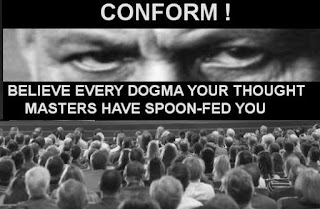
conformity
It's kind of like this in a public high school

Such students will also receive two years of physics studies. The physics courses will teach all kinds of mathematical calculation algorithms that 95 percent of students will very soon completely forget, but the courses will completely fail to teach the students something that they might remember the rest of their lives: an explanation of how the laws of nature and physical constants of our universe are very fine-tuned to allow for our existence. This is perhaps because teaching such a thing might conflict with the thrust of Darwinist materialism. Similarly, the high school student will also probably never be taught about the Big Bang, the baffling sudden origin of the universe, from what scientists say was a point of infinite density. Such a topic is conveniently omitted from the high school physics curriculum.

No course in psychology is normally required for high-school students. If the student takes such a course, there will be no discussion of any of the huge amount of evidence suggesting that the mind is something that cannot be explained purely by the brain. There will be no discussion of near-death experiences or accounts of apparitions or a discussion of very high-scoring subjects in ESP tests or people who managed to function well after half or 75 percent of their brains were surgically removed or replaced with fluid by hydrocephalus. The “we can't teach about anything spooky” rule will be followed.  In psychology courses and biology courses, there will be no discussion of biology facts that contradict the dogma that brains store memories, such as the extremely short lifetime of synapse proteins.  When the biology courses discuss morphogenesis, the growth of a human body from a tiny fertilized egg, the student may be given the false notion that such a growth occurs because of a reading of a body blueprint in DNA. There does not actually exist any such blueprint or recipe in DNA, which merely stores low-level chemical information, not high-level structural information, nor does there exist in a human womb anything sophisticated enough to read and execute a blueprint or recipe for making a human, which would be a set of instructions 1000 times more complex than a building blueprint (given all the incredibly complicated dynamics of cells).  The student may be given the impression that scientists understand how a fertilized egg progresses to become a full-sized human, even though such a progression is actually a thousand miles over the heads of scientists, being unexplained by any known biochemistry. 

The student enduring such a very dogmatic and one-sided course of study at his high school on a weekday such as Monday may rightfully wonder whether he is being religiously indoctrinated every bit as much as if he were attending a Sunday school class at a church.

Postscript: Julian Huxley has been called one of the founders of the so-called "modern synthesis" of evolutionary biology, and he coined that term. In an essay "Eugenics and Society," he made rather clear how Darwinism was to him pretty much a religion; for he stated this:

"Eugenics, Dean Inge writes in one of his essays, is capable of becoming the most sacred ideal of the human race, as a race; one of the supreme religious duties. In this I entirely agree with him. Once the full implications of evolutionary biology are grasped, eugenics will inevitably become part of the religion of the future, or of whatever complex of sentiments may in the future take the place of organized religion."

We saw the disastrous results of eugenics enthusiasm in the twisted work of the Nazis. A paper on Huxley states, "Julian Huxley was untroubled by this post-Orwellian 1984 nightmare – instead he continued to proselytize for the opposite: the idea of an evolutionary religion, based on objective science rather than revelation." So spellbound by his Darwinist religion, Huxley kept acting as a salesman for eugenics long after the horrors of the Nazis had been uncovered. 

Postscript: Another Huxley who acted as one of the chief advocates of Darwinism was Thomas Huxley. In his chief work arguing for Darwinism, he makes a statement that makes very clear how very much his considerations are motivated by a hatred towards the Catholic Church. He states this:  "In addition to the truth of the doctrine of evolution, indeed, one of its greatest merits in my eyes, is the fact that it occupies a position of complete and irreconcilable antagonism to that vigorous and consistent enemy of the highest intellectual, moral, and social life of mankind—the Catholic Church." The statement "makes mincemeat" out of Huxley's pretensions to be arguing on pure biology grounds, and makes it clear that his Darwinism has a very strong theological motivation, the motivation of antagonizing an existing religion. 

Thursday, January 30, 2020

"Move the Goalposts" Is the Skeptic's Favorite Trick

These days our science news sources typically try to get us all excited about many a science study that is not worthy of our attention.  But when a study appears that tells us something important, such a study will receive almost no attention if the study reports something that conflicts with prevailing dogmas about reality.  So some recent not-much-there study involving zapping dead brain tissue got lots of attention in the press, but a far more important neuroscience study received almost no attention.  The more important study was one that showed a rat with almost no brain had normal cognitive and memory capabilities. 

The study was reported in the Scientific Reports sub-journal of the very prestigious journal Nature, and had the title "Life without a brain: Neuroradiological and behavioral evidence of neuroplasticity necessary to sustain brain function in the face of severe hydrocephalus."  The study examined a rat named R222 that had lost almost all of its brain because of a disease caused hydrocephalus, which replaces brain tissue with a watery fluid. The study found that despite the rat having lost almost all of its brain, "Indices of spatial memory and learning across the reported Barnes maze parameters (A) show that R222 (as indicated by the red arrow in the figures) was within the normal range of behavior, compared to the age matched cohort."   In other words, the rat with almost no brain seemed to learn and remember as well as a rat with a full brain. 

This result should not come as any surprise to anyone familiar with the research of the physician John Lorber. Lorber studied many human patients with hydrocephalus, in which healthy brain tissue is gradually replaced by a watery fluid. Lorber's research is described in this interesting scientific paper. A mathematics student with an IQ of 130 and a verbal IQ of 140 was found to have “virtually no brain.” His vision was apparently perfect except for a refraction error, even though he had no visual cortex (the part of the brain involved in sight perception).

In the paper we are told that of about 16 patients Lorber classified as having extreme hydrocephalus (with 90% of the area inside the cranium replaced with spinal fluid), half of them had an IQ of 100 or more. The article mentions 16 patients, but the number with extreme hydrocephalus was actually 60, as this article states, using information from this original source that mentions about 10 percent of a group of 600. So the actual number of these people with tiny brains and above-average intelligence was about 30. The paper states:

"[Lorber] described a woman with an extreme degree of hydrocephalus showing 'virtually no cerebral mantle' who had an IQ of 118, a girl aged 5 who had an IQ of 123 despite extreme hydrocephalus, a 7-year-old boy with gross hydrocephalus and an IQ of 128, another young adult with gross hydrocephalus and a verbal IQ of 144, and a nurse and an English teacher who both led normal lives despite gross hydrocephalus."

Sadly, the authors of the "Life without a brain" paper seemed to have learned too little from the important observational facts they recorded. Referring to part of the brain, they claim that "the hippocampus is needed for memory," even though their rat R222 had no hippocampus that could be detected in a brain scan. They stated, "It was not possible from these images of R222 to identify the caudate/putamen, amygdala, or hippocampus."  Not very convincingly, the authors claimed that rat R222 had a kind of flattened hippocampus, based on some chemical signs (which is rather like guessing that some flattened roadkill was a particular type of animal). 

But how could this rat with almost no brain have performed normally on the memory and cognitive tests?  The authors appeal to a miracle, saying, "This rare case can be viewed as one of nature’s miracles." If you believe that brains are what store memories and cause thinking, you must regard cases such as this (and Lorber's cases) as "miracles," but when a scientist needs to appeal to such a thing, it is a gigantic red flag. Much better if we have a theory of the mind under which such results are what we would expect rather than a miracle.  To get such a theory, we must abandon the unproven and very discredited idea that brains store memories and that brains create minds. 

The Neuroskeptic blogger at Discovery magazine's online site mentions this rat R222, and the case of humans who performed well despite having the vast majority of their brain lost due to disease.  Let's give him credit for mentioning the latter. But we shouldn't applaud his use of a  trick that skeptics constantly employ: always ask for something you think you don't have. 

This "keep moving the goalposts" trick works rather like this. If someone shows a photo looking like a ghost on the edge of a photo, say that it doesn't matter because the ghost isn't in the middle of the photo. If someone then shows you a photo that appears to show a ghost in the middle of the photo, say that it doesn't matter, because the photo isn't a 6-megabyte high resolution photo.  If someone then shows you a 6-megabyte high resolution photo that appears to show a ghost in the middle of the photo, say that it doesn't matter, because it's just a photo and not a movie. If someone then shows you a movie of what looks like a ghost, say that it doesn't matter, because there were not multiple witnesses of the movie being made. If someone then shows you a movie of what looks like a ghost, the photography of which was observed by multiple witnesses, say that it doesn't matter, because the movie isn't a movie-theater-quality 35 millimeter Technicolor Panavision movie.  If someone then shows you a movie-theater-quality 35 millimeter Technicolor Panavision movie of what looks like a ghost, the photography of which was observed by multiple witnesses, say that it doesn't matter, because the ghost wasn't levitating. If someone then shows you a movie-theater-quality 35 millimeter Technicolor Panavision movie of what looks like a levitating ghost, the photography of which was observed by multiple witnesses, say that it doesn't matter because the ghost wasn't talking.  If someone then shows you a movie-theater-quality 35 millimeter Technicolor Panavision movie of what looks like a levitating talking ghost, the photography of which was observed by multiple witnesses, say that it doesn't matter, because the levitating talking ghost didn't explain the meaning of life to your satisfaction. 

The Neuroskeptic uses such a technique when he writes the following:

"In the case of the famous human cases of hydrocephalus, the only evidence we have are the brain scans showing massively abnormal brain anatomy. There has never, to my knowledge, been a detailed post-mortem study of a human case."

If there were such an alleged "shortfall," it would be irrelevant, because we can tell perfectly well from a brain scan the degree of brain tissue loss when someone has lost most of their brain, as happened in the case of Lorber's patients and other hydrocephalus patients.  Complaining about the lack of an autopsy study in such patients is like saying that you don't know that your wife lacks a penis, because no one did an autopsy study on her.  Neuroskeptic's claim of no autopsy studies on hydocephalus patients is incorrect. When I do a Google search for "autopsy of hydrocephalus patient," I quickly find several studies which did such a thing, such as this one which reports that one of 10 patients with massive brain loss due to hydrocephalus was "cognitively unimpaired."  Why did our Neuroskeptic blogger insinuate that such autopsy studies do not exist, when discovering their existence is as easy as checking the weather? 

There are many animal studies (such as those of Karl Lashley) that conflict with prevailing dogmas about the brain. One such dogma is that the cerebral cortex is necessary for mental function.  But some scientists once tried removing the cerebral cortex of newly born cats. The abstract of their paper reports no harmful results:

"The cats ate, drank and groomed themselves adequately. Adequate maternal and female sexual behaviour was observed. They utilized the visual and haptic senses with respect to external space. Two cats were trained to perform visual discrimination in a T-maze. The adequacy of the behaviour of these cats is compared to that of animals with similar lesions made at maturity."

Figure 4 of the full paper clearly shows that one of the cats without a cerebral cortex learned well in the T-maze test, improving from a score of 50 to almost 100. Karl Lashley did innumerable experiments after removing parts of animal's brains. He found that you could typically remove very large parts of an animal's brain without affecting the animal's performance on tests of learning and memory. 

Ignoring such observational realities, our neuroscientists cling to their dogmas, such as the dogma that memories are stored in brains,  and that the brain is the source of human thinking.  Another example of a dubious neuroscience dogma is the claim that the brain uses coding for communication.   A scientific paper discusses how common this claim is:

"A pervasive paradigm in neuroscience is the concept of neural coding (deCharms and Zador 2000): the query 'neural coding' on Google Scholar retrieved about 15,000 papers in the last 10 years. Neural coding is a communication metaphor. An example is the Morse code (Fig. 1A), which was used to transmit texts over telegraph lines: each letter is mapped to a binary sequence (dots and dashes)."

But the idea that the brain uses something like a Morse code to communicate has no real basis in fact.  The paper quoted above almost confesses this by stating the following:

"Technically, it is found that the activity of many neurons varies with stimulus parameter, but also with sensory, behavioral, and cognitive context; neurons are also active in the absence of any particular stimulus. A tight correspondence between stimulus property and neural activity only exists within a highly constrained experimental situation. Thus, neural codes have much less representational power than generally claimed or implied."

That's moving in the right direction, but it would be more forthright and accurate to say that there is zero real evidence that neurons are using any type of code to represent human learned information, and that the whole idea of "neural coding" is just a big piece of wishful thinking where scientists are seeing what they hope to see, like someone looking at a cloud and saying, "That looks like my mother."


Sunday, January 26, 2020

Why the Sizable Biologist Misconduct They Found May Be Only the Tip of the Iceberg

Without getting into the topic of outright fraud, we know of many common problems that afflict a sizable percentage of scientific papers. One is that it has become quite common for scientists to use titles for their papers announcing results or causal claims that are not actually justfied by any data in the papers. A scientific study found that 48% of scientific papers use "spin" in their abstracts. Another problem is that scientists may change their hypothesis after starting to gather data, a methodological sin that is called HARKing, which stands for Hypothesizing After Results are Known. An additional problem is that given a body of data that can be analyzed in very many ways, scientists may simply experiment with different methods of data analysis until one produces the result they are looking for. Still another problem is that scientists may use various techniques to adjust the data they collect, such as stopping data collection once they found some statistical result they are looking for, or arbitrarily excluding data points that create problems for whatever claim they are trying to show.  Then there is the fact that scientific papers are very often a mixture of observation and speculation, without the authors making clear which part is speculation.  Then there is the fact that through the use of heavy jargon, scientists can make the most groundless and fanciful speculation sound as if was something strongly rooted in fact, when it is no such thing. Then there is the fact that scientific research is often statistically underpowered, and very often involves sample sizes too small to be justifying any confidence in the results. 

All of these are lesser sins. But what about the far more egregious sin of outright researcher misconduct or fraud?  The scientists Bik, Casadevall and Fang attempted to find evidence of such misconduct by looking for problematic images in biology papers.  We can imagine various ways in which a scientific paper might have a problematic image or graph indicating researcher misconduct:

(1) A photo in a particular paper might be duplicated in a way that should not occur.  For example, if a paper is showing two different cells or cell groups in two different photos,  those two photos should not look absolutely identical, with exactly the same pixels. Similarly, brain scans of two different subjects should not look absolutely identical, nor should photos of two different research animals. 
(2) A photo in a particular paper that should be different from some other photo in that paper might be simply the first photo with one or more minor differences (comparable to submitting a photo of your sister, adjusted to have gray hair, and labeled as a photo of your mother). 
(3) A photo in a particular paper that should be original to that paper might be simply a duplicate of some photo that appeared in some previous paper by some other author, or a duplicate with minor changes.
(4) A photo in a particular paper might show evidence of being Photoshopped.  For example, there might be 10 areas of the photo that are exact copies of each other, with all the pixels being exactly the same. 
(5) A graph or diagram in a paper that should be original to that paper might be simply a duplicate of some graph or diagram that appeared in some previous paper by some other author. 
(6) A graph might have evidence of artificial manipulation, indicating it did not naturally arise from graphing software. For example, one of the bars on a bar graph might not be all the same color. 


research misconduct

There are quite a few other possibilites by which researcher misconduct could be identified by examining images, graphs or figures. Bik, Casadevall and Fang made an effort to find such problematic figures. In their paper "The Prevalence of Inappropriate Image Duplication in Biomedical Research Publications," they report a large-scale problem.  They conclude, "The results demonstrate that problematic images are disturbingly common in the biomedical literature and may be found in approximately 1 out of every 25 published articles containing photographic image data."  

But there is a reason for thinking that the real percentage of research papers with problematic images or graphs is far greater than this figure of only 4%.  The reason is that the techniques used by Bik, Casadevall and Fang seem like rather inefficient techniques capable of finding only a fraction of the papers with problematic images or graphs.  They describe their technique as follows (20,621 papers were checked): 

"Figure panels containing line art, such as bar graphs or line graphs, were not included in the study. Images within the same paper were visually inspected for inappropriate duplications, repositioning, or possible manipulation (e.g., duplications of bands within the same blot). All papers were initially screened by one of the authors (E.M.B.). If a possible problematic image or set of images was detected, figures were further examined for evidence of image duplication or manipulation by using the Adjust Color tool in Preview software on an Apple iMac computer. No additional special imaging software was used. Supplementary figures were not part of the initial search but were examined in papers in which problems were found in images in the primary manuscript."

This seems like a rather inefficient technique which would find less than half of the evidence for researcher misconduct that might be present in photos, diagrams and graphs. For one thing, the technique ignored graphs and diagrams. Probably one of the biggest possibilites of misconduct is researchers creating artificially manipulated graphs not naturally arising from graphing software, or researchers simply stealing graphs from other scientific papers. For another thing, the technique used would only find cases in which a single paper showed evidence for image shenanigans. The technique would do nothing to find cases in which one paper was inappropriately using an image or graph that came from some other paper by different authors. Also, the technique ignored supplemental figures (unless a problem was found in the main figures). Such supplemental figures are often a signficant fraction of the total number of images and graphs in a scientific paper, and are often referenced in the text of a paper as supporting evidence. So they should receive the same scrutiny as the other images or figures in a paper. 

I can imagine a far more efficient technique for looking for misconduct related to imagery and graphs. Every photo, every diagram, every figure and every graph in every paper in  a very large set of papers on a topic (including supplemental figures) would be put into a database.  A computer program with access to that database would then run through all the images, looking for duplicates or near-duplicates in the images, as well as other evidence of researcher misconduct. Such a program might also make use of "reverse image search" capabilities available online.  Such a computer program crunching the image data could be combined with manual checks.  Such a technique would probably find twice as many problems.  Because the technique for detecting problematic images described by  Bik, Casadevall and Fang is a rather inefficient technique skipping half or more of its potential targets, we have reason to suspect that they have merely shown us the tip of the iceberg, and that the actual rate of problematic images and graphs (suggesting researcher misconduct) in biology papers is much greater than 4% -- perhaps 8% or 10%. 

A later paper ("Analysis and Correction of Inappropriate Image Duplication: the Molecular and Cellular Biology Experience") by Bik, Casadevall and Fang (along with Davis and Kullas) involved analysis of a different set of papers. The paper concluded that "as many as 35,000 papers in the literature are candidates for retraction due to inappropriate image duplication."  They found that 6% of the papers "contained inappropriately duplicated images." They reached this conclusion after examining a set of papers in the journal Molecular and Cellular Biology.  To reach this conclusion, they used the same rather inefficient method of their previous study I just cited. They state, "Papers were scanned using the same procedure as used in our prior study."  We can only wonder how many biology papers would be found to be "candidates for retraction" if a really efficient (partially computerized) method was used to search for the image problems, one using an image database and reverse image searching, and one checking not only photos but also graphs, and one also checking the supplemental figures in the papers.  Such a technique might easily find that 100,000 or more biology papers were candidates for retraction.

We should not be terribly surprised by such a situation. In modern academia there is relentless pressure for scientists to grind out papers at a high rate. There also seems to be relatively few quality checks on the papers submitted to scientific journals. Peer review serves largely as an ideological filter, to prevent the publication of papers that conflict with the cherished dogmas of the majority. There are no spot checks of papers submitted for publication, in which reviewers ask to see the source data or original lab notes or lab photographs produced in experiments.  The problematic papers found by the studies mentioned above managed to pass peer review despite glaring duplication errors, indicating that peer reviewers are not making much of an attempt to exclude fraud.  Given this misconduct problem and the items mentioned in my first paragraph, and given the frequently careless speech of so many biologists, in which they so often speak as if unproven claims or discredited claims are facts, it seems there is a significant credibility problem in academic biology. 

Postscript: In an unsparing essay entitled "The Intellectual and Moral Decline in Academic Research," PhD Edward Archer states the following:

"My experiences at four research universities and as a National Institutes of Health (NIH) research fellow taught me that the relentless pursuit of taxpayer funding has eliminated curiosity, basic competence, and scientific integrity in many fields. Yet, more importantly, training in 'science' is now tantamount to grant-writing and learning how to obtain funding. Organized skepticism, critical thinking, and methodological rigor, if present at all, are afterthoughts....American universities often produce corrupt, incompetent, or scientifically meaningless research that endangers the public, confounds public policy, and diminishes our nation’s preparedness to meet future challenges....Universities and federal funding agencies lack accountability and often ignore fraud and misconduct. There are numerous examples in which universities refused to hold their faculty accountable until elected officials intervened, and even when found guilty, faculty researchers continued to receive tens of millions of taxpayers’ dollars. Those facts are an open secret: When anonymously surveyed, over 14 percent of researchers report that their colleagues commit fraud and 72 percent report other questionable practices....Retractions, misconduct, and harassment are only part of the decline. Incompetence is another....The widespread inability of publicly funded researchers to generate valid, reproducible findings is a testament to the failure of universities to properly train scientists and instill intellectual and methodologic rigor. That failure means taxpayers are being misled by results that are non-reproducible or demonstrably false."