Header 1

Our future, our universe, and other weighty topics


Thursday, June 13, 2019

Anonymously, Scientists Report the Paranormal as Much as Average People

For a long time, skeptics have attempted to use gaslighting to explain away observations of the paranormal. Gaslighting is when someone tries to shake confidence in an observational report by raising doubts about the mind or observational skills of the observer. A person engaging in gaslighting may try to suggest that you only reported seeing something because:

  1. you were hysterical;
  2. you simply got confused, and “mixed up” the observational details;
  3. you overreacted;
  4. you confabulated, filling in details later that you didn't actually see;
  5. you failed to observe carefully because you're not a “trained observer”;
  6. you're just a “fantasy-prone” person who confuses your imagination with reality;
  7. perhaps you hallucinated;
  8. perhaps you were intoxicated or under the influence of drugs.

Gaslighting is used by skeptics of the paranormal and also by the defense attorneys of accused rapists and sex abusers.


gaslighting

A recent study by Dean Radin and four other scientists (the study "Exceptional Experiences Reported by Scientists and Engineers" you can read here) helps to discredit claims that reports of the paranormal come mainly from people with poor observational skills. The scientists sent an email to 254,102 people, asking them to fill out a survey about extraordinary experiences they may have had.  Many of the people who got the email were scientists. Of the people who filled out the whole survey, 283 were from the general population, 175 were scientists and 441 were “enthusiasts” who had been identified as having an interest in the paranormal or the extraordinary.

The subjects were asked to answer “Yes” or “No” to questions about a large variety of possible paranormal experiences. Large fractions of the scientists who completed the survey answered “Yes” to some of the questions. For example:


Question Percent of survey-answering scientists answering “Yes”
Felt as though you were in touch with someone when they were far away from you? 59.2%
Received important information through your dreams? 59.4%
Known something about the future that you had no normal way to know ? 48.0%
Felt as though you were really in touch with someone who died? 39.1%
Experienced your awareness traveling outside of your body ? 27.0%
Known information about past events or an individual’s past experiences without any possible way of you knowing it? 43.4%
Seen events that happened at a great distance as they were happening? 15.5%
Caused your body to float in the air for any period of time using only your mind? 10.9%


From the table above, you might conclude that large fractions of scientists experience paranormal experiences. But that assumption might not be correct. The vast amount of people who got the survey email did not answer it. So it could be that only small percentages of scientists experience such things, and that people having such experiences were more likely to answer the survey.

But the survey does seem to offer important evidence relating to whether people who are “trained observers” are less likely to report paranormal experiences than average people. The table below compares some answers given by scientists in the survey to answers given by non-scientists.


Question Percent of survey-answering general population answering “Yes” Percent of survey-answering scientists answering “Yes”
Felt as though you were in touch with someone when they were far away from you? 52.7% 59.2%
Received important information through your dreams? 43.1% 59.4%
Known something about the future that you had no normal way to know ? 47.3% 48.0%
Felt as though you were really in touch with someone who died? 41.3% 39.1%
Experienced your awareness traveling outside of your body ? 20.2% 27.0%
Known information about past events or an individual’s past experiences without any possible way of you knowing it? 35.2% 43.4%
Seen events that happened at a great distance as they were happening? 12.1% 15.5%
Caused your body to float in the air for any period of time using only your mind? 7.8% 10.9%


We see from the table above that the percentage of scientists who reported such paranormal experiences was usually higher than the percentage of non-scientists who reported such things. The “trained observers” reported more paranormal experiences than the average person. This debunks claims or insinuations that reports of the paranormal are caused by unreliable observers.

It is interesting that the survey fails to ask about some of the main types of paranormal observations. If I had got the survey, I would have had to answer nothing but “No,” except for one or two questions, even though I have had very many paranormal-seeming observational events (as described here).

The survey should have had several additional questions, including the following:

  • Did you ever have a strong impression that a thought was traveling between your mind and the mind of someone else, even though nothing was spoken, typed or written?
  • Did you ever repeatedly get in photographs some type of  anomaly that you cannot explain?
  • Did you ever see some event around your home or office that you cannot explain, such as a lamp seeming to turn on by itself, a door seeming to open or unlock itself,  or a TV seeming to change channels by itself?
  • Did you ever notice some object that seemed to have appeared in an inexplicable way?
  • Did you ever see with your own eyes some sight that you cannot explain, such as something like a ghost or a UFO?
  • Did you ever have a thought of someone, just before the person unexpectedly called or unexpectedly appeared?

If these questions had been asked, an even higher percentage of respondents would have answered in the affirmative. 

Sunday, June 9, 2019

Belief in UFOs Doesn't Qualify as a Religion

These days it's a tough time for UFO skeptics. The New York Times recently released its second bombshell article on UFOs. The report begins like this:

"The strange objects, one of them like a spinning top moving against the wind, appeared almost daily from the summer of 2014 to March 2015, high in the skies over the East Coast. Navy pilots reported to their superiors that the objects had no visible engine or infrared exhaust plumes, but that they could reach 30,000 feet and hypersonic speeds. 'These things would be out there all day,' said Lt. Ryan Graves, an F/A-18 Super Hornet pilot."


Later we have an account of a pilot seeing a mysterious orb flying between two Navy jets that were only about 100 feet apart from each other:

"The pilot and his wingman were flying in tandem about 100 feet apart over the Atlantic east of Virginia Beach when something flew between them, right past the cockpit. It looked to the pilot, Lieutenant Graves said, like a sphere encasing a cube."


So the report was of a mysterious orb flying between two Navy jets. Such an account reminds me of my own empirical experience. I have published online more than 800 photos I have taken of mysterious speeding orbs, and also more than 600 photos I have taken of mysterious striped orbs.  The cube-inside-an-orb reported by pilot Graves seems like a case of a rectangular prism inside an orb, and the striped orbs I so often photograph with chord stripes look similar to an orb with a rectangular prism inside it (a cube is one type of rectangular prism).   I had previously twice photographed a "square in the orb" effect, once in a sky orb (as shown here). 


speeding orb
A mysterious speeding orb I photographed this week

Earlier the New York Times published  a detailed account of a UFO sighting. They interviewed Navy pilot David Fravor, who was asked to use his Navy jet fighter to investigate an unidentified object in the sky. Fravor reported that the vehicle “accelerated like nothing I've ever seen.”

LiveScience.com has got a reaction about these reports from SETI astronomer Seth Shostak. The type of comments Shostak makes are completely predictable. For years Shostak has tried to discredit UFO reports. He seems to hate the idea of extraterrestrials that are nearby, but he wants us to believe in extraterrestrials that are far away, and to help fund his efforts to search for them. Go figure.

On the LiveScience page, Shostak gives us some scrambled reasoning that UFO sightings off the US coast are what we would expect from a foreign power trying to monitor us. “Coastal regions are where you might expect to find a rival nation's advanced reconnaissance craft," Shostak said, "because incursions over the continental United States would be more obvious and easily detected.” So if China were to try to monitor us, they would put their spy drones over the ocean, not over land? That doesn't make much sense. 

Shostak also tries to suggest that maybe the UFO sightings were due to “some sort of software bug or instrument issue.” The same far-fetched explanation was suggested by astronomer Leon Golub, who states in the New York Times article, “there are so many other possibilities — bugs in the code for the imaging and display systems, atmospheric effects and reflections, neurological overload from multiple inputs during high-speed flight.”

Similar weak reasoning has been used for years by skeptics to try to dismiss massive photographic evidence for mysterious orbs in photos. Skeptics will tell us that such things may appear because of camera malfunctions. This idea is completely unbelievable because digital camera technology is a proven, reliable technology that has been around for nearly 30 years. A claim of malfunctioning cameras might have had some credibility around 1990 just after digital cameras were invented. But after decades of reliable performance by digital cameras, the idea that a camera might be malfunctioning to produce something like 600+ photos of mysterious striped orbs and 800+ photos of mysterious speeding orbs (both of which I have published, as you can see in videos here and here) has no credibility. Similarly, since television is a long-established reliable technology, no one has any credibility when they make statements such as, “I see the TV says Donald Trump was elected president, so my TV must be suffering an electronic malfunction.”

As for the claim that UFOs are appearing on imaging systems because of software bugs, it has little credibility because military target acquisition software is a well-proven technology that has been around for decades, and we can hardly imagine that the Navy would let the fate of fantastically expensive military jets depend on target acquisition software that had not been well-tested. A Navy jet nowadays goes for about 60 million dollars.

As for Golub's claim about reflections, it  cannot explain the latest UFO reports, and also is worthless in explaining the phenomenon of mysterious orbs. An object seen in mid-air can never be a reflection, because there is nothing solid nearby to cause a reflection, and reflected light always disperses in the air, never forming into disks or balls. Even if we imagine some cloud of ice crystals floating in the air that might reflect some sunlight (a far-fetched scenario),  such a thing would not appear to be a solid object or orb or ball but as an amorphous cloud, and such a thing would be reported as hanging in the air rather than moving at fantastic speeds. We also cannot explain mysterious lights seen near the water as reflections, as the water scatters the light it is reflecting, rather than making it appear as a ball or solid object. Reflections can only explain things seen in mirror-like surfaces or things appearing when someone is photographing through glass (such as when you take a photo from inside a commercial jet).


Hardly something that would be mistaken for a UFO

What seems like another recent attempt to discredit UFO observations involves an attempt to categorize belief in UFOs as a religion. This attempt is made by Diana Pasulka with a new book entitled American Cosmic. In this interview she attempts to describe UFO belief as a religion. She gives this not-very-satisfactory definition of religion:

One way we can make sense of this by using a very old but functional definition of religion as simply the belief in nonhuman and supernatural intelligent beings that often descend from the sky. There are many definitions of religion, but this one is pretty standard.”

Later in the interview Pasulka states the following:

The belief that UFOs and aliens are potentially true, and can potentially be proven, makes this a uniquely powerful narrative for the people who believe in it. Is it fair to call this a new form of religion? I think so.”

The definition of religion suggested by Pasulka is not at all a “standard” definition. The problem of defining what is a religion is a difficult one, and many different definitions of religion have been proposed. Any serious attempt to define religion must be sufficiently broad so that it includes every major human religion. Human religions include systems as Theravada Buddhism, Zen Buddhism, Taoism, and Confucianism. These religions do not involve a belief in supernatural intelligent beings that descend from the sky. Theravada Buddhism, Taoism and Confucianism originally did not involve a belief in any supernatural beings. A later form of Buddhism called Mahayana Buddhism did involve belief in many supernatural beings.

A good definition of religion would be one that covers all of these religions, and every major religion. I propose this definition: a religion is a set of beliefs about the fundamental nature of reality and life, or a recommended way of living, typically stemming from the teachings of an authority, along with norms, taboos, ethics, rituals, roles or social organizations that may arise from such beliefs. This definition seems to cover every religion I have ever learned about, and also covers some additional ideological frameworks that are sometimes classified as religions. (I mean the "or" in the definition as an "and/or.") 

If we examine religions such as Buddhism, Taoism and Confucianism, we will find that they are a system of beliefs about the fundamental nature of reality or life (or a recommended way of living), and that they do stem from the teachings of an authority. It is also true that both Christianity and Islam are a system of beliefs about the fundamental nature of reality or life (or a recommended way of living), and that they do stem from the teachings of an authority.

Now let us consider: does a belief in UFOs qualify as a religion according to this definition? It seems it does not. The first reason is that a belief in UFOs does not qualify as a “set of beliefs about the fundamental nature of reality or life, or a recommended way of living."

Consider the person who believes that UFOs must be some strange reality beyond human understanding. By believing in UFOs such a person has not at all adopted “a set of beliefs about the fundamental nature of reality or life, or a recommended way of living.” For such a person is likely to have no concrete belief pertaining to what causes UFOs. Such a person will typically think something like this:

Maybe UFOs are spaceships from other planets. Or maybe they come from some other dimension. Or maybe they're time travelers from the future. Or maybe some of them are angels. I don't know whether they're here to take over our planet, or whether they're here to help us. Who knows?"

Thinking along such lines does not at all qualify as a system of beliefs about the fundamental nature of reality or life, nor is it a belief about a recommended path of life. There is no standard set of doctrines shared by believers in UFOs, who are “all over the map” in their opinions about UFOs. So the mere vague belief that UFOs are some type of power beyond human explanation is too nebulous and vague to qualify as a system of beliefs.

One hallmark of a religion is the transmission of belief doctrines based on authority. If you believe in a creator of the universe based on the precise fine-tuning of the universe's fundamental constants, the sudden unexplained origin of the universe, and the improbability of chemicals ever randomly forming into something as fantastically organized as the simplest living cell, that's philosophy or philosophy of religion. But if you know nothing of such matters, and believe in a divine creator simply because you were taught that by your Sunday school or the Bible, that's religion.

But a transmission of beliefs by authority is not going on among UFO believers. There is no UFO belief authority that hands down doctrines that the faithful accept. There is nothing in UFO belief corresponding to a holy book, a church or clergy. In this regard, UFO belief fails to qualify as a religion.

Very oddly, in her interview Pasulka talks about some people investigating UFOs, and says, “Now they’re much more compartmentalized and worried about attracting too much attention or having their research distorted, so they work in the shadows and mostly independently.” Such “lone wolf” activity does not sound at all like religion, which is very much a social affair in which believers typically bond together for ideological reassurance.

The person interviewing Pasulka (Sean Illing) perceptively suggests some skepticism about her thesis, and asks the following, referring to the very social nature of religion:

I’m curious why you call this a new form of religion. Traditional religions have dogmas and rituals, and they function as an anchor for the individual and a community. I guess I don’t quite see the parallels in the case of UFOs and aliens. Am I missing something?”

That was an excellent question, and one that Pasulka does not answer convincingly, as she then mentions religions that do not match the definition of religion she earlier stated.  I classify Pasulka's  claim that UFO belief is a religion as "another recent  attempt to discredit UFO observations" because once you have called something a religion you have implied that it is mainly based on faith rather than evidence.  

But in the case of UFOs, there seems to be quite a lot of evidence. The link here shows only reports of UFOs made to one reporting agency (the National UFO Reporting Center), and only reports of sphere-like UFOs. We see more than 18 reports of sphere-like UFOs sighted during May 2019 in different parts of the US, with most of the reports mentioning a duration of more than a minute. So it seems that the spherical UFO reported by pilot Graves was not so uncommon.  In fact, the link I just gave goes to a list of more than 7000 UFOs with a spherical shape. 

Wednesday, June 5, 2019

Biological Orthodoxy Flunks the Software Test

Our biologists have long taught the doctrine of Darwinism, preaching that biological innovations appear because of random mutations and natural selection. But there has never been any good evidence that any complex macroscopic biological innovation ever appeared because of random mutations, natural selection, or any combination of the two. Referring to speciation (the origin of new species) in an interview, the distinguished biologist Denis Noble states, "So I go along with the view that there has been no really clear proof that speciation occurred via gradual mutation followed by selection." In the book Evolution and Ecology: The Pace of Life by Cambridge University biology professor K. D. Bennett, this mainstream authority comments on speciation (the origin of species). He says on page 175, "Natural selection has been shown to have occurred (for example, among populations of Darwin's finches), but there is no evidence that it accumulates over longer periods of time to produce speciation in the Darwinian sense."

But are there any experiments that back up the idea that random mutations and natural selection can produce very complex visible biological innovations? There are not. The plain fact is that never in human history have humans observed any very complex visible biological innovation naturally appearing, for any reason at all. There are various cases of weird mutations that have occurred because of exposure to radiation, but such mutations are almost always harmful, and we never see any new complex biological innovations appearing because of such mutations. Scientists have tried bombarding fruit flies with radiation for years, and no beneficial visible innovations ever appeared because of such a thing. The longest-running experiment on evolution is Richard Lenski's experiment, but that involves microscopic bacteria, and certainly is no evidence that visible biological innovation can occur because of Darwinian evolution. Very little has resulted from Lenski's experiment, and his main claim of innovation is merely that his bacteria can now kind of eat citrate. Such a biochemical tweak isn't anything very complex.

There is another way of testing Darwinian claims: by trying to create software that makes use of natural selection and random mutations, trying to achieve software engineering effects by "the preservation and accumulation of successive slight favorable variations," to quote Darwin. When computer programmers started to try this decades ago, some of them were very optimistic. There were quite a few people who thought along these lines:

Why think of how much natural selection and random mutations have produced in the natural world: all the very complex innovations of biology such as eyes, ears, wings and brains! If we only put natural selection and random mutations to work inside the computer, we can unleash vast forces of creativity. It will be a software revolution. Instead of manually creating programs through human design and human labor, we will be able to evolve software in a Darwinian fashion.”

For decades, many programmers have attempted to get natural selection to work inside the computer. How successful have they been? We can find the answer in a recent paper by Roman V. Yampolskiy entitled 'Why We Do Not Evolve Software? Analysis of Evolutionary Algorithms.”

Yampolskiy examines attempts to create software by using Darwinian methods. He points out that there is a great deal of hype about such attempts that does not match the meager results. Talking about evolutionary algorithms (EA), Yampolskiy states the following:

"It is interesting to do a thought experiments and try to imagine what testable predictions Charles Darwin would have made, had he made his discovery today, with full knowledge of modern bioinformatics and of computer science. His predictions may have included the following: (1) simulations of evolution will produce statistically similar results at least with respect to complexity of artifacts produced and (2) if running EAs for as long as possible continued to produce nontrivial outputs, scientists would run them forever. Likewise, he would be able to make some predictions, which would be able to falsify his theory, such as (1) representative simulations of evolution will not produce similar results to those observed in nature, (2) researchers will not be able to evolve software or other complex or novel artifacts, and (3) there will not be any projects running EAs long term because their outputs would quickly stop improving and stabilize. With respect to the public and general cultural knowledge, it would be reasonable to predict that educated people would know the longest-running EA and the most complex evolved algorithm. Similarly, even schoolchildren would know the most complex digital organism ever evolved."

Later, after reviewing work in this area, Yampolskiy states that both of the predictions that should have proven true if Darwinism is correct have not proven true. He also states that all of the listed events to falsify Darwinism have occurred. Specifically, representative simulations of evolution have not produced similar results to those observed in nature; researchers have not been able to evolve software or other complex or novel artifacts; and there have not been any projects running evolutionary algorithms long term. Moreover, no one can list the name of the longest-running evolutionary algorithm or the most complex evolutionary algorithm; and no one can name any complex digital organism that ever evolved.

It is now 2019 and the “Darwinian revolution” predicted for software development simply hasn't occurred. Computer programs are still being produced by human design and human labor. There has been some progress in automatic programming by means of code generators, but such code generators don't use natural selection. The results of programs running “evolutionary algorithms” are rather trivial things that aren't very complex – things such as character strings. There is no very complex commercially successful computer program that was produced through any type of evolutionary algorithm.  Computer program using a Darwinian scheme can accomplish some useful things, but it is generally true that such programs could accomplish just as much with fewer lines of code if they were not to use a Darwinian scheme.  Our software engineers have not been able to mine any useful engineering principles from studying the ideas of Darwin, who seems to have had no knowledge of engineering or any interest in it. 

There is another way of quickly judging whether evolutionary algorithms have been a very important player on the current software development scene.  We can simply look at the computer science courses taught at major universities, and look for a substantial presence of courses on evolutionary algorithms. Such a thing will not be found. You can see here the catalog of 155 computer science courses taught at Columbia. None of them is a course on evolutionary algorithms or genetic programming.  Similarly, none of the 60+ courses on computer science taught at SUNY Stony Brook is a course on evolutionary algorithms or genetic programming. 

Yampolskiy considers some possible reasons why we still do not evolve computer programs by any kind of Darwinian process. None of his possible reasons is very persuasive, except for the last one he considers, that the “Darwinian algorithm is incomplete or wrong” and that “the inspiration behind evolutionary computation, the Darwinian algorithm itself is wrong or at least partially incomplete.” Yampolskiy concludes, “Our analysis of relevant literature shows that no one has succeeded at evolving nontrivial software from scratch; in other words, the Darwinian algorithm works in theory but does not work in practice, when applied in the domain of software production.”

This statement by Yampolskiy is mainly correct, although he errs in stating that the Darwinian algorithm "works in theory." To the contrary, we know of a very good theoretical reason why it should not work. The reason is that a random mutation is merely a micro-fragment of a biological innovation. A particular biological innovation typically requires multiple new proteins, and the gene for a typical protein requires 25,000 or more base pairs arranged in just the right way.  A single point mutation changes or adds only one of those base pairs. So the relation of a random mutation and a biological innovation is like the relation between a random keystroke (or random character) and a complex computer program consisting of 20,000 or more characters. 

Since a mutation is merely a micro-fragment of a biological innovation,  there is no way that nature could ever have a filtering effect by which complex innovations are produced because good mutations are accumulated. Such a thing is no more possible than writing a computer program that creates useful computer programs (or useful books or essays) by generating random characters and then "accumulating the good characters" while "discarding the bad characters."


biological innovations

The fact that biological orthodoxy has flunked the software test should not come as a surprise to anyone who considers how the actual process of producing complex innovations bears no resemblance to the imagined process by which Darwinian processes supposedly produce biological innovations.  Our evolutionary biologists attempt to persuade us that very complex biological innovations appear because of an accumulation of countless tiny changes, each of which is individually rewarded. Nothing like that occurs when software teams produce complex new innovations. It is not at all true that software developers "release to production" each day's code changes,  thinking, "Each little change I make in a work day will benefit the system." 

Instead a new software release is always a very orchestrated affair in which many different code changes (almost always from different programmers) must be combined in a very coordinated way to produce a total effect that is beneficial, with many complex interdependent parts being brought together (by an experienced software release coordinator) in just the right way to produce a benefit, often in a way so that multiple "chicken or the egg" mutually dependent dependencies are very carefully resolved.  Darwinism has never credibly explained how such huge amounts of orchestration and coordination could be produced through natural selection, which is the mere fact that fit organisms reproduce more.  

An example of biological functionality with mutually dependent dependencies is the cardiopulmonary system in mammals, and the related organs it depends on. Capillaries and veins and hemoglobin molecules are useless without hearts, which are useless without such things. Hearts also require oxygen from lungs. But the lungs require a constant flow of blood from the hearts.  And the hearts won't keep beating steadily without the autonomic inputs of the brain, which itself requires the heart to keep it bathed in fresh blood.  Also, the heart won't have energy without a digestive system, which itself requires constant blood from the heart. So it's "which came first, the chicken or the egg" mutually dependent dependencies all over the place, and we can imagine no credible sequence of gradual mutation-driven innovations by which such interdependent things could have originated. 

Another example of such a "which came first, the chicken or the egg" problem has been pointed out by biochemist Michael Denton. After discussing in great detail various aspects of feathers, he states the following:

Every aspect of the feather’s origin challenges Darwinian scenarios....Which came first: the cellular condensations that created the barb, or the apoptosis that separated them into discrete filaments? Only if both developmental processes are in place can the adaptive end of a branched feather be realized. 

Denton also calls attention to the difficulty of explaining the origin of red blood cells that have no nucleus (called enucleate cells). He states this:

There is no known intermediate type of cell midway between the enucleate cell and the nucleated red cells of any other vertebrate species....Where there is an empirical absence of transitional forms, envisaging plausible hypothetical intermediates invariably proves impossible. And so it is here.

If we attempt to produce a Darwinian result using a computer, it may help to clarify a logical flaw in the Darwinian account of how complex things originate.  Any competent computer programmer could create a function that provides a random stream of characters, producing output such as "ewqiqwe23023nsdagdsogsd" or "gsdib9witb3252bfeyery" every second. Now let us suppose that we try to use such a stream of random characters to produce useful works such as essays, blog posts, and computer programs.  Following Darwinian ideas, and the frequent suggestion in Darwin's writings that biological innovations are produced by accumulations of favorable random changes,  we will try to do this by "accumulating the good stuff" and "discarding the bad stuff."  Will this work to produce useful works such as essays, blog posts, and computer programs? It certainly will not.  It also will not work to create a stream of random words (randomly getting a line from a list of 100,000 words), and then following a principle of "accumulating the good stuff" and "discarding the bad stuff," or a principle of "accumulating the useful stuff and discarding the useless stuff." 
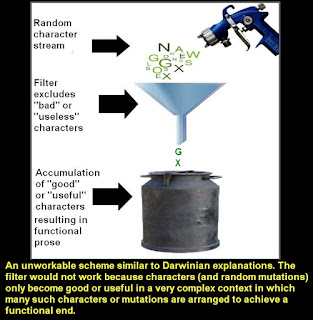

darwinism flaw

Why will such an attempt always fail? It's because at the character level and at the word level there is no way to distinguish between something good or bad, or something useful or not useful. All characters are equally useful, and all common words are equally useful.  So at the low level of individual characters and individual words, there is no way to apply any "survival of the fittest" or any filtering effect which allows "good letters" to accumulate into good literary works, or "good words" to accumulate into good essays or good computer programs.  Similarly, since a random mutation is only the tiniest fraction of a biological innovation (such as a millionth), without any intrinsic property of being good or useful in the sense of providing a survival benefit, there is no way for nature to produce complex biological innovations by "accumulating the good mutations" and "discarding the bad mutations." 

But it is rather easy to think otherwise. You might reason: if some biological innovation is useful (in the sense of producing a survival benefit), and the innovation is caused by 100,000 little point mutations, are not each of those mutations also useful? But to think that is to commit a fallacy called the fallacy of division, the fallacy of assuming that parts of a whole must have some property of the whole.  The parts of a whole do not necessarily have some property possessed by the whole. For example, while a college textbook is heavy, individual pages of that book are not heavy. 

If we commit the fallacy of division, we may reason that since some useful biological innovation built from 100,000 mutations is useful (in the sense of providing a survival benefit), therefore the individual mutations that built it are also useful in providing a survival benefit, and that nature can accumulate such mutations by "saving the useful mutations" and "discarding the useless mutations."  But after more careful thinking we realize that such a thing cannot occur, because the individual mutations do not have any property of being useful in the sense of providing a survival benefit, and such usefulness only arises late-in-the-game from incredibly complex and hard-to-achieve combinations of very many such mutations, combinations that are incredibly unlikely to occur by chance.  A principle of "good stuff piles up" works for the owners of ski lodges hoping to explain how they got nice snow accumulations, but such a principle is basically worthless for explaining the origin of cars, bridges, computers, ships, and complex biological innovations. 

Saturday, June 1, 2019

Why 2 New Studies Fail to Show Memories Are Stored in Brains

There is no real evidence that memories are stored in brains, and there are some very good reasons for thinking that long-term memories cannot be stored in brains. Among such reasons are the following:

  1. the fact that no one has ever found any sign of encoded information in a brain (other than the genetic information in DNA);
  2. the fact that the best candidates for a storage place for memory (synapses and dendriditic spines) are unstable structures that don't last for years, and the fact that synapses and dendritic spines are made of proteins with short average lifetimes of only a few weeks;
  3. the fact that the brain has no addressing system that might allow the exact tiny location of a memory to be instantly found, and make possible the instantaneous recall that humans display;
  4. the fact that brains and synapses are very noisy and slow, making them unsuitable as an explanation for memory recall that can occur instantly and with 100% reliability.

But scientists occasionally produce research papers trying to persuade us that memories can be stored in a brain. In this post, I will discuss two such papers that appeared in the news this week, and explain why they are not good evidence that memories are stored in brains.

Study #1: Another Optogenetic Study on Memory

This week a paper was published with the grandiose title “Artificially Enhancing and Suppressing Hippocampus-Mediated Memories.” The paper was authored by Ramirez and others. There were two experiments. In one experiment, mice were exposed to training to give them a memory regarding a stimulus, and an attempt was made to reactivate that memory by exposing the mice to the same stimulus. The brains of the mice were then examined, and the scientists claimed to found evidence that some part of the brain “showed significant increases in re-activated cells.” This type of finding is not good evidence for anything, because judgment of whether a cell has been "reactivated" is arbitrary, the very notion of "cell reactivation" is not a precise one, and any one looking for an evidence of a significant increase in something (and freedom to check many different areas) will always be able to find something. For example, if I have freedom to check 100 different parameters related to your body and chemistry after a physical and a blood test is performed on you, I will always be able to find some things that made a “significant increase.”

In another experiment, the scientists trained some mice to fear a stimulus, and then sent an optogenetic stimulation to a part of the brain that the scientists guessed was the storage place of the memory. The optogenetic stimulation can roughly be described as a brain zap. The scientists claimed that this resulted in increased “freezing behavior” suggesting that a fear memory had been artificially activated. 

There are two major reasons why the methodology is flawed. The first reason is that when part of an animal's brain is zapped, we have no idea whether a fear memory is being recalled after such a brain zapping. The alleged “increased freezing behavior” could be caused by the brain stimulation itself rather than a recall of a fear memory. A science paper says that it is possible to induce freezing in rodents by stimulating a wide variety of regions. It says, "It is possible to induce freezing by activating a variety of brain areas and projections, including the hippocampus (Liu et al., 2012), lateral, basal and central amygdala (Ciocchi et al., 2010); Johansen et al., 2010;  Gore et al., 2015a), periaqueductal gray (Tovote et al., 2016), motor and primary sensory cortices (Kass et al., 2013), prefrontal projections (Rajasethupathy et al., 2015) and retrosplenial cortex (Cowansage et al., 2014).”

The second reason such a methodology is dubious is that it is hard to reliably measure freezing behavior in rodents in an objective, standardized way without arbitrary judgment factors being involved. Consider a scientist doing an experiment that hinges upon an analysis of freezing behavior in rodents. There would be lots of arbitrary choices to be made, such as the following:

  1. What technique should be used to measure the degree of freezing in the rodent's movement? If automated software is used, what startup parameters or program inputs should be used? Such parameters and inputs can have a huge effect on the output of the program.
  2. What exactly should be counted as an indication that an animal's movement has frozen – complete lack of motion, no more than a slight movement, or no major movement?
  3. If the experiment is testing avoidance of some area where the animal previously experienced a fear stimulus, how far away should the animal be from that area for it count as an example of freezing?
  4. What time frame should be used in measuring the freezing? Should freezing only be considered exactly at the instant some brain stimulation is produced, or should the measurement time span be some length of time following that? If the latter, how long a time frame should be used?
With all these parameters for an experimenter to modify or vary as he wishes, it would not be too hard for anyone wanting to show “increased freezing behavior” to do so, just by modifying the parameters or how the data is accumulated, until the desired result is achieved. So in general, “increased freezing behavior” is not a very persuasive scientific result. It's too easy to get such a result just by fiddling with the measurement technique or data analysis details until an experimenter gets what he wants.

As discussed in this paper, randomization and blinding techniques are a very important scientific technique for avoiding experimenter bias. For example, what is called the “gold standard” in experimental drug studies is a type of study called a double-blind, randomized experiment. In such a study, both the doctors or scientific staff handing out pills and the subjects taking the pills do not know whether the pills are the medicine being tested or a placebo with no effect.

A memory experiment can be very carefully designed to achieve this blind randomization ideal that minimizes the chance of experimenter bias, so that the person measuring something like “freezing behavior” does not know whether the animal in question is or is not a member of the control group. Such a thing is a very important guard against experimenter bias. But such a thing is almost never done is any of the memory experiments purporting to show evidence of a brain storage of memories. And it wasn't done in the Ramirez study I am discussing. So the “gold standard” isn't being met. 

Perhaps the biggest problem in the study is its inadequate sample sizes. The study used study groups with 11 or 12 animals. It is well known that a minimum of 15 animals per study group is needed to achieve a modestly reliable result in an animal study. A 2017 study  entitled "Effect size and statistical power in the rodent fear conditioning literature -- A systematic review" looked at what percentage of 410 experiments used the standard of 15 animals per study group. The study found that only 12 percent of the experiments met such a standard. What this basically means is that 88 percent of the experiments had low statistical power, and are not compelling evidence for anything.

In her post “Why Most Published Neuroscience Findings Are False,” Kelly Zalocusky PhD calculates (using Ioannidis’s data) that the median effect size of neuroscience studies is about .51. She then states the following, talking about statistical power:

To get a power of 0.2, with an effect size of 0.51, the sample size needs to be 12 per group. This fits well with my intuition of sample sizes in (behavioral) neuroscience, and might actually be a little generous. To bump our power up to 0.5, we would need an n of 31 per group. A power of 0.8 would require 60 per group.

If we describe a power of .5 as being moderately convincing, it therefore seems that 31 animals per study group is needed for a neuroscience study to be moderately convincing. But most experimental neuroscience studies involving rodents and memory (including this week's Ramirez study) use far fewer than 15 animals per study group.

Zalocusky states the following:

If our intuitions about our research are true, fellow graduate students, then fully 70% of published positive findings are “false positives”.This result furthermore assumes no bias, perfect use of statistics, and a complete lack of “many groups” effect. (The “many groups” effect means that many groups might work on the same question. 19 out of 20 find nothing, and the 1 “lucky” group that finds something actually publishes). Meaning—this estimate is likely to be hugely optimistic.

In short, we have multiple reasons to suspect that the latest memory study by Ramirez is simply yet another neuroscience false positive. The study doesn't do anything to show that memory is stored in mouse brains; and even if you showed such a thing, it wouldn't prove that memories are stored in human brains. 

Study #2: Zapping Human Brains to Try to Improve Recall


Now let's look a very different type of study announced this week.  A UCLA press release announced a study in which people supposedly had improved memory recall after getting electrical stimulation in a brain region called "the left rostrolateral prefrontal cortex."


Each study group consisted of 24 people, who were shown 80 words on a computer screen, and asked to memorize them. The next day they were asked to recall the words, after some gizmo had been attached to their head.  One study group received 30 minutes of real electrical stimulation to their head. The other study group received only an instant of electrical stimulation at the beginning of the 30 minutes.  Supposedly the group that received the prolonged electrical stimulation scored 15% better at recalling the words. 


But it is very easy to explain this result without believing the prefrontal cortex of the brain had anything to do with it. The press release tells us that the brain stimulation produces "a warm, mild tingling sensation."  So from the way the study was designed, the people getting the actual stimulation could easily have been able to tell that they were in the "real brain stimulation" group and not the fake stimulation group (the control group). 


Imagine you're a participant in the study, and you feel minutes of real brain stimulation.  You may think to yourself something like: wow, I'm getting the real stuff, I'd better think hard, they're going to be expecting me to recall better.  But if you were in the control group, getting only an instant of brain stimulation, you might think, "Oh, I'm just in the control group, no need to recall that hard."  This could easily account for a 15% difference in the scores. 


Another possibility is that the brain stimulation did nothing at all to increase actual memory recall, but simply increased alertness. So the brain stimulation might have acted like a large cup of coffee acts to increase the alertness of someone in the morning.  We can imagine all kinds of reasons why alertness might have been increased by someone who was receiving an actual electrical stimulation of the brain.  Extra alertness could easily account for a 15% difference in scores. 


I may note that the results are also entirely compatible with the idea that memories are not stored in your brain. It could be that rather than being a device for retrieving memories, that the brain is largely a device for restricting our memory and consciousness, and that the brain acts kind of like a valve. Now suppose you electrically stimulate some part of the brain. That may somehow reduce this "valve effect," resulting in an increase in memory recall. 


If the brain actually were a device for retrieving memories, there is no reason why electrical stimulation in some part of the brain would cause recall of memory to speed up, just as there would be no reason why electrically zapping some part of a computer would cause it to increase the speed at which it retrieved information.  In previous posts I have specified the kind of reasons why the brain is not a plausible candidate for a memory recall system. These include reasons such as the lack of any addressing system in the brain allowing the precise location of a memory to be instantly found,  the fact that brains and synapses are very noisy (too noisy for reliable signal transmission during memory retrieval, as discussed here), and the fact that signal transmission in the brain (greatly slowed by synaptic delays and synaptic fatigue) is actually far too slow to account for instantaneous recall of memories (as discussed here).  Sending in some extra electricity to the brain would not help with any of these problems.  In fact, it would make one of them much worse (the noise problem), because the added electricity would just be more noise for a brain that already has way too much electrical noise inside it for it to be a plausible candidate for a device that instantly retrieves memories reliably.  


What brain electrical stimulation really is