Header 1

Our future, our universe, and other weighty topics


Tuesday, December 29, 2015

Where Hume Went Wrong on Miracles

Skeptics are fond of quoting a certain passage by David Hume relating to miracles, written in his book An Enquiry Concerning Human Understanding. The passage is as follows:

A miracle is a violation of the laws of nature; and as a firm and unalterable experience has established these laws, the proof against a miracle, from the very nature of the fact, is as entire as any argument from experience can possibly be imagined. Why is it more than probable, that all men must die; that lead cannot, of itself, remain suspended in the air; that fire consumes wood, and is extinguished by water; unless it be, that these events are found agreeable to the laws of nature, and there is required a violation of these laws, or in other words, a miracle to prevent them? Nothing is esteemed a miracle, if it ever happen in the common course of nature. It is no miracle that a man, seemingly in good health, should die on a sudden: because such a kind of death, though more unusual than any other, has yet been frequently observed to happen. But it is a miracle, that a dead man should come to life; because that has never been observed in any age or country. There must, therefore, be a uniform experience against every miraculous event, otherwise the event would not merit that appellation. And as a uniform experience amounts to a proof, there is here a direct and full proof, from the nature of the fact, against the existence of any miracle; nor can such a proof be destroyed, or the miracle rendered credible, but by an opposite proof, which is superior. The plain consequence is (and it is a general maxim worthy of our attention), ‘that no testimony is sufficient to establish a miracle, unless the testimony be of such a kind, that its falsehood would be more miraculous, than the fact, which it endeavors to establish; and even in that case there is a mutual destruction of arguments, and the superior only gives us an assurance suitable to that degree of force, which remains, after deducting the inferior.

The reasoning in this passage involves a number of fallacies. The problem starts at the very beginning where Hume defines a miracle as something that “is a violation of the laws of nature.” If you define a law of nature as something that always happens (a typical definition), and then define a miracle as something that violates such a law (something that always happens), then you are starting out by defining a miracle as something that can never happen. That is not fair if you considering whether miracles might happen, because it is a way of begging the question. It's rather like starting out an essay considering the possibility of ESP by defining ESP as an “impossible type of cognition.”

As it happens, some common types of things thought of as miraculous do not clearly involve violations of laws of nature. If some miracle worker or mystic or medium were to levitate a table or some other object (something that has actually been reported quite a few times), we need not at all think of this as a violation of the law of gravitation. Gravitation is the weakest force of nature, and even a very small force is able to overcome it (for example, you can cause an object to rise through air jets, magnetism, and so forth). So if we see something levitating, we need merely think “a small unknown force has been applied underneath the object, causing it to rise” rather than extravagantly thinking “the law of gravitation has been locally violated.” Similarly, a case of something apparently appearing out of nowhere need not be thought of as a violation of the law of the conservation of mass and energy, as there are all kinds of unknown ways in which local nearby matter might be transformed in a way that does not violate such a law. Similarly, cases of remarkable healing or resuscitation after apparent death do not violate any known laws of physics or chemistry, which say nothing about biology. Nor do they violate any laws of biology, which has no such laws as “cancer never reverses” or “people always die as soon as their vital signs stop.”

There is a better definition of miracle, which is simply something extraordinary and marvelous that is not explicable by natural or scientific explanations. Once we use that better definition, it's a great blow to Hume's reasoning. Another problem with Hume's reasoning is the naivete involved in its consideration of laws of nature.

Here are the kind of assumptions that Hume seems to make:
  1. Nature always behaves in fixed or predictable ways, without throwing us much in the way of surprises.
  2. Humans can figure out from their experience what these fixed tendencies are.
  3. Once humans have figured out these tendencies, they are then entitled to exclude any report of experiences that differ from these tendencies that have been observed in the past.
There are all kinds of reasons why such assumptions are invalid. For one thing, very often nature often throws us surprises, such as earthquakes, volcanic eruptions, meteors, and many types of anomalous phenomena. Secondly, humans are generally not smart enough or knowledgeable enough or experienced enough to be declaring that some particular tendency is an inviolable law of nature, based on our small experience which occurred in only the tiniest “zillionth” sliver of the universe's history, and occurred while living on only a “zillionth” iota of the universe's territory. Third, from the mere fact that we always have seen X happening, we are not entitled to conclude that X must always happen (unless we have solid knowledge of reasons why X must always happen). And from the fact that we have never previously seen X, we are not entitled to conclude that we cannot now start observing X.

For example, if you were an American colonist of Hume's time (around 1770), you might have deduced that it was a law of nature that big earthquakes don't occur anywhere near the American colonies, based on the “firm and unalterable experience” that no such earthquakes had been observed. But such a law would have been invalid, and very large earthquakes did occur in Missouri in 1811 (the New Madrid earthquakes). Similarly if you were a Roman living in Pompeii in 78 AD, you might have assumed it was a law of nature that “mountain tops never explode,” but you would have been soon surprised when just such a thing happened in the eruption that buried Pompeii. 
 
Such examples show how mistaken Hume was when he wrote this line from the passage cited above:

And as a uniform experience amounts to a proof, there is here a direct and full proof, from the nature of the fact, against the existence of any miracle; nor can such a proof be destroyed, or the miracle rendered credible, but by an opposite proof, which is superior.

No, a uniform experience does not amount to a proof. Even if humans have always experienced X, this does not prove that something different from X may some day occur. And even if humans have never experienced X, it is no proof that they will not in the future experience X.  

What Hume seems to suggest is a kind of reasoning which we might visualize by imagining a scale. On the left side is human experience suggesting that X does not happen. On the right side is some human experience suggesting that X did happen. Unless the right side outweighs the left side, according to Hume, we should not believe that X happens. But this makes no sense. If people in 100 cities are not blown up by asteroids, and they all conclude that “asteroids don't blow up cities,” we do not need 101 cities to be blown up by asteroids to show that an asteroid can blow up a city. A case of a single city being blown up by an asteroid is sufficient to show such a thing. Before September 11, 2001, it was generally believed that fires can't cause skyscrapers to fall, based on 1000 skyscraper fires. But we didn't need 1001 skyscrapers falling during fires to show that such a thing can happen; we only needed one of them like the two that fell on September 11, 2001.

What's ironic is that in many other places in his writings, Hume was very skeptical about human knowledge and human abilities. He often tended to think of human beings as error-prone stumblers and bumblers, and he famously claimed that reason is the slave of the passions. But when it came to considering man's ability to proclaim all-encompassing laws of nature from man's limited experience, Hume “checked at the door” his usual skepticism, and spoke in a very naive way as if such laws could be proclaimed with complete confidence. It's the same deal for many modern skeptics: they bring out unbounded skepticism for people reporting the anomalous, but zero skepticism towards those who are dogmatically declaring that such things can't happen.

Another commonly quoted statement by Hume is the one immediately following the paragraph quoted above. It goes like this:

When anyone tells me, that he saw a dead man restored to life, I immediately consider with myself, whether it be more probable, that this person should either deceive or be deceived, or that the fact, which he relates, should really have happened. I weigh the one miracle against the other; and according to the superiority, which I discover, I pronounce my decision, and always reject the greater miracle. If the falsehood of his testimony would be more miraculous, than the event which he relates; then, and not till then, can he pretend to command my belief or opinion.

This is often used as some justification for denying evidence of the paranormal. But the problem is that claims of the paranormal usually don't rest on a single person's testimony. The better claims of the paranormal are supported either by the testimony of many witnesses, or large amounts of photographic evidence or laboratory evidence.

moving orb
A photo I took yesterday, described here.

In some cases there are two of these three things to support the claim. For example, evidence for ESP includes testimony by countless observers and also lots of good laboratory evidence; and evidence for UFO's includes a wealth of witness testimony and photographic testimony. It's therefore fallacious to speak as it's all a question of whether we should believe one person's word.

Ironically, the very thing that Hume used as an example of testimony that can't possibly be true has actually been proven true. See here for quite a few cases of people who revived from death quite a while after they had been declared dead, with no vital signs. This is another example of why it's wrong to assume that some thing can't happen merely because it wasn't previously observed.

Friday, December 25, 2015

The Difficulties in Explaining the Big Leaps in Life's History

I read Bill Nye's book Undeniable: Evolution and the Science of Creation to give a well-known author a chance to change my opinion that there is no compelling evidence for the claim that the blind process of natural selection can explain the astounding wonders of biological complexity (for the kind of reasons I discuss here). Looking at the book's index, I found that only 8 pages in the 298-page book discuss natural selection. I didn't find this surprising, because while there is lots of evidence that evolution (or a succession of life forms mimicking evolution) has occurred, the evidence that natural selection is the main explanation for this progression is actually very weak. Natural selection is a real biological effect, which can explain a few things, such as a change in a population of organisms in which a trait held by the minority becomes a trait held by the majority. But natural selection is not very good at explaining the origin of new forms of biological complexity, contrary to what is often claimed.

Looking at the index's first reference to natural selection, I found immediately a very misleading statement by Nye. He states, “Evolution is also not random; it's the opposite of random” (a misstatement he repeats later). No, orthodox Darwinian evolution is, in fact, quite random. When I do a Google search for “definition of random,” the first definition that comes up is: “made, done, happening, or chosen without method or conscious decision.” The synonyms that are listed include “unplanned” and “undirected.” Evolution as described by Darwinian orthodoxy is therefore quite random, as very many evolution enthusiasts have themselves told us over the years.

Nye suggests that evolution isn't random because it “selects” fitter organisms. Using the same type of reasoning, we could argue that hurricanes aren't really random, because they “select” lighter buildings to destroy rather than heavy buildings made of steel and brick. We could also argue that forest fires aren't really random because they “select” wooden buildings to destroy rather than heavy steel buildings. Such reasoning about hurricanes and forest fires would, of course, be quite erroneous and sophistical. It is just as erroneous and sophistical for Nye to claim that evolution (as described by Darwinian orthodoxy) is not random just because it “selects” fitter organisms. The real issue in whether something is random is whether it is blind and mindless, without a plan. The type of evolution Nye believes in is utterly blind and mindless, without any plan; so it is extremely misleading for him to describe it as the “opposite of random.”

The first four pages in which Nye discusses natural selection do not give anything like a coherent argument that natural selection can explain biological complexity. In fact, Nye seems to repeatedly veer into attempts to explain natural selection by discussing marketplace and corporate behavior. This is misguided, because corporate and market behavior (such as the “survival of the fittest” of well-designed products) are examples of what is known as artificial selection , which involves conscious decision making and is entirely different from unconscious natural selection. You can in no way validate the power of natural selection by giving examples of artificial selection.

The main problem with believing that natural selection is the main explanation for biological complexity is that the biological world has a thousand marvels of immense coordination, in which components are arranged in extremely coordinated and complex groups of components; but neither natural selection nor random mutations offer any mechanism for coordination. Random mutations can explain why different small components might occasionally arise, but orthodox Darwinism offers no mechanism by which these components would arrange themselves into highly coordinated and complex groups of components. For the orthodox Darwinists there are countless problems of this type: how did nature “climb the staircase” to reach some top level of complex coordination, in such a way so that each step added to the reproductive value or survival value of an organism, so that each step was useful? Under Darwinian assumptions, each step must be useful, or we can't explain it.

One such “climbing the staircase” problem involves the evolution of wings. To the naive mind, it does not appear that a small part of a wing would have any use. Nye tackles this problem, but fails to explain it away. For one thing, his approach involves a kind of cheat. His chapter on the topic is entitled “What Good Is Half a Wing?” Trying to explain just that is cheating, because it is starting halfway up the stairway, when you should be starting at the bottom of the stairway. The question that should be asked is not “what good is half a wing” but “what good is an eighth of a wing” or “what good is a wing stump.” To explain this problem under orthodox Darwinian assumptions, one would need to offer a scenario by which a species might progress through this series: (1) no wing; (2) an eighth of a wing; (3) two eighths of wing; (4) three eighths of a wing; (5) four eighths of a wing; and so forth. One would need to explain how each of these progressions involved an increase in either reproductive value or survival value.

Nye is unable to explain such a thing. He offers two ideas to try to help explain the evolution of wings. The first is that organisms began to develop wings to keep them warm. This doesn't work, because that can't explain the first two steps in the stairway; it can't explain why a species would start to evolve a wing stump or just an eighth of a wing. A wing stump or an eighth of a wing is worthless for keeping you warm. If you doubt this, I suggest the following experiment. Break a chopstick in half, and paste a few feathers on it. Then tape that feathered half chopstick on your shoulders, and go out on a cold night. You will not feel any warmer.

The second idea Nye offers to try to explain the evolution of wings is to suggest that partial wings were useful for gliding. This does not work, for two reasons. A lesser reason is that gliding is only useful for certain types of animals (such as tree-dwellers); but it is believed that birds evolved from reptiles that did not live in trees. The larger reason is that to get even a capability for gliding, a wing must be quite well developed, much more than just a wing stump. So a gliding hypothesis cannot explain why an organism would evolve the first eighth of a wing or a wing stump.

For the orthodox Darwinian, there are countless problems like this wing stump problem – problems of explaining how blind evolution could have reached some improbable target involving a great complex coordination of components. If you shrink the scale, things get much, much worse. The problem of explaining the mechanisms of cellular machinery are vastly more difficult. For example, the basic cellular operation of protein synthesis involves at least six different very complicated components which must all be tightly coordinated: a genetic code, DNA, messenger RNA, ribosomal RNA, transfer RNA, and proteins. The degree of coordination at this microscopic level makes the coordination of muscles and bones in a wing look very trivial in comparison.

How can all this coordination be explained when Darwinian orthodoxy offers no mechanism for coordination? Nye offers no hint, and I do not find “coordination” in the ten-page index at the back of his book. I see in his index only two pages that discuss biological complexity (pages 60-61), and those pages offer nothing to explain it (other than the not very helpful claim that the “speed of sexual selection” may contribute to biological complexity). I also see no mention of “coordination” in the index of Ridley's 600-page textbook on evolution. But I guess that's not surprising, since explaining biological coordination is not something that Darwinian orthodoxy does in any substantive way.

A better book on evolution is Nick Lane's book Life Ascending: The Ten Great Inventions of Evolution. Lane talks about ten leaps that life had to make to get to where it is now, but he sure doesn't persuade a probing reader that natural selection was all that was involved. One of the great leaps he talks about is the leap of prokaryotic cells to eukaryotic cells. Prokaryotic cells are primitive cells, and eukaryotic cells are the vastly more complicated, feature-rich cells which we are made up of. The move from one type to another has been described as like moving from a one-room studio apartment to a millionaire's mansion. We could also explain it as like upgrading from a 1980's version of MS-DOS to the current version of Windows (Windows 10). 


Here is how Lane attempts to describe this change, using not natural selection as the explanation but the weird theory of endosymbiosis.

The world is split in two. There are the eternal prokaryotes and the kaleidoscopic eukaryotes. The transition from one to the other seems not to have been a gradual evolution, no slow climb to complexity...Only a rare and fortuitous event, a collaboration between two prokaryotes, one somehow getting inside the other, broke the deadlock. An accident. The new chimeric cell faced a host of problems...A happenstance solution may have given rise not just to the cell nucleus but also to a tendency to collect DNA and to combine it it in the endless constellations of the magical world around us. Another accident. The world of marvels around us, it seems, springs from two deep accidents. On such tender threads hangs fate. We are lucky to be here at all.

This is the weird theory that seems to be that a very complicated cell arose after one simple cell ate another simple cell and they somehow magically became a nice coordinated cell that was vastly more complicated. It's extremely hard to believe that this would happen by chance. “A quantum leap in complexity by digesting something” is not a plausible theory, particularly since eukaryotic cells are a hundred times larger in diameter than typical prokaryotic cells such as bacteria. That such a theory must be resorted to is further evidence that natural selection is not up to the job of explaining the origin of biological complexity.

Lane's book highlights the fact that the growth of biological complexity is a story of “great leaps.” These leaps include:
  1. The appearance of the first self-replicating molecules.
  2. The appearance of the first primitive cells, and the genetic code they required (a system of symbolic representations).
  3. The appearance of photosynthesis -- quite the marvel, judging from the complexity described by Lane, who describes it as five “complex interrelated systems” that “work in sequence...it's an enormously complicated way to crack this particular nut.”
  4. The appearance of eukaryotic cells vastly more complex than prokaryotic cells – a quantum leap which Lane suggests cannot be explained by a gradual progression.
  5. The transition of life from the sea to the land (hard to explain under current thinking, rather like explaining an evolution from earth-based organisms to organisms that live in a vacuum of outer space).
  6. The appearance of birds, which has the wing stump problem.
  7. The appearance of the human mind (with lots of features that natural selection doesn't explain, because they don't have survival value, as explained here).
Overall, the ability of natural selection and mutations to explain these things is poor. If scientists think otherwise, it's partly because they have long had a habit of underestimating requirements, as Lane does rather laughably when he makes this reductionist claim about the famous “hard problem of consciousness” emphasized by philosopher David Chalmers: “Surely Chalmers' hard problem is actually a problem in biochemistry.” As if some chemical equation could explain how Mind arises from matter.

But the very clannish and dogmatic community of evolutionary biologists will probably continue for quite a while to push the Official Party Line that natural selection explains the origin of biological complexity, in a way rather similar to the way that Marxist dogmas (an Official Party Line) would be handed down authoritatively from Moscow in the years of the Soviet Union. 

Postscript:  See this link for a list of about 50 researchers who are described as "a list of researchers and authors who have one way or another expressed their concerns on natural selection’s scope and believes that other mechanisms would better explain evolution processes." It's a very distinguished group (mostly scientists and professors), and each of them has written a book describing their views. 

Monday, December 21, 2015

Should the First Martian Astronauts Be “Anomaly Argonauts”?

The United States spent 24 billion dollars (the equivalent of 180 billion in today's dollars) on several trips to the moon to perform the very boring job of collecting rocks. Why was so much money spent on such a boring task? History books say that national prestige was one of the main reasons for the Apollo project. But there's another reason that is rather harder to explain. The Apollo project was funded largely because during its prime funding years people were still in the grips of an enthusiastic “space fever” that gripped the country in the late 1950's and the early 1960's.

To understand this space fever, we should imagine ourselves in the boring white-bread world of the late 1950's. In those years magazines and Sunday newspaper supplements started to proclaim the coming of an exciting new Space Age. To a public which had never seen a space flight, this seemed like almost the most exciting thing imaginable. When the Mercury program started putting astronauts into space, in very dangerous manned missions, it was for quite some time “the greatest show on Earth.” Each time a Mercury astronaut got on the launchpad, TV viewers really had no idea whether the whole thing was going to blow up in a fiery explosion.

In about the middle of this “space fever,” the Apollo program was announced. People were still in the grip of a great enthusiasm for space travel, and were willing to fund the program to the hilt. But by the time of the second moon landing, space fever started to wear off. People got quickly tired of the Apollo missions, and started asking: why are we spending such astronomical funds on missions that do little but gather rocks?

NASA would like the public to spend hundreds of billions of dollars on a mission to Mars. But it seems unlikely that the public will ever get Mars fever quite the way they once got space fever back around 1960. The public has now been exposed to so many space movies, space TV shows, and space video games that our attitude is now almost kind of:

Travel to another planet? Been there, done that.

Well, not really, but it sure feels that way, once CGI has treated you to a hundred different versions of astronauts on another planet, all in vivid detail.

So how can NASA generate the type of interest and enthusiasm that might be needed to fund a manned Mars mission? They won't be able to do it by highlighting the opportunities for rock collection on Mars. People have figured out from the Apollo missions that rock collection is as dull as dishwater.

But there's a way in which NASA might be able to brew up some serious interest for a manned Mars mission: leverage the paranormal.

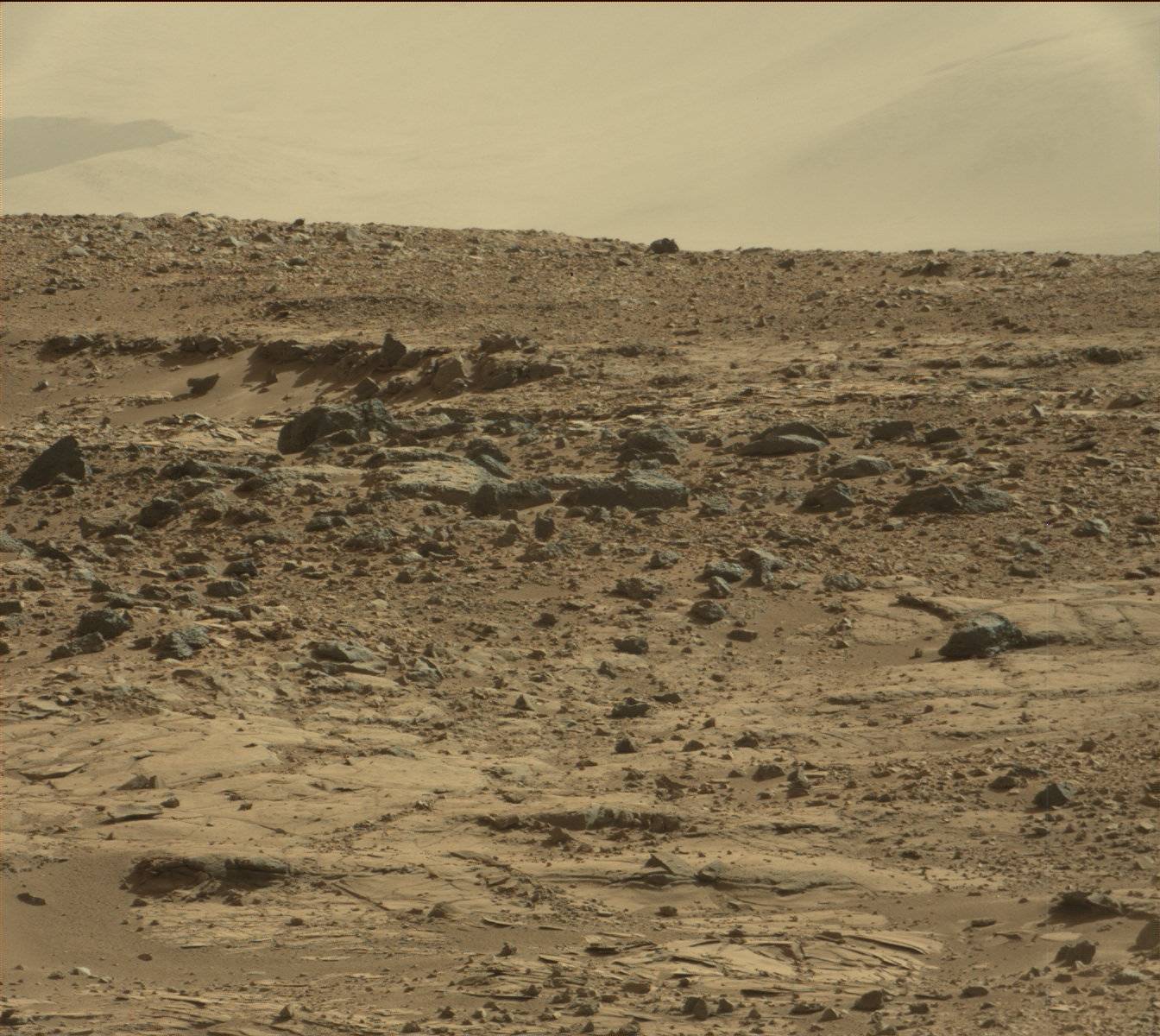
The Mars rovers such as Opportunity and Curiosity have photographed an astonishing variety of anomalous-looking things on Mars. They are discussed in this series of blog posts. You can find more examples by doing a Google image search for “Mars anomaly.”

Two recent examples are the "Mars mouse" shown at the top of this original NASA photo, and the Mars dome shown at the top of this original NASA photo. The composite photo below shows the "mouse" and "dome."

mars anomalies
Two of the many Mars anomalies (credit: NASA)

 I showed a closeup of this “mouse” to my wife and one of my daughters, without telling them it was from Mars, and asked: “What does this look like?” They both instantly answered: a mouse. Then there's the recently discovered anomaly discussed here, which looks like some ancient Assyrian face. 

NASA's approach to these anomalies has been very standoffish. But what if these anomalies (and similar anomalies that may be discovered in future years) were to be made the centerpiece of a new Mars mission? That just might generate the kind of enthusiasm needed to fund a new mission.

Here is how NASA might pitch a future Mars mission to the public:

It's time to wake up and smell the coffee. How many Martian domes and Martian “traffic lights” and Martian mouses and Martian sculptures and ridiculously long “levitating” Martian spoons can we photograph before it is obvious that some type of higher power is at work here, or was at work? We don't know what that higher power is, or whether it still exists; and we don't know whether it was extraterrestrial, spiritual, extra-dimensional or supernatural. But we want to send our guys to go investigate these incredibly strange things our rovers have photographed, and hopefully bring some of them back and put them in a museum for the whole world to look at. While doing this, we just might discover the secret of the universe.

That's a sales pitch that probably beats this one:

Please give us 500 billion dollars to send people to Mars, because rocks and boulders are incredibly interesting. Why on Mars there are some fascinating sedimentary striations, and all kinds of very interesting metamorphic mineral concentrations.

We can imagine a Mars mission specifically centered around investigating anomalies. It would require some rover vehicle that would be capable of driving many miles so that astronauts could investigate many different previously photographed anomalies. But this would probably be feasible. Most of the Mars anomalies are concentrated in particular areas of Mars that were traversed by the Opportunity and Curiosity rovers. The anomalies are not randomly scattered across the planet.

The issue of making anomaly investigations a central part of a future Mars mission is relevant to an important upcoming decision: the decision about where the next Mars rover should land. To keep in play the possibility of a manned mission centered around anomaly investigation, the next rover should land not all that far from either the Curiosity landing site or the Opportunity rover landing site. In that case you would (after about the year 2025) have two thirds of the discovered anomalies in a relatively small area of Mars that could be conveniently checked out by a landing team equipped with a rover vehicle.

I can imagine a way to describe astronauts on a mission centered around anomaly investigation. Recalling the ancient tale of “Jason and the Argonauts,” the astronauts could be described as Anomaly Argonauts. When you think of it, the story of “Jason and the Argonauts” was a tale of investigating and retrieving a paranormal object. The paranormal object was the Golden Fleece, which presumably was paranormal, because the fleece of a regular animal isn't made of precious gold. NASA could make use of this famous tale, kind of recasting it in modern garb. The sales pitch might go a little like this:

Long, long ago they told the tale of how brave voyagers risked great dangers to travel far away, so that they could bring back a strange eerie object more wondrous than any a man had ever seen. Now our brave astronauts will embark on a similar voyage, hoping to bring back not just one such object, but several of them.

I could imagine how such an approach might generate more interest than one in which astronauts are depicted mainly as just rock collectors.

Thursday, December 17, 2015

What You Read About the Paranormal Is Just the Tip of the Tip of the Iceberg

The average person may occasionally read about the paranormal, and may get the impression that it is some extremely rare thing, based on how infrequently it is reported. But there are reasons for thinking that what you read about the paranormal may be just the tip of the tip of the iceberg. Instead of being a “blue moon” type of thing, the paranormal may be extremely common. Various factors may have caused you to think of the paranormal as being something extremely uncommon, when it actually may be very common.

Let's look at what some of these factors may be. One factor is that probably the overwhelming majority of people who have paranormal experiences do not publicly report them. There are several reasons why someone having a paranormal experience may not report it publicly. He may fear being ridiculed, or he may fear that if he reports a paranormal experience he may be thought of as weird or flaky or a liar, and that this may hurt his job prospects. Or someone may not report a paranormal experience simply because there was not any physical evidence he can present to show the incident occurred. 

Of the people who do publicly report their paranormal experiences, probably the great majority simply make some social media entry that you are very unlikely to ever hear about. My guess is that 99% of all paranormal experiences are not reported in a way that would be likely to end up in a news story that you might ever read. Corporations are masters of milking the media for news coverage, but what is the chance that some person having a paranormal experience will then spam the news media (or issue a press release) in the right way to get good news coverage? Almost zero.

Another reason why the paranormal may be vastly more common than you might imagine is that your college or university probably failed to teach you anything about it. Modern colleges and universities are bastions of materialist thinking that like to exclude and denigrate the paranormal. When you took that psychology course in college, you should have learned all about the years of very substantial and methodical research done on the paranormal, particularly ESP. But you probably learned very little or nothing on the topic, leaving you with the impression that there isn't much there.

But what about news media such as newspapers, magazines, and online news sources? In general, they publish little about the paranormal. Someone with a very newsworthy account of a paranormal experience has only a small chance of getting substantial coverage in such media.

Below are some factors that tend to inhibit coverage about the paranormal.
  • News sources may exclude coverage of a paranormal story on the ground that it is not “respectable” or lacks prestige, even if it is well backed up by observations. But the weird speculations of some PhD may get exactly such coverage, even if they have no such observations to back them up. This makes no sense, because speculations should be the humble handmaidens of observations and experiments, rather than being granted a higher status.
  • A large fraction of paranormal experiences may be excluded on the grounds that they have some association with some religion. The thinking of a writer or editor may be that he doesn't want to discuss some paranormal experience associated with a religious person, on the grounds that this has low prestige, or that this may offend people of other religions or people with no religion. The problem with such an approach is that it ends up excluding a large fraction of all paranormal evidence. Once you've decided that you're not going to cover paranormal evidence associated with Catholics, fundamentalist Protestants, Hindus, Buddhists, Mormons, Shintoists, Spiritualists, and Muslims, you've then filtered out a large fraction (or perhaps a majority) of the evidence.
  • Some new and unique paranormal phenomenon may receive no coverage on the grounds of unfamiliarity or “excessive weirdness” (new types of paranormal phenomena typically seem extremely weird). Conversely, anything paranormal that has been long reported (such as ESP or phenomena at seances) may be excluded on the grounds that it is “old hat,” and “not news.”
  • A news media may use some rule that the stranger the experience reported, the more we should tend to doubt the person reporting it. The result may then be that some mildly paranormal things will get reported, but anything stranger may be excluded from news coverage on the grounds of “that's too weird for us to cover.”
  • If some paranormal news story does get covered by a news media, the story is likely to be “back buried” so that you probably won't read it, rather than “front-paged.”. Even if the story is very worthy of followup coverage, it probably won't get it. If things worked similarly for other types of stories, we might have got one back page story on the Lewinsky affair, with no followup stories.
The paranormal is almost never reported like this, even when it deserves such coverage

Reasons such as these may mean that you are unlikely to read about some important paranormal event that occurs. But what if you do happen to read a story about it? The chances are that after you read such a story you won't learn the most pertinent details, because of what we may call underreporting. Underreporting is described in this blog post. It's basically what happens when some news source excludes the most relevant and startling details of a story, the details that might make you say, “there's no way we can explain that.” An example would be if a witness exactly reported seeing a dazzlingly bright 50-meter disk in the sky, and such an experience is merely reported by a news media as a “a sighting of something unusual in the sky” or a “sighting of a disk-like object.” The sin of underreporting is habitually committed by wikipedia.com, which as a general rule has nothing but outrageously biased articles on paranormal topics, articles designed to make you think “there's nothing there.” The same sin of underreporting is committed by many other news sources.

As a result of all of these factors, you may end up reading in your lifetime very little about the paranormal. You may get the impression that the paranormal is some “blue moon” type of thing, and that people who have paranormal experiences are some very rare oddballs such as Uri Geller. But to the contrary, there is good reason to think that paranormal experiences occur to large fractions of the public. Public opinion polls that deal with experiences with the paranormal (not just beliefs about the paranormal) show that significant fractions of the public say they have had paranormal experiences. For example, a Pew Research poll indicated that 29% of the American public claimed to have been in touch with someone who died, and 19% claim to have seen a ghost. My guess is that a more comprehensive poll asking about all types of paranormal experiences (including UFO's, ESP, mystical experiences, precognition, highly improbable answered prayers, and so forth) might suggest that more than half of the public have had some type of paranormal experiences at some time in their life. In fact, this infographic tells us that 71% of Americans report having had a paranormal experience.

So despite the impression you get from our filtered print media, the paranormal may not be very abnormal.