Header 1

Our future, our universe, and other weighty topics


Tuesday, August 5, 2014

Five Evils of an "Evil Free" Universe

One of the main arguments against theism is called the argument from evil. This argument basically says that if a deity existed, he would not allow evil to exist. But before accepting such an argument, we must ask ourselves: could there actually be a universe without evil?

It may seem very easy to imagine such a universe. We simply imagine a universe filled with planets containing only happy, smiling people. Wouldn't that qualify as an "evil free" universe? But we commit a fallacy when we imagine such a universe, a fallacy I might call the snapshot fallacy. The snapshot fallacy is the fallacy of assuming that we can get a decent model of a possible universe by describing a single moment of time in that universe's history. A universe is not a static thing, but something that persists for billions of years. So any model or idea of a universe (whether scientific or philosophical) must consider not just one moment of time, but a huge length of time – a billion years at least.

A person using the argument from evil might say: no problem, we can just imagine a universe without evil existing for a billion years – a billion years of happy planets filled with nothing but happy smiling faces. But would such a universe actually be a universe without evil? I think not. It seems that such an “evil free” universe would actually have some very serious evils of its own. Below is a list of some of them.

The Evil of Boredom

One great evil of such an “evil free" universe is that it would be boring. Imagine you have been living in such a universe for a thousand years. You wake up one day and say “Let me check the news.” You go to your favorite news web site, and the main banner says, “Another perfect day.” You click on the smaller headlines looking for something interesting, but it's hard to find something very interesting. They're all just stories about perfect people having perfect days. You certainly can't go out and do something dangerous, since neither death nor serious injury is allowed in your universe.

The newspapers of Utopia are boring

Very bored, you turn on your television, trying to find an interesting movie. But the movies are boring. There has been no war, death, or illness in your universe. No one has ever faced any real danger, since neither serious injury nor death are allowed in your universe. So while you might be able to find a mildly interesting movie like Meet the Fockers or When Harry Met Sally, you cannot find any really stirring movie such as Gone With the Wind, The Godfather, Doctor Zhivago, or Titanic. 
 
Now imagine that this goes on for thousands and millions of years. You eventually are so bored with your living that perhaps you yearn for the escape of death – but that cannot ever happen, because death is an evil, and you are in an “evil free" universe.

Do you get the idea? It's the very real evil of boredom.

The Evil of Restriction

Consider your freedom in the universe we currently live in. You have the freedom to be good, and also the freedom to shoot someone. You have the freedom to give money to charity, and the freedom to steal money from your local church. But how would things be in an “evil free” universe? Presumably you would not have such freedom. You could only speculate on how things might work – perhaps if you wanted to shoot someone, your gun would suddenly be too hot to handle, or your hand would get a jolt of electricity from the sky. Or, if you tried to steal money from your roommate, perhaps you would suddenly become immobile. Regardless of how it would work, the result would be that you wouldn't be so free.

We regard freedom as being a very great good. We are told again and again: it's okay to empty our country's treasury (or go deep into national debt), and okay to lose lives and limbs of our soldiers, because they are fighting for freedom. So if freedom is such a great good, what should we call a lack of freedom? We might call it an evil. Indeed, we might call the restrictions on conduct in an “evil free” universe to be itself an evil – an evil we might call the evil of restriction.

The Evil of Stagnation

One of the most central aspects of our universe is the opportunities it allows for different types of rising from a lower state to a higher state, or from a less desirable state to a more desirable state. Such opportunities can exist on a personal level, a national level, or a planetary level. A person can rise from a state of poverty and ignorance to a state of wealth and wisdom. A nation can rise from a lowly, primitive state to a much more exalted and advanced state. A species can arise from a cave-dwelling state to a star-exploring state. One can use the words progress or evolution to describe such risings from a low state to a much higher state, but our language is weak in words to describe such ascents. But such risings from low states to higher states are the life blood of the stories that hold our interest.

But what if there were no such opportunities? What if we lived in a universe in which everyone had the same kind of life-story, a life-story that could never be something like “I traveled a long journey upward from the lowly anguish of poverty and ignorance, and ascended to the top of the mountain” but could only be something like this: “I started out thousands of years ago in a state of complete comfort and happiness, and now here I am centuries later, still existing in that same state of comfort and happiness”? And what if the tale of every country and every species was never anything more stirring than this: “They started out in a perfectly desirable state, and always kept existing in that same perfectly desirable state, ending up after their long journey exactly as they were when they began”?

There would, of course, be a certain problem with such a situation, and we might call that problem the evil of stagnation.

The Evil of Non-Appreciation

If we have experiences with suffering, unhappiness and hardship, this makes us more likely to appreciate and enjoy times of comfort and happiness. But imagine if there had never been suffering, unhappiness, or hardship. Would we appreciate the comfort and happiness we had? No, we would not. In fact, we would be completely blasé and complacent about our pain-free life. We would be like some spoiled “silver spoon” billionaire's son who never fully appreciated a delicious meal and stylish, roomy houses and fine clothes because he had never experienced anything else. The result would be a serious evil: the evil of non-appreciation.

It's easy to say that this would not be a big factor, but some simple math suggests otherwise. Let's imagine a person named John who has a 70 year life with some unhappiness and hardships, followed by a million year afterlife of heavenly bliss. Then let's imagine a person named Bill who experiences nothing but a million and 70 years of comfort and happiness. Suppose that John's experience with unhappiness and hardships makes him enjoy his afterlife 10% more because he appreciates it more. The result may be that John experiences a total net amount of happiness more than 9% greater than Bill experiences, even taking into account John's 70 years of unhappiness.

The Evil of Low Diversity

Nowadays many people regard diversity as a good. For example, colleges often proudly say: we don't want uniformity and homogeneity in our college; we value diversity. Diversity is a good thing. We might say that one of our universe's best characteristics is its very high degree of diversity. On our planet we have a very high degree of diversity in life forms and in human beings. But the universe offers much richer diversity.

Considering the universe as a whole, we might consider with awe the staggering degree of diversity it contains. There is a diversity of life forms, a diversity of histories, a diversity of physical locations, an unimaginable degree of variety. This has non-trivial consequences. For one thing, it means that exploring different planets in the universe (whether physically or by receiving radio or television signals) will prove to be a source of endless abundant pleasure and fascination, because there is such a huge variety of planets.

But imagine there isn't so much variety. Imagine things are much, much more monochromatic, because every planet is in a state of perfection. This lack of variation and variety is itself a certain type of evil, which we might call the evil of low diversity. 
 
All Possible Universes Have Serious Evils

These considerations lead to an important conclusion: viewing a universe from a proper perspective that includes huge vistas of time, it must be said that every possible universe has serious evils. While a perpetually pleasant pain-free universe may seem like an “evil free” universe if one considers it at a single instant of time (the snapshot fallacy), as soon as we fully and vividly imagine that universe persisting on in such a state for billions of years, we realize that such a universe would actually have serious evils such as the ones I have listed. One cannot evade such a consequence by imagining that the “evil free” universe lasts for a relatively short length of time, for such a universe would then have the evil of death, and the evil of its one demise. Nor can we imagine a truly evil-free universe by imagining an unpopulated universe, as that universe would have its own evils such as evils of low-diversity and evils of non-experience.

I may note that my list of five evils of an "evil free" universe is by no means complete. There are no doubt quite a few others that I have not mentioned.

But while a perpetually pleasant universe would have the evils I have mentioned, would it not be better than our universe? That depends on various unknowns regarding our universe. Some of the unknowns are as follows:
  1. Is there a life after death?
  2. If there is a life after death, how long does it last?
  3. If there is a life after death, what percentage of people experience bliss in such an afterlife?
  4. If someone first experiences earthly sadness and then moves on to a blissful state in an afterlife, will he enjoy such a state only slightly more (because of greater appreciation and contrast), or will he enjoy it very much more?
  5. Do the civilized species on planets such as ours eventually reach a state of great abundance and comfort because of scientific and technical progress?
  6. Do such civilized species typically exist in such a state for a period many times longer (possibly thousands of times longer) than the time length that they exist in widespread discomfort?
  7. If the latter hypothesis is true, could it be that the number of civilized species now existing in abundance and comfort is many times greater than the number of civilized species such as ours (considering the universe as a whole)? What is the ratio between these two numbers? Could it be as high as 100 to 1 or 1000 to 1, given the great age of the universe?
  8. For the average person living in our universe, what is the ratio between the number of years spent living in happiness and the number of years spent living in unhappiness (including time spent living in an afterlife)?
Under some sets of answers to these questions, we might judge that a perpetually pleasant universe is superior to our own universe. Under other plausible sets of answers to these questions, it might be right to judge that a perpetually pleasant universe is no better than our universe, or inferior to our universe. This point can easily be supported with specific hypothetical examples, but I will save that for another blog post. Here I may briefly note that in any universe in which the ratio of happiness to misery is very high (say 100 to 1 or 1000 to 1), considered over a billion-year time span, there is a large possibility that the existence of suffering and pain may be ultimately justifiable largely on the grounds that it leads to a greater net ratio of happiness compared to unhappiness or pleasure compared to pain, partially because of factors discussed above. Because of the possibility of an afterlife, and the possibility that our planet is untypical (being inhabited by an unusually primitive civilization), it is entirely possible that we live in a such a universe. The possibility of an afterlife cannot be excluded in such a discussion, as it is a possible consequence of the existence of a deity, which is exactly what is being debated.

We do not know the answers to the questions listed above. So we are in no position to judge whether our universe is inferior to some perpetually pleasant universe that we can imagine. This is one reason why the main argument for atheism (the argument from evil) is not valid. Another reason the argument is not valid is that a theist can defeat it (with great simplicity) by simply conceding the possibility of a deity with somewhat less than infinite power.

Saturday, August 2, 2014

Is Kepler-78b a Sign of Astronomical Engineering?

For decades astronomers have expected to one day find some sign of what is called astronomical engineering. Astronomical engineering is engineering on an astronomical scale, produced by a civilization. Astronomers have reasoned that since there are so many solar systems in our galaxy where life could evolve, we would expect that civilizations would have arisen on many planets, and that we would also expect to see evidence of large-scale activities by such civilizations. Such astronomical engineering projects might consist of a movement or manipulation of planets or asteroid belts, or the creation of huge artificial structures in space. One popular idea about astronomical engineering is that extraterrestrial civilizations might create a sphere around their sun to capture all its energy, a sphere known as a Dyson sphere.

Efforts to detect a Dyson sphere have come up short, but there may be a space discovery that offers possible evidence of astronomical engineering: the discovery of Kepler-78b, the “planet that shouldn't exist.”

Kepler-78b is a planet orbiting the star Kepler-78, a G-class star like the sun, located about 400 light-years away. The strangest thing about the planet is the location of its orbit. The planet orbits its star at a distance of about 900,000 miles, which is about the diameter of the sun and other G-class stars. This is an orbit which places the planet more than 30 times closer to its sun than the planet Mercury is to our sun. Scientists assume that the planet is some kind of lava world too hot for life to exist on it.

Scientists are baffled by how a planet of this size could exist in this orbit, and the Science Daily article on the discovery is entitled Lava World Baffles Astronomers: Planet Kepler-78b 'Shouldn't Exist.' The article says: “When this planetary system was forming, the young star was larger than it is now. As a result, the current orbit of Kepler-78b would have been inside the swollen star.” It then quotes astronomer Dimitar Sasselov as saying this about the planet: "It couldn't have formed in place because you can't form a planet inside a star. It couldn't have formed further out and migrated inward, because it would have migrated all the way into the star.” Sasselov therefore calls the planet “an abomination.”

But there is one way to explain this strange planet: by imagining that it is part of an astronomical engineering project started by a civilization living on some planet revolving around the sun-like star Kepler-78. Such a civilization may have moved the planet from a more distant orbit to its current orbit very close to the sun it orbits. The planet may have originally been a much larger planet (possibly a gas giant planet like Neptune or a frozen super-Earth several times larger than our planet). The planet may have been deliberately moved to the orbit close to its star, for the sake of stripping off its outer layers, and leaving behind an inner rocky metallic core. Such an astronomical engineering project may have been started for the sake of creating a gigantic mining target, a million-year source of metals and minerals to be exploited. Another possibility is that the astronomical engineering project may have been started with the goal of creating a new Earth-like habitable planet in the Kepler -78 solar system.

How to Move a Planet

Before considering such possibilities, we must ask: is it reasonable to imagine that an extraterrestrial civilization would be able to reposition planets in its solar system? Certainly when imagining such a civilization we should allow the possibility that they might have god-like powers of engineering. Such a civilization might be many thousands (or possibly even millions) of years more advanced than ours. Considering how much technical progress our civilization has made in the past hundred years, if we imagine an extraterrestrial civilization that mastered atomic power thousands of years ago, we should imagine that such a race would be able to do almost anything that is technically feasible.

When I wrote a blog post last year on this topic (entitled Is Mystery Planet Kepler-78b the Work of Intelligent Planet Movers?), I suggested the idea that a highly advanced civilization could move a planet in its solar system by causing asteroids to crash into the planet (and using asteroids as projectiles that might cause moons of a planet to crash into the planet). But it turns out there is a more sophisticated technique for moving planets. In 2001 three scientists wrote a scientific paper entitled Astronomical engineering: A strategy for modifying planetary orbits. The scientists describe how we could move our planet farther away from the sun by creating an accelerated mass stream that moves in a loop traveling between Earth and the planet Jupiter. The mass stream would consist of one or more asteroids or other massive objects. Jupiter would act as a gravitational slingshot to greatly accelerate the mass stream. The same technique could be used to move a planet closer to a sun. The accelerated mass stream would travel in a loop between the planet to be moved and the sun.

how to move a planet

As the highly accelerated asteroids pass by the planet, there is a transfer of angular momentum that causes the planet to be moved. Imagine if you are standing in a field and your friend runs towards you at high speed, looping around you before running away. If you grab your friend's coat edge as he is whizzing by, you will feel a little tug pulling you in one direction (and the faster your friend was moving, the greater the tug you would feel). Similarly, matter passing by a planet at high speed causes a little gravitational and angular momentum tug that can pull a planet in a particular direction. Given enough repetitions, sufficient speed, and sufficient mass in the matter passing by, this can be enough to gradually change the orbit of a planet.

So it seems that using techniques such as these scientists have described, an extraterrestrial civilization would definitely be able to move around planets in its own solar system. Changing a planet's orbit requires simple old Newtonian physics, not any far-out science fiction assumptions such as space warps or space-time wormholes. 
 
Why Move a Planet to an Orbit Very Close to a Sun?

But why would such a civilization want to move a planet very close to its sun? There are two possible motives:
  1. Kepler-78b might have been moved very close to its sun in order to heat up and “strip off” the outer layers of the planet, leaving behind a metallic rocky core that could be a mining target, a source of metals and minerals that might last for millions of years.
  2. Kepler-78b might have been moved very close to its sun in order to heat up and “strip off” the outer layers of the planet, leaving behind an Earth-sized metallic rocky core intended to be moved to another orbit in the habitable zone of the Kepler-78 solar system. This may be part of a massive astronomical engineering project to create a second habitable planet in this solar system.
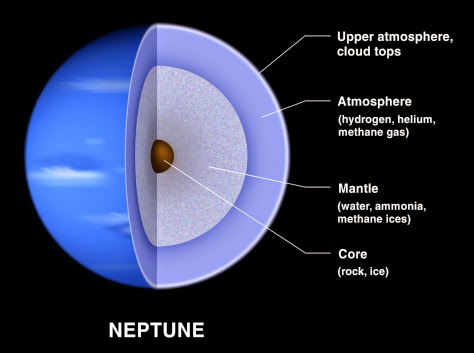
To explain both of these ideas, I must explain the idea of layer stripping. Planets such as Neptune, Jupiter, and Saturn are believed to be composed of different layers. For example, we see below a diagram showing the layers of Neptune. The outer layers are gases and frozen material. But the core is a rocky metallic core about the size of Earth. A similar diagram could be made of a frozen super-Earth planet with a mass five times greater than Earth, except that the proportions and element mixtures would be different.

layers of Neptune
Layers of Neptune (Credit: NASA)

Now what would happen if such a planet were to be moved very, very close to its sun, to the same distance that Kepler-78b is (a distance equal to about the diameter of the sun)? It would be like placing a big snowball with a rock at its center next to a big fire – the heat would strip off the outer layers, leaving only the rock remaining. All the gaseous and frozen layers of the planet would get so hot that they would steam off into space, like steam escaping from a boiling soup pan. What you would have left is a rocky metallic core about the size of the Earth – which exactly matches the description of Kepler-78b.

One possibility is that an extraterrestrial civilization will use Kepler-78b purely as a mining target, a source of metals and minerals. In such a case they might extract metals and minerals from the planet in its current orbit. Or they might later move the planet farther away, and then exploit its resources. It might be easier to mine the planet once it had been moved to a cooler location.

Another possibility is that extraterrestrials living in this solar system might later move Kepler 78b to an orbit in the habitable zone of their solar system, using the same simple technique they used to move the planet close to the sun. Their intention might be to create a new habitable planet in their solar system, a future home where they can live. They might have decided on such a massive astronomical engineering project after using up all the land and resources of their home planet, due to population growth.

Someone might object that Kepler-78b has been called a “lava world,” so such a planet would not be suitable as a future home for extraterrestrials living in the Kepler-78 solar system. But we're not actually sure that Kepler-78b is a lava world. There have been no measurements of the planet's temperature. The assumption that it is a lava world is based on the assumption that the planet has been in its current location for millions of years. But what if the planet had been moved to its location fairly recently, as part of an astronomical engineering project? In such a case it might not be a lava world. Imagine if the planet was in a particular stage of this “layer stripping” process when most of the gas and frozen layers had been stripped off, but there still remained a layer of ice a few miles thick. If such a planet were then moved to the habitable zone of the Kepler-78 solar system (the "Goldilocks zone" that is neither too hot nor too cold), it would be a rocky planet with oceans or seas, which could easily become habitable.

Gathering Support for These Ideas (Or Ruling Them Out)

Further scientific work may provide additional reasons for believing in these hypotheses, or such work may rule out these speculations. We do not know yet how many planets are in the Kepler-78 solar system. Kepler-78b is the only planet yet to be discovered there. But due to limitations in our planet detection techniques, it is perfectly possible that there is an undiscovered Earth-like planet in the habitable zone of this solar system. If such a planet were to be discovered (possibly by the forthcoming James Webb Space Telescope), it would make the ideas I have discussed seem more plausible (although it would not prove them true). If, on the other hand, astronomers were to conclude with high likelihood that there are no habitable planets in the Kepler-78 system, that would rule out the ideas discussed here.

There is also one way scientists might prove correct the ideas discussed here (or something close to them). We might point our radio telescopes to the Kepler-78 system, and listen for radio signals. If we were to detect such a radio signal, it would lend great credence to the ideas discussed here.

Wednesday, July 30, 2014

"Plant Intelligence" Studies May Hint at a New Theory of Mind

Last year Michael Pollan created something of a sensation with his New Yorker article entitled “The Intelligent Plant.” Pollan discussed a variety of findings and experiments which suggest that plants may have capabilities that somewhat resemble or mimic aspects of the human mind.

Pollan stated: “Plants are able to sense and optimally respond to so many environmental variables—light, water, gravity, temperature, soil structure, nutrients, toxins, microbes, herbivores, chemical signals from other plants—that there may exist some brainlike information-processing system to integrate the data and coördinate a plant’s behavioral response.” He pointed out that in 2006 six scientists had called for a new field of study to be called “plant neurobiology.”

I may note that intelligence is not necessarily the same as consciousness, so the idea that plants may have some degree of intelligence does not necessarily imply that plants have consciousness. Computer programs, for example, are not self-conscious, but do show some degree of intelligence.

Pollan claims that “plants have evolved between fifteen and twenty distinct senses, including analogues of our five,” such as sight, hearing, touch, and smell. Somehow plants seem to gather information and then “decide” where to move their roots or stems. A simple example is called phototropism: a plant will grow its stems toward a source of light. Plants also seem to grow away from competitors, notes plant ecologist Rick Karban. Botanists have studied phenomena that resemble communication or signaling between different plants. 

Is there a bit of Mind in our meadows?

Scientist Monica Gagliana has written a paper entitled “Animal-like Learning in Mimosa Pudica.” She claims to have detected that this plant species can “learn” to ignore a stimulus that it originally responded to.

Recently a scientific journal published a paper “Adaptive and selective seed abortion reveals complex conditional decision making in plants." The paper stated: “Ecological evidence for complex decision making in plants thus includes a structural memory (the second seed), simple reasoning (integration of inner and outer conditions), conditional behavior (abortion), and anticipation of future risks (seed predation)." The paper is summarized here, in an article entitled "Are Plants More Intelligent Than We Assume?"

Some materialists have dismissed and belittled such findings, claiming that they are all nonsense. Their reasoning goes like this:
  1. Neurons are the sole source of intelligence.
  2. Plants do not have neurons.
  3. Therefore plants cannot have anything like intelligence.
This reasoning is similar to the reasoning used to reject evidence for a wide variety of paranormal phenomena suggesting human consciousness can exist outside of the brain (phenomena such as near-death experiences, medium phenomena, and apparition sightings). The strategy is all too familiar: when someone accumulates or produces evidence that contradicts your assumption, portray that person as a fraud, a fool, or a fanatic. One may ask why materialists cling so stubbornly to the premise that neurons are the sole source of intelligence, given that no one has any real understanding of how neurons actually produce thoughts.

But what if there is something more than just trickery, misinterpretations or errors behind the numerous indications that neurons may not be the sole source of intelligence? One can imagine an alternate theory of intelligence that may be consistent with these findings about plant intelligence and indications of paranormal phenomena.

The theory might be something along these lines. It could be that there is some unknown external source of what we might call Mind Stuff. A sufficient amount of this Mind Stuff might result in self-conscious beings like us. A much smaller amount of this Mind Stuff might result in some limited degree of information processing capability such as may exist in plants. It could be that our brains are just receptacles for this Mind Stuff, or some kind of receivers that tune in to this Mind Stuff (or organs that attract this Mind Stuff, like a magnet attracts metal, or like a capacitor attracts electric charge). It could be that plants are able to somehow attract or store a small amount of this Mind Stuff. Through such a theory we might be able to get around the difficulty that plants seem to have a limited degree of something like intelligence, even though they have no neurons. We might also be able to explain the anomalous observations discussed here and here (such as the fact that some human minds perform well even with only half as many neurons). 

Although it fits all observations (including reports of paranormal phenomena), such a theory will no doubt be spurned by conventional theorists, who will continue to cling to the dogma that thought can only be produced by neurons, clinging to it like a young child clinging to his favorite stuffed animal.

Monday, July 28, 2014

Rendlesham Forest UFO: A Craft From the Year 8100?

When Americans think of a UFO sighting, they typically recall the famous incident at Roswell, New Mexico. But some people think that the strongest case of a UFO close encounter is another incident: a UFO sighting that occurred in Rendlesham Forest in the United Kingdom.

The Basics of the Incident

The incident began on December 26, 1980, near two US military bases, and was immediately investigated by US military personnel. USAF officers John Burroughs and Jim Penniston went out to investigate a strange light that appeared in the forest near their base. They reported seeing a small metallic craft about two meters high and perhaps two to three meters wide. They reported that the craft illuminated the whole forest with light. Penniston reported seeing strange symbols on the craft unlike any he had seen. Penniston said he touched the craft with his hand. Shortly thereafter, according to Penniston, the craft rose up to the air, and accelerated away at an “impossible” speed. 

UFO
Artistic depiction of the Rendlesham Forest sighting
 
The next day Burroughs, Penniston, and others from the base went searching for the site where the object had landed, and found a spot half a meter wide and 7 inches deep. The spot was checked for radiation, and found to have abnormally high radioactivity.

Later that day, the following was observed, according to an official Air Force memo on January 13, 1981 by Charles Halt, the deputy base commander:

Later in the night a red sun-like light was seen though the trees. It moved about and pulsed. At one point it appeared to throw off glowing particles and then broke into five separate white objects and then disappeared. Immediately thereafter, three star-like objects were noticed in the sky, two objects to the north and one to the south, all of which were about 10 degrees off the horizon. The objects moved rapidly in sharp angular movements and displayed red, green and blue lights. The objects to the north appeared to be elliptical through an 8-12 power lens. They then turned to full circles. The objects to the north remained in the sky for an hour or more. The object to the south was visible for two or three hours and beamed down a stream of light from time to time.

Halt stated that numerous individuals, including himself, witnessed this.

The Plot Thickens: A Craft From the Year 8100?

USAF officer Jim Penniston (retired) later added a unique twist to this UFO encounter. Penniston says that the day after he saw the UFO close up, and touched it, he saw in his mind's eye a string of binary digits such as 101010100111010. Penniston says he wrote the digits down in a notebook. He later gave the notebook to computer experts, to see whether they could decipher the binary digits. The experts reported that the binary digits could be translated into a message in English.

According to the experts, the message consisted mainly of geographical coordinates of some places such as the Great Pyramid in Egypt, and the Nazca lines in Peru. The message also supposedly contained these lines:

EXPLORATION OF HUMANITY
CONTINUOUS FOR PLANETARY ADVAN??
EYES OF YOUR EYES
ORIGIN YEAR 8100

Penniston was later hypnotized. He stated, “Under hypnosis, I reveal that they are time travelers from the future.” (Encounter at Rendlesham Forest by Nick Pope, John Burroughs, and Jim Penniston, page 241.)

A UFO that is a vehicle from future time travelers? This is very hard to believe, but it is an interesting theory. Most UFO enthusiasts hold a different theory, that UFOs are from other planets. Some have also speculated that some UFOs may be from some other dimension.

I can think of one difficulty involved in Penniston's claim. There is no such thing as a direct binary representation of English words. Any such binary representation must use some kind of intermediate mapping system for translating between numbers and characters in English. Penniston's binary message uses the intermediate mapping system known as ASCII. ASCII is a standard today, but there is little reason to believe that it will stay in existence for another thousand years. Why would people from the year 8100 be using ASCII?

There is also the following difficulty. If time travelers from the future were actually coming to our planet, and allowing humans to see and touch their craft, wouldn't this run the risk of altering our future (and their past) in unpredictable ways? For an amusing short fictional look at some of the difficulties that can arise when future tourists enter the past, see my short story Time Travel Hotline.

It may be rather easy to dismiss Penniston's binary message as something too fantastic for belief, but it is much harder to dismiss the whole Rendlesham Forest incident. The incident was witnessed by too many reliable witnesses to be easily dismissed. Anyone interested in examining further the evidence regarding this sighting may take a look at this fascinating website.